Philosophy
Reza Asadzadeh and Hooman Dorandish in Conversation with Mostafa Malekian: There Is No Misleading Book / The Concept of “Faith” Negates the Disclosure of Truth
In a conversation with Asadzadeh and Dorandish, Mostafa Malekian said his reason for not publishing his critique of the theory of Contraction and Expansion of Religious Law was to avoid upsetting former friends, and described hermeneutics not as a school of thought but as a science like physics, one that has no single representative.
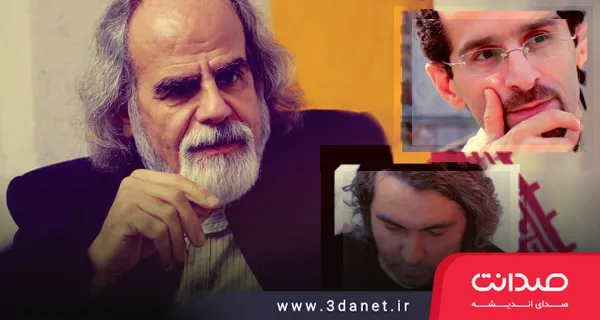
Reza Asadzadeh and Hooman Dorandish in Conversation with Mostafa Malekian – October 2014
There Is No Misleading Book / The Concept of “Faith” Negates the Disclosure of Truth
Reza Asadzadeh and Hooman Dorandish:
Mostafa Malekian is a thinker popular among contradictory intellectual currents. The irreligious and the faithful read his works, are persuaded by them, and persuade others. In a sense, everyone accepts him and no one accepts him! It depends on which of his books the reader has in hand. He has moved from fundamentalism to agnosticism. He was once a devoted student of Mesbah Yazdi and is now a secular critic of Abdolkarim Soroush. His supporters of yesterday are his opponents of today, and it is not at all unlikely that his advocates of today will be his deniers tomorrow. He is in search of truth and apparently has no fear of the reactions of his friends and enemies to the periodic renewal of his thoughts. Like Rumi, he could say: Cupbearer, bring one wine, how long will this tumult last? / Friends are drunk with confession, and enemies are drunk with denial! The following text is a conversation with Mostafa Malekian about the state of philosophical works in Iran today and issues such as misleading books and the ceiling and pillars of freedom of expression. In this conversation, he first explains the reasons for the weakness of Iran's intellectual community in producing philosophical works, then he articulates his own epistemological, psychological, and prudential reasons for defending freedom of expression and delineating its boundaries.
.
.
There Is No Misleading Book / The Concept of “Faith” Negates the Disclosure of Truth
Mr. Malekian, allow me to begin with an unrelated question. You apparently have a detailed article critiquing the book The Theoretical Contraction and Expansion of the Sharia, but for some reason you have not published it. Why?
I had not written that critique. The story was that in the summer of 1991, a number of friends asked me, since the university was closed, to hold a class for them outside the university curriculum at the Faculty of Theology and Islamic Studies of the University of Tehran. I accepted the proposal in principle but left the subject to the friends themselves. They suggested a critique of The Theoretical Contraction and Expansion of the Sharia. So, one summer, every week, for four hours a week, I critiqued the theory of Contraction and Expansion in that class. One of the friends in that class transcribed the tapes, and the result was a hefty book of nearly 800 pages. After some time, that same friend summarized those 800 pages into a 150-page collection. Those 150 pages were fully edited and ready for publication. For some reasons, I was not willing to publish it, but since I knew that news of this booklet would reach Dr. Soroush anyway, I gave a copy to Dr. Soroush so he could study it before publication. Perhaps about two or three weeks later, when I saw Dr. Soroush again, he told me it was a very good critique and I should publish it. But for certain reasons, it seemed to me better not to publish it. Unfortunately, however, this booklet had fallen into the hands of friends, and they had reproduced it. Three or four years later, two issues of the journal Al-Montalaq came into my hands; a journal in Beirut, published by the intellectual Shiites of Beirut. This journal was never sent to me, but because my critique of Contraction and Expansion had been translated and published in those two issues of the journal, they had sent me those two issues. I also knew the translator of my critique, but I had never met her to make any agreement with her about translating that detailed critique. Dr. Dalal Abbas, a professor at the American University of Beirut, was the translator of my article or booklet. I met her later, and she herself said that she had read this critique, found it a strong and good critique, and for that reason translated it into Arabic. She holds a PhD in Persian Language and Literature from the University of Tehran, and her doctoral dissertation was on Sheikh Bahai. In any case, she is completely fluent in Persian. So, my critique of Contraction and Expansion has been published, but in Arabic. It has not been published in Persian. Even now, to be honest, I do not like to publish that critique; because at that time, when I myself was also considered a “religious intellectual” and was in the same circle with friends, if I had published that critique, someone or some people might have been offended. Now that I have distanced myself from this current of thought, if I publish this article, certainly many people will be offended and a bad atmosphere will be created!
But in the conversation with the Farhang-e Emrooz website, where you very comfortably critiqued Dr. Soroush and Mr. Mojtahed Shabestari, what is the problem with publishing this detailed article as well?
If you mean the interview that was published, I do not know in what sense I had critiqued them. I had said those same things in 1998 in an interview with Akbar Ganji in the Rah-e No magazine.
But in the conversation with Farhang-e Emrooz, you had opened up the core of your critique a bit more.
Yes, but there really was nothing new in my recent remarks. The interview with Rah-e No was about the seminaries and modernity. Toward the end of that interview, I had raised these same criticisms of religious intellectualism. The conversation with Farhang-e Emrooz contained no provocative point. Its provocativeness, I think, stemmed from Mr. Jameh Bozorg’s so-called introductory essay. That introductory essay was very inflammatory. Believe me, I sent a message to Mr. Jameh Bozorg through his colleague—who also participated in the interview—that I would absolutely never do an interview with you again. The sentences Mr. Jameh Bozorg had written were not part of my remarks at all. He had recounted his own impression and had written interpretations that were utterly unexpected and contrary to the decorum of criticism. For instance, he referred to religious intellectuals with expressions that I had never used. Anyone who knows me at all knows that such words do not flow from my tongue or pen. In any case, that piece was very inflammatory. The second point that provoked some friends was the term hermeneutics. One of our problems in Iran today is that some specialists think hermeneutics is a school. Now, one expects no less from the youth, but specialists should not make such a mistake. Secondly, some people think that whenever anyone says something about hermeneutics, they are referring to Mr. Mojtahed Shabestari as the representative of this “school.” I have said many times that hermeneutics is not a school. Hermeneutics is like physics. Physics is not a school; it is a scientific discipline. Hermeneutics is also a science. It is the science of interpreting texts. Unfortunately, many people in our society have fallen into the error that hermeneutics, like existentialism (which is a philosophical movement) or phenomenology (which is a philosophical school), is a philosophical movement or school. And what is more, these individuals may suppose that the representative of this movement or school or tradition or philosophical tendency is Mr. Mojtahed Shabestari. Both of these suppositions are erroneous. Hermeneutics is a science. A science does not have a representative. If someone asks you who the representative of physics in Iran is, you would say physics is not a school to have a representative. Now, I will not dissect why this error has entered our minds. In any case, hermeneutics is a science. Among the literary sciences, we have a science called the science of interpretation. The science of interpretation in European languages is hermeneutics. This science of interpretation, of course, has branches. One branch is legal hermeneutics or the science of interpreting legal texts, which is very important and to which we in Iran pay no attention at all. The second branch is literary hermeneutics or the science of interpreting literary texts, to which there are occasional references in Iran. The third branch is religious hermeneutics or the science of interpreting religious texts. Of course, this science has other branches as well, but these three are its most important branches. We also have historical and ethical hermeneutics. For example, ethical hermeneutics deals with the interpretation of ethical texts. In any case, hermeneutics is a science. Like mechanics, one part of which is solid mechanics, another part is fluid mechanics, and a part of it is gas mechanics. In each part, there are also scientists and mechanics. One never says a science has a representative. Schools, traditions, movements, and tendencies have representatives. We can say that in philosophy there is the existentialist movement, the phenomenological school, the Hegelian tradition, and the psychological tendency, and these have representatives. Our first error is that we have considered hermeneutics a school or movement or tradition or tendency. The second error is that some say Mr. Mojtahed Shabestari is the representative of this school. For this reason, Mr. Mojtahed Shabestari took my words in the interview with the Farhang-e Emrooz website personally. They thought that whatever I said about hermeneutics, I said about them. But I absolutely do not believe that the science of hermeneutics has a representative, that I would want to consider them the representative of hermeneutics. My point is that religious intellectuals are interpreters of religious texts, and because they are interpreters of religious texts, their work lies in religious hermeneutics. That is, they are scholars of the science of religious hermeneutics. Therefore, Dr. Soroush, Dr. Shariati, Mojtahed Shabestari, Engineer Bazargan, and Mr. Kadivar have all been religious hermeneuticists. Anyone who interprets religious texts works in a branch of hermeneutics called religious hermeneutics. I myself am also a religious hermeneuticist. If one day I say this verse or that hadith means this, at that moment when I say this is the interpretation of this verse, I am working in the field of religious hermeneutics. I am truly very fond of Mr. Mojtahed Shabestari and am very displeased that they thought my address in that interview was directed at them.
If in that interview I had wanted to address him, I would first have had to consider hermeneutics a school, or a tradition, or a movement, or a tendency, in order then to consider him a representative of that school, tradition, movement, or tendency. Whereas I hold absolutely no such belief whatsoever.
Have Mr. Shabestari’s books fostered this misunderstanding in our society that the discipline of hermeneutics is a school of thought?
Allow me not to answer this question.
Why? Mr. Shabestari had a critique of you and wrote it down. It would be better if you, for the sake of clarification and elucidation, answered this question. Others, too, would benefit from these friendly critiques.
Now that you insist, I will answer. Conscious action and reaction are always different from unconscious action and reaction. In my view, we cannot easily distinguish whether an action is conscious or unconscious. If the implication is that Mr. Mojtahed Shabestari did this consciously, I do not take responsibility for that claim. But if the implication is that he unconsciously created the misunderstanding that the discipline of hermeneutics is a school of thought, yes, in my opinion, his works have unconsciously suggested that there is a school in the West called the hermeneutic school, and that some, including myself, Mojtahed Shabestari, are followers of this school or perhaps its spokesperson or representative in Iran. Truth-seeking requires me to say that he has unconsciously promoted such a notion. But regarding whether this practice was conscious, I take no responsibility. Our intellectuals, whether religious or non-religious, have committed these errors in abundance in this country; especially after the victory of the Islamic Revolution, which fortunately resulted in an unprecedented familiarity with Western culture for us. I must, of course, say that this familiarity was not the goal of the Islamic Revolution but rather its outcome. The aim of this revolution was never for us to become ever more familiar with Western culture. Unintentionally, things came to this point. In any case, as a result of this unprecedented familiarity, many errors – as you young people say – entered our discourse (this word “discourse” is also one of those words whose meaning I still have not understood!). For instance, absolute philosophy and adjectival philosophy are also among those strange and peculiar notions. I have never heard, in Western philosophy, anyone – not a single soul – say that we have absolute philosophy and also relative or adjectival philosophy! Yes, there is another matter, and that is that philosophy, and any other science, from one perspective, is divided into first-order science and second-order science. First-order and second-order science or philosophy is a valid distinction, but it does not follow from this separation that we have absolute philosophy and adjectival philosophy. Absolute philosophy or non-adjectival philosophy is a concept without a referent. Every part of philosophy speaks about something; therefore, it becomes adjectival philosophy. The philosophy of space means that part of philosophy that deals with the nature, rules, and properties of space. We have the philosophy of time, the philosophy of existence, the philosophy of knowledge, the philosophy of beauty, the philosophy of religion, the philosophy of art, and the philosophy of theology. If the objects of the adjectival phrase of philosophy are themselves a discipline, then the philosophy becomes second-order philosophy. If the object of the adjectival phrase of philosophy is not a discipline, the philosophy becomes first-order philosophy. For example, when we say the philosophy of physics or the philosophy of psychology, since physics and psychology are disciplines, these become second-order philosophy. But space, time, and language are not disciplines; therefore, the philosophy of space, the philosophy of time, and the philosophy of language are first-order philosophy. These mistakes in our intellectual community are not just one or two. The reason for these mistakes is that we were in a hurry to familiarize our audience with Western culture. Of course, I value this speed and haste; because the people of Iran are in dire need of information about the rich culture of the West. This information does not necessarily mean accepting all parts of Western culture; but our society must be aware of what humanity has done so that we do not reinvent the wheel! We are all busy reinventing the wheel; whereas we should take the already invented wheel and fix one or two of its flaws to deliver it slightly more complex and efficient to the next generation. The next generation will then make it a little more advanced until the wheel eventually turns into an automobile moving at 600 kilometers per hour. But if someone says we have broken with the Westerners and want to reinvent the wheel from scratch, that is pure stupidity and idiocy. To avoid falling into this stupidity and idiocy, we had no doubt that we must familiarize the people of Iran with the rich culture of the West. But because we were in such a hurry to do this necessary task, we sometimes stumbled ourselves and now say things that, if we were to recount them in the West, they would laugh at us.
So, since we have written more dictation after the revolution, our mistakes have also increased.
Yes, the works published in the last 35 years about and from Western culture are several times the total works published from the beginning of the Constitutional Revolution until the victory of the Islamic Revolution. I do not think that from the Constitutional Revolution to the Islamic Revolution, a hundred Western philosophical works were translated into Persian. But in these last 35 years, I think we have translated at least two to three thousand philosophical works from the Western world; whether works by the great philosophers of the Western world or works by second-rate philosophers. As you say, a person who writes dictation also makes mistakes. This point explains our mistakes but does not justify them. Therefore, some must come forward to correct the mistakes that have occurred. Of course, one should not exaggerate these theoretical mistakes. That is, we should not create the impression that we have committed many errors in the process of becoming acquainted with Western culture and philosophy.
Some people raise this issue from the standpoint that the post-revolution intellectuals, who have committed these theoretical errors, have suffered from incapacity and weakness compared to pre-revolution intellectuals. Whereas, apparently, pre-revolution intellectuals stood at lower rungs than post-revolution intellectuals in terms of familiarity with Western philosophical thought.
Overlooking a few individuals who are exceptions on both sides, on the whole, I believe that after the revolution, philosophical thought in Iran has become much stronger. I can almost say with certainty that in none of the four regions of the Islamic world—that is, in the Turkic-speaking, Arabic-speaking, Persian-speaking, and English-speaking spheres (such as India, Pakistan, Bangladesh, Kashmir, and Malaysia)—is philosophical thinking as strong as it is in Iran. I have dealt with the youth, students, researchers, thinkers, writers, and academics of these spheres. If we set aside the exceptions and consider the general trend, I can say with certainty that we Iranians are stronger than all of them in this field. I am absolutely not a nationalist and I fundamentally consider nationalism to be ethically wrong; but after the victory of the revolution, for reasons I do not wish to address now, despite the intentions of some, philosophical thought grew more among us. Compared to Turkey, the Arab world, and the English-speaking part of the Islamic world, we are now more familiar with Western philosophy and culture, and this is a cause for happiness and joy, and from here one can more or less explain the state of philosophical thought and works in Iran.
So, on the whole, we cannot accept the claim that Iran, in its current condition, is in a state of blockage and poverty of thought.
Yes, I suspect those who say this have projected their own state onto others. I do not believe at all that we are in a situation of intellectual blockage. That is to say, it is not the case that we are afflicted with national bigotry, dogmatism, rigidity, prejudice, and wishful thinking, and that our people and nation have succumbed to a kind of closed-mindedness; as if they consider the case closed on every issue, know the answer to every question, and pay no heed to other answers. If by rigidity we mean a condition whose necessary concomitants are dogmatism, rigidity, intolerance, exclusivism, prejudice, wishful thinking, disregard for reasoning, and superstition, we are, on the whole, not in such a condition. These eight negative phenomena are all children of narcissism. When a person becomes narcissistic, they develop dogmatism, rigidity, bigotry, and prejudice toward their own beliefs, claim exclusive possession of the truth, and become intolerant, wishful-thinking, unreasoning, and superstitious. Yes, there are people in our society who suffer from these traits and who delight in spreading their own negative states among the Iranian people. That is, they want to instill in us a pride born of ignorance. They want to keep us uninformed about the advances of the world and humanity, and then tell us, ‘You are the darlings of the universe!’ But the general public among us is not like this at all. I do not think at all that our young generation, our students, academics, and intellectuals, can be accused of such traits. In my view, those who make such claims look at the world through their own window and, by projecting their own state, have assumed everyone is like them. Our youth today think much more deeply and act more maturely. When the revolution succeeded, I was a 22-year-old youth. I was not slow-witted either. I was an average young man. If I were to consider myself representative of the average youth of that time, in comparison with an average 22-year-old today, my knowledge and depth of thought were far less. It happens very often that I converse with a young person and see that they are much stronger than I was in my youth in terms of knowledge, understanding, power of thought, and experience. I testify that the average young person of today, compared to the average young person of that time, is intellectually stronger. This situation is the result of the new circumstances, not the goal of the new circumstances.
Does the state of book publishing in our society, especially philosophical books, support this claim of yours?
Regarding philosophical books, I think we need to distinguish three things. First, in our society there is something called Islamic philosophy, which is usually, to a greater or lesser extent, favored in the seminaries. If by philosophical books we mean the books written in the last 35 years in the field of so-called Islamic philosophy, I believe we are faced with a severe poverty in this area. I can name the good books about Islamic philosophy and in Islamic philosophy right now, precisely because they are so few. None of these books contain any innovation; they repeat the same words of Sadra of Shiraz, but at least they contain good presentations. Perhaps in these 35 years, the number of these books does not exceed twenty volumes. But regarding Western philosophy, if you have authored books in mind, the situation is almost like the authored works in Islamic philosophy. That is, good books have been written, but their number is very small. In these 35 years after the Islamic Revolution, not even 30 valuable authored books on Western philosophy have been written. If we consider writing about Western philosophy to include the exposition, analysis, and critique of Western philosophy in the precise and technical sense of the word, it must be said that the good books we have written in this field are very few. But there is a third part, and that is the books in Western philosophy that have been translated into Persian. In this area, we have truly made noticeable and remarkable progress. Although we no longer have translators like Dr. Ali-Morad Davoudi, Dr. Mostafa Rahimi, Abolhassan Najafi, and to some extent Yahya Mahdavi—all four of whom translated from French—or Hamid Enayat—who translated from English—or we have very few translators at this level, this does not mean we do not have good translators. Those five were the leading translators of the pre-revolution era. But if we ignore the leading figures, overall, the translation of philosophical texts in the post-revolution era is qualitatively much better than in the pre-revolution era. We now have approximately 25 young translators of Western philosophical texts. A young translator means a translator under 40 years of age. The translations of these individuals are very good. And this is coming from me, who is very meticulous. During the Shah's time, I do not know of a translator of this quality at the age of 25; not even one. No one at that time was like our young translators today. Of course, it must be added that when the translation market heats up, those who are unskilled, or have other motives, or translate only to make a living, also enter the field of translation. In the translations of these individuals, there is an indescribable amount of chaos. In the field of Western philosophy, what is still missing in our country is critical journals. I, as an author or translator, and indeed I, as a human being, when I do something, must do my work firmly and soundly for one of these three reasons. First, that I fear God's judgment. That is, I believe that a discerning critic is watching me every moment. In that case, so as not to lose face before that discerning critic and to gain His approval, I do my work with the utmost soundness and without fraud, and I do not undertake work I am not skilled in at all. Second, that I do not believe in God and religious teachings, but I possess a living, awake conscience, and if I deviate even a bit from the standards of correct work, my conscience does not leave me alone. Third, that I value my reputation among people. That is, I say to myself, if someone criticizes me tomorrow and disgraces me before everyone, what dust will I pour on my head?! In other words, I possess the virtue of shame. According to the ethical scholars of ancient times, shame is the fortress of morality. If I am not even afraid of my own conscience, but I have shame that my theft, embezzlement, fraud, and deceit will disgrace me before people, I will not allow myself to commit such acts. A person should at least be ashamed of scandal before people. Religious and doctrinal beliefs may have weakened among many thinkers and cultured people, and they may no longer believe in that discerning observer. One can also sing a thousand lullabies to the moral conscience with excuses and pretexts! For example, a translator can tell his conscience, I have a wife and children and monthly expenses of three million tomans. If I want to translate using this method you approve of, my income will be five hundred thousand tomans a month. Do you not look at my wife and children and only see me?! Look at my sick wife and my child's university tuition! In ethics, it is also said, "Necessities permit prohibitions." If you fall into necessity, you can also do wrong things, and so on! So one cannot rely much on conscience either. So I must fear scandal before people. But when does this scandal occur?
When I translate or author a book and encounter four truly knowledgeable, fair, and rigorous critics—that is, these individuals scrutinize my work with a magnifying glass and inform the public about the quality of my work. We cannot leave people solely to their own conscience or religious beliefs and expect to witness good translations and writings. We must have serious critical journals. When such journals do not exist, I pass off buttermilk as grape syrup! I mix the worthless with the valuable, truth with falsehood, and translate. Now you might say that criticism does sometimes take place in our country. I am 60 years old and I understand the state of criticism in our country. For example, I publish a book, and you, who are my friend and fond of me, write something yourself or tell your friends to write something in journals saying that if Malekian had not translated this book, it is unclear where the state of the country's culture would have ended up! This translation has brought about transformations that we do not see but future generations will! Sometimes, too, you have a score to settle with me. These scores are sometimes factional as well. That is, we have no personal problem with each other, but there is a mafia on that side of which you are a member, and a mafia on this side of which I am a member. Previously, someone from your mafia published a book and I exposed him, and now it is your turn to retaliate! Believe me, most of the criticisms published in our country are not fair. That is, the person does not observe the standards of fairness. Never mind the critic being knowledgeable, rigorous, and not sloppy. In the position of criticism, we are merciless enemies, but if our friend writes B instead of A, we say that from the beginning everyone should have written B instead of A!When you say most critiques are unfair, do you mean most critiques are mafia-like or factional?
No, here we are no longer concerned with the critic’s motive and only consider their writing. We know the backstage of the critique, but fairness in the act of criticism has standards that must be evident in the critic’s writing. I do not wish to open the discussion of the factional and mafia-like backstage of critiques now; otherwise, I would recount many things for you.
You stated that our produced works in Islamic philosophy and Western philosophy are poor. This criticism might apply to you as well, since you have also been one of the active thinkers in the field of Western philosophy. Why are we poor in producing good books in the field of Western philosophy?
When we speak about this subject, we are speaking of the entire process. One or two flowers do not make a spring. But apart from that, I myself am also subject to this statement. If I say we do not have good authorship, this has causes, and I myself can be subject to these causes, and for that reason, I myself may not have good authorship on Western philosophy. If I am in the position of judging the state of our country’s culture, I am not supposed to refrain from expressing things that turn out to my own detriment. I say we have very little good authorship in the field of Western philosophy. I myself am one of those who deal with Western philosophy. Now you say, “You are the same.” I also say, yes, I am the same! That is, my statement includes myself as well.
Now, please tell us what the causes of this poverty are.
Its causes are varied, because people differ from one another. Each person’s weakness may have a specific cause. One cannot say that all those who have not authored works on Western philosophy, or have authored weak ones, have all been influenced by a single cause.
Does this weakness and deficiency not have common causes?
There is a set of causes, and each of us possesses one or two of the components of that set. This set might have seven components, and your weakness might stem from the second and third causes, while my weakness stems from the fourth and fifth. Consequently, your and my poor performance or underperformance do not share common causes. Therefore, if one of these, say, seven causes exists in any one of us, we cannot produce good authorship, yet each of us is afflicted by a separate cause.
Can you enumerate the most important of these causes?
Yes, I can say that three causes are more important than the others. First, when you want to write a good book about a philosopher, a school, a tendency, or a philosophical tradition, your discourse must be as systematic and simple as possible. In our culture, speaking in a bombastic manner is considered a value. A Western thinker says that a sage is someone who makes the difficult easy. Someone who makes the easy difficult is merely a charlatan. Since convoluted speech has become a value in our culture, I, as a professor, no longer convey an idea to my students in simple sentences; because if I teach or write a book in this way, those same students will accuse me of ignorance. So I come and speak of the projected extra-essential intra-consciousness intersubjectivity! This manner of speaking is no art. I can speak this way, but no one understands a word I say. In reality, this manner of speaking and writing has no benefit for my audience. If it has any benefit, that benefit is for myself, making me appear to be a profound thinker in your eyes. You, too, when you hear or read these senseless and meaningless words of mine, understand nothing, but you consider the problem to lie not with me but with yourselves, and you say, "We lack a philosophical mind!" Who can fathom the depths of Mostafa Malekian's words?! The clearest proof that someone has not learned something well is precisely that they cannot express it simply. If I have learned a subject well and it is completely settled and entrenched in my mind and conscience, I will express it in simple language. Of course, I am mindful that simplification must not go so far that the authenticity of the matter is lost. Albert Einstein has a very wise saying. He says: "Make things as simple as possible, but not simpler." Simplifying a matter has a limit. Its limit is not losing the authenticity and innovative aspect of the speech. For example, if someone asks me what substantial motion is, I cannot, in order to provide a simple explanation, say that Mulla Sadra said things move. Everyone has known that things move since the time of Adam, the father of mankind; so what was the innovation of Sadra of Shiraz? Thus, the purpose of speaking and writing simply is not to strip the idea of its authenticity. Now, suppose I want to write a good book about Schopenhauer. This book must, firstly, be systematic, and secondly, be written in the clearest possible manner. If my book has these two characteristics, those who must grant it a publication license will say that Malekian has promoted Schopenhauer! And they are right to say so; because anyone who reads such a book will become fascinated by Schopenhauer. If you see that a book I have written about Schopenhauer has been published, it means I have used those same projected intersubjectivity phrases in it, and the licensor knows that the reader of my book will not understand these complex sentences, and because they do not understand them, they will not become fascinated by Schopenhauer either! So they grant a publication license to be able to say, "We have even allowed Schopenhauer to be printed!" But if I write a simple and systematic book about Schopenhauer or Marx, they say Malekian wanted to turn everyone into a Schopenhauerian or a Marxist! Why has no easy, systematic book about David Hume been granted a publication license until now? Because such a book is considered propaganda for Hume. Have you ever noticed that the books by profoundly dissident figures that get publication licenses are those full of ambiguity? If you explain Buddha, Freud, and Darwin clearly, your book is deemed promotional. So the first cause is, to some extent, also due to the lack of freedom of clear and systematic expression. When I can only introduce Buddha, Hume, and Freud if I write a book full of ambiguity about them, I prefer not to write a book about these figures at all. When I write a book about Hume, they should not say, "This thought of Hume is dangerous, remove it from your book."
Before you move on to the second and third causes, allow me to offer a critique of this very explanation of yours. It seems to me you have stated the first cause in a somewhat exaggerated manner. For instance, during Khatami's presidency, if someone wanted to write a systematic and clear book about Hume, would Mr. Mohajerani's Ministry of Culture and Islamic Guidance have said that this book promotes Hume and should not be published?
If every decision and action of the Ministry of Culture and Islamic Guidance were under Mr. Mohajerani’s supervision, such a book could be written. But we must understand by now that in our country, a change of minister almost means a change of nothing at all! If Mr. Mohajerani had appointed three hundred people like himself in the Ministry of Culture and Islamic Guidance, we would not have had such a problem. But do you think that when Mr. Mohajerani became minister, everyone in the Ministry of Culture and Islamic Guidance shared Mohajerani’s thinking? I know of books that did not receive publication permits during Mr. Mohajerani’s very tenure as minister, because individuals at levels below the Minister of Culture and Islamic Guidance opposed the publication of those works. The minister does not issue publication permits.
But Mr. Mohajerani himself once said on television that someone who works in the ministry under my management, if they are aligned with me, all the better; if not, then either I must step aside or they must.
But this only shows that the situation at the Ministry of Culture and Islamic Guidance during Mr. Mohajerani’s time was better than during Mr. Ahmadinejad’s time.
Yet even during that period, when a better situation prevailed, apparently no clear and systematic authored book was published on Hume, Freud, or Marx. So the main cause was not the Ministry of Culture and Islamic Guidance.
I said there are three important causes. The outlook dominating the Ministry of Culture and Islamic Guidance in most periods has been one of the causes. There are two other important causes as well.
So let us move on to the second cause.
The second cause is that authoring takes more time and energy than translating, yet in our country, authoring does not yield more compensation than translating. In our country, authoring is more effective than translating in terms of creating social prestige, but financially, its situation is no better than translating. For instance, a translator who receives fifteen percent royalties on the back cover, if they also author a book, they are given sixteen percent and no more. I believe one should never say that authoring is more important than translating, or vice versa. There is authoring that is easier than any translation. There is also translation that is more difficult than any authoring. In my opinion, authoring and translating should not affect people’s standing. For example, people should not be told that in awarding your university base group rank, your translation gets half a point and your authored work gets ten points. This twentyfold gap is not at all acceptable. Is translating Hegel’s Phenomenology of Spirit easier, or authoring four books and four doctoral dissertations on Hegel? Clearly the former. But I believe that the author should be given more royalties. This no longer relates to the Ministry of Culture and Islamic Guidance; it relates to the publisher. But because royalties are not higher than translation fees, a person says to themselves, in the time it takes me to author one book, I can translate six books and earn six times the pay; so why should I not translate instead of author? You might say a cultured person should not be like this. I also say they should not be like this, but this is how it is! So the second factor is the economic factor. Economics plays a very important role in which book gets published and which does not. For example, translating a philosophical work takes as much time as translating 60 children’s and young adult books. Moreover, that philosophical work has a print run of 1,100 copies, whereas the children’s and young adult book sells 5,000 copies on the first day of the book fair, and on the second day, another 5,000 copies must be brought to the fair. The translator earns 2 million tomans from translating that philosophical book, but translating a children’s book brings the translator 2 million tomans a month. So, to summarize my view, authoring is not more valuable than translating, but because it takes more time, its compensation and pay should be higher than translating.
And the third cause?
In many cases, we get stuck at the terminology of a science or a school of thought. If I want to write a book about Nietzsche, I must first know Nietzsche’s terminology well. In the first stage, knowing the precise meanings of Nietzsche’s specific terms is necessary. It is the same in science. In the Principles of Jurisprudence (Uṣūl al-Fiqh), the first book I must read is purely about terminology; because I need to know what words like “istiṣḥāb” (presumption of continuity) or “tarjīḥ bilā murajjiḥ” (preference without a preponderator) used in Uṣūl al-Fiqh mean. The second stage is called problems. That is, I must know well what Nietzsche’s problems were and what solutions he proposed for those problems. The third stage is the stage of research or investigation. That is, I must understand whether Nietzsche solved those problems correctly or not. Now suppose that, due to a sense of backwardness, I go and become acquainted with the terminology of fifty Western thinkers. In that case, I can very well translate books about them. For success in translation, familiarity with a thinker’s terminology is sufficient. But if I want to author a book about thinkers, I must have a precise familiarity with their problems and also conduct research on their proposed solutions. Engaging with these two subsequent stages makes my work far more difficult. Therefore, translating is easier for me. That is, I might be able to translate ten books about a thinker but not be able to author even one book about him. So, the lack of necessary knowledge about Western thinkers is the third reason for the scarcity of our authored works in the field of Western philosophy. For example, I myself can translate a book about Heidegger, but I cannot write a book about him. This is a sign of my scholarly weakness.
Another factor that is apparently influential in this regard is the inclination toward lecturing. Many of our intellectuals, especially religious intellectuals, have a greater inclination toward lecturing than writing books. Most of Shariati’s and Soroush’s books were lectures that became articles, and ultimately a collection of articles was published as a book. You yourself are not far behind these two great figures! Religious intellectuals do not have books in the classical sense of the word. What effect does this inclination toward lecturing have on the poverty of authorship in our society?
In this regard, you must pay attention to three points. First, in the West today we also mostly have collections of articles rather than books. For example, a thinker writes ten articles in ten journals over five years, then publishes them in a single book. But I know that was not your point—that you were not asking why our intellectuals publish collections of articles instead of books. Your point was that if these collections of articles were the writings of these intellectuals, there would still be no problem; but these are the lectures of these individuals. An intellectual differs from an academic. The intellectual wants to bring the latest achievements of the human sciences and knowledge to the threshold of the masses' awareness. This is different from the work of an academic. An academic may work for twenty years and arrive at a theory about learning. The intellectual, insofar as he is an intellectual, recounts the product of that academic's work for the people. For the intellectual, the theory of learning is not important. He wants to use that academic's theory of learning to solve the people's problems and difficulties. When an intellectual deals with the people and lives in a country where people are more interested in listening to lectures than reading books, he too turns to lecturing. This point explains why our intellectuals, unlike our academics, are more inclined toward lecturing than writing articles and books. Of course, explanation is different from justification. But in discussing the justification of this approach, one must ask: is lecturing better, or are articles and books? I believe that if an intellectual can write down the very thing he expresses orally for the people, his work is far more valuable. That is, to write in the same simple language he speaks. Because in writing, three opportunities are available to me that I do not have in speaking. In writing, before my work reaches the threshold of your awareness, I can correct its errors. Second, a person in the position of speaking is always influenced by the feelings, emotions, and excitements of the lecture atmosphere. If in a gathering some people are ready to protest against me, whatever I do, I cannot avoid being influenced by the expression of their anger. But writing takes place in solitude, and a person in the position of writing is not entangled in an emotional, exciting atmosphere. You will deliver a single lecture in two different ways before an audience of like-minded people and before your opponents, but in writing you are not caught up in such positive and negative atmospheres. Third, in writing one can provide sources and references, but in a lecture, if I want to constantly give sources and references, they will tell me I do not know how to lecture at all. When a lecture is transcribed, there are always points in it that the reader of the lecture does not know where to follow up and examine. For instance, in a lecture I say, "Thomas Aquinas said such and such." I say this and quickly move on. But in an article, I can state in which of his books Aquinas expressed that sentence. So the first point was that today in the West too we mostly deal with collections of articles, not books. The second point was that if we can write articles with the same clarity and lucidity with which we express matters in lectures, writing articles is better than giving lectures. The third point is that intellectuals in our country, almost without exception, engage in political activity. No matter how apolitical an intellectual considers himself, he still becomes entangled with politics. Someone said to another person, "Why does every stone you throw hit my nose?!" He replied, "I do not mean to throw stones at your nose. Your nose is so big that every stone I throw hits your nose!" Politics in some countries has such a situation. For example, I raise an epistemological discussion and say David Hume did not believe in self-evident propositions. As soon as I say such a thing, a group says Malekian wants to negate the proofs for the existence of God. Thus, the intellectuals of our country, whether they want to or not, become entangled with politics. I myself, and likewise Mr. Mojtahed Shabestari, truly do not want to become entangled with politics; but what can we do when the other party's nose is so big! Whatever we say, he takes it personally. After all, when I speak about Wittgenstein and a group says Malekian also did a bit of advertising for homosexuality, what can I do? When my friend writes a book about Hegel and some people say this gentleman knows Hegel also had an illegitimate child and by addressing Hegel he wants to eliminate the ugliness of this issue, what is to be done? I heard from the tongue of one of the great professors of this country who said, "Do you know that when this Hegel died, he had an illegitimate child?!" Of course, this person is considered a great professor by those gentlemen.
Another one of these “great professors” once told me that just as we soak walnuts in lemon juice for a certain stew, these Westerners, from all the alcohol they drink, have their brains steeped in alcohol, and no sensible words can come out of such brains! In the last fifty years, the most enlightened cleric we have had was the late Motahhari, yet this same late Motahhari says that Bertrand Russell is someone who changed wives several times in his life! Now, what does this have to do with the truth or falsity of Russell’s ideas? Nothing! In any case, because the intellectual inevitably sees himself in a context of political activity, he cares about the emotional charge of his speech. He tells himself that in such an atmosphere, if I write my words in an article, compared to when I give a speech, my words will have less impact; because in a speech I can raise and lower my voice at the right moment, move my hand intelligently, and generate an excitement that my article is incapable of producing. You don’t read an article at a political rally; you give a speech and use rhetorical techniques to influence the audience. When the atmosphere becomes overly political and politics pervades everything, the intellectual also involuntarily prefers giving speeches to writing articles and books.You mentioned that in the West today, too, we are dealing more with collections of articles than books. Were these articles originally lectures as well?
Academics in the West usually write the first half of it. So they read it first. That is, if a professor's class is three hours, at least one hour or an hour and a half is devoted to reading the lesson text aloud, and the rest of the class to questions and answers. Although that professor is also speaking in class, his speaking and reading aloud is posterior to writing. Our writing is posterior to our speaking. But Western intellectuals are not like this. They, like our intellectuals, give lectures on many occasions. For example, Noam Chomsky. The intellectual Chomsky, that is, not Chomsky the linguist. Chomsky the linguist wrote his books and articles. That is, his books and articles are not the product of his lectures. But the intellectual Chomsky, when he wants to speak out against Israel and America, gives lectures. And he gives very exciting lectures. He very much likes to use the exciting power in the tonality of his voice and his body language, and he does so.
Was your own personal motivation for your lectures to excite the audience and have a greater impact on them?
No, I happen not to be a good speaker and I have never lectured with that intention. I have a different problem. Some thinkers write well and speak well. Of the thinkers I have seen in my life, two were better than all the rest. One was the late Motahhari. He wrote well and spoke well. Of course, I do not mean that he necessarily put forward good ideas. I mean he spoke well, taught well, and wrote well. The other was the late Zarrinkoub. He also taught excellently, lectured excellently, and wrote excellently.
Of course, Ayatollah Khamenei once said in a meeting with members of the office for the works of the late Motahhari that Martyr Motahhari was not a good speaker. That is, completely contrary to your opinion.
I was a student of the late Motahhari for six years, and my own experience does not testify to his weakness as a speaker.
You were talking about your personal motivation for lecturing.
Yes, some thinkers also write very well but are a disaster in the classroom! They simply cannot express and convey the material. They write the book very neatly, but they are rambling speakers. I cannot give examples here, otherwise, several very prominent thinkers come to mind. Some thinkers' speech is very understandable, but their writing is not understandable; because they write in a complex way. I belong to this group. When I speak, I can convey the material well to everyone. But my writings are very convoluted and compressed. Because I am incapable of writing clearly and simply, I have turned to lecturing. We have not come to this door in pursuit of dignity and status / We have come here seeking refuge from the misfortune of fate! My writing ability has never been strong, and I have not been able to write well. My students and audiences over the past two decades have always told me that my writing is difficult and complex, but my speech is clear and lucid. Therefore, I have turned to lecturing. Of course, this point only explains my work, it does not justify it.
You spoke of the restriction on the freedom to author works in the field of Western philosophy. Those who impose these restrictions believe in something called "misleading books." In your opinion, does a misleading book even exist?
Let us first assume that we do have misleading books. I don’t recall exactly what position Mr. Ahmad Masjed-Jame‘i held at the Ministry of Culture and Islamic Guidance nearly twenty years ago. At that time, owing to our friendship dating back to 1974, I told him that we are no longer in an era where you can prevent the publication of misleading books. Even if you do so, these books will be printed elsewhere, and people will read them with great eagerness and avidity. Therefore, it is in your interest to grant publication licenses to misleading books, but also issue a directive to publishers requiring them to leave one-twentieth of the volume of any book that could be considered misleading blank and send it to the Ministry of Culture and Islamic Guidance. Leave fifteen pages of a three-hundred-page book blank so that one of the thinkers acceptable to you can write a critique of that book in those fifteen pages before the book is published. In this way, the book that reaches people’s hands in any case will be published along with a critique. Moreover, it creates a marketplace of intellectual friction. People can judge between the author and the critic of the book. If the Ministry of Culture and Islamic Guidance now wishes to deal properly with “misleading books,” this is the best way. But let us turn to the discussion of the very existence of the “misleading book.” Of course, the term “misleading book” (ketāb-e żālleh) is mistaken. We should say “misguiding book” (ketāb-e możelleh), because we mean to say that a certain book is misguiding. The idea of the misleading or misguiding book draws from a very profound theory: the theory of the disclosure of truth. This theory holds that truth is self-evident; therefore, if some people oppose the truth, their opposition must certainly stem from ill intent. If I say 2+2 equals 4, and you oppose me, all observers will say you bear animosity toward me, because 2+2=4 is a self-evident truth. The theory of the disclosure of truth exists at the very foundation of the theologies of all world religions. The founders of religions and sects, and subsequently the theologians who have appeared on the stage of history throughout the history of religions and sects, all considered truth to be self-evident. Hence, if someone opposed the truth, they would say he has opposed “clear reason” (ʿaql-e ṣorāḥ). Someone who opposes clear or explicit reason is certainly “stubborn” (mokāber), meaning he contends against the truth out of obstinacy. For truth is exceedingly clear. So someone who contends against the truth out of obstinacy certainly harbors ill intent, and his opposition cannot be attributed to his ignorance. Now, what is this ill intent? It is that he wants to divert his fellow human beings from truth to falsehood. And what is there after truth except error? After truth, there is nothing but error and misguidance. So this person intends to be a misguider, and his book is misguiding. However, the theory of the disclosure of truth is, from an epistemological standpoint, a thoroughly scandalous theory. Today, no epistemologist anymore says that truth is self-evident. Yes, there are epistemologists who believe that in the realm of mathematics we deal with self-evident or potentially self-evident truths. The self-evident is called bayyen, and the potentially self-evident is called mobayyan. Some in the science of logic also believe in the existence of such truths. But even these same individuals say that if we step outside the domain of logic and mathematics, we no longer deal with self-evident and potentially self-evident truths at all. That is, no truth is self-evident. Not to mention that some philosophers of mathematics believe that mathematics, the most certain of the sciences, absolutely does not possess the certainty we expect and imagine. They do not mean that Riemannian geometry and Lobachevskian geometry have also emerged alongside Euclidean geometry. They mean that we suppose mathematics, arithmetic, geometry, and number theory possess self-evidence, but if we scrutinize them a little, we see that these too lack self-evidence. An American philosopher of mathematics named Morris Kline, who is himself a mathematician, has written a book of roughly 400 pages titled Mathematics: The Loss of Certainty. From beginning to end of this book, he presents a single argument to show that mathematics has no certainty whatsoever. Now, I want to say that even if we disregard these developments, we encounter the disclosure of truth only in the realm of logic and mathematics.
Is the scandalous nature of the theory of the disclosure of truth also confirmed by an intra-religious perspective? Because the idea of misleading books, in our society today, arises from the intra-religious perspective of certain individuals.
I have two answers to this question. First, religion cannot tell us to suspend our reason. If I have a rational proof for the non-manifestness of truth, religion must refute this proof. Didn't you yourself say that on the Day of Resurrection, every human being, even if the external messenger has not reached them, will be argued with through their inner messenger? And you considered the inner messenger to be human reason. So you accept that we cannot strip our reason of its validity. Now, if I have a rational proof that testifies to the non-manifestness of truth, religion must adapt itself to this rational proof (of course, I have more than one proof). Religion cannot say to set aside that proof; rather, it must say how it refutes our rational proof. Second, we must look at religious texts to see if we find anything that tells us truth is non-manifest. I say that from religious and scriptural texts, you can extract whatever you want. This is the property of religious texts. The Ash'ari and Mu'tazili theologians, who were so opposed to each other, grounded all their claims in the Qur'an. Why? Because from this well, depending on what bucket you lower into it, whatever your heart desires comes out. Ibn Arabi says: Someone asked my master, Abu Madyan: 'Who is the murid (seeker)?' My master Abu Madyan said: 'The murid is one who extracts from the Qur'an whatever he wills!' It is interesting that Ibn Arabi approves of this point. The religious intellectualism movement has also shown that Abu Madyan's statement is correct; because religious intellectuals have also extracted everything from the Qur'an. Liberalism, democracy, modernism, humanism, tolerance, pluralism, and whatever else they wanted, they extracted from the heart of the Qur'an. Mr. Mesbah also extracts whatever his heart desires from the Qur'an! Now you ask, can something be found within religion that negates the theory of the manifestness of truth? My answer is that religion, on the one hand, says 'What is there after truth except error?' or, in a rhetorical question of denial, asks 'Is there any doubt about God?' (a-fī Allāhi shakk?), meaning at least one manifest truth exists, and that is that 'God exists.' But on the other hand, the Prophet says: 'O God, we have not known You as You deserve to be known, and we have not worshipped You as You deserve to be worshipped.' And also: 'O God, how can I enumerate praise upon You? You are as You have praised Yourself.' We cannot even utter Your praise. You are such that only You must praise Yourself. If the Prophet says that even he has not known God as He should and ought to be known, what does this mean? It means truth is not manifest.
But in this statement, the very existence of God is not the subject of discussion; rather, the matter concerns a deep knowledge of God. Otherwise, the Prophet had no doubt about the existence of God.
Yes; but when aspects of the truth are not clear even to the Prophet himself, the Mu'tazili and Ash'ari followers of the Prophet no longer have the right to kill each other over whether God has attributes or not. During the Mihna (Inquisition), Ash'ari and Mu'tazili theologians issued orders for the torture and murder of one another over this very issue. Each of them believed the truth was manifest. Therefore, if it is just us and religion, we are faced with various intra-religious perspectives regarding the manifestness or non-manifestness of truth. They tell us the Resurrection exists and belief in the Hereafter is among the necessities of religion. But the Qur'an also says this about the believers: 'Those who think (yaẓunnūna) that they will meet their Lord.' That is, 'Those who think they will meet their Lord.' (Al-Baqarah, 46) And it also says: 'It may be (ʿasā) that your Lord will raise you to a praised station.' (Al-Isra, 79) And also: 'Perhaps (laʿalla) God will bring about something new after that.' (At-Talaq, 1). The Qur'an itself says 'ʿasā' (perhaps) and 'laʿalla' (maybe), but they demand that we must necessarily believe the Resurrection is clear. Does the Qur'an not say 'Those who think they will meet their Lord'? If you read this verse to a theologian, do you know what he says? He says 'ẓann' (thinking/supposition) here means certainty.
But in this verse, the meeting (liqāʾ) is apparently presented as a mystical station. That is, some people think they will attain the divine meeting. Meaning it is not that they doubt the very existence of God, but rather they doubt their own attainment of the divine meeting.
I have two answers. First, what these theologians say contradicts the Arabic lexicon. In Arabic, ẓann does not mean certainty. Second, the Qur’an says yuʾminūna bi-l-ghayb (they believe in the Unseen). What does this mean? It means that the object of faith possesses a kind of non-manifestness. There is an unseenness in it. In Arabic, if I say anā aʿlamu al-ghayb (I know the Unseen), this statement is paradoxical; because we use the word ʿilm (knowledge) when a spotlight has been cast upon the object of knowledge and we have encompassed it. So we cannot say, “I know something hidden, veiled, and obscure.” But one can say āmannā bi-l-ghayb (we believe in the Unseen). Because there must be an unseenness in the object of faith. An objection has just occurred to me, and I will answer it as well! You might say, does not the Qur’an say that God is the Knower of the Unseen and the Visible (ʿālim al-ghayb wa-l-shahāda)? So why do you say that knowledge is not attributed to the Unseen? The answer to your objection is that God knows that which is unseen for us, not for Himself. That is, everything is visible (shahāda) for God. Whatever is visible or unseen for us is visible for God. When the Qur’an introduces the instances of the Unseen and then says that the believers have faith in the Unseen, it means that there is an unseenness in the objects of faith. Yuʾminūna bi-l-ghayb. Ghayb means a matter in which there is a kind of veiledness, hiddenness, ambiguity, and concealment. For this reason, Thomas Aquinas said that every believer remains a believer until his last breath; when he draws his last breath and his soul is taken, he becomes a knower (ʿālim). Why? Because the object of his faith possessed unseenness for him before death, and he had faith in those things, but in the world after death, everything that was unseen for him becomes visible, and the believer transforms into a knower. The first lexicon in the Arabic language, Kitāb al-ʿAyn, belongs to Khalīl ibn Aḥmad al-Farāhīdī, who was one of the Shiʿa scholars and lived during the time of Imam al-Bāqir. In this book, he identifies the difference between faith and knowledge as follows: if we have no ambiguity whatsoever regarding an object, we have knowledge of it, but if the object is somewhat obscure, then we have faith in it. For this reason, the Qur’an constantly speaks of faith as a positive matter; because believers believe in something that is veiled. If that thing were to become manifest, accepting it would no longer be a distinction. If I were your teacher and told you that the sum of the angles of a triangle is 180 degrees, and I presented a proof that you could in no way refute—meaning you accept all the premises of the proof and all the steps I took in it—in that case, would you be compelled to believe the proposition that the sum of the angles of a triangle is 180 degrees, or would it be voluntary? If the premises and steps of my proof are correct, you are compelled to believe the conclusion of the proof. Now suppose we could present such a proof for the existence of God. In that case, people would be compelled to believe that God exists. If they were compelled to believe, would their belief merit reward? A compelled act does not merit reward, but faith does. Unbelief also merits punishment. So if faith merits reward and unbelief merits punishment, then unbelief and faith must be voluntary matters. Under what circumstances can unbelief and faith be voluntary? When a spotlight has not been cast upon the object such that one cannot deny it. If the object of cognition is one hundred percent visible and known, accepting it does not merit reward. So faith merits reward because it is voluntary, and it is voluntary because the object of faith possesses veiledness and unseenness. So ultimately, I must say that the concept of “faith” negates the disclosure of truth. The concept of faith says that God, the Resurrection, prophethood, and the angels belong to the realm of the Unseen. The story of Abraham also well supports this claim. God said to Abraham: a-wa-lam tuʾmin? “Do you not have faith, Abraham?” And what did Abraham say? Qāla balā wa lākin li-yaṭmaʾinna qalbī. He said, “Yes, but so that my heart may be at rest.” So faith is compatible with lack of rest (iṭmiʾnān) or doubt. Can we consider Abraham, who lacked rest, as not a believer? Rest or certainty is attained when a spotlight has been cast upon the object and no flaw remains in it!
So your view is that because the concept of “faith” negates the disclosure of truth, believers also cannot consider any book to be misleading.
Exactly. I stated the verdict on whether truth is manifest or not from an epistemological standpoint. Then you asked what verdict we should issue regarding the theory of the manifestness of truth from an intra-religious perspective. And I said that in the Quran we have “Is there any doubt about God?”, and we also have “And what is there after truth except error?”, but we also have “those who are certain that they will meet their Lord” and “Perhaps God will bring about after that a [new] matter.” In the Quran, both views—the manifestness of truth and the non-manifestness of truth—have support. The very concept of faith, which alongside righteous deeds constitutes the two main pillars of religious thought, is based on the non-manifestness of truth. Islam is not like Eastern religions. In Eastern religions, that is, in Buddhism, Hinduism, Daoism, Shinto, and Jainism, faith does not exist at all. Faith exists in Western religions—that is, in Islam, Christianity, and Judaism. If the concept of faith tells us that truth is not manifest, then how can you, as a Muslim theologian, speak of a misleading book?
Thus, in a faith-based community, freedom of expression must be a fundamental principle.
Yes, because truth is not manifest, and anyone’s speech might contain a vein of truth. Therefore, everyone must speak so that I can find a vein of truth in their words. Humanity must move slowly, gradually toward the truth. The very pillars of this religion do not permit us to believe in misleading books.
If no book or article is misleading, then the cultural administrators of any society must allow the publication of all books and articles. Is this really the case in practice? That is, does this degree of freedom of expression even exist in the Western world?
Here, three points must be distinguished. The first point is addressing this discussion from a psychological standpoint. Up to now, we have been speaking about this subject from a philosophical-epistemological standpoint. I will state the psychological standpoint with reference to the Quran—meaning this standpoint has support in the Quran. Suppose I claim to be the strongest boxer in the world, but whenever a boxing match is announced somewhere, I refuse to participate. Does this behavior of mine confirm that I deeply believe I am the greatest boxer in the world? No! Someone who deeply holds such a belief about himself welcomes every boxing match, because he sees every match as paving the way for his own victory and, consequently, as a point in his favor. Every match is an arena for his proof. The Quran says: “God’s word is the highest”—meaning God’s word is unsurpassed. Whatever word is spoken, God’s word still has the upper hand. You also claim to present God’s word. So you must welcome every intellectual contest. Psychologically speaking, if you were settled in the depths of your soul that you present God’s word, and you truly believed that God’s word is the highest, you should cry out: “O people! Bring your misleading books! Let whoever wants to write any book, write it; because we will come to confront you once again and overcome you once again.” Your hands and wings should not tremble at the speech of others. If your hands and wings tremble, it means you do not represent God’s word, or you do not believe in the truth of that verse which considers God’s word above all words. Therefore, if a religious intellectual says, “Allow misleading books to be published,” this person appears less devout than a certain cleric, but inwardly is more devout than him, because he truly believes that God’s word is never defeated.
So, up to this point, you have stated your epistemological and psychological reasons in defense of freedom of expression. But in which human civilization and society has this amount of freedom of expression actually been realized, such that every book and article is permitted to be published?
I have three answers. First answer: In which human society has lying never occurred? Lying has occurred in all societies. So let us lie! The fact that censorship exists in other societies does not imply that censorship should also exist in our society; because one cannot derive an “ought” from an “is.” My second answer is that if people see that they suffer harm from the expression of certain statements and they vote that those statements should not be expressed, then the dissemination of those statements can be prevented. In my book Tradition and Secularism, I have explained that matters requiring collective decision-making fall into three categories: actual objectives, potential objectives, and subjective matters. Regarding actual objectives, one must not consult the people, but regarding potential objectives and subjective matters, one must consult the people. If the people believed that the truth must be told even if the heavens fall, then so be it; but if the people opposed this view, such truthful statements should not be expressed. Misleading books are subject to the same ruling. If the people voted that certain statements about the event of Karbala or the event of the Mi'raj should not be uttered, the dissemination of these statements can be prevented. But do you think the people would cast such a vote? However, if one day the people did cast such a vote, I would accept this limitation on freedom of expression. Because these matters are instances of potential objectives, and regarding how to deal with potential objectives, the majority of the people must vote.
Can we hold a referendum about writing on any subject and then tell authors to write or not to write?!
We have no choice but this. In that article, I said that we can never consult the people's vote regarding whether this food is poisonous or not, or regarding the weight of that object; because in measuring these matters, we have a scale satisfactory to both sides. But regarding potential objectives and subjective matters, we must consult the people's vote. Consulting the people's vote is sometimes direct and sometimes indirect. That is, sometimes we consult the people's representatives. But my third answer is that the discussion about the censorship of misleading books can be pursued in two domains: benefit-harm and truth-falsehood. With regard to the benefit or harm of a book or a piece of news, we can consult the people's vote. The truth or falsehood of that book or news is a separate discussion. The dissemination of news about an event may be harmful to the people, yet that news may be true.
Moreover, the instances of harm may also change from one historical period to another.
Yes. In fact, harm is also a potential objective. If we do not say it is subjective.
You have passed through various intellectual phases, and your books cover these different phases to some extent. Now, when you see that those works of yours which you yourself have moved beyond form the basis of thought for a number of people, how do you feel?
If a person's transition from one way of thinking to another is the product of following the fashions of the time or aimed at riding the waves in society, he has suffered a great loss. But I truly do not have such a feeling about my own intellectual transformations. That is, I genuinely feel that out of a quest for truth, I have moved from that intellectual terrain to this intellectual terrain. Even though in each decade I have spat upon my previous decade, because this spitting has been out of a quest for truth, I am very happy.
My question was not about the motivation with which you moved from intellectual phase A to intellectual phase B. Your truth-seeking is taken for granted. The question was: now that you consider, for example, your third intellectual phase to be incorrect overall, when you see people accepting the ideas of that phase of yours and promoting them in society, do you not get the feeling that such-and-such a book of mine has become a cause of misguidance for a number of people?
Yes, yes; I truly feel that way. That is why I have such a strong urge to tell everyone that the belief I held during that period was a mistaken idea. When I see people clinging to those intellectual phases of mine and determining their own path in life, I genuinely suffer. My suffering aside, I know that this situation does not create a moral problem for me; because I believe an honorable person must be like a thermometer. You cannot say to a thermometer, “At 2 p.m. you said the temperature was 27 degrees, but now you say it is 17 degrees!” The thermometer must fluctuate. It cannot always show the same number. I once thought that A was B, and I expressed my view sincerely. But once I have become convinced that A is not B, I can no longer say A is B. The thermometer never ties its present state to its past. Nor does it tie its future to its present. It says, as long as the temperature is this, I will stay on 17. But if the temperature reaches 27 degrees, I will go to 27, without any shame or embarrassment! I think a thermometer-like person is an honorable person.
How does this approach differ from opportunism?
It differs greatly. Opportunism means making truth a tool for untruth. That is, I know that A is B, but because everyone believes A is not B, and they gain some livelihood from expressing this belief, I too say A is not B. The opportunist looks to see which way the wind blows, but I have moved against the wind. That is precisely why I have ended up destitute!
In fact, you have never wanted to be the intellectual leader of a group. Because an intellectual leader gains their identity from their thoughts.
Yes, an intellectual leader must tie their identity to one of their theories. For example, a thinker may have moved past a certain opinion or theory of theirs twenty years ago; but through that opinion, they gained clients, devotees, students, and disciples, their books sold, and they were invited here and there. So they say, I will spend the rest of my life with this same opinion, even though that opinion has lost its validity in their mind. I am truly not such a person.
Is this not a criticism of Dr. Soroush?
I do not specify any instance; because I am not privy to people's inner states to know whether a certain person still truly believes in that opinion of theirs or not.
If you were to give a recommendation to your admirers now, would you advise them not to read your works from the 1980s and 1990s?
No; because I do not believe there is any misleading book. I always say, read any book, but for taking a stance, refer only to two things and use two criteria. First, present every opinion to your reason and moral conscience. If your reason and moral conscience approve that opinion, then as long as this approval holds, commit to that opinion. We have no scale other than reason and moral conscience. In theoretical matters, reason is our scale, and in practical matters, moral conscience. But we must refer to our reason and moral conscience with sincerity and seriousness. Sincerity means not intending to deceive myself or others. Seriousness means that intellectual matters should not be part of my life's decoration, something I engage in occasionally for recreation. The Quran also says, Jahidu fina. Jihad, mujahada, or juhd, all three of which are infinitives of jahidu, mean exerting one's utmost effort. That is, pour out whatever ability you have. Istifragh means pouring out. Moreover, the Quran says Jahidu “fina.” That is, your striving must be in the path of truth, not in the direction of keeping up with the intellectual fashions of the age. For instance, we should not say, most young people are going this way, so I too will ride this wave to gain a few young disciples. I think if we refer to our reason and moral conscience with sincerity and seriousness, whatever opinion we arrive at poses no problem. Therefore, I do not tell anyone, why are you reading that book of mine? I only hope that they weigh my book with their own reason and moral conscience. If the process of referring to your reason and moral conscience is sincere and earnest, then whatever its product may be, accept it fearlessly.


Discussion7 comments
سلام بنده به آقای ملکیان محبت دارم ولی اینجا یک مورد از بی انصافی ایشان را ذکر می کنم: ابتدا یکی از علل عدم تالیف کتب مطلوب فلسفی را فقدان آزادی بیان عنوان می کنند ولی به محض پرسش های دقیق مصاحبه کننده عقب نشینی کرده و علت مورد نظر یعنی عدم آزادی بیان را تلویحا کنار می گذارند. این که همیشه عوامل دیگر را باعث نرسیدن به اهداف خود بدانیم، یکی از مصیبت هایی است که دامنگیر ما شده است. ای کاش در ناکامی ها ابتدا خود را و عملکردمان را بکاویم.
با سلام از حرفهای ایشان راجع به کتب ضاله متعجب شدم. اولا که در ایشان چطور توانستند علت حکم را بفهمند؟ در امور عقل عملی، ادعای کشف تمام دارند؟ ثانیا بنا به همین علتی هم که گفتند(که حق آشکار است و فقط فردی که سوء نیت داره، مطلب اشتباه مینویسه پس نباید پخش بشه) [که باز تاکید میکنم، کشف علت حکم تقریبا محاله و حتی این فرضیه، محکم هم نیست چون در کتب ضاله بحث بر سر نیت مولف نیست، بلکه اثر کتاب نگاشته شده مهم است] خب از ایشان میپرسیم حتی در فرض عدم وضوح حق، آیا باز امکان سوء نیست هست یا خیر؟
آيه شريفه فبشر عبادي الذين يستمعون القول فيتبعون أحسنه ناظر بر عدم وجود قول مضله و كتب ضاله هست، مجادلات روشن و ازاد انديشانه صادق ابن محمد ، با دَهريون و منكران معاد ، گواه بر بي أساس بودن حكم حرمت و منع نشر كتب مضله است، مزيد بر اين، استناد به كتاب قران ، با توجه به روش مبهم تجميع ان و حتي وجود شك و ترديد در صحت انتساب برداشت هاي مدعيان ان از زبان خداوند ،،،،،امري غير منطقي است، تنها دليل اينكه مدعيان حقانيت برداشت هاي قرآني شان كه اين كتاب از سوي خداوند است اين است كه در قران فرموده از خداوند است ،دور باطل سفسطة و مغلطه،،،،،،،،،
آيه شريفه فبشر عبادي الذين يستمعون القول فيتبعون أحسنه ناظر بر عدم وجود قول مضله و كتب ضاله هست، مجادلات روشن و ازاد انديشانه صادق ابن محمد ، با دَهريون و منكران معاد ، گواه بر بي أساس بودن حكم حرمت و منع نشر كتب مضله است، مزيد بر اين، استناد به كتاب قران ، با توجه به روش مبهم تجميع ان و حتي وجود شك و ترديد در صحت انتساب برداشت هاي مدعيان ان از زبان خداوند ،،،،،امري غير منطقي است، تنها دليل اينكه مدعيان حقانيت برداشت هاي قرآني شان كه اين كتاب از سوي خداوند است اين است كه در قران فرموده از خداوند است ،دور باطل سفسطة و مغلطه،،،،،
سلام جناب آقای تبریزی عزیز اولا این این آیه ای که شما فرمودید دلالت بر عدم وجود کتب و اقوال ضاله ندارد و عدم حرمت ندارد . این آیه فقط می گوید عبادی کسانی اند که حق گرا هستند یعنی دنبال حق هستند . ثانیا مطلب تاریخی هم که گفتید باز ربطی نداشت واقعا که گفتن حرف های ضاله حرام نیست و ... ، اتفاقا برعکس . امام صادق علیه السلام بی کار نبودند که هر کسی هر حرفی زد بیایند و جواب بدهد بلکه حرفی را جواب می دهند و رد می کنند که باعث گمراهی شود ثالثا شما فرمودید که قرآن را اصلا نمی شود فهمیدو غیره ... بله به شما حق می دهم چون کسی که یک دور قرآن را نخوانده باشد نمی تواند بگوید فهمیدم یا خیر . همانطور که در بالا عرض شد قرآن محکم دارد و متشابه و خداوند خود در قرآن می فرمایدهُوَ الَّذي أَنْزَلَ عَلَيْكَ الْكِتابَ مِنْهُ آياتٌ مُحْكَماتٌ هُنَّ أُمُّ الْكِتابِ وَ أُخَرُ مُتَشابِهاتٌ فَأَمَّا الَّذينَ في قُلُوبِهِمْ زَيْغٌ فَيَتَّبِعُونَ ما تَشابَهَ مِنْهُ ابْتِغاءَ الْفِتْنَةِ وَ ابْتِغاءَ تَأْويلِه یعنی او کسی است که قرآن را بر تو فرو فرستاد که بعضی از آیات آن محکم که بازگشت همه آیات به آن است و بعضی دیگر متشابه اند. پس امام کسانی که انحراف قلبی دارند اصلا به محکمات توجه ندارند برای فتنه به پا کردن و تغییر معانی این متشابهات. یعنی خود قرآن هم بحثی در مورد متودولوژی فهم دارد که باید دقت شود . شما وقتی به قرآن به اندازه یک رمان هم توجه نداشته باشید این بلا را سر قرآن می آورید . به عنوان یک مصداق در مورد قرآن در مورد کتب ضاله بنده آیه ای محکم انتخاب کرده ام که دیگر برو برگرد ندارد و اگر شما می توانید آیه ای خلاف این را بیاوید که تصریح به مخالفت داشته باشد به نظر می رسد آیاتی که آقای ملکیان و شما در این موضوع انتخاب کرده اید همه متاشبه اند چون می توان برداشت های مختلف از آن ها داشت در مورد این موضوع و بنده آیه ای دقیق انتخاب کردم و آن هم این است که : وَ مِنَ النَّاسِ مَنْ يَشْتَري لَهْوَ الْحَديثِ لِيُضِلَّ عَنْ سَبيلِ اللَّهِ بِغَيْرِ عِلْمٍ وَ يَتَّخِذَها هُزُواً أُولئِكَ لَهُمْ عَذابٌ مُهينٌ (6) نگاه کنید گفته است از مردم کسانی اند که حرف های بیهوده را می فروشند برای گمراه کردن از راه خدا... آنها برایشان عذابی است درد ناک . ببینید هم تصریح به وجود لهو الحدیث دارد و هم تصریح به اینکه برایشان عذاب درد ناک است یعنی این کارشان حرام است ممنون از توجهتان
بسم الله الرحمن الرحیم اولا به شدت از سایت صدانت به خاطر تلاشش برای گسترش افکار اساتید تشکر می کنم . دوما یک سری نکاتی به نظرم می رسد اگر از نظر شما هم ضاله به حساب نمی آید لطفا بذارید : 1- در رابطه با بحث های قرآنی ایشون هست و اون هم اینکه ایمان رو ایشون به معنای ظن گرفته اند اون هم از نظر یک لغوی که زیاد مطرح نیست ، حال اینکه ما وقتی به خود قرآن مراجعه می کنیم اصلا کلمه ی ایمان معنایی که بعد معرفتی رو بشناسه نداره بلکه بعد روانی داره . و معناش به معنای گرایش هست که بسیار بنده برای فهم این واژه تلاش کردم 2- ایشون فرمودند مثلا الذین یظنون انهم ملاقو ربهم به معنای ظن است و نه یقین . باید عرض کنم تا جایی درست می گویید ، واژه ی ظن به معنای ظن است اما وقتی ظن قبل از ان به معنای حتما و قطعا می آید اون بار معنایی خودش رو از دست می ده و بار معنایی ان را به خودش می گیره که این نوع دستور زبان هست در عربی 3- عرض شد که ایمان بار معرفتی نداره و بار روانی داره در عوض خود قرآن از واژگانی استفاده کرده که بار معرفتی داره و در مورد غیب به کار برده . در آیات ابتدایی سوره بقره از و هم بالاخره یوقنون استفاده شده که آخرت قطعا مصداقی از غیب هست و یا افی الله شک که خود ایشون اشاره کردند یا و جعلناهم ائمة یهدون بامرنا لما صبروا و کانو به آیاتنا یوقنون از واژه های یقین استفاده شده است . پس به غیب می توان یقین داشت و این اصلا منافی ایمان به غیب نیست پس این که ایمان به غیب مثبت نظریه نا آشکارگی حقیقت هست نظری قابل اثبات نیست فعلا 4- اینکه از قرآن هر چیزی می توان کشید بیرون به شدت مورد انتقاد هست و دلیلش این هست که قرآن آیات محکم دارد و متشابه . یعنی قرآن آیاتی دارد که تصریح دارد در مسئله ای و آیاتی که چند بعدی هست . باید با آن آیات محکم این را حل کرد . مثلا در بحث همین ولایت فقیه عده ای به تصریح می گویند آقا ما ضد ولایت فقیه نیستیم این می شود تصریح پس کسی حق نداره به صرف اینکه نظری از ولایت فقیه نقد شد به وسیله ی این آقا اون رو ضد ولایت فقیه بدونه 4- طبق همین مقدماتی که عرض شد که خودشون هر کدوم مطالب اصلی هم بودند ما کتب ضلال و حرف های ضلال داریم با توجه به خود آیات که به دستور خود خدا نباید گسترش پیدا کنه . مگر اینکه بگوییم خود خدا هم ملتفت نبوده که حق ناآشکار است و از این قبیل نظرات. 5- در قانون اساسی اجرای قوانین اسلامی جزء قانون اساسی هست و یکی از این قوانین اسلامی همین عدم پخش کتب ضلال هست 6- فرق یک فیسوف و یک سیاستمدار در جامعه اینه که همه پرسی رو هر چند وقت یک بار یک فیلسوف قابل اجرا بلکه دستور به اجرا می ده ولی سیاستمدار این کار رو غیر ممکن می دونه و موجب از هم گسیختگی جامعه . با تشکر از سایت صدانت
اقای محمد نیا شما گفته اید که نمیتوان هر چیزی را از قرآن بیرون کشید . خب !گفته شما کذب ( و بل دروغ ) محض است . از قران هم جسمانیت خدا در میاید ( و مجسمه بر این اعتقادند )و هم بی همانندی خدا . از قرآن هم جبر در میاید هم اختیار . عده ای ولایت فقیه در میاورند ، عده ای هم دمکراسی ، و قس علیهذا ..... - بقول فلاسفه ادل دلیل علی امکان وقوع شی ء وقوعه . یعنی اینکه در مقام اثبات و تحقق هزار جور فرقه و هزار جور تفسیر و غیره داریم . کارت نمایندگی رسمی جناب خدا هم دست کسی نیست که ما بفهمیم آها این نماینده اصلی یه . - ضمنا شما میگی محکم و متشابه داریم . خب همون داستان هزارو یکشب ، اینجا هم تکرار میشه . حسن میگه محکم اینه ، حسین میگه محکم اونه ، تقی میگه محکم اینه ، نقی میگه محکم اونه . این وسط یکی پیدا میشه و میگه اصلا ایه ای که گفته محکم و متشابه داریم ، خودش متشابهه . خلاصه اوضاع شیر تو شیر تر از انست که بتوان ادعای ختم مخاصمه کرد . و در حال حاضر حداقل بیش از پنجاه قول در باب محکم و متشابه وجود دارد . علامه طباطبایی به بیشتر انها اشاره کرده است