Religion
Intellectualism and Truth: A Conversation between Mostafa Malekian and Abdolkarim Soroush
Mostafa Malekian and Abdolkarim Soroush expressed differing views in a conversation about the relationship between intellectualism and truth. Malekian defined intellectualism as 'the articulation of truth and the reduction of suffering,' while Soroush emphasized their ambiguity.
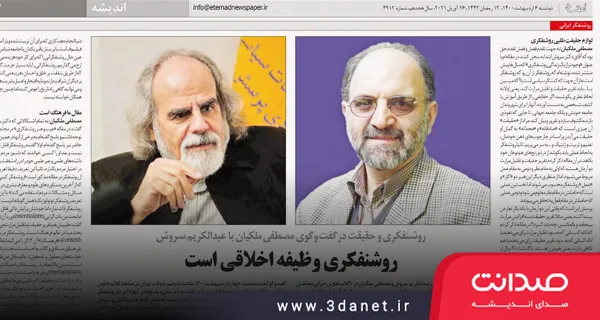
Intellectualism and Truth: A Conversation between Mostafa Malekian and Abdolkarim Soroush
Intellectualism is a Moral Duty
Mohsen Azmoudeh:
The conversation between Abdolkarim Soroush and Mostafa Malekian[1] on Clubhouse is a significant and noteworthy event for the audience of thought in Iran. Two influential intellectuals in the post-revolution years, especially in the 1990s and 2000s, both of whom emerged from the current of religious new-thinking, although Soroush has consistently defended the controversial term "religious intellectualism" over these four decades, while Malekian from the very beginning spoke of its "paradoxical" nature and, in his intellectual evolution, has even distanced himself from the current of "religious new-thinking." Now these two intellectuals, Soroush at 76 and Malekian at 65, faced each other to speak about the relationship between intellectualism and truth. Malekian continued to defend his well-known definition of intellectualism, namely "the exposition of truth and the reduction of suffering," and enumerated its requisites, while Soroush believes that the concepts of "intellectualism" and "truth" are ambiguous and polysemous, and one must be very cautious in their usage and in providing definitions for them—if a definition is even possible. This conversation, which took place on Saturday night, April 24, 2021, at 10:30 PM Tehran time on the Clubhouse page "New Perspective Circle" [2], had many listeners and concluded with their questions and answers with these two intellectuals. What you are reading is a report of the first 100 minutes, which includes the speeches of Malekian and Soroush. At the end of this segment, Malekian said about Soroush: "Any fair-minded person would accept that in the intellectual current after the Iranian Revolution, whether religious intellectualism or non-religious intellectualism, the most influential figure is Dr. Soroush; therefore, such discussions are not intended as disrespect. I hold him in the highest esteem with all my being. I personally have learned things from him. These discussions are scholarly and truth-seeking." Soroush, in response, said to him: "Of course, your tone is very friendly, sincere, compassionate, and scholarly. Even assuming it contained a reproach, which it absolutely did not, it is in the context of dialogue, but I am very pleased that our intellectual horizons and views are close to each other."
The Requisites of Truth-Seeking in Intellectualism
Mostafa Malekian
By virtue of precedence in merit and the merit of precedence, it is only right that Dr. Soroush should speak first. In my article titled “The Tragic Aspects of Intellectual Life” [3], published many years ago, I wrote that the intellectual, insofar as he is an intellectual and not a political activist or an academic or the like, must engage in the articulation of truth and the alleviation of suffering. That is, firstly, on a theoretical level, he must strive, if he has acquired truths through education or personal discovery, to reveal, articulate, and express them to the citizens of his own society and indeed the global community, to the extent of his influence. By “truth” I mean that which “sincerely” and “earnestly” appears to him to be true, for we all dwell within the frameworks of our own minds, upbringing, genetics, and so forth. Secondly, on a practical level, the intellectual must strive to reduce the pains and sufferings of his fellow human beings. In that article, I noted that the articulation of truth and the alleviation of suffering are two ideals, the former pertaining to the realm of theory and the latter to the realm of practice. From another perspective, however, both constitute the “work” and “action” of the intellectual, but the first is an action whose outcome is realized in the realm of theory, and the second an action whose outcome is realized in the realm of deed. The question is, when these two ideals come into conflict—when, for example, the articulation of truth leads to an increase in suffering, or vice versa—what is to be done? In the article, I mentioned that the arguments of those who rule in favor of alleviating suffering and the arguments of those who rule in favor of articulating truth are equally balanced, that is, they carry equal weight. Twenty years after writing that article, it still does not seem to me that any argument has been advanced to demonstrate the superiority of one of these tasks over the other. Therefore, each of us must consult our own intuitions, and preferring one over the other is considered a matter of moral intuition. In the article, I wrote that my own intuition tells me that the articulation of truth is more important than the alleviation of suffering. I would add here that when I speak of consulting one’s own intuition, it is because there is no decisive, irrefutable argument; otherwise, each side has its own arguments. Thus, based on my own preference grounded in my intuition, it seems that in intellectualism, the concern for truth is ultimately far greater than the concern for reducing pain and suffering. Consequently, I see intellectualism as being in the service of articulating truth. One might ask, assuming these statements are accepted in theory, what is the result or what are the results? The first result is that the intellectual, insofar as he is an intellectual, must not be a sycophant, a flatterer, or a toady toward the people, nor speak as if the masses are free from all ignorance, error, ill intent, faults, and shortcomings. Sycophancy creates problems. If the intellectual’s perception is that “I am the representative and spokesperson of the people,” this means “I defend what the people believe in.” Against whom is this defense? Probably against the political regime ruling that society. That is, as if the ruling political regime is, say, illegitimate and holds improper positions, and the victims of this illegitimacy are the people, a people who are, in and of themselves, blameless. I call this kind of intellectualism “cultural representation of the people,” and I cannot accept it. I accept an intellectualism that judges the people; that is, it does not believe it must necessarily be the people’s defense attorney, but rather believes that many of the disorders in people’s lives are rooted in the people’s own culture, and therefore this culture must be critiqued. Of course, this critique of the people’s culture is not pleasing to them, but it is in their best interest. In this sense, the intellectual may well oppose the people’s “wants” but does not oppose their “needs.” In our history, intellectuals, when speaking of “the people,” have always used expressions such as “the noble nation,” “the brave nation,” “the self-sacrificing and patient nation,” and so on, whereas, in my view, love for the people requires that we not use these epithets, but rather say: O people, because we love you, when what pleases you conflicts with your best interest, we prefer your best interest. Your best interest lies in our correcting your false beliefs, pointing out your inappropriate feelings and emotions, and striving to transform your unreasonable wants into reasonable ones. In my view, culture refers to these three things. Therefore, the intellectual, instead of being the spokesperson for the people, must be their judge, provided that he does all this through reasoning—that is, as Russell says in his book Power, by appealing only to the forces of “persuasion,” not to the forces of “excitation,” nor to the forces of “coercion.” Thus, the intellectual can never and should never impose his will upon another.
To distinguish true belief from false belief, apt emotions from inapt emotions, and reasonable desires from unreasonable ones, he must draw on the forces of persuasion, rational convincing power, and argumentation. The intellectual’s stance, therefore, is never one of superiority. Domineering and looking down on people is the work of someone who resorts to motivating and coercive forces. The intellectual appeals to reason, and if someone prevails in a rational contest, no domineering has taken place. The second point is that, when speaking with people, the intellectual must, in order to prevent truth from being sacrificed, reduce ambiguity, equivocation, and obscurity in speech as much as possible. Paul Edwards says that what he learned from Russell is that one need not speak obscurely in order to be profound. Truth-telling requires eliminating ambiguity, equivocation, and obscurity in speech because, first, if people are to find the truth, it is better that they find it with less effort. Ambiguity, equivocation, and obscurity impose unnecessary pain and suffering on the audience, especially when people could discover a truth by spending less time, energy, and talent. Some in ethics believe that not inflicting unnecessary pain and suffering on others is a pillar of morality; second, a person can misuse ambiguity, equivocation, and obscurity in speech and twist the discourse so that he comes out the winner in any case. Whereas, to safeguard the truth, we must speak with the utmost clarity. The third point is that no kind of ideological thinking is compatible with truth-telling and truth-seeking. Therefore, the intellectual must, insofar as his knowledge and awareness permit, and by looking at himself from above and recognizing his own ideological stances, avoid ideological thinking. Of course, each of us may not succeed in pursuing this valuable end, but we must not refrain from it as much as possible. Ideological thinking means declaring the file on a subject, issue, or problem closed and the deliberations sufficient. The intellectual must never declare the deliberations sufficient. From this, the fourth point becomes clear: in addition to avoiding ideological thinking, the intellectual must not tie his personality and character to his own opinion. The intellectual must conceive of an identity for himself that is dynamic and fluid, not fixed and static, and remain committed only to argumentation. Another point that conflicts with truth-seeking and intellectualism is the distortion and improper interpretation of others’ words. The intellectual must convey the message of a messenger exactly as he states it to others, even if he himself disagrees with the content of that speech. If I disagree with Kant’s words, I must first explain his words exactly as he himself stated them, and then express my disagreement with him, not introduce Kant to others as I myself understand him. Likewise, the intellectual must take responsibility for his own speech and not pass off his own words under someone else’s name. The final point is that the instrumental use of human beings, in Kant’s phrase, is never right. One of the instrumental uses of people by someone claiming to be an intellectual is to express his speech only within specific circles. When a speaker or professor expresses his speech within a specific circle, then those within the circle either, out of attachment to him, do not wish to critique it or lack the power to critique him. If the intellectual is a truth-seeker, he must consider a kind of democratization of education. Creating circles of disciples and devotees is something the Pythagoreans invented in history, which later also found its way into our mystical and Sufi circles. A circle, as long as it remains a circle, poses few dangers, but its flaw is that it soon turns into a movement, and movements cannot be easily stopped. I therefore believe that an intellectual should express the things he says in one place everywhere else as well. In what I have said, I had in mind the implications of my own speech about intellectual truth-seeking, and I did not have any specific individual or group in mind.
Intellectualism and Truth
Abdolkarim Soroush
I have spoken and written extensively about intellectualism and religious intellectualism. The most recent was an interview with the Zeitoon website on my seventieth birthday, where I offered new points on the relationship between intellectualism and religion. Of course, I do not intend now to define, explain, or defend religious intellectualism, and I will try to clarify the ambiguity in the discussion of "intellectualism and truth." Unfortunately, both of these concepts are ambiguous to me; I still do not know the definition of intellectualism, nor is truth as clear to me as it should be, for reasons I will explain. Hence, I am incapable of unveiling the relationship between intellectualism and truth, and I cannot do so easily. Many have said, and the professor also stated, that the intellectual's task is the articulation of truth and the alleviation of suffering. Of course, for the sake of rhyme, I suggest the expression "articulation of truth and alleviation of hardship." Naturally, he is the originator of this expression and has authority over it, in the words of Rumi: Since you have been the origin of the Mathnawi / If it increases, you have increased it. When Mr. Malekian and others say that the task of the intellectual and intellectualism is the articulation of truth and the alleviation of suffering, I ask myself, "Who is the intellectual?" It is as if it is assumed that there are beings, a group, or a sect called intellectuals, and we are defining their duty, function, and best work. I am not now in a position to critique Mr. Malekian's view, and I adopt his definition as an example. If "articulation of truth and alleviation of suffering" is part of the definition of "intellectualism," then this statement is nothing more than a tautology. But if it is not part of the definition of intellectualism, then one must specify who the intellectual is and what characteristics they have; then say: O you who have such characteristics, you must engage in the articulation of truth and the alleviation of suffering. I have observed this point regarding most definitions of intellectualism: that they say "the intellectual must grapple with power," or "the intellectual must be the sand in society's shoe," or "the intellectual must fight against lies, corruption, and oppression," and so on. My question in all these statements is: who is meant by the intellectual who must do these things? Does intellectual refer to the educated? Or the religious? Or a group of the educated, such as sociologists? If any of these definitions is adopted, the problem is somewhat resolved, but when we lack a clear definition of the intellectual, what they should and should not do remains shrouded in ambiguity. Therefore, the intellectual has no clear meaning, and despite the term "enlightened" (roshanfekr, literally "bright thought") being used in its title, there is no bright thought here. To understand who the intellectual is, we must move beyond definitions, because these multiple definitions are neither comprehensive nor exclusive. Therefore, to understand who the intellectual is, we must look in a nominalist and empirical way at who has generally been called an intellectual. We should take the most important and complete instances and define intellectuals based on this, and not present our own preconceived notions for the intellectual and their duties. For example, Mr. Malekian's definition of the intellectual as someone who articulates truth and alleviates suffering is not exclusive, meaning it also encompasses others, such as physicians who do both. Epidemiologists and environmental activists also do this. By this expression, all of these are considered intellectuals. This is, of course, very good because it shows that the intellectual has a wider circle and does not only include a specific group whom we address. Articulating truth and alleviating suffering is a good task. Therefore, physicians, environmental activists, fighters against oppression, and those who disseminate any branch of knowledge in the world are all considered intellectuals. Thus, intellectualism is a universal duty, and generally, those who are compassionate towards people and sincerely spend their possessions, whether scientific or non-scientific, out of this compassion and mercy for creation, are intellectuals. Therefore, one should not limit and confine a specific group—for example, the educated—and call them intellectuals, then address whether this group fulfills its duty or not. Intellectualism is a very large circle that encompasses many, and in the sense mentioned, individuals can also be intellectuals to varying degrees. But the definition of truth is also important. It was said that the intellectual must tell the truth, but which truth? Medical truth, physical truth, religious truth, or...? By expressing which truth is a person considered an intellectual, or is it their duty to tell it? I may not consider another's truth to be truth, and vice versa. How can one ask people to tell the truth? Furthermore, does the intellectual speak of theoretical truths or practical truths? There is a distinction between theoretical truths, such as those in physics and philosophy, and practical truths, such as those in ethics. Which category of these truths should the intellectual express in order to fulfill their duty as a truth-teller? Should the intellectual speak every truth, or might they waste people's time with this truth-telling? They might mistakenly tell fables instead of the truth, or speak irrelevant and futile truths! Which truth should be told? Another point is the cost of expressing the truth. The costs of expressing different truths vary. For example, in a liberal society, as long as laws and regulations permit, grappling with the government costs nothing, and one can easily criticize the government. But in some other societies, speaking certain truths is very costly. Should these costs be placed on the shoulders of intellectuals? Do we have the right to expect this of them? If we say so, then the circle of intellectualism becomes very limited and does not exceed three or four stars—those who place everything they have on the platter of sincerity, step onto the stage, grapple with power, and speak a truth whose cost is very high. In that case, only Seyyed Jamal al-Din Asadabadi, Shariati, Engineer Bazargan, and so on would be considered intellectuals. With this responsibility, even Russell and Sartre could not be considered intellectuals. Therefore, regarding the relationship between intellectualism and truth, one must ask: which truth, at which cost, in which society and context, with which audience? Until these are clarified, the task of intellectualism and truth remains undetermined. Another point is: must the intellectual always speak the truth? Since the time of Plato, we have had the concept of the 'noble lie'—that governments are sometimes permitted to tell a noble lie. A physician is also sometimes permitted to lie for the patient's benefit. Expressing the truth depends on the circumstances, the cost of the action, and the audience. Therefore, insisting on expressing the whole truth and nothing but the truth is a heavy burden on the intellectual, and one must fear God if they wish to burden another so heavily and demand such an immense responsibility from them. Must the intellectual, by virtue of being an intellectual, not be bound to any school or belief? Of course, I accept that 'the wise' (I deliberately avoid using the term intellectual, as it is unnecessary) must, by the dictate of reason, leave reason free—to accept something to the extent their reason permits, and where their reason does not permit, to, in Ibn Sina's words, place it in the realm of possibility or the crucible of ambiguity and deferral: 'Whatever strange thing reaches your ears, leave it in the realm of possibility, so long as the demonstrative proof does not repel it from you.' This is the dictate of rationality. But is it possible to have no assumptions or presuppositions? Did Sartre have no presuppositions? He believed in responsibility. He was an existentialist and brought his existentialist approach to bear on his intellectualism. He believed in good and evil. Mr. Malekian himself, who considers the clarification of truth and the reduction of suffering to be good, therefore, before stating the intellectual's duty, believes in good and evil—meaning he is inevitably committed to an ethical school in which good and evil are defined in a particular way, and among its instances are the clarification of truth and the reduction of suffering. Every wise and thoughtful person is like this. Therefore, no one can be committed to no framework at all. Of course, we must not be dogmatic, meaning we must be ready to change our presuppositions. Intellectualism in the modern era has become exceedingly more difficult because we live in the postmodern era, and speaking of truth has become very difficult. Richard Rorty said that in the Middle Ages, God was the measure of all things; in the modern era, reason became God; and in the postmodern era, there is no God at all. That is, all criteria have collapsed. Postmodernism began with an attack on reason and rationality, through the idea that we have a plurality of reasons and rationalities and modernities, and consequently, a plurality of truths. Hence, speaking of rationality, and consequently truth, and consequently intellectualism, has become very difficult. As a result, in his view, intellectualism has no essence and therefore no definition. It is so devoid of essence, or its essence is so broad, that it encompasses many individuals, and everyone in society has a duty of intellectualism and enlightenment, each according to their rank. Secondly, truth is far more veiled, hidden, and plural than to demand that some people speak the whole truth. Truths are very diverse and concealed. Expressing some truths carries high costs, and one cannot expect everyone to keep their relationship of commitment to truth clear at all times. Thirdly, truth, as we imagine, is not so clear even in the positive sciences; in philosophical and theological discussions, where ambiguity is greater, accusing others of not speaking the truth or not observing fairness are polemical and personal discussions that are of no benefit.Fourth, having a framework for intellectual thought is very good; we should ask intellectuals to articulate and clarify their frameworks so that they can be critiqued. What is one's duty? Everyone must fulfill their duty in this world, the work for which they have been trained and raised—whether they are a philosopher, a nurse, a physicist, a sociologist, or otherwise. At the same time, we honor those intellectuals who pay a cost for their work. Great respect must be given to intellectuals who pay a cost through compassion for the people and benevolence. They possess nobility over others, are a source of pride and credit for humanity, and can sometimes change the course of history, but such a thing is not demanded of everyone.
My Subject Is Culture
Mostafa Malekian
I was mindful of all the objections Dr. Soroush raised in the article “The Flaw and the Art of Intellectualism”[4] and have responded to them; I have also responded to some of them in this very discussion. Firstly, he said the intellectual is indefinable, and then he called him someone who is compassionate toward the people and places his scientific and non-scientific assets at the people’s disposal out of compassion for them. Secondly, this definition is precisely my definition of the intellectual in the aforementioned article: “An intellectual is someone who uses the latest achievements of the human sciences and knowledge to solve the people’s issues and problems.” On this assumption, the definition of the intellectual is not tautological. He said the intellectual has no essence, yet he himself attributed an essence to him, but my discussion is not about essentialism and its rejection. He said physicians also convey truth and reduce suffering. Our discussion is in the realm of culture. The intellectual performs those three tasks (distinguishing true from false beliefs, appropriate from inappropriate feelings, and reasonable from unreasonable desires) within the context of “culture.” My subject is culture, not the body, the economy, or anything else. The intellectual deals with mental states—beliefs, feelings, and desires. But which truth? In changing beliefs, theoretical truths are intended; in changing feelings, emotions, and desires, practical truths are intended. But at what cost should truth be expressed? The gist of the matter differs from its correctness or incorrectness. In my talk, I had expressed no opinion at all regarding this question. But as for his saying, how can you ask an intellectual to expose his life, property, honor, and reputation to a thousand dangers? I have written in the article that being an intellectual is not a legal or juridical duty for any human being, but rather a moral duty. No one can be compelled to morality. Morality and moral duties only have meaning within the context of freedom. Moral duties also find meaning within the realm of what is feasible. I did not say that human beings must be intellectuals; rather, I said that if someone decides to be an intellectual, they must be thus. If morality were compulsory, it would no longer be morality, just as law without compulsion and coercion is not law. But the point that everyone has a particular stance, perspective, approach, and view of the truth is also accepted, and I alluded to it. I said the intellectual is not ideological, and not being ideological does not mean having no stance, but rather means not considering any stance as the final stance. Of course, we all have stances on many matters; intellectuals certainly have stances too, but I said an intellectual is someone who abandons their stance if a reason is presented against it. Likewise, we all have presuppositions. The point is that the intellectual must abandon their presuppositions if a reason is presented. Dr. Soroush said we are living in the postmodern era, that all truths have collapsed, and that there are varieties of truth. Firstly, living in the postmodern era does not mean we must be postmodern in epistemological terms or in terms of the ethics of belief. One can live in the postmodern era and demonstrate, by presenting reasons, that all the claims of postmodern thinkers are erroneous. Secondly, he speaks of the collapse of all truths in the postmodern era, yet he himself clings tightly to certain pre-modern truths. Why is this so? Because we have no such duty, and everyone must refer to their own reason. So how can he expect me not to adhere to modern beliefs in the postmodern era?!
Let Us Take Intellectualism Out of the Narrow Circle of Definitions
Abdolkarim Soroush
I—as I said—did not take a position against Mr. Malekian in my remarks, nor do I dispute his definition; I was expressing my own view. Merely to clarify my own point, I drew the closest example from his speech. I have not read that article, nor am I aware of it. If, despite some differences of opinion, our views coincide, then so much the better. By living in the postmodern era, I do not mean that we should abandon our beliefs or submit to postmodernism, but rather that truth has become more veiled. It is as if, after Kant, holding metaphysical positions has become far more difficult. What is meant by the postmodern era is that people generally do not accept that the intellectual articulates the truth, because the discovery and expression of truth has become vastly more difficult. My intention with “having compassion for the people” was not a comprehensive and exclusive definition of intellectualism; my aim is to take intellectualism out of the narrow circle of definitions. By the broad definition I offered, all of us can be intellectuals. You said you are not concerned with the body but with culture. Are the body and economics not part of culture? What can be said about psychiatrists? In my view, intellectualism has a wider circle. Many can be intellectuals; of course, it is not their legal duty, but it can be their moral duty. Moral duty brings moral obligation, even if one does not act upon it. Therefore, the circle of intellectualism and truth in the postmodern age is very ambiguous, and discovering the relationship between the two is far more difficult than in the past. Ultimately, relying heavily on pure reason gets us nowhere. When we speak of intellectualism and rationality, we have stepped into dark valleys. We must open up the space and accept plurality, diversity, and the multiplicity of truths and the paths to reach them. In my view, if we widen this circle, everyone enters it. Exclusion and shutting out are not conditions.
Malekian: Instead of being the spokesperson for the people, the intellectual should be their arbiter, but they must do all this through reasoning—that is, as Russell says in his book Power, by resorting only to “persuasive” forces, not to “motivating” forces, nor to “coercive” forces. Therefore, the intellectual can never and should never dominate another. To demonstrate the distinction between true belief and false belief, appropriate emotions from inappropriate emotions, and rational desires from irrational desires, they must employ persuasive forces and the power of rational persuasion and argument; thus, the intellectual’s stance is never from above.
Soroush: But is it possible to have no assumptions or presuppositions? Did Sartre have no presuppositions? He believed in responsibility. He was an existentialist and brought his existentialist approach to bear on his intellectualism. He believed in good and evil. Mr. Malekian himself considers the articulation of truth and the reduction of suffering to be good; therefore, before stating the intellectual’s duty, he believes in good and evil—that is, he necessarily adheres to an ethical school in which good and evil are defined in a particular way, and among its instances are the articulation of truth and the reduction of suffering. Every rational and thoughtful person is like this.
.
.
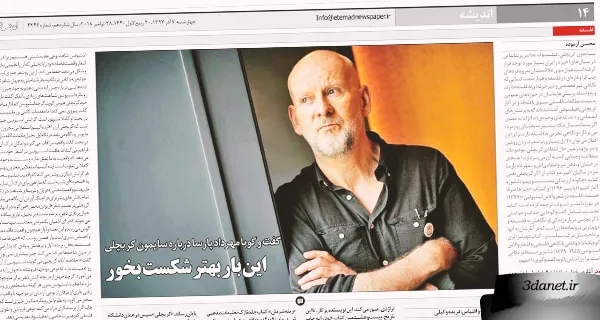
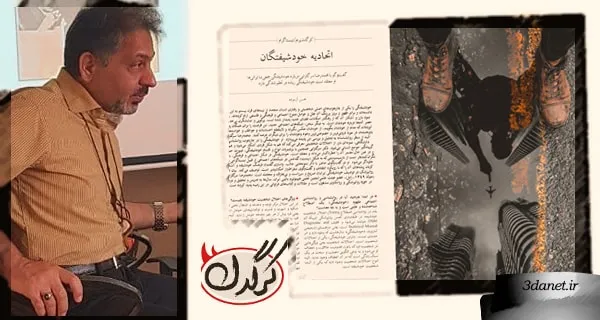
PDF file of the Etemad newspaper report on the conversation between Mostafa Malekian and Abdolkarim Soroush, titled “Intellectualism and Truth”
Reporter: Mohsen Azmoudeh
.
.
[1] Intellectualism and Truth, a conversation between Abdolkarim Soroush and Mostafa Malekian, April 24, 2021, New Perspective Circle (Watch on YouTube, listen on Anchor, Castbox, Download audio on Telegram)
[2] New Perspective Circle on Telegram, on YouTube
[3] Describing the Truth and Alleviating Suffering: The Ethical and Tragic Face of Intellectual Life, by Mostafa Malekian, Aftab, Year 2, No. 13, March 2002, pp. 44–47
[4] The Defect and Art of Intellectualism, by Mostafa Malekian, Negah-e No Quarterly, No. 116, Winter Issue
.
.
Discussion5 comments
ظاهرا عنوان « روشنفکری وظیفه اخلاقی است» غلط است. چون هیچکدام از طرفین این را نگفتند. دکتر سروش که واضح است، استاد ملکیان هم گفتند روشنفکری وظیفۀ اخلاقی نیست، این یک انتخاب است، ولی اگررر کسی این انتخاب را کرد آنگاه وظایف اخلاقی خاصی مثل تقریر حقیقت و تقلیل مرارت خواهد داشت. روشنفکر بودن وظیفۀ اخلاقیِ کسی نیست.
ملکیان گفت : « در مقاله نوشتهام که روشنفکری، یک وظیفه حقوقی و قانونی هیچ انسانی نیست بلکه وظیفه اخلاقی است.کسی را نمیتوان به اخلاق اجبار کرد. »
آقای صدری تیکهی بسیار زشت و حقیری به استاد ملکیان انداخت و ایشان هم خوب از خجالتش درآمد. اینجور بحثها جای نمکپرانی نیست. هرکه نمک ریخت، نمکسود شد.
عرض ادب و احترام راهارتباطی با با کانال و سایت صدانت چی هستش؟ چطوری می تونم مطلبی را درباب این گفتگو برایتان ارسال کنم؟
سلام info@3danet.ir