Philosophy
Mohsen Azmoudeh in Conversation with Mehrdad Parsa on Simon Critchley
Mehrdad Parsa, translator of Simon Critchley's works, sees his thought as a rebellion that has pulled philosophy out of the academy and tied it to real life. A conversation on the relationship between a philosopher's life and thought, and the reason for turning to translating Critchley's works.
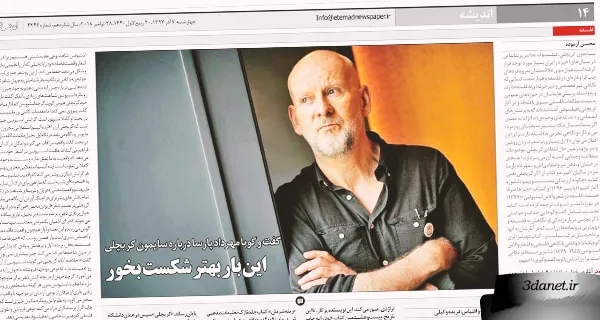


Mohsen Azmoudeh: Simon Critchley, the contemporary British philosopher, has attracted considerable attention in Iran in recent years, both from those interested in leftist and continental approaches in philosophy and from those who have a non-specialist, non-professional view of philosophy and have been drawn to philosophical studies through their questions in the public sphere. In Critchley’s works, they have encountered a philosopher who addresses concrete questions and existential concerns (not necessarily in the existentialist sense, but more in the everyday sense) and takes an experiential view of philosophy. Many reasons can be cited for this reception: Critchley’s clear, direct, yet critical language, the engaging and relevant subjects he tackles, his brilliant ideas, his sharp and critical mind, and so on. In recent years, Mehrdad Parsa has also translated two of Critchley’s books, namely How to Stop Living and Start Worrying (Autumn 2017) and Things Merely Are: Philosophy in the Poetry of Wallace Stevens (2018), both published by Nashr-e Shavand. The first book comprises fascinating and readable conversations with Critchley about his life, his view of philosophy, and the most important themes he addresses in his works, such as death, politics, and so on. The second book is a small but readable work offering a philosophical look at the poems of Wallace Stevens (1879–1955), the eminent American poet. On this basis, we spoke with him:
***
I wanted to begin by asking about the reason for your inclination toward translating Critchley’s works. We primarily know Mehrdad Parsa as a translator interested in continental philosophy, especially its contemporary thinkers, who pays attention to the boundaries of philosophy with art, psychoanalysis, and politics. Now, in your body of work, we see two books by Simon Critchley. First, please tell us, what is the reason for your inclination toward translating the works of this contemporary thinker?
Let me answer using Critchley's own simple sentences. Critchley says: "Sometimes I follow a path simply because it fascinates me ... and reading a book, listening to a conversation or something a student says still captivates my mind and senses." To me, the important point of this approach is its emphasis on the thinker's necessary openness to the mind's maximal engagement with the world, and even a welcoming of things that may overflow his perceptual boundaries. In the history of philosophy, we have often witnessed the opposite of this approach. Many philosophers, especially system-builders, have ignored their sudden, impulsive interests and inclinations lest they stray from the main current of their work; or, rather than thinking about what is, they have thought about what, in their view or according to the requirements of their thought-system, ought to be. On the other hand, Kierkegaard, for instance, equips us with tools to resist any kind of system-building thought, the prime example of which is perhaps Hegel's system, and later this same Kierkegaardian critique of modernism appears in other thinkers from Bataille to Kristeva. Instead of philosophical generalities, the thinker should speak of a sense of his own "philosophical fragments" or "philosophical micro-inclinations," and Critchley follows this very path, not overly concerned with the contradictions of his micro-philosophical concepts, and in his interests, he flits from one branch to another at every moment. Likewise, on the level of translation and research, it would not be bad to say yes to our sudden interests and inclinations. In Deleuze's phrasing, it is better in youth to pursue personal interests and minor questions, and to save the question "What is philosophy?" and more general, principal issues for old age. Therefore, I think the importance of Critchley's thought lies in showing us that perhaps these philosophical details are "more real" than philosophical generalities and principles. Critchley's thought is a kind of rebellion that pulls philosophy out of the academy and ties it to real life. He speaks of music and poetry as much as of thought and cinema, and it seems to me these are the only things we can take delight in within real life. On the other hand, the humorous language and jokes in his text add to the appeal of his works. Unlike Žižek, Critchley does not import his jokes into the serious world of philosophy; rather, he transforms the world of philosophy itself into a humorous world, and this is particularly evident in his treatment of the concept of humor or the idea of tragicomedy in Beckett's works. The book "How to..." has an extremely engaging prose and content that carries every reader along with it. In that same book, there was a reference to another book of his titled "Things Merely Are," whose central idea about "epistemological disappointment" and the discussion of "sad transcendental idealism" was enough for me to set about translating it. Apparently, failure and melancholy hold more appeal for me than success and happiness! Ultimately, Critchley's thought, in a way, brings me closer to philosophy and gives it a more real dimension, especially since, while translating these two books, I would sometimes ask Critchley himself about my ambiguities in order to understand a complex concept, particularly to better grasp his interpretations of Stevens's poems.
In an interview included in the book "How to...," Critchley evades defining himself and even dodges his own previous humorous remark. At the same time, he dedicates a chapter of the book to narrating his own life and, in fact, to the relationship between the philosopher's life and his thought. What relationship exists between these two, and from this perspective, how is Critchley's own world delineated?
Critchley argues that there is a necessary link between a philosopher's life and their thought, and it is this very fact that makes biography an important issue. In a sense, philosophy itself begins with a narrative of the life and death of Socrates, as if the love of wisdom and philosophical death in the life of Socrates the philosopher is the first brick in the wall of philosophy. Especially if we consider philosophy as a way of living, examining the lives of philosophers seems essential. Although this necessary link can be seen throughout history, it is perhaps more pronounced in some cases. Nietzsche is a good example of this, and it seems impossible to properly understand his thought without knowledge of Nietzsche's life. Nevertheless, analytic philosophy and twentieth-century philosophical thought largely link philosophy to argument, reasoning, and verifiability, and eliminate the philosopher's life from the philosophical narrative. Perhaps the removal of biographical details and the disregard for the influence of events and the philosopher's dispositions on philosophical thought is partly related to philosophers' efforts to achieve scientific precision and distance themselves from personal aspects. In many areas of the humanities, such an effort to 'become scientific' has taken place. On the other hand, for instance, Heidegger says of Aristotle: Aristotle was born, he worked, and he died. Of course, if we were in Heidegger's place, we might also prefer that no one pry into the details of our lives and adopt an approach like his! This is the very idea of 'being in view' that Critchley refers to in the book. In the first chapter of the book, Critchley provides a compelling and humorous narrative of his own life; from his family and academic problems to the events that led him into the realm of philosophy. This chapter shows that Critchley's life and thought are deeply intertwined, and even the trace of certain events in his life is evident in his thinking and the themes he addresses. Critchley says that perhaps with a kind of psychoanalysis, one can explain the cause of many thinkers' inclinations, and this issue demystifies any thought that claims totality and the representation of reality. Schopenhauer says somewhere that a person mistakes the limits of their field of vision for the limits of the world. Critchley helps us become aware of these limits and demystify our minds.
Critchley is one of those philosophers who constantly redefines philosophy in his works, and the very nature of philosophy and philosophizing is an issue for him. What is his view of philosophy, and more clearly, what does he want from philosophy?
The reason for this constant redefinition is that Critchley’s conception of philosophy is fluid and process-oriented. In his view, philosophy lacks any a priori essence, and it is precisely this characteristic that allows him, by redefining philosophy, to bring impossible subjects into the realm of philosophical thought. Philosophy in this sense is not necessarily a professional or academic activity but is nothing other than the very act of philosophizing and questioning, and this questioning is, of course, always tied to a cultural and social context. Thus, “philosophy is the living activity of critical thinking in a particular context and is fundamentally always local in character.” Philosophy lives in the hope that, by posing universal and general questions, it will challenge the “doxa” and the opinion that holds sway in a particular tradition, and this brings about human liberation and broadens one’s field of vision. Stanley Cavell says that adults, too, need a tool for education and training to break their dogmatic beliefs, and philosophy provides such a tool. In this way, by weakening the sanctity and transcendent status of philosophy as an activity tied to a social context, Critchley arrives at the issue of the historicity of philosophy. He says that, contrary to Wittgenstein’s view, which considers philosophy an anti-historical activity, philosophy and the history of philosophy are intertwined, and this issue gains particular centrality from Kant onward. The insight of historicity allows us to set aside traditional metaphysical concepts and find more concrete things. Critchley points to two important concepts in Kantian thought: finitude and contingency. Finitude shows that there is no God-like perspective and no external reference point for human experience and its confirmation; therefore, the finitude of experience, the world, and the human subject’s perception must be acknowledged. Furthermore, human experience is fundamentally contingent and eventual, depending on the manner of its occurrence. Both of these insights bring the subject down from the heavens to the earth and place them within the contingent network of history, culture, and society. This amounts to a kind of return to and revision of the tradition of continental thought, which, of course, in Derrida’s terms in “Violence and Metaphysics,” is by no means considered a traditional act.
One of Simon Critchley’s essential characteristics is crossing the artificial boundaries between various fields of the humanities, art, and philosophizing with and through the aid of artistic, literary, cinematic works, and even football. What is your assessment of this approach of his to philosophy? Does this not damage philosophy as a specialized discipline?
It leads more to dynamism than damage. Critchley’s works are replete with references to subjects that hold no importance for most past philosophers. In the title of one of his books, these subjects are called “impossible objects”: football, music, poetry, suicide, and many topics about which a philosopher, even if consenting to discuss them, can hardly say anything. I mentioned that, in Critchley’s terms, philosophy is an activity that occurs in a specific context, and is therefore something deeply tied to the life and circumstances of the philosopher. There is nothing straightforward and neat about philosophy and the world. Everything is messy and entangled, so we should expect that human thought, philosophizing, and questioning will also follow multiple and different paths. A philosopher who seeks system-building and wants to present a precise philosophical system undoubtedly strays very far from what Bergson called the “center of indetermination,” and their perceptual system distorts or “subtracts” a large part of reality. Critchley does not submit to this subtraction, or minimizes it. The range of his interests is so broad that he has even written a book about David Bowie. Why? Because he thinks Bowie’s music creates illusions behind which lies “a restless nothing.”
One of the subjects that might be, in a sense, outside the boundaries of philosophy and that Critchley addresses is the idea of love. What is his conception of love, and what are its philosophical aspects?
Critchley has not yet devoted an independent book to love, but in How to Live… we find a summary of his view on the matter. He says that love, contrary to Hegel’s view, is not an event that occurs between independent beings within the framework of contractual bonds like marriage, but rather something more excessive and destructive that demolishes the fortified boundaries of the subject and paves the way for an other to enter into one’s self. His view on this approaches mystical approaches and, of course, he draws it out of the erotic aspects of one of the Old Testament stories, namely the “Song of Songs” of Solomon. We see something similar to Critchley’s approach in Lars von Trier’s film Breaking the Waves. One of the female mystics through whom Critchley advances his discussion is Poret, who explains seven stages of love and annihilation. The first two stages are obedience to religious commandments and following Christian teachings. But “Bess” (the female character in Breaking the Waves) enters the story from the third stage onward. In the third stage, to attain a kind of annihilation and to realize love, one must abandon the self in order to create a space within oneself for the entry of love. The fourth stage is a stage of passion and ecstasy that has a divine aspect, and in the same way, in the next step, one must distance oneself from this divine aspect, and this act allows God to enter into the human self, and the annihilation of the soul gives way to the infinite divine reflection. Critchley considers this stage more important than the seventh stage, which pertains to joining the eternal divine life. The importance of Poret’s mystical view lies in the moment of emptying oneself and welcoming the other and difference. Lacan says, “I believe in feminine jouissance insofar as it is something surplus,” so Critchley concludes that female mystics advance on the path of experiencing something surplus, and this is a kind of experience of transgression. The experience of jouissance and the experience of love possess something excessive that manifests in the form of a surplus, and of course, the “Song of Songs” introduces it in the form of something corporeal and earthly love; it seems von Trier follows the same path. Referring to Alain Badiou’s discussion of love, Critchley says love is an event that presents a trial and a test, from which, of course, we often do not emerge triumphant. We can add that the demand of love means emptying oneself for the entry of an indeterminate and infinite other, and thus this issue is also linked to the concept of infinite demand.
Death is one of the central concerns in Critchley’s works. Why is this subject so important to him, and what is his view of death?
Critchley presents his main argument about death in the book Very Little... Almost Nothing, stating that his father's death was the motivation for writing the book and engaging with the subject of death. In this book, he begins his discussion of death by criticizing Heidegger's view that authentic Dasein is always underway toward death. Heidegger believes that authenticity is nothing other than the internalization of death and finitude, and overcoming and mastering it. Human courage in the face of death is the condition for authentic Dasein. The Futurists held a similar view: death as a masculine assertion and a self-overcoming, which then makes authenticity possible through this self-sacrifice. On the other hand, the fundamental experience of death, according to Heidegger, is the result of the relationship I have with my own death. However, on both points, Critchley moves closer to the thought of Levinas and Blanchot. Firstly, he takes as his basis Spinoza's view that "a free man thinks of nothing less than of death," and therefore, instead, focuses more on human finitude as the framework that defines the limits and boundaries of human life. In other words, for him, death is approached through the lens of finitude. With this assumption, following Levinas and Blanchot, he attempts to critique the concept of the "power of being" or Dasein's mastery and dominance over death. The subject not only lacks the courage to face death, but its very being is fundamentally defined by an inability to be, by a dread of death. The experience of death for Dasein is something that reveals itself not in the disclosedness of being, but in the experience of night and darkness; like the experience of a buzzing, rustling sound that unnerves a person and before which one "falls to the ground." And as for the second point: according to these thinkers, the death of the other is more important than my own death. Death enters my world through the gateway of the other, and it is perhaps here that the mourning/melancholia dichotomy becomes highly significant. For Levinas and Derrida, the human being is defined by the experience of impossible mourning, and subjectivity can never achieve the hypothetical authenticity of Heidegger because the experience of mourning turns it into a fragmented being, whereas Heidegger's Dasein seems incapable of mourning. Ultimately, Critchley shows himself indebted to an approach defined by powerlessness in the face of death. He is a critic of the heroic and epic approach to death and is, in fact, even opposed to the issue of authenticity.
In the book Things... we witness a contemporary philosopher's reading of a contemporary poet's poems. Philosophers from Plato and Aristotle to the present have spoken extensively about poetry. Briefly and concisely, what is Critchley's view on the subject of poetry?
We mentioned that Critchley often writes about subjects that the philosophical mind finds difficult to address. Poetry is one such subject, and we realize the impossibility of expressing it in philosophical language especially when Critchley himself, at the beginning of the book, points to the paradox of his own undertaking: wanting to speak in philosophical language about a poetic experience that can, in truth, only be spoken of in the language of poetry. Of course, anyone familiar with the world of Wallace Stevens would praise Critchley’s sharp eye rather than find fault with him, for Stevens is perhaps the most philosophical poet to have ever put pen to paper. Critchley clarifies the book’s central problem from the very outset. In his view, Wallace Stevens’s philosophical world helps us to reframe and move beyond the philosophical problem of epistemology, or the relationship between thought and things, or mind and world. In the first part of the book, Critchley discusses Stevens’s early poems and shows that, for Stevens, the world is the product of the mind’s activity, and the mind’s activity presents things to us as they are. In Stevens’s later poems, however, we witness a kind of retreat, for in these poems reality maintains its distance from the imagination that orders and shapes it. Poetry, therefore, is nothing but the experience of failure in the phenomenological view of the world. The poet only gives us ideas about the thing, not the thing itself. This approach of Stevens bears many resemblances to Kant’s thought, and Critchley himself says that, although Stevens does not entirely follow Kantian arguments, the Kantian and Romantic premises are quite evident in his discussion. Stevens’s tendency is what Critchley calls “disappointed or frustrated transcendental idealism.” At first glance, the imagination, like schematization in Kant’s discussion, frames reality and makes its comprehension possible, but ultimately Stevens shows in his poems that reality does not belong to us and is utterly indifferent to our existence. Disappointed transcendental idealism clarifies better than any other tendency that solid, hard reality resembles a “rock” that we have no way of comprehending. Nature and reality resemble a naked, alien thing that all human efforts to grasp remain unsuccessful. In his interpretation of the poem “Of Mere Being,” Critchley says that at the end of the mind’s fantasy, the bird perched on the palm tree sings a foreign song that is entirely meaningless to humans. Only sound is heard, and this melody and song, like reality, lacks human meaning and feeling, and it is for this reason that “things merely are: the palm, the bird, the song and its feathers, and the wind moving gently through the branches. Nothing more can be said.” In short, Critchley says, Stevens is important because he teaches us a kind of humble encounter with the world. Although the world exists for us through the lens of the mind’s activity, Stevens ultimately speaks, without any sophistry and in a language devoid of mysticism, of a kind of peace in the encounter with reality. I think this approach complements what Heidegger means by questioning; a kind of humility and philosophical piety that bestows a particular insight upon the philosopher.
Critchley even devotes a chapter of the book to Terrence Malick’s films. What connection exists between Terrence Malick and Wallace Stevens that leads Critchley to include this chapter in the book?
The common theme between these two is a Heideggerian concept. I mentioned it earlier; something often translated as “calm” (Ruhe). Critchley, referencing Maurice Blanchot, says that two main tendencies confront us in our encounter with things: on the one hand, the subject’s mind strives to encompass the whole of reality within itself and fit it into its own perceptual frameworks. Hegel’s voracious mind, which wants to swallow all aspects of reality, is an example of this, and Critchley calls it transcendental idealism. He says, “When we name something, we both dominate it and kill it.” On the other hand, however, the subject can preserve the immediacy and thingness of things. The subject can take the side of things and allow them to continue their existence without human intervention and without imposing any human meaning. The question is, in this second tendency, what kind of encounter should we have with the hard “rock” of things? Critchley answers this question in the book’s appendix, by addressing Terrence Malick’s film “The Thin Red Line.” He says “calm” is the key to Malick’s art and Stevens’s late poems, both of which invite us merely to the simple contemplation of things. In poems like “Study of Two Pears,” “Prelude to Objects,” “Thirteen Ways of Looking at a Blackbird,” and many other poems, Stevens proposes a kind of phenomenology that seems to stop midway, and this is when the human mind maintains its distance from the “thing-in-itself” and respects the impossibility of objects. In Malick’s works, from “Badlands” and “Days of Heaven” to “The Thin Red Line,” we encounter the sheer indifference of nature and the world toward human intentions and purposes; as if nothing changes itself according to human goals, and our last recourse is to contemplate them with “calm”; a palm tree simply standing there, heedless of human feeling and meaning, with a gentle breeze stirring in its branches.
In closing, please tell us, what do Critchley’s works offer to philosophy enthusiasts and our readers in general?
The importance of Critchley’s objective approach lies in pulling the philosopher’s mind down from the ivory tower of official and classical philosophy and drawing its attention to things that the history of philosophy has always rejected and denied. We mentioned examples of this, partial and incomplete things such as poetry, music, and cinema, which, in the opinion of many philosophers, contaminate the pure language of philosophy. From the very beginning of philosophy, such subjects were rejected as “dirty Platonic forms” or pests of the Republic; not to mention the allegory of the cave, with which Plato, even before the invention of cinema, thoroughly discredited it. On the other hand, Critchley’s books speak of a kind of humility and retreat from the world, and this is an idea well thematized in the book “Things Merely Are,” the mere contemplation of things and, in fact, in Francis Ponge’s phrase, “taking the side of things.” And finally, perhaps it should be noted that Critchley pulls down not only the philosopher’s mind but also the philosopher himself, his status and dignity, and allows the reader to identify with him. When we read the first chapter of the book “How to Live…” and he tells us about the details and fascinating adventures of his own life, we experience a strange sense of similarity and feel that he is narrating our own lives. In this way, he more or less reduces the distance between the philosopher and the reader and makes us feel that if fortune favors us, hard work in learning and philosophizing is enough. Critchley quotes Beckett: “Try again, fail again, fail better.” This is an insight for everyone so that we can endure our tragic condition. In Woody Allen’s phrase, when tragedy goes on too long, it turns into comedy; or fail again, fail better this time. It seems we too live in Beckett’s dark and sinful world, which, from sheer tragedy, has made us laugh. It is a significant event that Critchley extracts the comedy of the world from the tragedy of life.
.
.
PDF file of the above text in Etemad newspaper
.
.
Mohsen Azmoudeh in Conversation with Mehrdad Parsa on Simon Critchley
This Time, Fail Better
Published in Etemad newspaper, Wednesday, November 28, 2018
.
.




Discussion0 comments
No comments yet; let yours be the first voice.