Philosophy
Anthony Kenny's History of Philosophy in Conversation with Reza Yaghoubi: History of Philosophy as a Dialogue of Ideas
Anthony Kenny's history of philosophy fills the gap for an up-to-date, coherent work among older and popularizing texts. With lucid prose and an analytical approach, it makes key concepts of medieval and contemporary philosophy accessible to readers.
Anthony Kenny's History of Philosophy in Conversation with Reza Yaghoubi, Translator and Researcher
History of Philosophy as a Dialogue of Ideas
Mohsen Azmoudeh
Etemad Newspaper; Issue 4849 – Monday, January 25, 2021
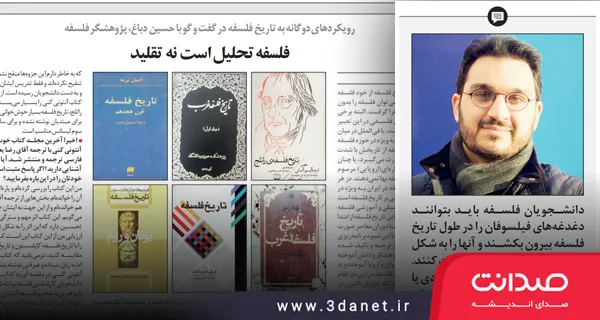
The history of Western philosophy has always held a special place among philosophy enthusiasts in Iran. The first significant and noteworthy text in introducing Iranians to modern European philosophy, The Course of Wisdom in Europe by the late Mohammad-Ali Foroughi, is in fact a history of philosophy that, despite the production and proliferation of many more up-to-date and research-oriented texts, has still retained its status and value in various respects. The foundation of philosophy education in Iran at the undergraduate university level is also based on the history of philosophy, a subject that itself sparks various debates and discussions and has many proponents and opponents. Over the course of roughly a century of our acquaintance with modern Western philosophy, various histories of philosophy have also been translated and authored in Persian. Besides Foroughi's classic book, one can mention works such as Bertrand Russell's History of Western Philosophy, Will Durant's The Story of Philosophy, volumes of Émile Bréhier's History of Philosophy, and most importantly, the detailed, nine-volume History of Philosophy by Frederick Copleston, the latter of which, given the aforementioned educational approach, has practically become a textbook. In recent years, some other histories of philosophy, such as the Routledge History of Philosophy, a collaborative work, have also been translated into Persian. Recently, the fourth and final volume of Anthony Kenny's A New History of Western Philosophy, translated by Reza Yaghoubi, has been published in Persian by Parseh Publishing. On this occasion, and considering the introduction mentioned, we posed the following questions to him.
To begin, and considering the aforementioned introduction, please tell us what, from your perspective, was the reason or cause for translating yet another history of philosophy? That is, before addressing the merits and features of the book you have translated, please explain why you thought we needed another history of philosophy? More precisely, from your viewpoint, what were the deficiencies, shortcomings, or problems of the previous works?
The last volume of Copleston's History of Philosophy was published in 1975, that is, 46 years ago. Russell's History of Philosophy is even older. I won't comment on their translations, but previously, the available histories of philosophy were both old and lacked an approach suitable for all audiences. For instance, one cannot expect everyone to cope with Copleston's style of expression or to start with that book. Apart from his difficult prose for beginners, specialists are also seeking a more systematic and coherent approach. There are other books, like Will Durant's, whose title as a history of philosophy cannot be taken very seriously. That is, their main title should be A Brief Introduction to the History of Philosophy, because they focus more on the anecdotal details of philosophers' lives and the engaging parts of their thought, having a promotional rather than an educational aspect. The same goes for other story-like books published in this field. They have a promotional and entertaining approach rather than providing serious education. There was a void for such a book—a book that, while offering serious philosophical education, also considers non-specialist audiences and possesses three characteristics: clear and lucid expression combined with a clear categorization of concepts and step-by-step instruction; a manner of presenting material that is not dry and tedious; and thirdly, being comprehensive—that is, being up-to-date and taking into account recent philosophers and recent philosophical developments.
Referring back to the first question, please tell us why you translated this particular book? Does the present book resolve these shortcomings and problems?
Yes. Kenny himself has spoken about this. Its up-to-dateness is obvious. Regarding his approach, he has also said that he chose a middle way between Copleston and Russell—that is, being more precise and comprehensive than Russell (and fairer) and more entertaining than Copleston. It is both up-to-date, not outdated like previous histories of philosophy, and its exposition is not dry and tedious. The greater merit of this book is that an analytic philosopher wrote it. That is, someone steeped in analytic philosophy for a lifetime, who now, with that same clear and precise gaze, delineates the main and key concepts of thinkers, and by clearly explaining those concepts and their interrelations, provides a comprehensive view of each philosopher's thought. After studying each section, you feel that, despite the clarity and fluency, you have learned the main components and key concepts of each thinker in such a way that you feel you have no problem understanding that individual's philosophy. In fact, it gives you keys with which, when you enter the classic works and original texts, you can easily proceed and gain entry into their philosophical world. Once the key concepts and frameworks are identified, what remains are the more classic and specialized works, which it is then time to study. On the other hand, it was the first time I saw in a history of philosophy that modern philosophers from Wittgenstein onwards were included. Both Continentals and Analytics. On the analytic side, it fully covers the contemporary analytic philosophy movement, discussing Quine, Strawson, Davidson, Kripke, David Lewis, Peter Geach, Anscombe, and others. On the other side, Heidegger, the Frankfurt School, Habermas, Derrida, and Rorty (although Rorty stands apart from this distinction), modal logic, modern logic, logicism, psychologism, and many new schools of this kind are included in an easy yet comprehensive language. However, as Kenny himself says, 'There is no shallow end in philosophy.' Also, whatever the author does, he 'cannot relieve others of the task of reading philosophy.' No book is so complete and comprehensive that it never confronts the reader with difficulty. In that case, one would have to turn to those brief story-like accounts that only present the attractive and entertaining parts. Let me also add that in the second volume, which is on medieval philosophy, few books can be found that explain and elucidate medieval philosophy so clearly, lucidly, and with a fresh perspective. It explains the logical innovations of the logicians of that time in light of the innovations of modern logic, which is unique in its kind. It also presents other medieval topics in such a way that the problems of today's world can be seen mirrored in them. The second volume is truly beyond a simple textbook. In my opinion, it is an original work on the Middle Ages.
For our unfamiliar audience, could you tell us who Anthony Kenny is and what he has done?
Anthony Kenny, a contemporary analytic philosopher, was born in 1931 in Liverpool. He initially studied for the priesthood at the Pontifical Gregorian University in Rome, where he acquired a high level of expertise in ancient and medieval philosophy, particularly Thomas Aquinas, under figures such as Copleston and Bernard Lonergan. He later entered the University of Oxford for graduate studies, which at the time was at the height of the linguistic analysis movement, and he became friends with Wittgenstein's immediate students, such as Anscombe and Geach. Together with them, he founded the school of Analytical Thomism, which reached its zenith with Kenny himself. He has authored nearly 50 works and is proficient in German, Greek, French, and Latin. He has also translated several books by Aristotle into English. That is to say, in his study of philosophical schools, he has largely worked from primary texts in their original languages, with the exception of Arabic, about which he explicitly expresses regret in the second volume, lamenting that he does not know Arabic to read Avicenna's works in the original. Many of his other works are pedagogical, such as the books he has written on Frege, Wittgenstein, Aquinas, Kant, and the Enlightenment, while his research works are on Aristotle, Thomas Aquinas, the philosophy of mind, ethics, and the history of philosophy. However, his dominant perspective is the analytic one. Not that he has a strong bias or particular prejudice in favor of analytic philosophy; wherever he has seen a specific point from continental philosophers, he engages with it. His positions are also significant. He was initially a fellow of Balliol College, became Vice-Chancellor of the University of Oxford, served as President of the British Academy, and eventually retired. In recognition of his scholarly services, he was knighted, receiving the title 'Sir.' His latest book, a work on the life, thought, and legacy of Kant, is his final book, and he has stated that he will not write another. I have also translated this book, and it is ready for publication, to be released by Parseh Publishing.
If there are several translated and authored works in Persian in the field of the history of Western philosophy, this is even more the case in the West, with greater number and variety. What motivation and goal has Kenny himself stated for writing yet another history of philosophy?
To be honest, there are not that many serious and widely-read histories of philosophy in the West either. As far as I have seen recently, there are only two or three other histories of philosophy, which, naturally, because of the pen of Kenny, who is a great philosopher, or Copleston, are hardly comparable to these histories of philosophy, even in the West. This is mostly because they are collaborative works, and the dispersion and difference in the authors' approaches and their serious tone do not attract audiences. They are mostly used in research circles and for reference. In this respect, Iran and the West are not very different. Kenny was invited by Oxford University Press to write this history of philosophy, proposed to him considering his abilities and the existing gaps, and it is a textbook for undergraduate students. That was the motivation, but it has surpassed this goal.
It seems that various methods can be adopted for writing the history of philosophy, for example, a philosopher-centered method, a school- or movement-centered method, writing the history of philosophy based on the evolution and development of ideas and thoughts, or writing the history of philosophy within the context of political, social, cultural, and economic developments... What is Kenny's method in writing the history of philosophy?
Kenny has combined two methods: the historical method and the thematic method. Of course, in the book's introduction, he has fully explained that the historian of philosophy must not neglect contexts, nor ideas. He considers the dominance of a purely historical view, a purely context-based view, and a purely problem-based view to be a defect and has avoided them, meaning he has adopted a comprehensive view. Experts also confirm and admire this comprehensiveness of his. That is, he considers both the contexts and the manner of the transformation of ideas, as well as the ideas themselves, in isolation.
Fundamentally, in your view, what is the importance of the history of philosophy in becoming acquainted with and understanding philosophy?
Unlike the history of other disciplines and sciences, the history of philosophy is of fundamental and central importance. Because philosophy, unlike the natural sciences, is always dependent on its own past. That is, other sciences reflect on their foundations separately and through other thinkers, but philosophy always needs to return to its own foundations. The history of philosophy means the constant return to foundations and rethinking them. Something that is not very evident in other sciences, especially the natural sciences. You can easily become an astronomer without knowing that centuries ago the astrolabe was used instead of the telescope or that the Earth was once considered the center of the universe. But you cannot learn philosophy without knowing where the concepts you hold came from, who said what about them, and with what arguments. Because anyone who wants to say something new and express a new thought must inevitably start from the most fundamental concepts. For this reason, the deficiency of the Hegelian view is evident here. The history of philosophy is not the history of war, conflict, death, and the battle of ideas; it is the history of constant return to foundations and rethinking them. So, the history of philosophy is itself a kind of philosophizing and learning philosophy. Because in philosophy, you are never free from the need for foundations. Ideas exist alongside one another, not in battle and conflict with each other. The history of philosophy is a dialogue of ideas, not their defeat, rupture, and battle.
You yourself are a graduate of philosophy and know that we in Iran are the inheritors of a rich philosophical tradition, the history of which has unfortunately been written mostly by others, whether Arabic-speaking authors like Majid Fakhry (in English, of course), Hanna Fakhoury, and Khalil al-Jurr, or authors in European languages such as Seyyed Hossein Nasr and Oliver Leaman in English, and Henry Corbin in French. In your opinion, how will the publication of works like Anthony Kenny's History of Philosophy help motivate Iranians or teach them the method of writing the history of philosophy?
The growth of the historiography of philosophy in the West has been due to the growth of philosophy itself. From the very beginning, they started with the course of ideas. The first historian of philosophy was Aristotle. Although the Idealists would like to bestow this honor upon Plato, Plato mentions the theories of predecessors in the course of discussions, but this bears no resemblance to systematic historiography. Since the time of Aristotle, Westerners have been accustomed to constructing their philosophical systems in conjunction with the citation and critique of past philosophies, and this is what led to the first histories of philosophy being written in antiquity. After Aristotle, his first successor in the Lyceum, namely Theophrastus (originally named Tyrtamus, whom Aristotle nicknamed Theophrastus because he spoke with a divine tone—in Greek meaning 'one who speaks with a godlike tone'), has another history of philosophy, extant in fragments of his that survive from a book called On the Senses, all the way down to Diogenes Laërtius and others in the modern era. In fact, in the West, due to their heavy reliance on critique and citation, the history of philosophy has been prevalent and has remained so to this day. In the Islamic world, however, it initially entered as an independent science, with Aristotle's views in mind and a problem-oriented approach predominating; subsequently, the minds of thinkers, more than engaging in philosophizing, were worried and preoccupied with reconciling them with Quranic verses, traditions, and theological doctrines. In fact, there was not much room for the clash of opinions and the establishment of philosophical systems, and there was a tendency in Islamic thought to be a 'shop of unity,' with thinkers having in mind to find the definitive, final, and true answer to these problems in a way compatible with religious sources, and to bring the matter to a close. In such an atmosphere, not much value is given to the course of ideas. If we want our philosophy to experience this same dynamism and movement and, consequently, to have histories of philosophy of that kind, we must make philosophy itself dynamic, bring it out of this state, and give it a leap. There is also no necessity to start from Avicenna and Mulla Sadra, because Western philosophy itself, in the Middle Ages, pursued views taken from Muslim philosophers and commentators like Avicenna and Averroes until it reached today's philosophy. They took this path. They also took from what we offered and started. So there is no need to think we must start from point zero, because the price of that is ignoring all the thoughts of thinkers and their achievements from that time until now. Kenny's method is also clear and specific; if someone with the fluent pen and the particular clarity he possesses were to do this work in the field of Islamic philosophy, it would be entirely feasible. But it must be done by someone who has devoted their life to these works and is familiar with the subtleties, interpretations, and innovations of each. Of course, besides those you mentioned, Oxford and Cambridge have published new and good books, but they are collaborative. For example, Oxford published the Handbook of Islamic Philosophy a few years ago, in which Iranian authors such as Reza Pourjavady, Sajjad Rizvi, and Fatemeh Fana have written articles, and it traces the course of thought up to Allameh Tabatabai and Zaki Naguib Mahmoud, the Egyptian positivist philosopher. Adamson also has more than one work in this field.
Writing a history of philosophy by a single person, and that too the history of over 2500 years of idea-formation by great and foundational thinkers, seems at first glance ambitious and extremely difficult. Mastery and command over such a long and rich history, in order to present a fair and acceptable account of it to the general audience, appears, if not impossible, at least very difficult at first sight. In your opinion, did Anthony Kenny manage to fulfill such a difficult task?
If this is an ambitious undertaking, Russell and Copleston are more deserving of that title. But it is not an ambitious undertaking. There have been scholars in our own country who have single-handedly written voluminous multi-volume works of twenty volumes or more on the history of Iran or Islam. It is difficult, to be sure, but this work was done by someone who has studied philosophy all his life, learned ancient and Latin philosophies from primary sources, went to Oxford at the height of the flourishing of analytic philosophy and learned modern logic and modern philosophies, and then, in his later years and with all the accumulated knowledge and learning of a lifetime, set about writing this book. Although he has said, and makes no claim—in his own words, in this age of specialization—to be informed about the most subtle points concerning all philosophers and thinkers, a general history of philosophy with a unified approach and pen always has its own advantages over collective histories of philosophy full of differences and diversity of perspective, and it is not necessary in such a book to include every minute detail about all philosophers and philosophies. Such histories of philosophy are always general works. In my opinion, Anthony Kenny has not only fulfilled this task, he has done so better than anyone who has ever undertaken it, and many readers have shared with me, through messages or face to face, that by reading this book they have emerged from bewilderment and found here things they had searched for and not found in similar works. The best proof of this is that, in my view, Kenny's analytical perspective has not allowed him to leave anything vague or unfinished in any subject he has entered, and he has conveyed ideas clearly and with high caliber. In such a way that the reader feels they have learned enough about a thinker to feel that they now know that individual and their thought, at least in broad outlines, and have a clear understanding.
It is natural that every historian of philosophy, according to their interests and perspectives, has a greater interest in and inclination toward certain currents, schools, and philosophers, and has an angle on or relatively less knowledge of another group. For instance, it is well-known regarding Copleston that he was not very familiar with modern philosophies, or that his attachment to Christianity influenced his reports of others' views. The same is true of Russell, in whose history of philosophy continental philosophers of the twentieth century do not enjoy much esteem, whether due to unfamiliarity or lack of affinity or... In the end, if you would like to offer your judgment of Anthony Kenny's book from this aspect, what would you say? Can it be said that in his history of philosophy, he too has elaborated some philosophies and ideas more and others less, and if so, how and, in your view, why?
This is an important question because it is the question most readers ask. Copleston and Russell wrote those books at a time when impartial, serious textbooks with today’s specialized and rigorous approaches did not yet exist, and they tended toward personal perspectives. Today, when a specialized academic publisher commissions a philosopher like Kenny to write a history of philosophy, it does not expect to receive his personal views on philosophers and present them as a university-level textbook. Kenny himself has noted this point and was aware that he should produce a book worthy of the status of a textbook, but he has incorporated his personal views in his other works. My judgment, to be truly fair, is that Kenny has done justice to fairness and impartiality. In keeping with philosophy and the writing of the history of philosophy, every author is obliged, in addition to a fair exposition and the strengths of each thought, to bring up its weaknesses and the criticisms leveled against it, and he has done this. But this duty is the duty of the courage to think and not to be overwhelmed by the greatness and names of individuals, which is seen in all textbooks, especially the more recent ones, and in his own words, showing the confusions that brought them down is not an insult to them. However, our emphasis that he has an analytical perspective does not mean a biased and one-sided view (not to mention that in our country the distinction between analytic and continental philosophy has also become tainted by politics). For instance, his view of continental philosophies is not mocking or tendentious. He has also explicitly stated that continental and analytic philosophies are misnomers. Because Frege and Wittgenstein, who were among the founders of analytic philosophy, were from the non-English-speaking world, and Russell and Moore were also initially influenced by Hegel and idealism. He also points to Gilbert Ryle’s efforts to reconcile these two modes of thought. In any case, the fair-minded reader will see that in this book, just as they become acquainted with an impartial exposition and elaboration of Wittgenstein, Frege, Russell, Moore, Ryle, Strawson, Quine, Davidson, and so on, they read about Heidegger, Husserl, Derrida, the Frankfurt School, and Habermas with the same impartiality and fairness. Because, as I said, the author is aware that his book is intended to be a course of study for Oxford students, and specialized textbooks today have specific frameworks that oblige the author to observe them. The only complaint I have heard was from some friends who are advocates of hermeneutics, but as you know, hermeneutics is not an entirely philosophical current and in many of its subjects it departs completely from the realm of philosophy, and these days it has become a separate branch. This objection, in my view, is not valid.
There is no need to think we must start from point zero, because the price of that is ignoring all the thoughts of thinkers and their achievements from that time until now. Kenny’s method is also clear and distinct; if someone with the fluent pen and particular clarity that he possesses were to do this work in the field of Islamic philosophy, it would be entirely feasible.


Discussion0 comments
No comments yet; let yours be the first voice.