Philosophy
Mohsen Azmoudeh in Conversation with Mohammad Sanati: Confronting a Frayed History
In this interview, Mohammad Sanati views Freud as a child of modernity, emerging from the philosophies of Descartes and Darwin. He psychoanalytically examines the roots of contemporary Iranian thought and does not consider Freud's critique of autonomous reason to be foundational.
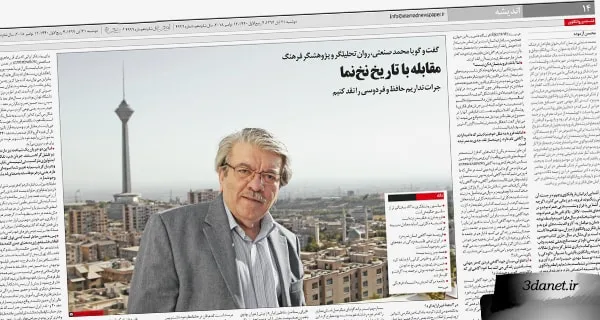
Mohsen Azmoudeh: Among Iranian readers and cultural figures, Mohammad Sanati is known less as a successful and prominent psychoanalyst than as a cultural critic and committed researcher in the fields of literature and philosophy, who, with a psychological perspective and approach, re-examines our intellectual and cultural heritage, and in this endeavor, he is not one for pleasantries or flattery. He is one of the most influential figures in Iran who, through his articles, lectures, dialogues, and writings, has played a significant role in clearing the dust from Freudian thought and the psychoanalytic intellectual current, especially as in important works such as Sadegh Hedayat and the Fear of Death and Psychological Analyses in Art and Literature, he has strived to go beyond mere introduction and translation of Freud's ideas and, by utilizing Freud's ideas and thoughts, has analyzed Iranian culture, history, and thought, particularly in the works of Iranian writers, artists, and thinkers. The occasion for the present conversation was the publication of several new translations of Freud's works, and initially, the discussion began with the topic of the relationship between Freud and philosophy. But very soon during the conversation, I realized that instead of this topic, it would be better to address the more serious and fundamental issue of philosophical thought in contemporary Iran. Dr. Sanati made important points in this regard and, with his psychoanalytic approach, delved into the roots of certain intellectual tendencies in contemporary Iran.
- It has been a long time since Iranians became acquainted with psychoanalysis and its prominent figure, Sigmund Freud. Although this acquaintance has been accompanied by ups and downs and, in the early decades—at least—was accompanied by distortions. Fortunately, in recent years, thanks to the attention of translators and authors to the works and ideas of Freud and the psychoanalytic intellectual current, the degree of misunderstandings has diminished. For example, this year, his book Moses and Monotheism has been reprinted in a translation by Saleh Najafi, and another book containing a selection of his articles on clinical psychoanalysis, titled A Child Is Being Beaten, has been compiled, translated, and published by Mehdi Habibzadeh. Our discussion is dedicated to the relationship between Freudian psychoanalysis and philosophy. Freud's concern in the late nineteenth and early twentieth centuries, which was the era of the dominance of the discourse of modern science, as we know, was that the result of his efforts be recognized as scientific work, and for this reason, despite deep philosophical veins, he did not emphasize the connection of his work with philosophy. While we know he had a deep acquaintance with philosophy and also had a fundamental impact on the philosophy that came after him. First, I would ask you to outline for us the philosophical context in which a thinker like Sigmund Freud emerges and appears? From what philosophical background does Freud arise?
Sigmund Freud was first and foremost a neurologist and a scientist; he authored scientific papers, and it was through his studies in these fields and his work with physicians such as Breuer and Charcot that his attention turned to the treatment of “hysteria.” It was as a result of these very studies that he arrived at the discovery of the unconscious. Freud’s aim, therefore, was scientific and clinical—that is, by discovering the unconscious and founding psychoanalysis, he sought to advance his discourse on a scientific basis. He also took a serious interest in applying this science to treatment in clinical work, just as, after him, a major part of psychoanalytic work has been devoted to clinical treatment. The path I have taken in the field of psychoanalysis in Iran has, to some extent, followed a similar shape. That is, part of my work has been devoted to applying the psychoanalytic perspective to art, literature, myth, history, culture, and so on, while another part of my efforts has focused on clinical work and bringing psychoanalysis into the academic sphere. But regarding the philosophical context in which Freud began his work, it can be said briefly that Freud was a child of modernity. Thus, what influenced Freud was the philosophy of modernity and the Enlightenment. The basis of this thought was Cartesian thinking, in the sense of the separation of mind and body. Under this Cartesian view that the human mind is a conscious mind, Freud also raised the issue of the unconscious. That is, he said that Cartesian consciousness remains in its place, but human behavior arises from unconscious motivations. Freud went so far as to say that the greater part of human behavior is the result of unconscious motivations. Therefore, one of the philosophical underpinnings of Freud’s thought is Cartesian thinking. But another branch of thought that later influenced Freud is Darwin’s ideas, which come from biology and the philosophy of evolution—that is, the view that humans, in any case, have a history to which they must pay attention. On this basis, psychoanalytic thought is a historiographical mode of thought. In other words, psychoanalysis’s return to human childhood and infancy, progressing with the individual along this path, and looking at the course of their life’s development and their relationships with others, is a historiographical or, to put it more clearly and better, a biographical approach. This biographical approach in psychoanalysis is, I believe, influenced by Darwinian ideas that have impacted philosophy. But more than any other philosopher, perhaps the ideas of Schopenhauer and Nietzsche influenced Freud. In addition, Freud himself was very interested in philosophy, attended philosophy classes, and was interested in philosophical issues in the domain of the mind, which is why he attended the classes of Franz Brentano (the German philosopher and psychologist, and teacher of Edmund Husserl). At that time in Germany, phenomenological philosophy was developing, and one of its prominent figures was Brentano, who wrote the book “Descriptive Psychology.”
- You called Freud a child of modernity. But we know that, alongside figures like Nietzsche, Darwin, and Marx, he is among the founders of a serious critique of modernity. In this sense, can he be called a wayward child?
No, I do not accept that characterization. The critique of modernity is part of modernity itself. The basis of modernity is rationalism, objectivity, a scientific view of this world, and also the issue of human will. On this basis, modernity has critiqued itself from the beginning. Critiquing modernity does not mean opposing it. So these three were all dutiful children of modernity who critiqued it within the very theoretical framework of modernity.
- But isn’t Freud’s critique foundational?
Yes, its foundational nature lies in its confrontation with Descartes. The grounds of modernity begin with the Renaissance (15th and 16th centuries AD) and reach the Enlightenment (17th and 18th centuries AD) and philosophers like Kant. In the early 19th century, we witness the formation of Romanticism and Idealism. But Romanticism and Idealism cannot be called anti-modernity. Of course, these intellectual currents are completely different from the Enlightenment, but when we consider them as a whole, they fall under modernity. Can one say that Hegel is anti-modernity? He is the greatest idealist philosopher.
- But Freud’s critique of autonomous human reason, which claims total will and consciousness, lays the groundwork for a serious critique of modernity.
That is not the case. In one of the books I am due to publish, I address myth-thinking and reality-avoidance, and I have dealt with this very issue: that Freud addresses consciousness and says it is something self-evident. Whereas today we know that self-consciousness is not self-evident. Many contemporary physicalist philosophers have challenged consciousness and self-consciousness. They even try to eliminate it from scientific vocabulary. But what Freud calls into question is not the principles of modernity, but Cartesian thought. Cartesian thought should not be equated with modernity. It is true that the foundation of science after Descartes is largely based on Cartesian thought, meaning its basis was self-consciousness. Therefore, what Freud strikes a blow against is the belief in human self-consciousness. We still hold this belief, even though we are not very modern and largely live in a traditional, pre-modern society. Yet, there is still a belief in our society as if a person is aware of everything about themselves. If you ask an illiterate person now, they will say, 'I know everything about myself.' Do you know anyone who says they don't know?!
- Is there not a difference between the self-consciousness of an individual living in a pre-modern world and the self-consciousness Descartes speaks of?
Yes, there is. But my discussion is about the belief in this self-consciousness, and that the pre-modern human perhaps also held such a belief that they possess consciousness. We rarely encounter philosophers and scientists who say, 'I do not know.' Of course, there are some, for instance, the famous expression, 'My knowledge reached the point // where I knew that I am ignorant.' But this understanding was not a general matter. The public thought they knew and were aware.
- And you believe that Freud criticized this general understanding?
Yes, Freud struck a blow against human self-consciousness. Just as Darwin struck a blow against human superiority, and Copernicus questioned the centrality of the Earth. These were common beliefs at that time, although they were also the pseudo-scientific myths of the age. Freud himself says that all three struck a blow against human 'narcissism,' the idea that humans consider themselves the center, the best, and the highest. Introducing the unconscious into the mind falls under the critique of Cartesian thought. Otherwise, did this very issue of the unconscious not exist in some form in the philosophy of the Idealists or the Romanticists of the early 19th century? Schopenhauer believed there was a blind spot, and one of Schopenhauer's students was the German philosopher Karl Robert von Hartmann (1842-1906). In 1869, he wrote the book 'Philosophy of the Unconscious.' Therefore, even the term 'unconscious' was coined before Freud.
- Considering what you said, what then is Freud's importance?
In the late nineteenth and early twentieth centuries, philosophy had lost its former importance. For philosophy to tell science what to do or not to do no longer held its previous significance. Therefore, raising the issue of the unconscious by a philosopher like Hartmann was not very important. Philosophy gained more importance in the second half of the twentieth century. In Iran, too, a kind of philosophomania has emerged in recent decades...
- What do you mean? That Iranian cultural enthusiasts read a lot of philosophy?
No, a kind of pseudo-mystical philosophy, which is wisdom-like, is read. Even the existentialist and phenomenologist Heidegger is read with a Fardidi-mystical reading. But it is from the 1990s onwards that first-hand philosophical books have been translated, and people read much more philosophy. Previously, such an inclination to read philosophy did not exist in Iran. Before the revolution, philosophy was confined solely to the philosophy department at the University of Tehran or the Philosophy Association. Others who studied in other fields had no inclination to read philosophy; even reading philosophy was not considered a merit for those working in traditional seminaries. Perhaps the same situation existed in Freud's time...
- Dr. Sanati, you have raised a very important point, so much so that I believe its significance far outweighs the discussion of Freud and philosophy. For this reason, and with apologies to you and the readers, I would like, with your permission, to pursue this last topic. You mentioned that it is only in the last one or two decades that Iranians' attention to philosophy has flourished. My analysis of this matter up to now has been that this post-revolutionary turn to philosophy might be attributed to the trauma of the revolution—that is, the blow the revolution dealt to the Iranian consciousness and psyche. In other words, the shock of the revolution gave rise to a kind of self-awareness within the Iranian conscience, posing the question on a philosophical level: how did we become what we are, what is happening in the world, and so on. That is to say, one could argue that the Iranian mentality became aware of its philosophical void and turned to philosophy to understand what had occurred. Do you accept this assessment? Can this psychoanalytic explanation be offered to justify the public's embrace of philosophy over the past three decades?
You raised an important point. Yes. Of course, I think this trauma occurred before the revolution. That is, the trauma begins right in the philosophy department of the University of Tehran, or even much earlier, in the Qajar era, which I will touch upon. In a recent conversation I had about the crisis of intellectualism in universities, I addressed this issue. Developments took place in the 1940s, after the Allied occupation of Iran. The academic and university developments of modern Iran had occurred in 1934, that is, the second half of Reza Shah's government, which had been established ten years earlier. The modernization advances, which had begun rapidly and with remarkable acceleration to achieve their goals, were interrupted by the Second World War and then the occupation of Iran. After September 1941, the country's situation was chaotic, and intellectuals, as in every period of failure, were searching for direction, connection, and identity! And in this context, two lines of thought emerged. One of them is the Marxist-Leninist line of thought, represented by the Tudeh Party, whose roots are evident from the Reza Shah era and which had widespread and prominent influence among Iranian intellectuals and the educated. The Tudeh Party even got people reading books, but readers whose approach had to be from the perspective of Marxism-Leninism and Stalinism. The formation of the second intellectual school begins in 1945 with Henry Corbin's important lecture on the philosophy of Illumination and its relationship with Iranian mysticism and the ancient beliefs of pre-Islamic Iranians. This lecture, in my opinion, is very important because it presented, in a different way, the desire for antiquarianism that had been strengthened during the Reza Shah period. This antiquarianism reinforced a kind of 'Iranian' narcissism in the face of the very intense humiliation that had emerged during the Qajar era. During the reign of Fath-Ali Shah, Iran's successive defeats by the Russians and then the confrontation with the West occurred, and Iranians suddenly became aware of how backward they were! An illiterate, poor society, grappling with disease and death, backward and stagnant, heading towards decay. The Constitutionalist intellectuals and even some Qajar kings like Fath-Ali Shah and Naser al-Din Shah tried to bring European culture to Iran. There was this desire to repair that humiliation, which antiquarianism compensated for to some extent. This is the psychoanalytic understanding of the humiliation and shame that occurs in the individual and society after catastrophic events. That is, if we have now fallen from the horse, we were once a great empire and dominated the whole world and had great kings like Cyrus and Darius. That is, we had great cultural, social, and political records, and a rich history backs us up, a history that, of course, has always come to our aid in times of crisis. Of course, this form of antiquarianism cannot be attributed solely to the Reza Shah period. This was the need of a people who had been severely humiliated and felt inferior. They had suddenly awakened and realized they had fallen behind the entire world. In relation to this desire to repair the humiliation and devastating shame, they had to strive to rise again. Mirzadeh Eshghi wrote the 'Opera of the Resurrection of the Kings of Iran' before the Pahlavi era with this very aim. Part of this repair of humiliation, however, took place during the Reza Shah era, both through this kind of return to the myth of kings and the glorious Iran-Shahr, and through the process of modernization. That is, within 16 years, society achieved accomplishments unprecedented in our history of the past several centuries. That is, since the Mongol era, we had nothing in the fields of economy, politics, science, and industrial infrastructure and modernization. What was done in this period is astonishing. I am not concerned that the intellectuals of the 1940s onwards denied all of this. Of course, recently we see that these actions have become apparent to them, and they are gradually freeing themselves from those historical myths. Indeed, where were the intellectuals, and what view of history did they have that they could not see these differences?! In any case, my point is that when Henry Corbin raised the relationship between the philosophy of Illumination and ancient Iran, it was as if everyone suddenly found what they had lost, because after that we saw that interest in Corbin increased. Henry Corbin had a great interest in Iranian mysticism and conducted valuable research in this field with enthusiasm and passion. It was he and his teacher Louis Massignon who introduced Hallaj and many past Sufi masters to the world, and likewise, Corbin's valuable works include the classes of Sufis and the people of chivalry and the javanmardan. The value of Corbin's research in the field of Islamic mysticism is undeniable, although this research sometimes became sentimental because Corbin himself was a Christian mystic.
بگذریم، درست است كه عرفان در خانقاهها وجود داشت و بین مردم كوچه و بازار و اهل زورخانه و قهوهخانه ارزشهای عرفانی شناخته شده بود و مردم با آن زندگی میكردند. فرقههای عرفانی و سلسلههای صوفی متعددی نیز وجود داشت. اساس فرهنگ ما هم كه به قول داریوش شایگان شعر بوده است و طاق و رواقش در زمان حافظ ساخته و تكمیل شده و اگر بخواهیم فرهنگ هزار سال گذشته خودمان را جمع و جور كنیم و ببینیم بیشترین فرآورده فرهنگ و جامعه ما چه بوده، میبینیم كه شعر و عرفان مهمترین تولید یا «سهم آورد»(contribution) فرهنگ و تمدن ایرانی است. در این تردیدی نیست. ولی با انقلاب مشروطه و رویارویی ایرانیان با فرهنگ فرنگی كه اساسش مدرنیته، یعنی خردورزی و شك و واقعیتبینی و گفتمان انتقادی بود، فاصله تحصیلكردگان با عرفان زیاد شد. چون عرفان اساسش، تجربه شهودی، یقین و ایمان و گریز از خردورزی و عینیت به معنای مدرن آن بود بنابراین كم كم از تاثیر تجربههای صوفیانه بر روشنفكران كاسته شده بود. گرچه هنوز به اشعار فارسی دلبستگی داشتند ولی تلاش میكردند، آن اشعار عرفانی با محتوای ملكوتی را به زبان زمینی تفسیر كنند! كما اینكه هنوز هم چنین تمایلی بسیار رایج است. اما كاری كه هانری كربن میكند این است كه عرفان را از سطح عمومی به سطح تحقیقاتی(scholarship) و دانشگاهی(academic) برمیكشد. بنابراین بخش دیگری از روشنفكران ما جدا از آنها كه چپ بودند و دور و بر ماركسیسم لنینسم و استالینیسم گرد آمده بودند، حول و حوش هانری كربن و فلسفه اشراق گرد آمدند.- Was there also a confrontation between these two currents?
Yes, the thought that Henry Corbin was strengthening stood, in a way, in opposition to that Marxist current. That is, just as Marx said “Workers of the world, unite,” Henry Corbin said “Orientals of the earth, unite.” In this way, it was as if these two currents confronted each other as two ideologies. Even though we know that none of the followers of these two schools accept the ideological nature of their beliefs in the sense of being dogmatic beliefs! In any case, Henry Corbin posited an Eastern identity possessing spirituality and morality against a modern Western identity that had been emptied of morality and spirituality. So, Corbin’s circle was in search of a lost spirituality that humanism and modernity had severed from Western Christian culture, and the West was caught in a state of estrangement for which Corbin found the path to salvation in the Philosophy of Illumination.
- Could it be said that another meaning of this confrontation was that in leftist thought there was egalitarianism and a striving for uniformity, whereas in the Iranshahri thought that Corbin emphasized, that hierarchical outlook, with the ideal king at its apex, still persisted?
Yes, that is exactly right. In that lecture, he emphasizes myths such as Kay Khosrow. From his perspective, Kay Khosrow is the ideal king. Another important point of emphasis for Corbin, which captivated and mesmerized the intellectuals of that time, was his saying that where Heidegger reaches a dead end, Suhrawardi begins. This is very attractive for an Iranian intellectual who, for centuries, had no “contribution” to modern civilization. Someone from the West comes and introduces Suhrawardi as the one who opens a way out of the dead ends of Heidegger’s thought. Thus, one can see why Corbin held such great appeal, and as a result, many intellectuals gathered around Corbin, initially in the Philosophy Department of the University of Tehran, and in later years, with the presence of Fardid, then Seyyed Hossein Nasr, and others, it reached its peak of flourishing in the 1960s. That is, a kind of Corbinism took shape in opposition to Marxism, a Corbinism that sought a singular identity, a singular Eastern identity or a singular Iranian identity that had to stand against the West and modernity. Ultimately, from its heart emerged the Westoxification and anti-modernity thoughts of the 1960s, and the return to oneself and what one already possessed, and Asia against the West.
- But these two currents also share a similarity. That is, both are reductionist. The leftist current reduces thought to a Marxist-Leninist ideology, and the Corbinist current (in your terms) has a regressive aspect. Meaning, in both, philosophy in the sense of critical thought is absent.
That is precisely the case. I mentioned that both have an ideological nature, and ideology prevents critical thought and blocks its path. Everything is pre-fabricated and pre-thought; of course, one’s basis is scientific, and in the other, the mythical structure is very prominent, but in both, critical thought is rejected like heresy in religion. Although in both, criticism of the other and the outsider is the most important tool for attracting followers. But as I said, none of the followers of these schools and doctrines accept the dogmatic nature of their own beliefs.
- So it is for this reason that one can say we did not have philosophizing in the serious sense of the word before the revolution.
Yes, but in any case, the Iranian Institute of Wisdom and Philosophy and the Philosophy Department of the University of Tehran were established before the revolution. Even the imperial system, particularly through Farah, paid attention to philosophy in the sense of Islamic wisdom and mysticism, with her favored philosopher being Seyyed Hossein Nasr. Seyyed Hossein Nasr was everywhere and was very influential culturally. It was not just that he eventually became the head of Farah’s office. Before that, he was the president of Aryamehr University and held other positions, and had a very prominent presence in all cultural and educational organizations and throughout Iran’s higher education system. In fact, the most important cultural architect of the 1960s and 1970s in Iran is Seyyed Hossein Nasr, under whose patronage the others operated. He was the link between Allameh Tabatabai and Henry Corbin, and in his recent interviews, he points to aspects of his support for the active intellectuals of that time.
- But philosophy was not critical in nature.
That is certainly the case. Because Seyyed Hossein Nasr is a deeply conservative Islamologist. He was the mastermind of the philosophy department at the University of Tehran. Seyyed Hossein Nasr himself was a person who was also influenced by Corbin. Fardid was the same. The rest were as well. Even Dariush Shayegan was someone who, after the revolution, fundamentally revised his thinking and, in my opinion, contributed greatly to strengthening that kind of outlook which seemed philosophical but was in fact not philosophizing and was more akin to theosophy and mysticism. That perspective was essentially a kind of Islamic mysticism plus a kind of Orientalism. That is, they believed that identity is "fixed and unitary," as if at some point in time an Iranian identity existed like a Mendelian gene that is immutable. As if we could be the same as we were in the time of Cyrus. Whereas change and dynamism are part of identity. Can one imagine a child who is born not changing by the time they reach my age? Now consider this transformation over the course of history. How can it be said that we have had a single, unitary identity? Where has this unitary identity been and where is it? Besides, is a unitary identity even a positive thing? We have fought so many wars with the peoples of the world and, based on our history, made conquests, interacted with other cultures, took from them and gave to them, intermarried, and mixed generations emerged. Arab culture, Turkish culture, Mongol culture, and so on have influenced us. How can it be said that we still have a unitary identity? Yet the pre-revolution intellectual imagined it this way and was in search of this pure, unitary essence! On this basis, your statement is entirely correct that it was a kind of pseudo-philosophical notion in which a type of Indo-Iranian mysticism was present, and everyone was searching for that Eastern essence. "Mother India" is repeated frequently in the writings of Al-e Ahmad. Of course, roots and origins are important. It is certainly important that we know our cultural past and be aware of how much we have been influenced by, for example, Hindu culture, or by other cultures, and what we have given them. But not everything is the root; the trunk, branches, blossoms, and fruit are also important. At that time, attention to roots had become a global phenomenon.
- You said that this awareness did not exist among those who engaged with philosophy in that era. Yet in writers like Sadegh Hedayat, we see that while he is aware of the origins of Iranian identity, he is also not oblivious to a critical view of it.
As it happens, I chose Hedayat precisely for this reason. Hedayat has two intellectual periods, though one might say three. His first period continues until the years 1933-34. In his first period, he too is part of the antiquarian group. Influenced by figures like Zabih Behrouz, Pirnia, and Pourdavoud, he writes books such as Maziyar, Parvin, Daughter of Sasan, and The Tale of Aniran, among others. In that period, scholars like Pourdavoud, Moghadam, Behrouz, and others conducted extensive research on the Avesta and ancient Iranian culture and were important and valuable researchers. Therefore, my intention is not to question the value of their work. But my discussion concerns the glorified belief in ancient civilization, which must be subjected to critique. Just as Westerners are not supposed to live in the time of Homer. Did Westerners accept to remain Platonists and Aristotelians forever? No, they used Plato and Aristotle, then subjected them to critique and built the philosophy of their own time. Therefore, that tendency to fixate us in the past, under whatever title it may take shape, must be criticized, whether it is called Iranshahri, or Corbinian, or whether we call it the Philosophy of Illumination, or the lifestyle of Cyrus the Great. I am a critic of any thought that seeks to fixate us in the past, deprive us of dynamism, and tell us that we are immutable and that immutability is good because it is pure and unadulterated. This claim of purism, essentialism, and essence-centrism must be criticized. They use attractive vocabulary to describe it, which is appealing to the youth. Whereas being pure and unadulterated is neither necessarily a reality nor desirable. Their essence-centric thoughts had led them to these beliefs.
- So you are saying that it was in the later period or periods that Hedayat became a critic of this antiquarianism.
Yes. From 1313 (roughly 1934 AD), that is, almost from the beginning of the National Socialist (Nazi) Party's rise to power in Germany, we witness this shift in Hedayat. In the book Eighty-Two Letters by Hedayat to Hassan Shahid Nura'i you discover that he was an inquisitive person. His advantage over his peers and in his own time was precisely this curiosity and intelligence. They were either mesmerized by Marxist ideology or inclined toward antiquarianism and mysticism. Some, like Mojtaba Minovi, Saeed Nafisi, Foruzanfar, and others, were engaged in literary research on the mystical heritage of the past. Of course, at that time, in the 1300s (1920s), Corbinism had not yet emerged, and Iranian intellectuals did not know what connection Illuminationist philosophy had to ancient Iran. Also, those intellectuals were not as curious as Hedayat. Whereas Hedayat, who had taken an interest in 'Iranian' and Aryan nationalism, suddenly, within a short span, noticed another kind of nationalism that was growing in the West and had many adherents in Germany. So he writes to his friend asking him to send books on the subject. In my view, it is there that he realizes what consequences might emerge from the heart of this antiquity-oriented nationalism. This is my analysis of Hedayat's transformation, and I believe that in this way we can explain Hedayat's almost sudden change; otherwise, understanding this intellectual metamorphosis becomes very difficult. All at once, he turns from a fierce, romantic antiquity-worship that was anti-Arab, anti-Mongol, anti-Turk, and so on, into a critic of 'Iranian' nationalism in The Blind Owl. I have pointed out in my book that, contrary to what some other analysts of The Blind Owl have imagined, this narrative is not about these 14 centuries; their analyses are largely a reaction to the last four decades and are mostly extra-textual and political analysis! Whereas Hedayat did not write that way. Symbolic and metaphorical references like 2 qeruns and 4 abbasis refer to history. That is, he is talking about 2,400 years and 2,500 years; he is not talking about 1 qerun and 4 abbasis so that I could say he means 1,400 years. Up to his own time, he sees this entire 2,400-year history as junk. Being junk, meaning the obsolescence of this frayed history. Hedayat's masterpiece was that he wrote a story whose very structure is mythical. The structure of the story The Blind Owl is mythical, but it is an anti-myth myth, a myth-killing myth. There you see that in parts of the narrative he attacks his own desert-wandering ancestors and such. One is astonished: three years earlier he was writing Maziyar and Parvin, Daughter of Sasan. What happened? In my opinion, that letter fills this gap. In this letter, he wants to know what will happen when nationalism moves from the concept of patriotism to extreme chauvinism. Hedayat committed suicide in 1330 (1951), at a time when the national movement was led by Mosaddegh. But he had developed such a problem with antiquity-oriented nationalism that I think he could no longer tolerate this type of nationalism. Therefore, both for this reason and because Hedayat saw the critical discourse as the path for Iranian society to reach modernity, he holds a special place among our contemporary intellectuals. Part of the critical discourse is scientific and philosophical critique, and another part is the critique of superstitious and mythical beliefs. Hedayat writes Neyrangestan. Although we know that Hedayat was very interested in myths, legends, and folk culture and knew that they must be collected, interpreted, and preserved, he also knew that we are not supposed to live by those legends; rather, we must preserve them, just as we must preserve objects in museums.
- Let us move on from Hedayat as an example of an exceptional intellectual who grasped critical thought. We no longer see such a figure. In the mid-1350s (1970s) we see figures like Shahrokh Meskoob and Mostafa Rahimi. Of course, one might say these figures also later became aware of mental idols. On the whole, as was raised at the outset, it was after the revolution that attention to philosophy flourished. But the question is whether this flourishing of attention to philosophy is not a kind of psychological solace-seeking, or is it a form of self-awareness?
In 2009, in a critique of the intellectuals of the 1960s, I said that we have a new generation of intellectuals who emerged after the war. You rightly pointed out that after the trauma of the revolution and the war, intellectuals suddenly realized that there was a problem, a deficiency, a lack in the thinking of pre-revolution intellectuals. Before the revolution, in the 1960s, I was a medical student, studying at the University of Tehran between 1963 and 1970. At that time, if a medical student read a philosophy book, it was considered beneath their dignity! Moreover, the philosophy books that were available were extremely limited and had poor translations; the works were usually third- or fourth-rate. We had very few new philosophy books that we could read in Persian. The intellectual of the 1990s and the new generation of intellectuals differ fundamentally from previous eras in this respect. First, they are aware of the intellectual shortcomings of the 1960s and 1970s intellectuals—intellectuals who believed in quasi-philosophical ideas, insisted on them with vehemence, acted upon them, and, under the umbrella of 'Westoxification,' harbored hostility toward the fundamental principles of modernity from which democracy emerged, and paradoxically, under the banner of advocating democracy, fought against despotism while themselves holding dogmatic beliefs! This was the intellectual predicament of the 1960s! In the 1980s, the university had been purged; some professors were forced into retirement at home, and others emigrated. But a number of the old intellectuals found their way to a new feast, which was a poisoned chalice. All these developments came together to give rise to a translation movement. I remember that in the early 1990s, I myself went to the Ministry of Culture and Islamic Guidance and obtained a publishing license. My intention was to translate first-rate books, and I entrusted the management of the work to my friend Jamshid Arjomand. He has since passed away, and I loved and still love him for his honesty. But in any case, he lacked the necessary drive for publishing. However, others who began working in those same years succeeded. Of course, initially many publishers were unwilling to print such works, saying these books had no readership and would not sell. But from the early 2000s, these works began to flourish, and a grassroots translation movement took hold and proved effective.
- Of course, as you said, the translation of these works had begun in the early 1990s. For example, Arghanun is a successful example in this field, or Nashr-e Markaz...
Arghanun was supported by the Ministry of Culture and Islamic Guidance and had nothing to do with the private sector. Nashr-e Markaz was also limited. Publishers like Ney also only emerged in the late 1990s. In any case, the seeds of this movement were sown in the 1990s, and first-rate philosophy books were translated and published. For instance, some works of Kant, such as the Critique of Judgment, were translated and published, and good translators like Rashidian, Ashuri, Fuladvand, Parham, and Badrei undertook the translation of philosophical works, while younger figures also turned to translation and translated works of postmodern philosophy.
- So a kind of philosophical self-awareness emerged?
In my view, it is better to say that in the 1990s and 2000s a kind of cultural self-awareness emerged regarding the sense that we had somehow not taken the right path. For instance, from the 1990s onward, Dariush Shayegan began to critique himself, writing works such as What is a Religious Revolution? and The Shattered Gaze, and subjected his own ideas to criticism. Or researchers and historians like Homa Nategh undertook a critique of their own historiography and that of their predecessors. All these events came together and gave rise to that cultural self-awareness from the mid-1990s onward. It was there that we gradually began to see shifts and transformations in the thought of intellectuals and cultural figures. I myself recall that when I returned to Iran in 1986 and endeavored to return to the fundamental question of Freud and psychoanalysis, I encountered very intense resistance. I became the head of Roozbeh Hospital and the director of the psychiatry department at the University of Tehran, and by rights I should have had the authority to introduce psychoanalysis into psychiatry, but it was impossible. Because there was resistance among psychiatrists, and in addition there was fierce resistance from leftists against psychoanalysis. Our left was still under the influence of Marxism-Leninism and Stalinism and would say that psychoanalysis focuses on individualism and is corrupt, and so on. On the other hand, under the influence of Dr. Shariati and his article on women, accusations had been leveled against psychoanalysis. Before the revolution, too, we were confronted with two readings of psychoanalytic thought—a political reading on one side and a mystical reading on the other—both of which were distorted. So whichever direction we tried to move in, there was a problem or we faced accusations. For this reason, after 4 or 5 years at the University of Tehran, I was deemed undesirable, and this view persisted until a few years before my retirement. Interestingly, they did not even dismiss me, and I do not know why! In any case, from those very first years after my return and facing resistance from the elite, I decided to bring psychoanalytic thought into the public sphere through the analysis of cultural products. Of course, I had long been very interested in cultural discussions; I had previously written theater criticism and so on. But when I returned to Iran, I was a psychiatrist, practicing psychotherapy and psychoanalysis, and I wanted this field to flourish. Because I thought this psychoanalytic perspective could give society another dimension and could foster a kind of analytical outlook. As you mentioned at the beginning, just as Westerners were able to critique their own culture by analyzing it, and it was from that critique that modernity and all the transformations of modernity and even postmodernity emerged, we too had to do this. Greek culture was under the influence of Homeric culture for 500 years and lived with it until the time of Socrates and Plato, when another period emerged; then came the period of tragedy, followed by the Middle Ages, then the Renaissance, then the Enlightenment, and so on. That is, they have passed through various periods. Yet they still critique Homeric culture. Do we dare to write a critique of the Shahnameh?! Do we dare to write a critique of Hafez?! No! Because the Shahnameh, the Divan of Hafez, and the Masnavi-ye Ma'navi are sacred to the Iranian people! Is that not so?! I must be able to say somewhere: why is it not possible to critically analyze the Shahnameh, Hafez, Rumi, and Attar? Our intellectual censorship is sometimes stricter than government censorship!
- Truly, no one dares to write a fundamental critique of these works.
When the Psychoanalysis Research Group was established at the Academy of Arts—though later, with the changes that occurred at the Academy of Arts, all these new groups were also dismantled—we nevertheless held a conference at the end, and at that conference I addressed the analysis of Kay Khosrow's vengefulness. I read my paper with fear and trembling. Because I thought that if I analyzed Kay Khosrow and his vengefulness, it would be perceived as my having called the Shahnameh into question. Whereas that was not the case. My point was that Ferdowsi was not merely a poet, but possessed a very profound cultural perspective and could reflect the culture of his time both sociologically and psychologically in the Shahnameh, and make us today aware of how people thought back then, that is, in Ferdowsi's time and among the Iranian people of his era, and what their cultural life and linguistics were like. What role did vengefulness and revenge play in that culture? This is one example. My analysis received no response. Respectfully, as is often the case, you are met with silence! My discussion was whether this perspective helps me, in this present time, to see whether this vengefulness still continues or not?
- Unfortunately, it does.
If our culture, in Dariush Shayegan's interpretation, is founded upon poetry, and in my opinion our poetry is founded upon mysticism, and Henry Corbin also says that Kay Khosrow is that ideal king, then do I have the right to ask why this perfect human being was so vengeful? And not only Kay Khosrow, but Kay Kavus and Fereydun are the same. That is, vengefulness exists in all three. One of these three even thanks God for giving him a "hyper-vengeful" child! Look at the word "hyper-vengeful"! (That from Iraj's seed, one renowned/ I see, hyper-vengeful, his belt bound) Today you read Max Scheler's book titled "Ressentiment" and you know what ressentiment means? In the same sense that Nietzsche also speaks of. But this ressentiment has had a persistent and tenacious presence in our culture; therefore, it is not enough for us to translate Max Scheler's book; rather, we must work on our own culture with attention to it. My point from the beginning has been that one part of our work is importing translations of first-rate modern works, and this is a very valuable endeavor. But our other important task is to be able to critique and analyze our own culture with the products of modernity and the modern perspective, one of whose forms is the psychoanalytic perspective. Who is supposed to analyze our culture? Nicholson? Henry Corbin? We ourselves must do this. If they do it, we will, of course, hold it in high esteem, but if Mostafa Rahimi and Shahrokh Meskoob do it, we beat them over the head. Of course, the work of Meskoob and Rahimi must also be evaluated and compared, and, for instance, the nature of their view of myth and the differences between these views must be considered. The nature of the view of myth held by Jalal Sattari, Mehrdad Bahar, Mostafa Rahimi, and others differs from one another. I have read and continue to read their works; therefore, one must read their works, hold them in esteem, and grasp their perspective.
- Now, more than two decades have passed since the early 1370s. That is, a quarter of a century has passed since that emergence of cultural self-awareness. In your opinion, what is the achievement of this cultural self-awareness?
In that same conversation I had with Mr. Sirus Alinejad about intellectuals, I stated that I am very hopeful about this new generation intellectual, that is, the intellectual who has grown since the second half of the 1370s. I have nothing to do with Iran's situation, which has fallen onto rocky ground. That is another issue and the result of another perspective. But the achievement we have from these very activities of the 1370s is very important. Of course, I myself began cultural analysis before the 70s, but analysis begins from this very context.
- Like the discussion of death-consciousness that you raised.
Yes, the issue of the culture of death is very important. A society that becomes this death-obsessed reaches a kind of cultural blockage. When I fear death, I try to do something to escape it. But there is a time when I become death-seeking. There is a time when I think that life on earth and earthly life is entirely illusion and ornament, that everything is absurd, everything is nothing, and relying on the saying that we should not be attached to what is perishable, we say that we should do nothing in this world. As a result, we arrive at this very backwardness. The modernity in which Freud was born and raised was a modernity that believed in the philosophy that humanity can change this world, and modernity did change this world. Of course, it partly destroyed nature. We can critique it. But we cannot ignore all this progress of modernity. We cannot ignore that the average lifespan in Iran sixty years ago was much lower than it is now, because one-year-old children no longer die. The state of health and hygiene has improved. These are the achievements of modernity, meaning science. These are not the achievements of death-obsession. Freud was raised in that era and, of course, possessed this critical thinking that allowed him to stand and critique the culture of his own time, and as a result, he wrote Totem and Taboo. He wanted to see how human culture could be understood from within myth. Naturally, we too must be able to arrive at a different, progressive culture from within our own myths and through their critique. Just as Freud relied on the philosophy of modernity and began from there, our point of departure can also be critical discourse and the philosophy of modernity. We are compelled to live in the modern world.
- And you believe that this has happened in this quarter-century?
Yes, I think two lines are in motion. One is the line that occurs in the realm of politics and economics. But there is another line that has been under the skin or on the skin—I don't know, I don't know its desirability or undesirability, I don't know whether it is insider or outsider, but I know that it has existed. Why are you, as a member of the young generation, here now? Why are you asking me? You know that I have been a critic of traditional culture. You know that I have been and still am an advocate of modernity, while also believing in the critique of modernity. I have written about Hedayat and I have written about Tarkovsky. I admire Tarkovsky's cinema. I truly love this cinema intensely from an aesthetic perspective. I have seen the film Nostalghia more than ten times. His film Mirror is very beautiful. But in that same book (Time and Immortality in the Cinema of Tarkovsky), you see that I critique his regressive gaze toward Slavic mysticism. I have a critique of his regression. I critique the fact that Tarkovsky praises the barefoot Slavic dervishes in Andrei Rublev or in Nostalghia. I critique Tarkovsky's apocalyptic view, which is present both in Nostalghia and, more intensely, in The Sacrifice.
- Of course, Tarkovsky also has Slavophile tendencies.
Yes, and it is entirely open to critique. Therefore, in my book, I have both praised Tarkovsky and critiqued him. But unfortunately, only one person from the Book House wrote a review of this book, and in it, they hurled all kinds of insults at me. The most important insult in that review was that they wrote the biggest flaw of Sanati is that he is scientific! Interestingly, that review also won the award for the best review of the year. This is a story we see in the early 1380s [2000s]. But fortunately, it is not like that now. Now those same books are read more. If the book Sadegh Hedayat and the Fear of Death had not been denied a publication license during Ahmadinejad's time, it would have been printed once a year and would probably be in its fourteenth or fifteenth printing by now. My other book, Psychological Analyses in Art and Literature, has also reached its seventh and eighth printings and is a kind of textbook in many places. The book Death (the final issue of Arghanoun) has also been printed many times, each time with print runs of 3,000 to 5,000 copies. It has been read more than expected.
- And you consider this reception a good sign?
Yes, in the book “Death” I tried to show how Western culture saved itself from the culture of death and turned toward life in modernity. You asked at the beginning in which philosophical context Freud was nurtured. He was nurtured in a philosophical context that was oriented toward life and the future. For this reason, the basis and foundation of Freud’s work became Eros. Thanatos (the death instinct) was added to his work in 1920, after the First World War. But for 25 years, the basis of Freud’s thought was Eros. I believe Freud took this Eros from Schopenhauer. The philosopher who proposed the concept of “will to life” (WILL TO LIFE) and in fact says the principle is the will to life. If we compare this with what happens in the culture of death, we see that in that culture, the principle is death, and it tells us we are in this world for another world. It is an otherworldly, apocalyptic view. As if this world is not God’s creation! This is a kind of Zoroastrian thinking that divided the world into the material and the spiritual, Ahura and Ahriman, light and darkness. It is this kind of thinking that later enters the philosophy of Illumination and Illuminationist wisdom. So if Freud entered the arena with scientific and philosophical backing and achieved a valuable outcome, we too must not fail to benefit from the backing of science and philosophy on our path.
.
.
PDF file of this conversation in the Etemad newspaper
.
.
Mohsen Azmoudeh in Conversation with Mohammad Sanati, Psychoanalyst and Cultural Researcher
Confronting a Frayed History | We dare not criticize Hafez and Ferdowsi
Published in the Etemad newspaper, pages 14 and 15, Monday, November 12, 2018
.
.


Discussion5 comments
بسیار عالی بود
بررسی فرهنگ براساس نگرش فروید! فردی دارای تواهمات ابطال شده که حتی بر اساس ساینتیزم و پوزیتیویسم مردود و نوشته های مالیخولی او بی معنی است! بایست دانشجو مطالعه ای در تاریخ و علم داشته باشد و تحقیق کند چنین افرادی که هستند و چرا به قرن 19 و 20 که تاریخ تعصب و فرهنگ نفرت در جوامع جهانی است روی می آورند. چقدر غیر علمی! چقدر متعصبانه! چقدر غیر معقول!
چقدر از متن شما من فهمیدم که گفته دکتر صنعتی غیر علمی! متعصبانه! و غیر معقول! است
من همیشه از نوشته ها و گفت وگوهای دکتر صنعتی لذت وافر برده ام. یکی از برجستگی های نگرش او در این است که رگه ها و گرایش ها را در هر مقطع تاریخی دقیق دسته بندی می کند و سپس به نقد و بررسی آنها می پردازد، بدون اینکه هیچ نوع قدسیتی برای کسی یا نگرشی قائل باشد و آنها را از دایره ی نقد بیرون بیاندازد.
«آیا ما جرات داریم که بر شاهنامه نقد بنویسم؟! آیا جرات میکنیم بر حافظ نقد بنویسیم؟! خیر! زیرا شاهنامه و دیوان حافظ و مثنوی معنوی برای مردم ایران مقدس هستند! » سال 1367 که سال بزرگداشت حافظ بود ، زیر عنوان « از حافظ بت نسازیم » ، دو بیت از سروده های او را نقد کردم ؛ همکاران فرمودند « هر کو بی هنر افتد ، نظر به عیب کند » و « گر خطا گفت نگیریم بر او » . در باره سهراب سپهری در کانال شاعران آشنا نوشتم که « پشت دانایی اردو بزنیم ، نام را بر گیریم از اشیاء ... » تبلیغ بی شعوری است ، گفتند جنبه های زیبایی شناختی شعر را نمی بینم و با بررسی مضمون و توجه به برآیند سخن ، « شعریت شعر » را از کانون توجه دور می کنم .باری ، پرسیدن دشمنی است و نقد همانا کشتار ؛ اما ابزار دهان بندی سخنوران داغ و درفش نیست .