Philosophy
Dual Approaches to the History of Philosophy in Conversation with Hossein Dabbagh: Philosophy Is Analysis, Not Imitation
Hossein Dabbagh distinguishes two approaches to the history of philosophy: narrating developments as a story, or critiquing ideas. He sees philosophy education in Iran as based on rote memorization, whereas in Europe the emphasis is on critical analysis; philosophy is analysis, not imitation.
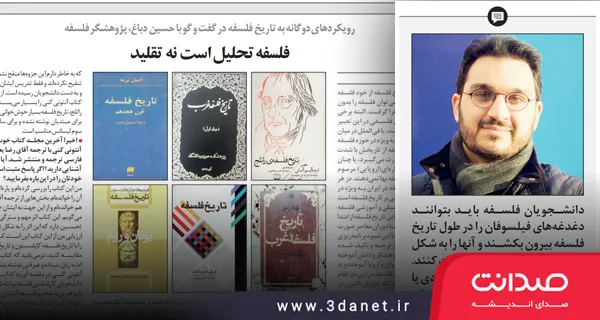
Dual Approaches to the History of Philosophy in Conversation with Hossein Dabbagh, Philosophy Researcher
Philosophy Is Analysis, Not Imitation
Kaveh Rahnamā
Etemad Newspaper; Issue 4849 – Monday, 6 Bahman 1399
It is famously held that the history of philosophy is inseparable from philosophy itself, and that one cannot learn philosophy without studying its history. Of course, certain philosophical currents and schools dispute this well-known interpretation; for instance, among a number of approaches, particularly within the analytic philosophy tradition, the separation of philosophy from its history is pursued with greater intensity, or, as is customary in the Continental (European) philosophy tradition, the history of philosophy is not given much weight. In any case, the teaching of philosophy in Iran, especially in universities, is largely based on the history of philosophy; that is, the academic and educational planning of philosophy for students is structured around the history of philosophy from its beginnings, namely ancient Greece, up to the contemporary era. Books and works have been translated and authored in accordance with this method of planning. Hossein Dabbagh, a researcher and graduate of philosophy, has studied philosophy in both Iran and Europe and is well acquainted with the methods of teaching philosophy in these two systems, especially as he now teaches and conducts research in philosophy in Europe. On the occasion of the publication of Anthony Kenny's A New History of Western Philosophy, we posed the following questions to him.
First, please tell us what the history of philosophy means from your perspective, and to what extent is it relevant and important for learning about and becoming acquainted with philosophy?
I look at the history of philosophy in two ways. First, I see the history of philosophy as a story, a scenario, or a screenplay that has elements and actors, who are the philosophers. These actors have played their roles throughout history and have departed, leaving a story written for us. Someone might look at the story itself, meaning the history and the historicity of this story is important to them—that is, where it began, what ups and downs it had, what ideas were proposed, and where it ultimately ended up. This is a perspective we might also have when reading a story or watching a film. The other view is to consider this same metaphor of a story or screenplay regarding the history of philosophy, but to think to yourself that you can detach certain parts of this story or scenario, independently and in isolation from the rest of the story, read them more carefully, extract their points, and, as the saying goes, dissect, break down, and ultimately critique the elements that shape this story. In contrast to the first view, which brings us closer to
About twelve years ago I experienced studying philosophy in Iran, and it is possible that the situation at universities has changed since then and I am more or less unaware of it. But what has stayed in my mind is that, according to the division I offered in answer to the first question, most of what was taught in universities under the heading of the history of philosophy by professors was based on the first approach—that is, as if we read the history of philosophy as a story: where it began, what transformations it underwent, and what end it came to. Generally, the focus is on what philosophers have said, and nothing more. But why philosophers said such things, or whether they were right or not, is not considered very important. Many of the questions professors ask students in their exams merely concern their memorization—that is, what a certain philosopher said. Even in our university entrance exam, most questions relate to memorized material from the history of philosophy, whether Western philosophy or Islamic philosophy. It rarely happens that, in a university class, a professor, while discussing the history of philosophy and laying out philosophers' views, asks students to evaluate ideas. My limited experience was such that even when a student asked their professor a question and criticized a philosopher's view, the professor would sometimes belittle and disparage the student, saying that they were not at a level to criticize that philosopher! I had the experience that professors showed little inclination for students to criticize ideas, as if the only issue was for students to memorize what had happened over the course of history. But critical evaluation of ideas, and dissecting philosophers' arguments and criticizing them in a logical manner, took place less often. It is possible that some professors at some universities where I was not present did this, but I personally did not experience such a thing.
Is the same method and framework used for teaching philosophy at European universities?
I have studied at universities in England, and my limited experience relates to this context. But even this much is completely contrary to what happens in Iran. Since I graduated in analytic philosophy, I must confess that this philosophical tradition does not have a very good relationship with "history," and mere history-reading is not much of a priority for it. In analytic philosophy, in my experience, the second approach to the history of philosophy is dominant—that is, you extract and isolate parts of this story and history, then independently extract, analyze, and critically evaluate a philosopher's view in a book or even a paragraph of their article. This is a skill a student must learn. In fact, when students are awarded a degree as a philosophy degree, the expectation of professors and the university is that students have acquired the skill of critical thinking. That is, first, they acquire the skill of reading texts, meaning that the student can read the original text of a philosopher themselves. This is while in history of philosophy books, others usually write about philosophers. Second, students must be able to extract and draw out the ideas of that text one by one. Third, they must critique and examine them. I prefer this second approach to the history of philosophy more—that is, the attitude that students acquire logical-philosophical skills. In my opinion, a student who earns a philosophy degree should not only be able to know the history of philosophy from beginning to end and have it memorized. Of course, this is a virtuous task, and it is good for students to know what thinkers have said throughout history, to put themselves in their place, and to know what went on in their minds. A student who graduates from university and bears the degree of philosophy must possess this skill of philosophical-logical thinking—that is, be able to analyze and break down ideas, not only throughout the history of philosophy but also to apply this skill in other domains. For example, they can use this skill in legal claims and logically analyze the assertions of individuals in court. A philosophy graduate can apply this skill in writing stories, screenplays, and even film criticism. This skill is cultivated when one does not rely solely on memorization and does not view the history of philosophy merely as a scenario to be read, but when we can also critique parts of it.
Frederick Copleston's voluminous, weighty, and classic book has become a textbook for philosophy students in Iran—a book that, alongside its merits and value, has not been immune to criticism. Alongside this work, other books such as Russell's History of Philosophy, Will Durant's History of Philosophy, Émile Bréhier's History of Philosophy, Mostafa Malekian's booklet on the history of Western philosophy, the Routledge History of Philosophy, Bryan Magee's The Story of Philosophy and the Great Philosophers, and others have also been translated and authored. Given your own familiarity with these works, what is your assessment of this body of work as a whole?
To take the master's entrance exam in Iran, I was obliged to read these works, and I can evaluate them to some extent. This evaluation is possible from two aspects: first, in terms of the work itself, and second, in terms of its translation. I will begin with Copleston's History of Philosophy: this book is a precise and readable work, and it is usable in English as well, although nowadays, at least I have not seen it being taught in universities. Of course, the universities where I have studied have emphasized consulting the works of the philosophers themselves. But in any case, Copleston is a usable work, although unfortunately, some of its volumes have not been well translated and are not usable. There is a good Persian translation of Russell's History of Philosophy, but compared to Copleston's book, it lacks the necessary precision. Even Anthony Kenny, in his own book on the history of philosophy, explicitly refers to Russell's History of Philosophy and says that it is a good book but imprecise. I agree with him. Especially where he evaluates Arabic philosophy or Islamic philosophy, his assessment is not very precise. He explicitly emphasizes that Avicenna and Averroes had no original ideas and are ultimately just commentators on Aristotle's philosophy. I agree with Russell that many Islamic philosophers were influenced by and commentators on Aristotle, and this is not a new or novel point, but the notion that Islamic philosophy is a footnote to Aristotle's philosophy and has no novel or original theoretical points is due to his unfamiliarity with Islamic philosophy. Bryan Magee's books are both good in themselves and have superb translations, especially since in Magee's books, an evaluation of philosophical ideas is also seen. Books like Will Durant's History of Philosophy are written for the general public and are, of course, very good for beginners, but students must certainly go beyond this. I have personally used the Routledge Philosophy book a great deal. Unfortunately, I have not read the translations of this book in Iran, but the work itself is very precise and is more recent compared to the other works you mentioned. Mr. Malekian's booklet, in my belief and by his own account, is a selection and summary of other existing works on the history of philosophy. In my belief, reading history of philosophy books like the works of Russell, Copleston, and Anthony Kenny makes studying Mr. Malekian's booklet unnecessary, especially since, as far as I remember, these booklets have not been edited, and he has not revised them himself; only his lectures were transcribed and reached the students. Among these works, I greatly admire Anthony Kenny's book; like the Routledge series, it is a very readable history of philosophy, although it is not written for beginners and is suitable for the second or third year of a bachelor's degree.
Recently, the latest volume of Anthony Kenny's good and newer book was also translated into Persian and published, translated by Mr. Reza Yaghoubi. Are you familiar with this book? If so, please share your opinion on it?
I have reviewed this book and read parts of its volumes. I have also read portions of Mr. Yaqubi's translation, and I commend him for his efforts. This is an important and monumental work, and it is praiseworthy that we have it in translation. My assessment of this book is that, firstly, if you compare it with Copleston's History of Philosophy and the Routledge History of Philosophy, you will find it to be a precise book, but it is not written in a simple, non-technical language. Anthony Kenny himself states in the introduction that this book is written for undergraduate philosophy students, and the reader needs some familiarity with philosophical concepts to be able to use it. In some discussions, I think it goes into depth, while in others it remains at the surface level. At times, he even writes about the private lives of philosophers and addresses their emotional lives. For instance, he has written points about the private relations between Nietzsche and John Stuart Mill. One of the attractive features of Anthony Kenny's book is that, while writing history, he also includes his own opinions. For this reason, it is as if in some parts of the book you are reading history, and in other parts, philosophy. For example, when he writes about Marx, he critiques him. It is clear that we can disagree with his view, but this is an engaging exercise. Kenny's views have, of course, been criticized and discussed by other philosophers; for example, his view on the gap between continental philosophy and analytic philosophy has been debated. He has seriously assumed a distance between continental and analytic philosophy in history. One might not accept this view. For instance, it can be shown that some philosophers whom Kenny assessed as analytic, such as Rorty, McDowell, and Putnam, have used the ideas of continental philosophers, and it is not the case that there is an unbridgeable gap between continental and analytic philosophy. In my opinion, Kenny (especially in the fourth volume) has not explained the views of some philosophers with sufficient strength; for example, he has not discussed the works and thoughts of J. L. Austin with vigor. Another attractive feature of this book is its thematic approach, which is seen in the fourth volume. In this volume, Kenny has brought discussions of philosophy of language, epistemology, philosophy of mind, politics, theology, metaphysics, philosophy of religion, and so on. Of course, it must be admitted that the Islamic philosophy section of this book is not very interesting. Although one cannot fault him, as he does not know Arabic and has not delved deeply into the views of Islamic philosophers, and as a result, the Islamic philosophy section of the book is very thin. But despite all the criticisms one might have of his selection of philosophers—which is, of course, inevitable and seen in every history of philosophy book—his book is very useful, and philosophy students, in particular, can benefit greatly from it.
Finally, I would ask you to offer your own suggestion for teaching the history of philosophy in Iran, considering your experiences and the existing works.
I agree that philosophy students should read the history of philosophy as history and have its content memorized to some extent. Knowing what philosophers have said and the ups and downs of the history of thought is, on the whole, very insight-enhancing. But this is not enough, and I believe that the critical evaluation of philosophers' views is among the duties of those who study philosophy, especially philosophy students. Philosophy students must be able to extract the concerns of philosophers throughout the history of philosophy and express and critique them in a clear, explicit, and logical manner. This task, which can be called critical thinking or critical thought, is one of the serious skills every student of philosophy must acquire. Currently, many translations of history of philosophy books have been published in Iran. I prefer histories of philosophy that are thematic. The history of philosophy, especially in the recent era, has become more thematic, meaning you can go back and reread the history of philosophy under various subjects and different titles such as religion, ethics, politics, and so on. This thematic view trains the mind. Other new books have also been translated in Iran recently, such as the book by Nigel Warburton and David Edmonds, which is, in a sense, a narrative of philosophy but accompanied by criticism and evaluation of philosophers' views. In the tradition of Islamic philosophy, Peter Adamson's book, in particular, is a very good work that has a more analytical view of the history of Islamic philosophy compared to older works, and I favor this analytical view because it is not just narrative; parts of criticism and evaluation are also present in it.
Students of philosophy must be able to extract the concerns of philosophers throughout the history of philosophy and express and critique them in a clear, explicit, and logical manner. This task, which can be called critical thinking or critical thought, is one of the serious skills that every student of philosophy must acquire. The history of philosophy, especially in recent times, has become more thematic, meaning you can go back and reread the history of philosophy under various subjects and different headings such as religion, ethics, politics, and so on.

Related articles
All articles Philosophy
Anthony Kenny's History of Philosophy in Conversation with Reza Yaghoubi: History of Philosophy as a Dialogue of Ideas
 Philosophy
Reza Yaghoubi on the Publication of Anthony Kenny's A New History of Western Philosophy: 'Philosophy and the Historiography of Philosophy'
 Philosophy
Anthony Kenny's essay 'Enemies of Academic Freedom'
 Religion
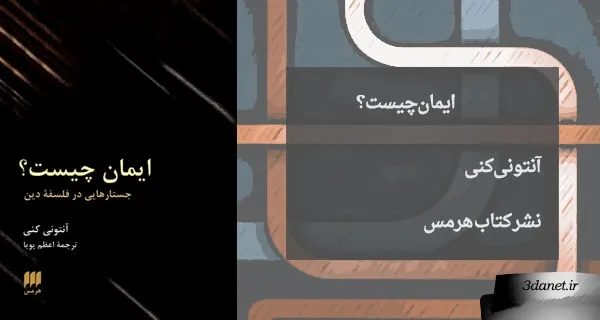
Introducing Anthony Kenny's What is Faith?
 Philosophy
Discussion0 comments
No comments yet; let yours be the first voice.