Philosophy
Mohammad Mehdi Mojahedi’s essay “Intellectualism and the Three Domains of Emancipatory Critique”
Intellectualism today is a three-dimensional space of critique: Kantian for emancipation from immaturity, Marxist in political economy, and Foucauldian in genealogy. This understanding prevents the conceptual anxiety of intellectualism or its vapid generalization to all professions.
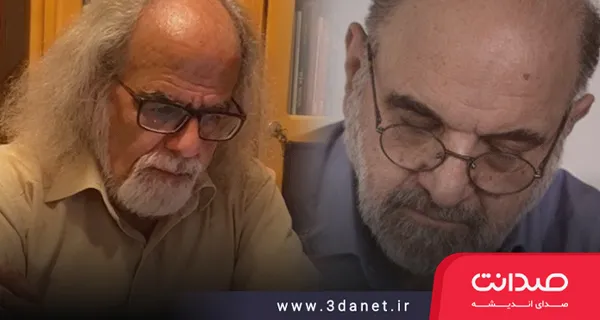
Intellectualism and the Three Domains of Emancipatory Critique
On the Margins of the “Intellectualism and Truth” Discussion
Mohammad Mehdi Mojahedi
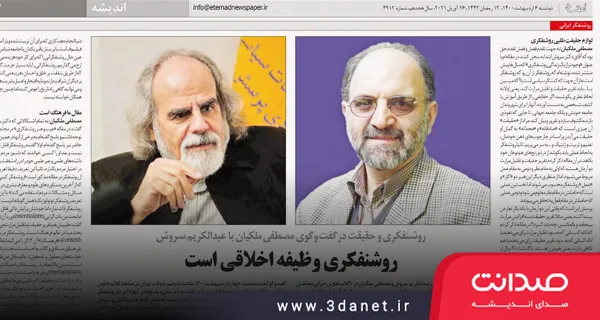
The public dialogue between Professor Abdolkarim Soroush and Professor Mostafa Malekian[1], which took place on 24 April 2021, hosted by the “New Perspective Circle”[2] in cyberspace, is a rare and powerful example of the kind of discussions and debates that, if they were to take hold, recur, and persist, even in virtual space, could truly breathe life and vigor into our frostbitten culture and politics; “until when will our metaphor become wedded to truth.”
The following note contains a brief exposition of one of the two points I raised during the question-and-answer session following the discussion between the two esteemed professors. I am grateful and appreciative of the kind attention both distinguished professors paid in the responses they added to this point.
Considering the history and genealogy of intellectualism in the modern era, it becomes clear that this title has referred, and continues to refer, to a variegated intellectual-political current that carries and engenders various levels of critique as the beating heart of the Enlightenment movement. This critique draws its life and substance from a doctrine that Kant first shared with us in the modern era. Critique, as Kant proposed, is an open, overarching, and reflexive endeavor to discover and eliminate error, an endeavor without which the human being remains in a state of “immaturity-minority” (Unmündigkeit), fails to attain the level of autonomy, and does not reach the threshold of self-governance. For Kant, imitation, dogmatism, rigidity, strictness, prejudice, immaturity, and bloodthirstiness are all the interwoven fabric of immaturity-minority that, in the absence of critique, ensnares and suffocates our humanity in the cocoons of custom and habit. This critique is the hallmark of the Kantian domain of intellectualism. This domain of intellectualism is the field in which an emancipatory tradition formed, gradually coalescing around this understanding of enlightenment and further developing with the ideal of political freedom in liberal thought.
This Kantian tradition was later refined in the hands of Marx, and through his theoretical efforts, the second domain of intellectualism was opened. Marx sought not only to discover and describe the conditions of possibility and the limits of the social, political, and economic realization of critique as an emancipatory act, but also to recommend and prescribe them. The seed he planted was fruitful and contributed to a Copernican revolution in understanding the mechanism of emancipatory critique. Before Marx, with Hegel, we had come to understand that emancipation requires the birth of the civil individual and the acceptance of the responsibility of civil-political ethical life (Sittlichkeit), and, contrary to the conception of the ancients, it arises neither from the anti-social individual morality of abstinence and salvation (Christian ethics and Stoic ethics), nor from the asocial Kantian morality oriented toward the ideal observer (Moralität). Marx taught us that emancipatory critique, as an act contingent upon social responsibility, and as the result of a commitment to the ethics of political-civil responsibility (Sittlichkeit), depends on the critique of the political economy of power. In other words, we learned from Marx that emancipatory critique, which is the beating heart of freedom, has conditions of a political-economic justice nature. Thus, the intellectual current after Marx did not abandon the ideal of Kantian enlightenment, but on this path, it stepped into a new phase, opened a new domain in the world of intellectualism, and showed that not every political arrangement and economic configuration sets the business of emancipatory critique in motion.
In the late modern and postmodern era, critique has entered a new phase, and thus, another domain has been added to the two Kantian and Marxist domains of intellectualism. In his body of work, including his rereading of Kant’s essay “What is Enlightenment?”, Foucault proposes that critique not only has an epistemological domain and an economic-political domain, but also a genealogical and archaeological domain that adds a new dimension to both prior domains of critique.
Thus, intellectualism today is a three-domain space of interwoven critiques that evoke and necessitate one another. Wherever we begin the business of emancipatory critique—from any of these three domains—the continuation of the path inevitably leads to the other two.
Emancipatory critique is the very constitutive axis that binds together the various domains and stages of the intellectual tradition. With this understanding of intellectualism, neither does the alleviation of suffering and the articulation of truth become entangled, nor does the increasing complexity and obscurity of truth in the postmodern era plunge the concept of intellectualism into anxiety. With an understanding of the three-domain process of intellectualism, we neither fall prey to arbitrary, a priori definitions indifferent to the history of intellectualism, nor do we stretch the scope and reach of this title so wide that it applies to most professionals, tradespeople, and practitioners, effectively becoming a redundant, superfluous, and vacuous concept, portable by all those whom neither they themselves nor others would call intellectuals, and whose work—from medicine, nursing, health and psychological counseling, and engineering to political and civic activism, university professorship, politicking, management, and journalism—is not called intellectualism. This three-domain understanding of intellectualism also avoids the vague and misleading distinction between culture and non-culture, which would equate intellectualism with the articulation of truth and the alleviation of suffering within the space of culture, while placing the articulation of truth and the alleviation of suffering in the domain of the body and nature outside the circle of intellectualism. With this three-domain understanding of intellectualism, we no longer find intellectuals to be cloistered retirees of the humanities faculties.
.
.
[1] Intellectualism and Truth, a conversation between Abdolkarim Soroush and Mostafa Malekian, 24 April 2021, New Perspective Circle (Watch on YouTube, listen on Anchor, Castbox, Download audio on Telegram)
[2] New Perspective Circle on Telegram, on YouTube
.
.



Discussion0 comments
No comments yet; let yours be the first voice.