Religion
Course: "Religion Through the Lens of Evolution and Cognitive Science," Taught by Hadi Samadi and Saeed Garmaroudi
How can religion be understood through evolutionary theory and the findings of cognitive science? By examining the origins and mechanisms of religious belief, the relationship of religion to rationality and morality, and the role of cultural and social factors in religion's persistence, this course offers an empirical, interdisciplinary approach to the study of religion.


Hadi Samadi
مدرس
Saeed Garmaroudi
مدرسThe course "Religion Through the Lens of Evolution and Cognitive Science" took an interdisciplinary approach to the origins, mechanisms and persistence of religious beliefs and behaviors, drawing on evolutionary psychology, cognitive science and cultural evolution. Beyond its theological and philosophical dimensions, religion was studied as a human and cultural phenomenon, one that can be understood only by attending at once to the workings of the human mind and brain and to the processes of evolution and cultural transmission.
The central focus of the sessions was an introduction to contemporary theories and research on how religious beliefs take shape, on the cognitive and psychological foundations of theism and atheism, and on the role of cultural and social factors in the spread and endurance of religion. Topics such as the relationship between religion and rationality, the relation of religion to morality, cultural evolution, and the influence of cultural differences on the varied forms of religiosity were also discussed and examined.
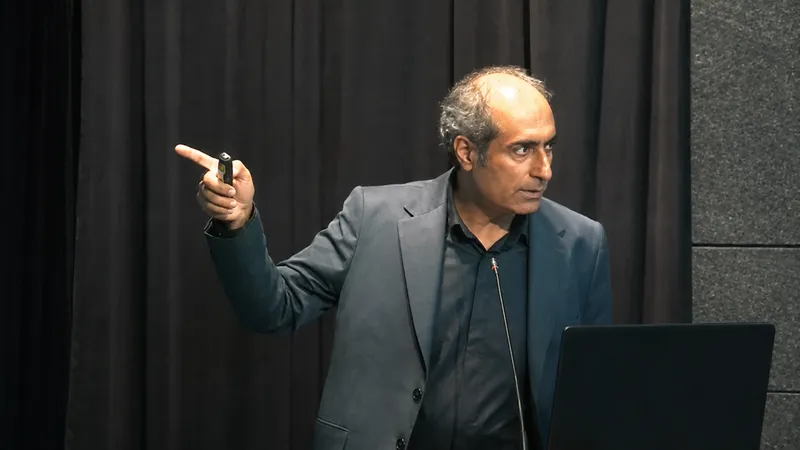
This course, the first in a two-part series, was organized around the book Disbelief: The Origins of Atheism in a Religious Species (Disbelief: The Origins of Atheism in a Religious Species) by Will M. Gervais. It ran for eight sessions and was taught by Saeed Garmaroudi, a faculty member in the Department of Psychology at Wesleyan University in the United States, and Hadi Samadi, assistant professor in the Department of Philosophy of Science at the Science and Research Branch of Islamic Azad University, Tehran.
The course was organized by the Center for Psychology and Religion Research at Shahid Beheshti University, the Psychology Scientific Association of Shahid Beheshti University, the House of Wisdom and Imagination and Rava School.
The course was held online, and offline access to the recorded sessions was also available. Over these eight sessions, participants were introduced to a number of the most important approaches and scientific findings in this field and studied the phenomenon of religion from an empirical, analytical and interdisciplinary perspective.
Session One: The Evolutionary Puzzle of Belief and Disbelief
Aims and preliminaries; an overview of the book, its author, and the interdisciplinary scientific background
Session Two: Common but Inadequate Answers to the Puzzle of Religion
Three common but inadequate views of religion: that it is purely genetic, purely cultural, or purely a prescription or product of childlike credulity
Session Three: Is Atheism More Rational?
The relationship among rationality, atheism and theism
Session Four: The Cognitive Science of Religion
Evolutionary and cognitive-science approaches, content biases, and the naturalness of religion
Session Five: Culture and Cultural Evolution
Cultural evolution, conformity with others, imitation of prestigious and knowledgeable individuals, and other learning biases
Session Six: Religion in Its Cultural Context
Symbols of the gods and the functions of religions, Mithras, survival, transformation, and in what ways Zeus and Ahura Mazda are alike and in what ways they differ.
Session Seven: Why Do Some Religions Endure?
The reasons for the durability and persistence of some religions, and the role of culture as an effective factor in group selection
Session Eight: Summary and Analysis
Summary and analysis, and an evaluative (conversational) look at the topics of the course









Discussion0 comments
No comments yet; let yours be the first voice.