Philosophy
How to Confront the Absurdity of Life
Thomas Nagel does not regard arguments from death or human insignificance as conclusive proof of absurdity; rather, he sees the sense of absurdity as arising from the conflict between the seriousness of our choices and the ever-present possibility of viewing them with detachment. Life does not require an endless justification.
Many of us, at certain points in time, feel that life is meaningless or absurd and fall into despair. We often provide reasons for life's absurdity and try to demonstrate that this is indeed the case. Thomas Nagel, the American philosopher, has examined this subject, and we will proceed to review his views.
When you consider life absurd and meaningless and want to do something, you will say to yourself, "So what?" After I die, say a thousand years from now, what importance will this thing I am doing now have? Besides, what importance could what happens to humans a thousand years from now have for me? Such statements uttered by a person who has arrived at absurdity are often related to time and place.
We are small and insignificant in the boundless universe; likewise, in terms of time, given the age of history, the duration we live in this world is very short and insignificant, and we could die at any moment. But the point is that these facts do not make our lives absurd. If a seventy-year life is absurd and meaningless, can you imagine how absurd and meaningless a life that had no end would become? Or if we were not so small in this boundless universe, or if we were very large in size and the universe were very small, how could we escape the absurdity of life?
In our lives, we work, earn money, make friends, buy houses, study, form families, and find jobs, but we all know that we will eventually die, so what is this life for? We strive so much and so much happens, yet in the end we die. However, it should be noted that our life is not a chain of events where the end of each chain connects to the beginning of another chain; rather, our life is sometimes composed of chains that are not connected to one another.
For example, when you have a headache and take a pill, or go to an exhibition to enjoy paintings, you do not need a justification to show these actions are rational; these actions are rational and therefore not absurd. Thus, rational justifications in our lives, in many cases, come to an end somewhere, and we do not need to continue seeking rational justification forever. For instance, when someone asks you why you go to look at paintings and you reply that it is because you enjoy looking at paintings, you no longer need to provide another justification for this action, and the rational justification ends with this answer.
Therefore, the meaningfulness of your visit to the painting exhibition does not require a definition or justification beyond the fact that you enjoy the paintings. Now, you might feel, regarding this example or other examples, that more justifications can be offered and thereby demonstrate the meaningfulness of those actions; nevertheless, these justifications end somewhere. If we were to find a justification for every action other than the action itself, we would end up in a vicious circle or infinite regress.
Arguments that emphasize the absurdity of life, in fact, incessantly ask us, "So what?" and expect that for every reason we give, there must still be a further justification. Arguments based on the absurdity of life make an inappropriate request; they tell us that the reasons we give for our actions are insufficient and that any reason or justification that ends somewhere is incomplete. It is as if the absurdist argument is not seeking a reason to be convinced that life is not absurd, but is merely seeking to negate any reason that we consider justified or meaningful. But if our reasons and justifications are never supposed to end anywhere, we fall into infinite regress.
Absurdity and meaninglessness occur in our lives when reality does not align with our level of expectation or the claim being made. For example, suppose a professional criminal is put in charge of a humanitarian organization, or someone professes their love to the recorded message of a telephone answering machine, or at an awards ceremony for a film festival the statuette breaks in the winner's hand. In such situations, we usually try to bring about a change in the circumstances; for instance, we might alter our level of expectation, or remove ourselves from that situation entirely. In such conditions, one can always think of a change that eliminates or diminishes the meaninglessness. The idea that life as a whole is absurd and meaningless occurs when we realize there is an asymmetrical level of expectation or claim regarding life. Of course, it cannot be denied that the lives of some people, due to their desires, the conditions they have, or the relationships they establish with other human beings, are absurd and meaningless, but the notion that life in general and from a universal perspective is absurd and meaningless is another matter. The feeling of life's absurdity arises because we take our lives very seriously, and yet there is always the possibility that we might suddenly view everything we consider serious and important as arbitrary and conventional, and doubt it.
We need energy and focus to live, and we must be able to choose, and in this way, it becomes clear that what we have chosen is of lesser importance compared to what we have not chosen. Furthermore, we always have the possibility of standing outside the world and human life, and from this standpoint, everything that happens in human life appears gratuitous and worthless. Therefore, we have two types of approaches to life. One is from within life, and the other is from beyond life, and when these two approaches conflict with each other, life becomes absurd and meaningless. Our life has two aspects: first, within our own lives, we must engage with life's affairs seriously, and the second aspect is that we cannot escape the doubts that exist in our lives.
We are all serious to ourselves and pursue a serious life according to our goals and interests, regardless of whether we seek fame, money, victory, beauty, knowledge, liberation, or mere survival. Human life is full of calculation, effort, planning, failure, and success, and each of us pursues our desires with a certain degree of energy and laziness.
We humans do not act solely on impulse; we think about what we want to do, weigh its consequences, exercise caution, and every so often ask ourselves whether what we are doing is worthwhile. Our lives are full of small choices connected to one another within a structure of limited time—that is, the lifespan of each human. We decide what tasks to undertake and what goals to pursue, with which people we want to spend time, and what kind of human being we want to be ourselves. In confronting the details of life, we expend a great deal of energy, take risks, and engage in weighing those very details. Each of us spends a great deal of time and energy on grooming, health, emotions, being useful in society, self-knowledge, and relationships with friends and family, regardless of understanding what the world is and what is happening in it. Human life is a full-time job on which each of us spends decades of our time, energy, and focus. At the same time, we have the possibility of looking at life from the standpoint of an omniscient being, and it is this perspective that simultaneously makes us aware and causes life to appear ridiculous.
As mentioned, justification and providing reasons for something being meaningful must end somewhere, but when we go to the standpoint of the omniscient being, we realize that our reasons and justifications are based on reactions and habits that we never question, and we cannot justify them except by going around in a circle, yet even after such considerations, we continue to repeat them.
We want a number of things without reason and do not demand a reason for some actions, and these matters are gateways to skepticism. When we look at ourselves from the standpoint of an omniscient being, we realize that the things we do are very trivial and no necessity can be imagined for them. When we look at life from the standpoint of an omniscient being, we notice that human life is very arbitrary and conventional, but this point does not prevent us from continuing life, and our absurdity and meaninglessness are defined precisely by this. We can look at life from the standpoint of an omniscient being while at the same time not abandoning our trivial activities.
Some try to escape the absurdity and meaninglessness of life by defining grand goals for themselves; these individuals often believe that the absurdity and meaninglessness of life result from small and insignificant goals. So this group of people thinks of a context larger than themselves and tries to define a place for themselves within it. For example, by dedicating all or part of their lives to society, the state, revolution, the progress of history, scientific endeavor, or religion, they seek fulfillment. However, it should be noted that the role we define for ourselves in a larger context can only give meaning to our lives if that context itself is meaningful, and its meaning is comprehensible to us; otherwise, it will not bring meaning to our lives.
Suppose there are a series of beings who raise humans to eat our flesh; this cannot give meaning to our lives. First, we are unaware of the meaningfulness of those beings' lives; second, although in this role we have, our lives might become meaningful for them, it is not clear how their lives would become meaningful for us. But being in the service of God, the state, a revolution, or a movement is different from this example. When we submit to something larger than ourselves, we feel that we are part of a larger thing and that larger thing constitutes a part of us, and therefore our role in this matter provides meaning for life. Although a person who believes in the absurdity and meaninglessness of life may not accept these larger matters and may demand reasons and justifications for them. Again, this person must be reminded that justification and reason come to an end somewhere; God, homeland, family, and friends are reasons that can give meaning to our lives.
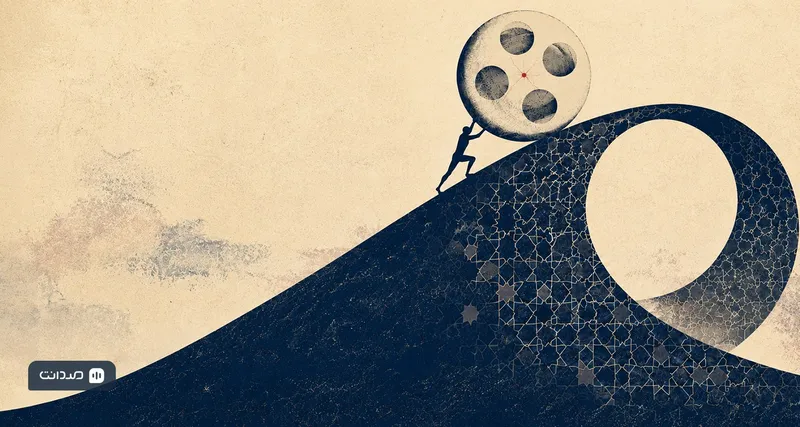
Albert Camus says in The Myth of Sisyphus that absurdity occurs because the world is incapable of answering our demand for meaning. This statement implies that if the world were otherwise, it could answer our demand for meaning. But this is not true; we cannot imagine a world in which we exist and deep doubts do not arise. Absurdity does not result from our confrontation with life but from our confrontation with ourselves.
We have the ability to stand in the position of an omniscient being and can look at life from that perspective, but standing in that position does not allow us to grasp the real or deep meaning of life and understand that the life we are engaged in is absurd and meaningless. Rather, the possibility of standing in this position highlights the point that if we were other beings with different abilities, or in other words, if we looked at the world from a position other than the human position, our lives would be different, and what we considered meaningful, serious, or valuable would change.
That we can say something is absurd and meaningless is only possible if we have a standard or criterion for seriousness and meaningfulness, and when something deviates from this standard and criterion, we can say that it is absurd or meaningless. But when someone wants to say this about the whole of life, they actually intend the philosophical sense of absurdity and meaninglessness; in fact, they want to tell us that there is no criterion or standard for the meaningfulness of life. This position is similar to the position of skeptics in epistemology. In both examples, our human intellectual limitations combine with the possibility of transcending these limitations, and this very fact fundamentally causes us to use the term "intellectual limitation."
When you look at a glass, how can you be sure that you are awake, that what you are looking at is a glass and not the illusion of a glass? These are the questions the skeptic asks us. Although his questions are legitimate, we cannot give convincing and decisive reasons in response. Instead, considering human life, our experiences, and natural history, we in fact point out that we cannot provide a justification or convincing reason for the skeptic, and he is simply forced to accept these reasons. Skepticism, like the absurdism mentioned earlier, does not cause us to stop living our lives; rather, it causes us to adopt a different attitude toward life.
As we continue our lives, we have the possibility of observing ourselves and thinking about ourselves, about the things we do, and looking at the totality of life. In this process, we watch ourselves like a stranger. Perhaps, considering this position of ours, we can understand why the absurdist offers arguments like those cited. These arguments are not strong, yet they are a kind of expression of feelings about the condition in which we can be observers of ourselves.
The moon or the life of a mouse are not meaningless or absurd. The moon makes no effort to orbit the earth and has no purpose. A mouse, despite having to struggle to survive, is not meaningless to itself because it lacks self-consciousness and cannot step beyond itself to observe itself in the totality of life and say to itself, "I am only a small, insignificant mouse." But if this mouse were to gain self-consciousness, its life would be absurd, because despite finding self-consciousness, it remains a mouse, and this new ability will not allow it to transcend the desires of a mouse. With its new self-consciousness, it must continue a life full of doubts and uncertainties it cannot answer, yet this life is at the same time one in which it has many goals it cannot abandon. Now, can we humans put an end to the problem of the absurdity and meaninglessness of our lives by abandoning the standpoint of the omniscient? This cannot be done consciously, because if we want to consciously abandon this standpoint, we must first affirm it, and every time we want to deny this standpoint, we in fact first affirm its existence. Therefore, we must either forget it entirely or never have acquired it in the first place, which does not seem possible. Another solution is, like some mystics, to be indifferent to our body, our desires, and our human affairs, and to approach as much as possible the standpoint of the omniscient, the standpoint from which human life appears meaningless and absurd. In this case, the person is not forced to engage in meaningless human life. However, it must be remembered that this kind of asceticism and austerity is also dependent on one principle, which is that the person takes themselves seriously. Although this type of life will also not be meaningful from the standpoint of the omniscient, in this type of life, transcendental consciousness becomes less involved in worldly affairs. And this itself is a kind of absurdity: to forcibly place a dissatisfied transcendental consciousness in the service of a small creature called a human being.
And the important question is: Is the absurdity of life a reason for suicide? Albert Camus rejects suicide and instead prescribes defiance and scorn. He believes that if we shake our fist at a world that does not listen to our demands, we can save our honor. This act does not redeem life from absurdity, but it grants it a kind of authenticity. Camus's approach is overly romantic and stems from self-pity. Absurdity is one of the most human of our characteristics, a manifestation of our most evolved traits. Like skepticism in epistemology, absurdity is only possible because we humans have the possibility of standing beyond ourselves and observing ourselves.
If the absurd allows us to perceive our real condition, why should we try to escape from our condition or be distressed? The absurd, like epistemological skepticism, is a result of human intellectual limitations, and these are not reasons for sorrow unless we decide to treat them as such. Nor is there any need to resort to dramatic reactions like Camus, for even if we perform these reactions in private, we have still contradicted ourselves. If nothing really matters, why should the very fact that nothing matters, matter?



Discussion3 comments
عالی بود متشکرم
بحث در مورد امور جزئی زندگی نیست بلکه بحث در باره کل زندگی است که باید هدفمند با اینده روشن ومستدل باشد. خالق انسان او را سر گردانی در تاریکی ها نجات داده است . باقی می ماند خواستن و انتخاب خود انسان.
بحث در باره امور جزئی زندگی نیست بلکه کل زندگی باید هدفمند ودارای اینده روشن ومستدل باشد.خالق انسان اورا از سر گردانی در تاریکی ها نجات داده است . باقی میماند خواستن وانتخاب خود او .