Art
15 Best Absurdist Films (Explorations of the Absurd, Meaninglessness, and the Contradictions of Human Life) You Shouldn’t Miss
This article introduces 15 outstanding films that explore the question of the absurd (the sense of meaninglessness that arises from humanity’s encounter with an unresponsive world) from various perspectives. From black comedy and satire to tragedy and surrealist cinema, these works portray the human search for meaning in a complex and sometimes irrational world.

In existentialist philosophy, the concept of the absurd (the sense of meaninglessness that arises from humanity’s encounter with a world in which it seeks meaning but finds no inherent or definitive answer) emerges from a fundamental conflict: human beings have a deep desire to find meaning, purpose, and significance, yet the world remains silent in response to this longing. Albert Camus, the French philosopher and writer, compares this human condition to the fate of Sisyphus in Greek mythology in his book “The Myth of Sisyphus”.
According to the myth, Sisyphus attempted to escape death by deceiving Hades. But after he was returned to the underworld, he was condemned to an endless punishment: he had to push a massive boulder up the slope of a mountain; yet each time the stone neared the summit, it rolled back down, forcing Sisyphus to begin everything again from the start. For Camus, the human condition resembles this fate: we are constantly trying to create meaning, achieve our goals, and understand our place in the world, yet we repeatedly encounter failure, repetition, and unanswered questions.
The concept of the absurd gained an important place in twentieth-century art and literature and became closely connected with existentialism. Writers such as Albert Camus, Samuel Beckett, Fyodor Dostoevsky, and Franz Kafka addressed this issue in their works and raised questions about the meaning of life, human identity, God and religion, loneliness, suffering, madness, and the social condition of humanity.
In absurdist stories and works of art, characters often find themselves in situations where they must search for meaning in a world that offers no answers and is sometimes irrational. Although the word “absurd” may initially evoke something humorous or strange, its meaning is not limited to comedy. The absurd can appear both in the form of satire and comic situations and in profound human tragedies. From dark and playful comedies to heavy and painful narratives, all can serve as ways of confronting this question: if the world has no predetermined meaning, how should human beings live?
In what follows, we introduce 15 films that explore the question of the absurd through satire, black comedy, tragedy, comedy, exaggeration, and other cinematic techniques; films that examine humanity’s endless effort to find meaning, success, and understanding in the world—a search that sometimes reaches no answer but continues nonetheless.
1. Zelig (Zelig) — Woody Allen, 1983

If you were to watch only one film by Woody Allen, it should be “Zelig.” Made in 1983 and starring Mia Farrow and Allen himself, the film tells the story of Leonard Zelig, a man whose shyness and inability to socialize are so extreme that, in order to be accepted by others, he unconsciously takes on the appearance and mannerisms of whoever happens to be around him.
In many of his quasi-intellectual New York films, Allen essentially plays himself, emphasizing his social anxiety and inability to fit in with others; but in “Zelig,” he goes a step further and turns his own introverted traits into a full-fledged satire.
With a firm comedic sensibility, the film adopts the mock-documentary format to recount the life of a man whose existence embodies the ultimate desire to blend in and be accepted—a desire that grows in many introverts. By pushing his chameleon-like self-mockery almost to the point of literal realization, Allen raises a fundamental question about identity: how important it is to discover one’s own identity, and how that identity shapes our relationship with others and with the world.
2. Songs from the Second Floor (Songs from the Second Floor) — Roy Andersson, 2000
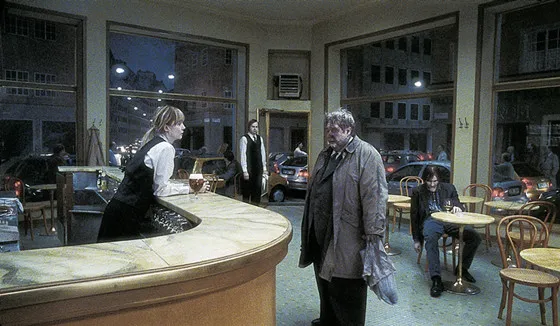
“Songs from the Second Floor” is the brilliant cinematic poem of Swedish filmmaker Roy Andersson; a film that takes us through the many complexities and pleasures of the human condition. It is part of the collection known as Andersson’s “Living Trilogy,” which also includes “You, the Living” (2007) and “A Pigeon Sat on a Branch Reflecting on Existence” (2014).
His compatriot Ingmar Bergman approaches existentialism through a darker lens; a perspective expressed in his profound psychological dramas through depressed and anxious characters and a constant fear of death and madness. Andersson, by contrast, prefers comedy and views life as an endlessly absurd and amusing phenomenon.
Inspired by the Peruvian poet César Vallejo, the film speaks of compassion, love, and suffering. It is a caress, an embrace, and a love letter addressed to those whom life has wounded; an invitation to keep going.
3. Life of Brian (Life of Brian) — Terry Jones, 1979
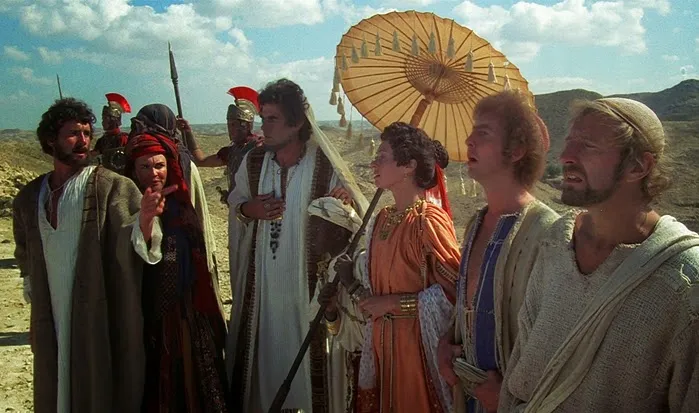
Among all Monty Python films, “Life of Brian” shines above the rest. This intelligent comedy satirizes the story of Christ. Brian, the protagonist, is a young man born on the same day as the Messiah and is repeatedly mistaken for a prophet.
With Monty Python’s distinctive absurdist comedy style, the film targets the absurdity of organized religion and the desperate situations that arise when, out of fear of loneliness and meaninglessness, we seek refuge in religion.
The film ends with an uplifting song, but its message is serious and powerful: being alive may be terrible; our expectations will probably never be fulfilled; we will all suffer; dissatisfaction will follow us everywhere; and death has watched us from the very day we were born. Even so, if we look toward the brighter side of life, perhaps we can enjoy it for a while.
4. Closely Watched Trains (Closely Watched Trains) — Jiří Menzel, 1966

The protagonist of Jiří Menzel’s “Closely Watched Trains” is a young man who begins his first job at the railway station in his hometown. The film belongs to the movement now known as the “Czechoslovak New Wave,” a period when Czech cinema reinvented itself through experimentation.
The young filmmakers of this movement—including Miloš Forman, Věra Chytilová, and Menzel himself—who had grown weary of the methods of the communist government, sought to restore to cinema the vitality and passion absent from the forms of socialist realist art imposed by the regime.
In this complex, Oscar-winning comedy, Miloš, the film’s protagonist, encounters the reality of sex for the first time in his life. The story takes place during World War II and the German occupation of Czechoslovakia; yet rather than the war itself, what we see is the unfolding of the sexual dimensions of the characters who pass through the railway station.
The vast reality of the human condition is reduced here to sexual necessity; the events of the world become little more than a backdrop for our growth and sexual desires.
5. Dr. Strangelove or: How I Learned to Stop Worrying and Love the Bomb (Dr. Strangelove) — Stanley Kubrick, 1964

“Dr. Strangelove” evokes a sense of strangeness from the moment we encounter its comically long title. Made in 1964 during the Cold War, the film reveals the absurd nature of armed conflicts by satirizing them.
A paranoid general in the U.S. military, convinced that the Russians are contaminating America’s water supply, decides to act on his own and sets mechanisms in motion that could lead to a nuclear holocaust.
At its core, the film is an exploration of the nature of human violence. If “Paths of Glory” presents war openly, focusing on its moral consequences and portraying the terror and suffering of the trenches, “Dr. Strangelove” examines the madness of those who issue commands. War is seen as a strategic game that, at least for those who play it in the war room, is as abstract and intellectual as chess or checkers.
6. Synecdoche, New York (Synecdoche, New York) — Charlie Kaufman, 2008
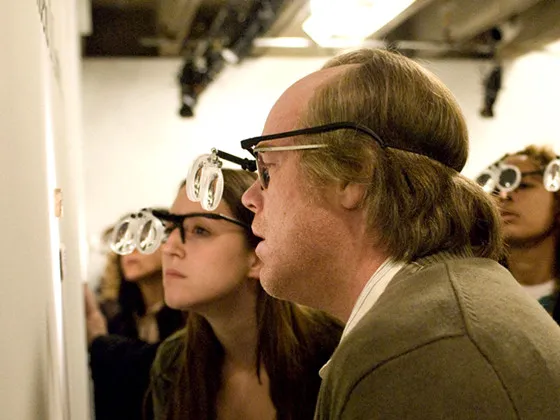
Charlie Kaufman gained widespread fame and acclaim with “Being John Malkovich” and “Eternal Sunshine of the Spotless Mind,” but “Synecdoche, New York” is perhaps the most complex and ambitious work of his career to date.
This is a rich, character-filled drama in which Philip Seymour Hoffman plays Caden Cotard, a theater director who begins constructing a life-sized replica of New York City inside a massive warehouse. The production, as an ultimate search for truth, becomes a mirror in which Caden watches his own life falling apart.
Even when Kaufman delves into the deepest existential themes, he still manages to draw occasional laughter from the audience—with a very dark and twisted humor. “Synecdoche, New York” shifts genres effortlessly, moving from absurdist comedy to devastating existential drama with remarkable ease. It is not an easy film to watch: it may force you to reassess your entire life, or perhaps draw you toward looking into a mirror where an unsettling image awaits you.
Death is everywhere in this film and, just like in life, always arrives unexpectedly. So it is better to enjoy our stay in this world while it continues, rather than obsessively searching for answers that do not exist or waiting for a salvation that will never come. The film is an invitation to create something beautiful.
7. The Exterminating Angel (The Exterminating Angel) — Luis Buñuel, 1962

This masterpiece by Luis Buñuel was made in 1962 and remains a fully realized example of surrealist cinema. In Mexico City, a group of bourgeois guests gathers for dinner at a mansion.
When the night ends, everyone politely says goodbye and decides to leave; but just as they attempt to exit the dining room, they inexplicably stop in place and find themselves unable to cross the threshold.
The film critiques the hypocrisy and double standards embedded in the mindset of the upper classes—traits that can also be found today among the middle class. After the guests are forced to accept their isolated and unpredictable life inside the room, they attempt to preserve their dignity and status; but eventually their social masks fall away and their raw, animal nature is revealed.
The denial of our instincts is exposed: as time passes and the situation becomes increasingly desperate in the absence of any logical answer, sex, survival, and territory become the guests’ primary concerns.
8. Cosmos (Cosmos) — Andrzej Żuławski, 2015

“Cosmos” is the final film by Polish director Andrzej Żuławski. Adapted from a novel by Witold Gombrowicz, the film follows two young men who travel to a small suburban town in search of refuge and peace. Witold, the protagonist, is a law student who begins a mad, detective-like investigation after discovering a hanged sparrow near the house where he is staying.
The film has the hysterical atmosphere that only Żuławski could create and is filled with self-referential jokes—references both to the film itself and to the many works the director created throughout his career.
The film is filled with symbols that Witold desperately tries to decode and clues that seem to lead to the next clue without any apparent logic. As the feverish story unfolds, the characters seem possessed; they all behave in erratic and unpredictable ways, and Witold attempts to organize and explain them within a system of pure absurdity.
9. The Lobster (The Lobster) — Yorgos Lanthimos, 2015

“The Lobster” is a film about the failure of love in postmodern society. In the world presented by Greek director Yorgos Lanthimos, being single is forbidden. Everyone must be in a relationship, and if someone separates from their partner, they are taken to a hotel where they have only 45 days to fall in love with another guest. If they fail, they are transformed into an animal of their own choosing.
The film rebels against the artificial and performative pursuit of love in our time; an era in which emotions have given way to the fear of loneliness. Love has become a mechanical and bureaucratic process, complete with deadlines and schedules, carefully controlled to keep us in the safe zone between fear of loneliness and fear of genuine feeling. Selfishness, self-deception, and fear have weakened our ability to understand and achieve true fulfillment. “The Lobster” seeks to free us from this cold prison.
10. Birdman or (The Unexpected Virtue of Ignorance) (Birdman) — Alejandro González Iñárritu, 2014
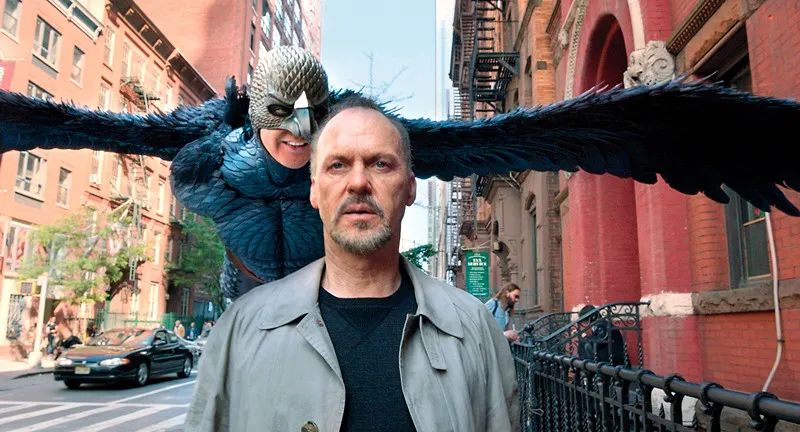
The word “pathetic” describes something that evokes pity, sympathetic sorrow, or regret; something miserable and deserving of compassion. Riggan, the film’s protagonist played by Michael Keaton, fits this description easily. Once famous for playing the superhero Birdman in his youth, he decides to redefine his identity as an artist by staging Raymond Carver’s play “What We Talk About When We Talk About Love” on Broadway.
Riggan’s Birdman persona is constantly at war with his artistic self. The public prefers him as an entertainer, but Riggan feels suffocated by that life and decides to risk failure rather than continue living within Hollywood’s money-driven and heartless entertainment machine.
“Birdman” is the most intellectually ambitious film by Oscar-winning Mexican director Alejandro González Iñárritu, and it critiques both the worlds of art and entertainment. Riggan embodies the struggle of creative individuals: their battle with the world, critics, and themselves; an effort to overcome inner demons and pursue their artistic passion.
In this film, art and entertainment are two sides of the same coin, and the work seeks to discover what distinguishes them from one another. The film seems to suggest that we turn to entertainment when we want to laugh for a while, and we turn to art when we have finally accepted that we need salvation.
11. Eraserhead (Eraserhead) — David Lynch, 1977

“Eraserhead” is David Lynch’s first feature film and a schizophrenic nightmare in which we glimpse the life of Henry Spencer, a man living in a decaying world filled with factories and abandoned places. He is a factory worker on leave, has a girlfriend, and she is pregnant. In a disturbing environment where everything seems to be collapsing and a strange hissing sound echoes everywhere, the woman gives birth to a monstrous child whose crying never stops.
The film’s images are powerful, harsh, and bewildering. Lynch’s surrealist approach and the absence of a conventional narrative transform it into a deeply unsettling experience. The eerie atmosphere of Henry’s life reflects his own psychological landscape. He is trapped in an unpleasant existence, forced to live with an unwanted mutant child, and his only consolation is a vague promise: “In heaven, everything is fine.”
12. Anomalisa (Anomalisa) — Charlie Kaufman and Duke Johnson, 2015

Charlie Kaufman has established himself as a fully fledged existentialist writer. In “Anomalisa,” he explores love, identity, and the human condition. Although it is an animated film, the work is deeply human; in fact, it is so human that it hurts.
Michael Stone, the protagonist, is a customer service writer and a highly respected figure in his field. He is a dull man whose everyday gray life has numbed him. In this state, he has reached a condition of self-isolation and sees others as beings completely lacking distinctive qualities; everyone even speaks to him in the same lethargic voice.
The film paints a dark picture of human relationships. When others are so tedious, how can one become interested in anyone? Things change during a business trip, where Michael meets Lisa, a shy and ordinary woman, and falls in love with her almost at first sight. The story progresses, and by the end, a taste of melancholy and sadness remains. Relationships fail, love fails, and what once seemed brilliant and full of promise may appear dull and disappointing the next day—without anyone knowing why.
13. Broken Flowers (Broken Flowers) — Jim Jarmusch, 2005
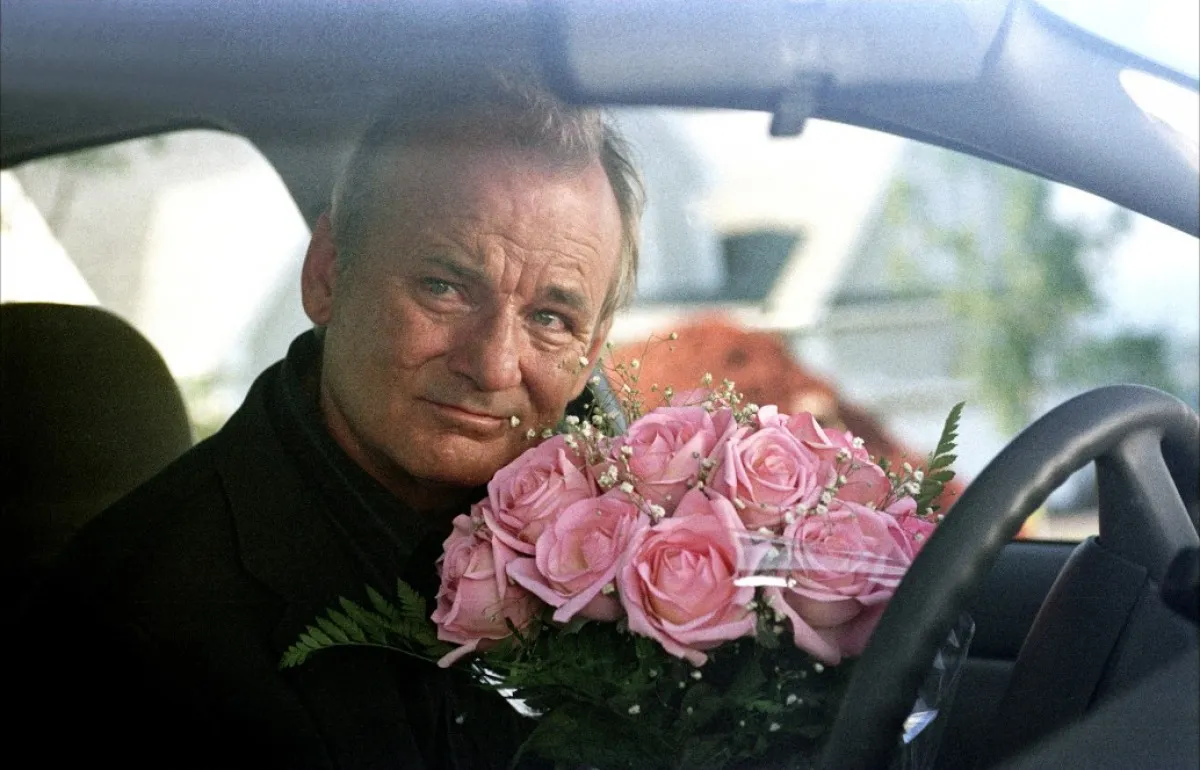
“Broken Flowers” is a deeply moving and human film. Bill Murray plays Don Johnston, a man who, after being left by his girlfriend, receives an anonymous letter from a former lover. In the letter, the woman reveals that she gave birth to his son nineteen years earlier and that the boy is now searching for his father.
Don, with the help of Winston, his amateur detective-like neighbor, sets out to find the anonymous author of the letter and visits all the women he was involved with during that period. The structure of the film consists of a series of character studies through which the mystery of Don’s fatherhood is gradually revealed.
At each encounter, a different reaction awaits Don: sometimes joy, sometimes humiliation. We, the viewers, also piece together the fragments like detectives, decoding Don’s youthful relationships with his lovers and catching only brief glimpses of their present lives.
This film is about people’s lives and their stories. It forces us to think about those who were once part of our lives and ask ourselves what happened to them: Are they happy? Are they suffering? Do they ever think of us from time to time?
14. Safety Last! (Safety Last!) — Fred C. Newmeyer and Sam Taylor, 1923

“Safety Last!” can easily be considered Harold Lloyd’s masterpiece; an exhilarating and suspenseful physical comedy in which we see him climb the exterior of a building as part of a publicity stunt. The story goes like this: Harold leaves his small hometown and heads to the big city, hoping to earn enough money to marry his girlfriend, Mildred. But the success he expected does not come, and he eventually settles for a simple job as a store clerk.
His boss organizes a contest and promises a thousand-dollar prize to whoever brings the most customers to the store. Harold teams up with one of his friends, a “human fly” who is supposed to climb the building and share the prize with him. But things do not go according to plan, and Lloyd himself is forced to climb the building.
The pursuit of economic success in this film becomes a full-scale circus. The romantic story of a man willing to risk his life to impress the woman he desires creates an exciting experience; yet at the same time, it reveals the madness hidden within our money-driven society.
Money has become the key to realizing our dreams: we need money to have a satisfying life, express love, and enjoy respect. If we are unlucky enough to belong to the lower or middle classes, we must be prepared to sacrifice our time, dignity, and security in order to achieve it.
15. Brazil (Brazil) — Terry Gilliam, 1985

In this seemingly endless Kafkaesque opera, we witness the hardships and misfortunes of Sam Lowry, a bureaucrat who becomes an enemy of the state because of a typographical error in an official document. With its labyrinthine structure, the film uses its dystopian and dreamlike atmosphere to satirize life in the postmodern world.
The government monitors everyone; every available inch of space is used for advertising; and people’s personalities and dreams are discarded in favor of efficiency and obedient behavior. Sam represents the oppressed worker, someone who resembles a robot trapped within the mechanical machinery of a job that brings him no satisfaction.
The only place where Sam can be at peace with himself is the world of his dreams; a world in which he is a superhero and embarks on surreal missions to save the woman he loves. “Brazil” is a life-affirming film about individual liberation.
The film seems to ask: How truly civilized is a civilization that makes all our days boring and miserable? “Brazil” is a warm invitation to break free from the chains of the corporate lifestyle; the very lifestyle that suppresses our imagination and our heartfelt desire to search for something more natural and pleasurable.
Source: Taste of Cinema website





Discussion0 comments
No comments yet; let yours be the first voice.