Political Science
Introducing the Book “Four Theories of Governance: A Study of the Relationship Between Constitutionalism and Legitimacy” by Mohammad Amir Ghoddousi
The book Four Theories of Governance by Mohammad-Amir Ghodousi examines the relationship between constitutionalism and legitimacy in modern Iranian history. By analyzing four major theories, Ghodousi addresses the question: 'Can a government be both religious and constitutionalist?'

Introducing the Book “Four Theories of Governance: A Study of the Relationship Between Constitutionalism and Legitimacy”
Ahmad Savari
PhD Student in Religious Studies, University of Religions and Denominations, Qom
Governance is an inseparable aspect of collective life, and humanity finds itself compelled to rely on it for managing the affairs of living. Governance is realized through reliance on political power; hence, the question has always been raised: what is the source of political power, and how should it be realized? Should governance be founded on the principle of self-rule and autonomy of each individual citizen, or should it be based on divine teachings?
During the Constitutional Revolution, this question was raised seriously for the first time in the contemporary political history of Iran. Some considered the legitimacy of political authority to be based on the vote and consent of the general public, while others regarded only God and religious decrees as the legitimizing factor of governments; to the extent that they said: “No policy is legitimate unless it conforms to the Sharia, and no one has the right to govern unless they have obtained their legitimacy from the Divine realm.”
A brief look at the history of this political dispute in contemporary Iran shows that politics lies between religious decrees and the rights of the people. Explaining the nature and instances of religious decrees concerning the public sphere, as well as the essence and scope of the people's rights, and ultimately the relationship of the political matter with them, is a difficult task and therefore requires scholarly research.
Mohammad Amir Ghoddousi, a researcher in the philosophy of public law and a graduate of Mofid University, who completed his postgraduate studies in public law at Shahid Beheshti University of Tehran and, in addition to his background in seminary studies, achieved first place nationwide in both the master's and doctoral entrance exams, has attempted in the book Four Theories of Governance to unveil the root of these disagreements and, through precise and meticulous analysis, to confine the aspects of this historical dispute, based on a rational limitation, to the proponents of four theories. These theories are: “The Theory of Constitutionalism,” “The Theory of Legitimacy,” “The Theory of Constitutionalism within the Framework of Legitimacy,” and “The Theory of Legitimacy within the Framework of Constitutionalism.”
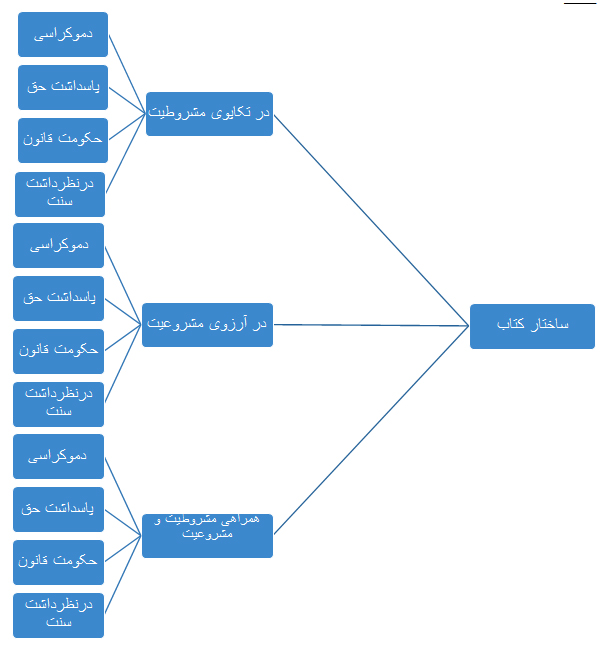
The structure of this book includes a preface by the esteemed Dr. Abolghasem Fanaei, a well-known contemporary scholar of religion and ethics, an introduction by the author, and three detailed chapters:
Chapter One: “In Pursuit of Constitutionalism”;
Chapter Two: “In Desire of Legitimacy”;
Chapter Three: “In Search of the Concordance of Constitutionalism and Legitimacy.”
At first glance, the reader expects to review four chapters corresponding to the book's title; however, since, in the author's view, the theories of “Legitimacy within the Framework of Constitutionalism” and “Constitutionalism within the Framework of Legitimacy” are very similar, and he did not have sufficient raw data to examine and analyze each separately in detail, he has organized both approaches in the third chapter; for instance, thinkers such as Kadivar and Soroush fall under the theory of “Constitutionalism within the Framework of Legitimacy,” and thinkers like Fanaei and Naraghi fall under the theory of “Legitimacy within the Framework of Constitutionalism.”
What is meant by constitutionalism in this research is a term in the field of the philosophy of public law, and not precisely the common term from the Constitutional Revolution. In fact, the Constitutional Revolution is a historical event and, at most, a temporal and local instance of this philosophical approach.
The main concern of Ghoddousi's research is: “Can a government possess both the values of constitutionalism and the values of legitimacy?” In other words, “Can a government be both religious and constitutionalist?”
To provide a clear answer to this question, Ghoddousi first defines the concepts of constitutionalism and legitimacy.
“Mashru‘eh describes a government that is established based on religious dos and don’ts and continues and endures according to those same precepts.” This definition is very general; for theories of religious government are numerous, and its scrutiny is only possible within the framework of each unique theory; the dos and don’ts of constitutionalism, however, are a construct of modern humanity and a product of modernity. For this reason, it emerges from the lines of this research that the author defines constitutional government as follows: “A government established and sustained with the aim of preserving a just public order and safeguarding the rights and freedoms of individuals, based on four components: democracy, the rule of law, rights-orientation, and consideration of the traditions of the habitat.”
In the first chapter, he explains constitutionalism in detail and provides extensive explanations for the four aforementioned components, namely 1. Democracy, 2. Human Rights, 3. The Rule of Law, 4. Consideration of Society’s Traditions.
Democracy means the administration of public affairs based on public opinion; this democracy has no restriction other than respect for the fully equal rights of all types and categories of minorities and a commitment to not disrupting the just order of society. Such an interpretation of democracy considers all citizens involved in their own destiny. In a democratic society, Muslims and non-Muslims, believers and atheists, men and women, and all kinds of minorities have an active role in managing society’s affairs and share equally in their own destiny. This means that no creed or ideology holds guardianship over citizens and cannot limit citizens’ decisions in the administration of the public sphere. Ghoddousi insists that democracy in our time must not be reduced to anything less than this.
Human Rights means the rights of humans qua human, which must be safeguarded and guaranteed by states. The transcendental human possesses numerous rights, only a portion of which are articulated and crystallized in the Universal Declaration of Human Rights. A rights-based government is one that recognizes all the rights of humankind, including the freedom to change religion, equality between men and women, equality between the theist and the atheist, and the equality of various categories of citizens. Human rights are the nomos of constitutionalist thought and the dividing line between legal dictatorships and rights-based governments.
The Rule of Law means the regulation of all the country’s affairs based on law and continuous oversight of this matter; a law that the people’s representatives have enacted based on the principles of democracy and communicated to law enforcement officials for implementation. The goal and ideal of the “rule of law,” unlike the “rule of jurisprudence,” is not the otherworldly felicity of humanity; rather, it is the safeguarding of the just order of society and the rights and freedoms of individuals. That is, in a law-based government within constitutionalist thought, constructing the paradise of religions on earth is not the objective, and the sovereign does not seek to impose its subjective values and its desired model of the concept of the good upon citizens in the name of law. Law merely provides the groundwork for the self-actualization of each and every citizen according to their own will and discernment and does not support totalitarianism and authoritarianism in any way.
Consideration of Society’s Traditions means moving towards the values of constitutionalism while taking into account the realities of each society’s habitat. From the author’s perspective, attention to the traditions of the habitat is, on the one hand, the fruit of a sincere interest in, commitment to, and belief in the universal values of constitutionalism, and on the other hand, the product of correct and precise knowledge and awareness of the necessity of paying attention to the contexts of every society that embarks on the path toward constitutionalism.
In the first chapter, in addition to providing a comprehensive definition of these components, he examines their place in a constitutional government, and in the second chapter, after defining Mashru‘eh government, he addresses the crucial question of what the place of these components is in a Mashru‘eh government. In the second chapter, he clearly shows that none of the four aforementioned concepts are fully accepted among the proponents of Mashru‘eh.
Finally, in the third chapter, he examines the possibility of a synthesis between Mashruteh and Mashru‘eh and specifies the place of the four mentioned components in the theory of the synthesis of constitutionalism and legitimacy.
The diagram below shows the general structure of the book:
Given the foregoing, the answer to the question of whether a religiously legitimate government can be compatible with these four components finds an independent response within each theory.
As we mentioned earlier, Ghoddousi has categorized the answers given to this question under four theories, and the book is accordingly named, in order to answer this question, “Four Theories of Governance: A Study of the Relationship Between Constitutionalism and Legitimacy.”
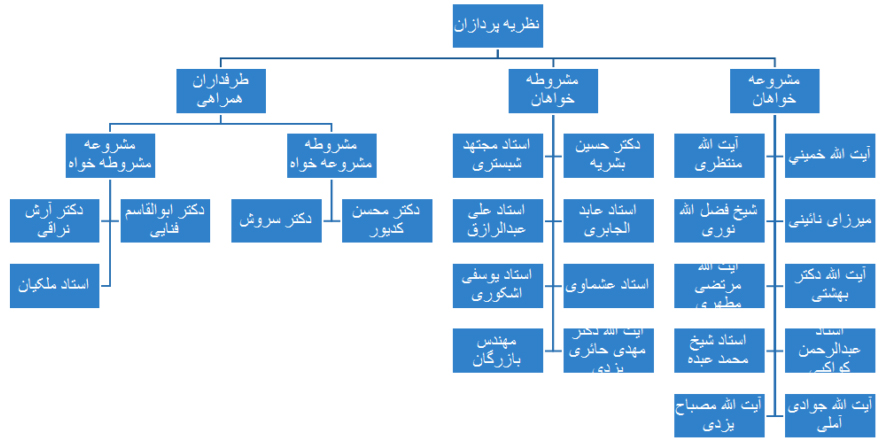
1- The advocates of religious legitimacy are those who desire religious government and acknowledge that the four aforementioned components are, in many instances, incompatible with religious teachings, or at least that their definition of religious teachings necessitates the incompatibility of these teachings with the fundamental principles of constitutionalism.
It can be confidently stated that the majority of jurists fall into this category, and if apparent differences are seen among their views, this difference lies in the varying types of their advocacy for religious legitimacy. In this group, one finds both Ayatollah Khomeini and Ayatollah Montazeri; both Sheikh Fazlollah Nouri and Mirza Naini. Even Morteza Motahhari, despite all his relative tolerance towards republicanism and his defense of certain levels of minority rights and the right of opponents to express their votes and opinions, as well as his opposition to the esoteric and social guardianship of jurists, falls under the group of advocates of religious legitimacy. Obviously, Mesbah Yazdi, who explicitly attacks republicanism and grants no consideration to the vote and opinion of the general public in establishing the legitimacy of religious government, is also an advocate of religious legitimacy. He goes so far as to consider the holding of elections in the Islamic system as being due to the expediency of the Guardian Jurist at this point in time and deems it lacking intrinsic desirability. He also does not consider the constitution to have value in and of itself and regards its validity as contingent upon the signature of the Guardian Jurist beneath it.
The placement of figures such as Mirza Naini, Morteza Motahhari, and Mohammad Hossein Beheshti under this group, and placing them alongside Sheikh Fazlollah Nouri, Mesbah Yazdi, and Javadi Amoli, is not due to Ghoddousi’s failure to discern the differences in their thoughts; rather, it is because their understanding of concepts such as democracy and constitutionalism is not precise, and the correct, modern meaning of these concepts is absent from their thought.
2- Absolute constitutionalists are those who desire a government with the aforementioned components and acknowledge that religious teachings are, in many instances, incompatible with those four components. Of course, constitutionalists themselves are of two types: religious and non-religious. “Religious absolute constitutionalists” are thinkers who do not see religion as having specific injunctions in the political and social sphere and consider the determination of the desirable type of government to be delegated to human reason and experience.
In fact, the advocates of religious legitimacy and a portion of the absolute constitutionalists agree on the point that Sharia is, in many instances, incompatible with constitutionalism. “Non-religious absolute constitutionalists,” such as Mohammad Reza Nikfar, are not discussed in the book; for this group has settled its account with religious teachings and has no belief in or commitment to them. However, among the “religious absolute constitutionalists,” one can point to thinkers such as the later Bazargan, Mehdi Haeri Yazdi, Mohammad Mojtahed Shabestari, Yousefi Eshkevari, Ali Abd al-Raziq, and Ashmawi.
3- The third group are constitutionalists who, although they acknowledge the values of constitutionalism, have their hearts set on religious teachings, and for this reason, they present a reading of constitutionalism that can be compatible with religious teachings. This group gives primacy to religious teachings and embraces the values of constitutionalism only to the extent that they do not conflict with the explicit teachings of religion, and if such an explicit conflict occurs, they sacrifice constitutionalism at the altar of legitimacy. According to the author of the book, some religious intellectuals, such as Abdolkarim Soroush and Mohsen Kadivar, fall under this group.
4- The fourth group are constitutionalists who, like the second group, are committed to all the requisites of constitutionalism and simultaneously hold religion and the values of constitutionalism as authentic, offering a reading of religious teachings that can and must be able to reconcile with constitutionalism. In the view of this group, a religion and Sharia that is incompatible with the values of constitutionalism is incompatible with truth and justice, and therefore certainly not the intention of the Wise and Just God. Abolqasem Fanaei and Arash Naraghi fall under this group.
Although Ghoddousi tries to stand at a height above the dispute among these four theories, it seems his heart is with the theory of "legitimacy within the framework of constitutionalism" or "absolute constitutionalism"; for his pen becomes sharp and incisive in criticizing the theory of "legitimacy" and the theory of "constitutionalism within the framework of legitimacy." Particularly in the first chapter, where he conceptually clarifies the requisites of constitutionalism, he clearly shows that he is sympathetic and in harmony with these values.
One of the merits of the book is the titles chosen to introduce the views of each thinker; titles that show the author is well acquainted with the political theory of that intellectual: "Bazargan, the Advocate of Minimalist Religion," "Mesbah Yazdi, the Drawn Sword Against Democracy," and "Arash Naraghi, the Proponent of Civil Religion" are among these titles.
The contrast between the thinkers' views is such that it stirs the enthusiasm of any thoughtful reader; for instance, it brings up both Professor Ashmawi, who said: "Islam was a religion, not politics," and Ayatollah Khomeini, who said: "By God, Islam is entirely politics." It discusses both Mehdi Haeri Yazdi, who advocates the theory of the agency of joint private owners, and Abdollah Javadi Amoli, whose heart is devoted to the absolute guardianship of the jurist.
In this book, the author also addresses the views of Davoud Feirahi and Seyyed Javad Tabatabai. He describes Davoud Feirahi as entangled in inconclusive verbosities and Seyyed Javad Tabatabai as lacking a coherent and consistent theory.
Ghoddousi calls Mohsen Kadivar, despite all his explicit statements in favor of secularism, a "Sharia-bound constitutionalist," and in the final pages of the book, he depicts a concise and comprehensive account of his intellectual dispute with Arash Naraghi. Naraghi, in the guise of an advocate of civil religion, criticizes Soroush and Kadivar, considers their desired democracy bound by religious constraints, and expresses concern that if the followers of Soroush and Kadivar's ideas seize political power, they would, out of religious duty, restrict the human rights of a number of minorities. Ghoddousi's skill in extracting what he sees as the contradictions in Kadivar's thought is noteworthy in this section of the book.
The thought of Naraghi and Fanaei, although it falls under the group of Sharia-bound constitutionalism, has a very subtle difference regarding the relationship between legitimacy and constitutionalism, which has not escaped the author's eye. This difference lies in the realm of how they engage with public reason, which the author tries to scrutinize in several paragraphs. Naraghi considers any legislation based on purely religious reasons as unjust and contrary to justice, whereas Fanaei believes that what is prohibited is legislating outside the framework of reason and ethics, and legislating based on purely religious reasons is not in itself a violation of justice and therefore not prohibited.
The chart below shows under which group each of the well-known theorists in the field of religion and politics falls:
This book is also rich in terms of references and citations, to the extent that it has twenty pages of sources and references, many of which are recent; such that some of its sources were published just two months before the book's unveiling.
.
.
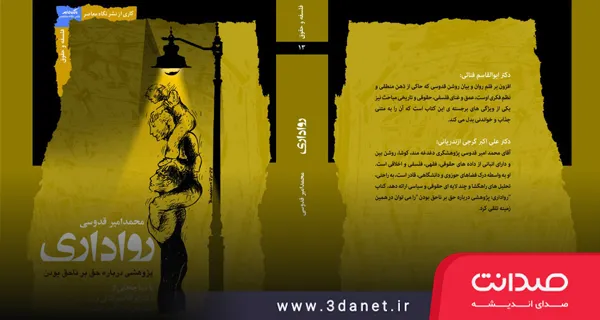
The Book Four Theories of Governance; A Study of the Relationship Between Constitutionalism and Legitimacy
Publisher: Negah-e Moaser
Author: Mohammad Amir Ghoddousi
.
.




Discussion3 comments
بنده با فیلتر و سانسور هایی که تا به حالا از ج.ا دیدهام خیلی مخالف هستم، اما به نظرم واقعا فضای مجازی موجود همه حدود و مرزهای اخلاق جنسی را نابود میکند. متاسفانه دنیا را افراط و تفریط فرا گرفته است، در اینجا حداقلهای حقوق زنان به رسمیت شناخته نمیشود، از آن سو شرکت هایی مانند گوگل، بی پردهترین و غیر اخلاقی ترین محتواهای پورنوگرافی و برهنگی را به رسمیت می شناسند و به نمایش می گذارند. به نظر بنده اینها مصداق نا حق غیر قابل مدارا هستند و هر چقدر هم ما با موفقیتها و دستاوردهای اروپا و غرب موافق هستیم نباید تسلیم این تباهیها و سیاهیها بشویم. خلاصه سخن بنده این است که اگر ج.ا مثلا با همین شرکت گوگل گفتگو کند که محتواهای صریح جنسی، به هیچ وجه، نشان داده نشود، کار درست و صحیحی است. باور کنید نوجوانها و حتی کودکان ما هم به تدریج دارند مبتلای این محتواهای پلید و پلشت میشوند.
الآن چه ربطی به کتاب داشت ؟
معرفی مختصر و مفیدی بود. ممنون