Philosophy
On the Book “Four Readings of Tabatabai” by Shahram Etefagh
The book Four Readings of Tabatabai by Shahram Etefagh examines four intellectual and political currents shaped by the teachings of Tabatabai. The work aims to return the country to the path of development and a liberal-democratic order through a critique of these trajectories.
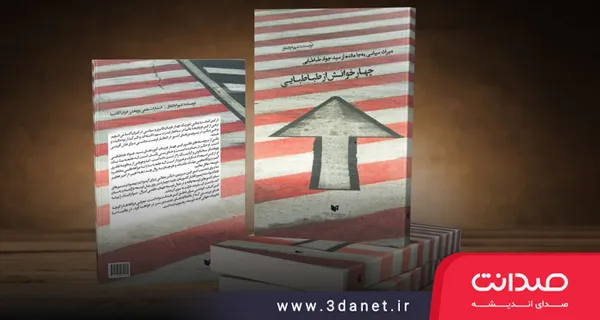
Audio Files of the Book Four Readings of Tabatabai
Written by Shahram Etefagh
With an Introduction by Kazem Alamdari
Publisher: Iran Academia Institute
Place of Publication: The Hague – Netherlands.
About the Book:
In this work, the author acquaints us with the theoretical foundations of four intellectual and political currents and their sub-branches within Iran's political sphere. Some of these currents have had a share in the power structure and have been influential; and others, inside or outside the country's borders, are awaiting a suitable opportunity to play a role.
One of the theoretical sources of these currents is the teachings of “Seyyed Javad Tabatabai,” and it is considered their common denominator.
These four currents are the “Conservatives,” the “Conservative Jurisprudential Liberals,” the “Constitutionalist Monarchists,” and the “Extreme Nationalists.”
The author believes that our country has, over the past few decades, neglected the crucial matter of “development” and no longer has the leeway to test uncharted paths, and emphasizes that we must strive to get our country's train back on the track of development and poised to move towards a liberal-democratic order and take steps on that path.
In this regard, this book has been an effort to realize this goal: introducing the detours and dead-end alleys that will lead to new nowheres, and comparing them with some global experiences that have led to “development.”
In appreciation of the years of scholarly activity by Professor Yadollah Mowqen and his constraints, the author has dedicated this book to him.
.
.
Click here to download the PDF file of this book
.
.
Audio and Video Files:
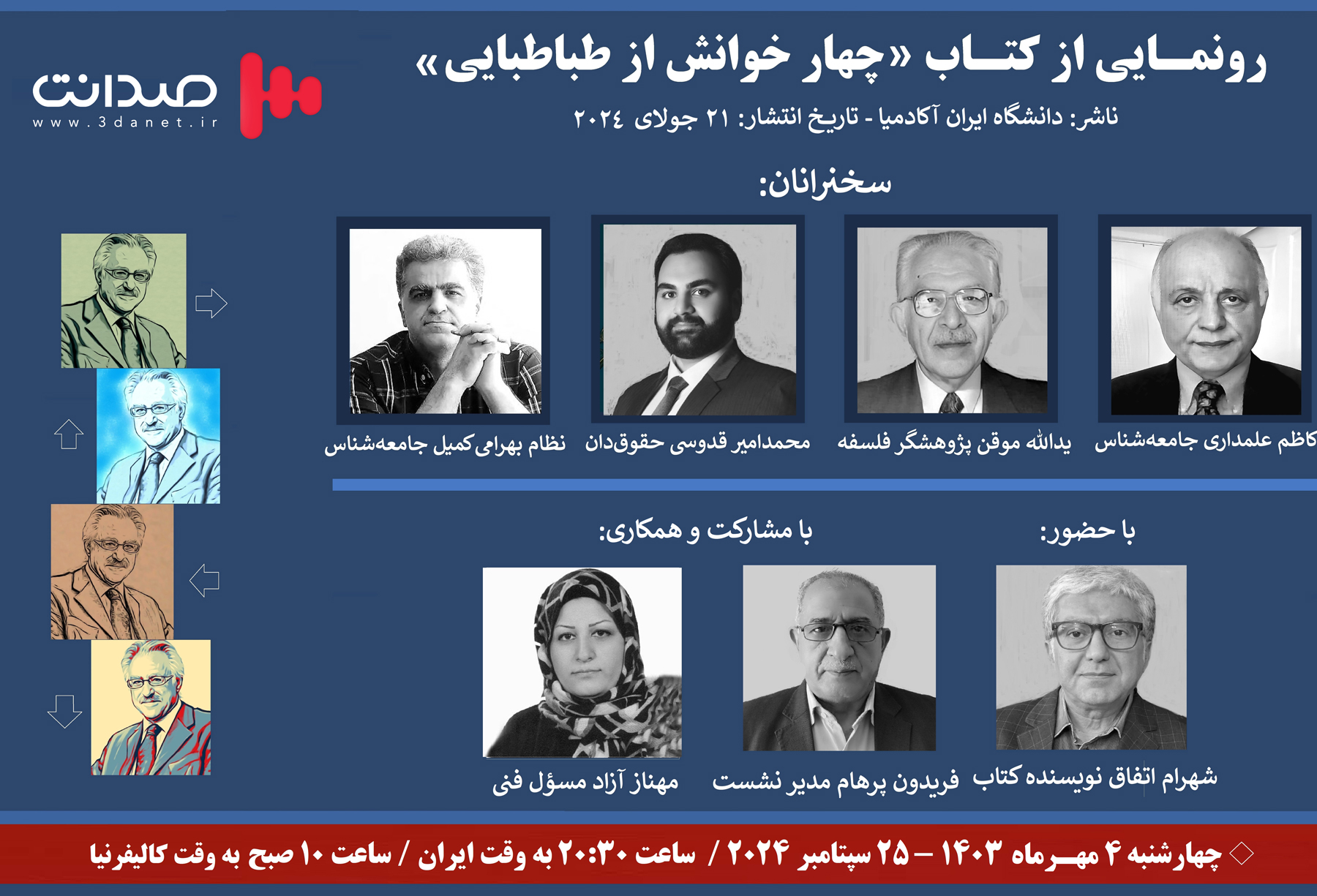
Unveiling of the Book Four Readings of Tabatabai:
Written by Shahram Etefagh
Publisher: Iran Academia Institute
Place of Publication: The Hague – Netherlands.
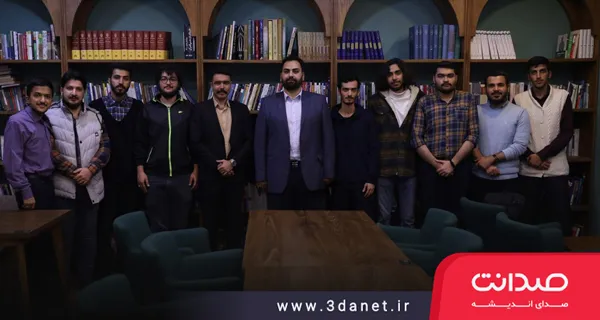
Speakers: Kazem Alamdari, Yadollah Mowqen, Nezam Bahrami Komail, Mohammad Amir Qudusi
Session Chair: Fereydoun Parham
Technical Affairs: Mahnaz Azad
Host of this Event: Sedanet
Audio file of the first part of the unveiling session
Audio file of the second part of the unveiling session
Audio file of the third part of the unveiling session
Listen to the full session audio on Castbox | Spotify
Watch Yadollah Mowqan's remarks on the book "Four Readings of Tabatabai"
.
.
Lectures on the book Four Readings of Tabatabai (read by the author):
.
"Preamble and Introduction" and the story of the book's publication
.
Reading "Chapter One" from Part One of the book
What does "reading" mean?
.
Reading "Chapter Two" from Part One of the book
Summary of Tabatabai's views
.
Reading "Chapter Three" from Part One of the book
"Anachronism" and Tabatabai
.
Reading "Chapter Three" from Part One of the book
The matter of "Secularism" (1)
Definitions and disarrays
Addition ➖➖➖➖🔻 Javad Tabatabai's comment on Yadollah Mowqan
.
Reading "Chapter Three" from Part One of the book
The matter of "Secularism" (2)
The difference between the "secular," the "customary," and the "worldly"
Differences and similarities between Judaism, Christianity, and Islam
.
Reading "Chapter Three" from Part One of the book
The matter of "Secularism" (3)
Mowqan's lecture and conclusion
.
Reading "Chapter Three" from Part One of the book
"Methodological Positions" on humanity and history
Read by the author
Addition ➖➖➖➖🔻 The human condition in the eyes of Iranian poets: Fereydoon Moshiri
.
Reading "Chapter Three" from Part One of the book
"Iran's Past"
Read by the author
Addition ➖➖➖➖🔻 (1) An excerpt from Javad Tabatabai's lectures, (2) an excerpt from Yadollah Mowqan's critique of Tabatabai's interpretation of Hegel and Iranshahri, (3) an excerpt from Soroush Seyedi's account of the origins of "Iranshahri" claims in Iran.
.
Reading "Chapter Three" from Part One of the book
"Iran's Present and Future"
Addition ➖➖➖➖🔻 An excerpt from the lecture series of Nezam Bahrami Komeil
.
Reading "Chapter Four" from Part One of the book
Categorizing development theories and situating Tabatabai among them
.
Part Two of the book: "The Conservative Reading" and Chapter Five: "Critics, Narrators, and Followers"
Addition ➖➖➖➖🔻 An excerpt from a speech by Mehdi Tadayoni on Iranshahri
.
Reading "Chapter Six" from Part Two of the book, "Ijtihad in Modernity"
Addition ➖➖➖➖🔻 Excerpts from the lecture series of Ebrahim Sahafi and Javad Tabatabai
.
Reading "Chapter Six" from Part Two of the book: The trial of "intellectuals and the university institution" and the exoneration of the "institution of politics" and the "institution of the clergy" and ...
Addition ➖➖➖➖🔻 Excerpts from speeches by Ebrahim Sahafi and Rahmatollah Bigdeli
.
Reading "Chapter Six" from Part Two of the book: How does Tabatabai link the "Paykan production line" with "ijtihad in modernity" and "political philosophy"?
Addition ➖➖➖➖🔻 Excerpts from an old interview with Sadegh Zibakalam (in the early days after the 1979 revolution)
.
Reading "Chapter Six" from Part Two of the book:
Five approaches to "modernity" and Tabatabai's crisis in extracting "modernity" from within "tradition," an examination of the dead ends of: "indigenous social sciences" and the "Iranshahr University"
Addition ➖➖➖➖🔻 Excerpts from a speech by Ahmad Bostani
.
Reading "Chapter Six" from Part Two of the book: Points continuing from Podcast 16
The dangerous idea of establishing "indigenous humanities"
.
Part Three of the book: "The Reading of Jurisprudential Conservative Liberalism" and Chapter Seven: "Critics, Narrators, and Followers"
The theoretical positions of Quchani and the Executives of Construction Party and their mode of political engagement with the clergy and intellectuals (Part One)
.
Chapter Eight of the book: "A Critique of the Reading of Jurisprudential Conservative Liberalism"
The theoretical positions of Quchani (member of the political board of the Executives of Construction Party) and his solutions for Iran's future (Part Two)
Addition ➖➖➖➖🔻 Excerpts from speeches by Mohammad Quchani and Nezam Bahrami Komeil
.
Chapter Eight of the Book: “A Critique of the Reading of Jurisprudential Conservative Liberalism”
A critique of the theoretical positions of Quchani (Executives of Construction Party) and a critique of their solutions for Iran’s future (Part Three)
Addition ➖➖➖➖🔻 Excerpts from a speech by Mohammad Amir Qoddusi and a speech by Sara Shariati
.
Chapter Eight of the Book: “A Critique of the Reading of Jurisprudential Conservative Liberalism” (Part Four)
Does Tabatabai have any connection or relation to liberalism?
Addition ➖➖➖➖🔻 Two excerpts from the words of Javad Tabatabai
.
Part Four of the Book: “The Constitutionalist Reading” and Chapter Nine: “Critics, Narrators, and Followers”
The theoretical and political positions of “Constitutionalist Monarchists,” inspired by the thought of Javad Tabatabai (Part One)
Addition ➖➖➖➖🔻 Excerpts from Mehdi Khalaji
.
The theoretical and political positions of “Constitutionalist Monarchists,” inspired by the thought of Javad Tabatabai (Part Two) Addition ➖➖➖➖🔻 Excerpts from speeches by Alireza Kiani, Hojjat Kalashi, and Farkhondeh Modarres
.
The theoretical and political positions of “Constitutionalist Monarchists,” inspired by the thought of Javad Tabatabai (Part Three) Addition ➖➖➖➖🔻 Excerpts from speeches by Ahmad Bostani, Shahin Nejad, and Hashem Aghajari.
.
The theoretical and political positions of “Constitutionalist Monarchists,” inspired by the thought of Javad Tabatabai (Part Four)
Addition ➖➖➖➖🔻 Excerpts from the book by Azadeh Khorrami-Moghaddam with the voice of Naghmeh Mojtabai and an excerpt from a speech by Nezam Bahrami Komil.
.
Critiques of “Iranshahri Historiography”
An examination of examples of historical distortion and fabrication (Part One)
Addition ➖➖➖➖🔻 Excerpts from speeches by Amir Khadem and the audiobook “The Hidden History” by Meqdad Nabavi
.
Critiques of “Iranshahri Historiography”
An examination of examples of historical distortion and fabrication (Part Two: Kurdistan)
Addition ➖➖➖➖🔻 An excerpt from the poetry collection of Mastoureh Ardalan with the voice of Naghmeh Mojtabai and excerpts from the book “The History of Mardukh” by Mohammad Mardukh Kurdistani with the voice of Majid Tavalla.
.
Critiques of “Iranshahri Historiography”
An examination of examples of historical distortion and fabrication (Part Three: Khuzestan and Baluchistan)
Addition ➖➖➖➖🔻 An excerpt from a speech by Mohammad Albu Ali
.
Critiques of “Iranshahri Historiography”
Part Four: Where is Iran? Where is Iranshahr? Who is Iranian?
Does the theory of the “Continuity of Iran” hold true? Do we speak the language of Ferdowsi’s Shahnameh today?
Addition ➖➖➖➖🔻 Excerpts from the speeches of Alireza Manafzadeh, Mohsen Renani, Behrouz Chaman-Ara, Zia Sadroleshrafi, Javad Tabatabai, and Yousef Azizi Bonitorf (voiced by Pouyan Kaboli).
.
Part Five of the Book: “The Extreme Nationalism Reading”
The theoretical and political positions of “extreme nationalists,” inspired by Iranshahri thought (Part One)
Addition ➖➖➖➖🔻 Excerpts from Houshang Amirahmadi and Vahid Bahman
.
Chapter Eleven: Critics, Narrators, and Followers of Extreme Nationalism
The theoretical and political positions of “extreme nationalists,” inspired by Iranshahri thought (Part Two)
Addition ➖➖➖➖🔻 Excerpts from Javad Tabatabai, Jason Reza Jorjani, Shahin Nejad, and Shahram Arian
.
.

Discussion4 comments
سلام ودرود ببخشید پاکدست شماره 17،مطالعه «فصل ششم» از پاره دوم کتاب: نکاتی در تداوم پادکست ۱۶ ایده خطرناک تاسیس «علوم انسانی بومی»، قابلیت دانلود رو نداره و پیغام خطا میده امکان داره لطف کنید و مجددا بارگذاری و یا اصلاح بفرمایید با تشکر از شما و سایر همکاران
سلام و درود اصلاح شد
جهان در شرف جنگ جهانی است و جامعه روشنفکری در مورد nuances of meanings سید جواد طباطبایی و غذا دادن به حیوانات(موضوع چندی پیش)، تفاسیر ممکن لیبرالیسم و موضوعاتی از این قبیل مطلب میزند. جوان و پیر ایرانی و وطن دوست، اهل فکر و اندیشه! به این دلیل می گوییم قشر درس خوانده صداقت ندارد، مشکلات را پنهان می کند، تطهیر نسل کشی می کند، غرب را سانسور شده تحویل تو می دهد. روشنفک را بشناس.
انگار نه انگار که دنیا تکه تکه میشود. گویی چهره نسل کشی و پاکسازی قومی لیبرال دموکراسی که حتی مردم آمریکا و فرانسه و تمامی کشورهای غربی را به خروش آورده اصلا وجود ندارد. لیبرال دموکراسی دو چهره دارد، در صلح که حاکمیت مزورانه اش را تسلیم می شوی، و با نظریه های دانشگاهی سعی می کند گیجت کند و وقتی حرف منطق و حساب دانشگاهی حالیت نمیشه و فکر و اندیشه آن بگوید این همان نظریه قصابی و کشتار با نقاب لبخند بر لب و رشوه پولی و جنسی به جوانان است. شرم بر