Religion
Introducing the Book 'Humanity's Expectation of Religion'
The question of what humanity expects from religion, after being raised in the West and in contemporary Iran, was elaborated upon by Ayatollah Javadi Amoli in 2012 in a book published by Isra. The work examines the necessity of prophethood, anthropology, and Islam's response to humanity's fundamental needs.
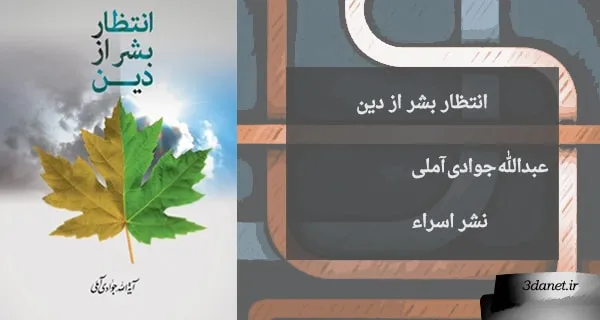
In the last two centuries in the Western world, modern theology and the philosophy of religion have addressed the issue of humanity's expectation of religion, raising the question of which human needs religions fulfill in the contemporary world. This discourse underwent profound transformations until it was also specifically raised in Islam. Of course, precisely when this discussion emerged in Islam is a matter of dispute among historians and religious thinkers. Some believe that the elucidation of this issue—which human needs religion, especially Islam, is meant to answer—was first introduced in Islam by Imam Muhammad al-Ghazali, while others trace this view back to the time of the Shiites in Islam and believe it was explicated in the teachings of the Pure Imams (peace be upon them).
In contemporary times, especially in Iran, the origin of this view can perhaps be sought in the thought of intellectuals such as Iqbal Lahori (of Pakistan). However, the individual who specifically introduced this theory in post-revolutionary contemporary Iran can be identified as Dr. Soroush. He proposed the theory of the minimal and maximal religion in his book The Expansion of the Prophetic Experience, which at the time drew various reactions.
Various scholars expressed their opinions on this matter in different books and articles. Then, in 1391 AH (2012 CE), Ayatollah Javadi Amoli addressed this subject in an independent book. Published by Isra Publishing, this book, in various chapters, seeks to outline the general principles and conceptual foundations of the issue of humanity's expectations of religion and the ways of explicating it through an examination of the proofs for the necessity of sending prophets (peace be upon them), an investigation of the benefits of religion, anthropology, and an examination of the sources of religion. The final section of the book also presents Islam's response to some of humanity's important demands.
Discussion0 comments
No comments yet; let yours be the first voice.