Philosophy
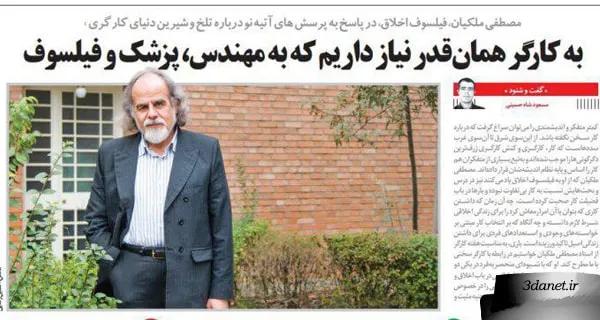
Kargadan Weekly Interview with Mostafa Malekian
Malekian sees the zest for life as independent of calculation, but in its absence, practical rationality dictates that life's costs and benefits be weighed. A cost-benefit deficit is a necessary condition for suicide, not a sufficient one, for fear, concern for loved ones, and religious beliefs act as deterrents.

Calculating and arriving at the conclusion that the cost of living outweighs its benefit is a necessary condition for suicide, but it is not a sufficient condition, because three other factors may arise that prevent us from committing suicide: one is that we may lack the courage to do it.
We may have loved ones and know that if we commit suicide, life will become hell for them. In order not to turn the lives of our loved ones into hell, we refrain from suicide, because we say that by committing suicide we relieve ourselves, but we subject others to torment, torture, pain, and suffering, and since those individuals are dear to us and we do not wish torment and suffering upon them, we therefore desist from suicide...
.
Kargadan Weekly Interview with Mostafa Malekian
.
Of the Suffering We Endure A Conversation with Professor Mostafa Malekian On the Joy of Living and the Vague Inclination toward Suicide
.
As Rumi narrates it, “Just as Galen the generous said, ‘from / the air of this world and from desire,’” he is willing to continue his life half-dead in the hindquarters of a mule rather than die. On the other hand, Rumi tells the story of Hamza, the Master of Martyrs, who went into battle against the enemy without armor and said, “He for whom dying appears as peril / takes the command ‘cast not yourselves’ into his hand.” We visited Professor Malekian and asked him: can it be said that Galen had a zest for life and Hamza a zest for death? Moreover, can the zest for life be obtained through a cost-benefit calculation of living? Where does this zest for life come from in the first place, and how does it disappear, and... I remember one day we were discussing euthanasia. That day’s discussion was a missed opportunity, and the reason was that you said discussions about euthanasia are not independent, and we must first clarify our own position on suicide before entering into other matters. That day, the discussion of the zest for life and existence came up. I heard another point from you where you said a person does some reckoning, thinks about profit and loss, and realizes whether life, with its pain, suffering, and calamities, is worth it or not. If it is worth it, well, they continue living in whatever way. If it is not worth it, they terminate life at some point. Is this zest for life the same as this worthiness? That is, within this reckoning, it becomes clear whether I have a zest for life... No, these two are different. What we interpret as the passion, zest, and vitality of life is an inner state arising from the category of "feelings, emotions, and affects." If this inner state exists within you, you have no need whatsoever for any weighing, measuring, or calculating of the costs and benefits of life, nor do you need to refer to practical rationality. Your personality and character are shaped by five factors: one, the issue of heredity; two, education and upbringing, especially the education and upbringing of the early years of life; three, age; four, mental experiences; and finally, five, psychological type. It is these five factors that cause your personality and character to differ from my personality and character, or my personality and character to differ from another's personality and character, and in general, they make every human being's personality and character different from another's. When these five factors come together, they create in some human beings a zest for life (in other words, élan vital); that is, vital vitality or the passion for life. Human beings who possess a zest for life have not reasoned for living, nor have they made calculations, nor have they used an abacus, nor have they calculated the costs and benefits of life. Through the interplay of these five formative factors, they have found themselves possessed of vital passion and a passion for life. So much so that if one day you ask them to calculate the costs and benefits of their life, they will laugh at you and say, "Why should I do a reckoning for something from whose pleasure I am overflowing, to see whether I want to continue it or whether I want to kill myself and not continue?" Thus, in principle, "élan vital" pertains to the realm of our feelings, emotions, and affects, and in this realm, there is no calculation of costs and benefits. Such human beings are fundamentally enamored with life and cling to it with all their might, and if someone tries to separate them from life, they will certainly resist. Why? Because they derive pleasure from life itself. But if, for some reason, you either never had this élan vital from the beginning or lose it over time, then you are compelled to resort to calculation for continuing life. In fact, it is here that you become in need of practical rationality. Because the outcome of practical rationality is that it tells a person, "Do not undertake an action whose cost exceeds its benefit, and if for some reason you have undertaken an action and midway through you become aware that the benefit of this action is less than its cost, you must stop that action." It is here that a person comes to themselves and says, "The most important action I am undertaking is the very act of living." So I must do a reckoning about the very act of living and see whether its cost exceeds its benefit or is less. If its cost is greater, by the rule of reason, I must stop this action, and in fact, stopping the action of living is nothing other than suicide. In practical rationality, it is said that whenever you want to start an action, you must calculate its costs and benefits, and if in this calculation you reach the conclusion that its cost exceeds its benefit, you either should not start that action, or if you have started it and realize during the course of it that its benefit is less than its cost, you must stop it. The "action of living" does not have the first option, because the beginning of life is not within my or your control.
پس شق دوم معنا دارد که اگر وسط کار متفطن این معنی شدی که فایده زندگی به هزینهاش نمیارزد، باید آن را کات کنی. فایده و هزینه زندگی را باید محاسبه کرد و به اقتضای عقلانیت عملی ما باید از نو ارزیابی کنیم تا ببینیم باید به زندگی ادامه بدهیم یا نه. در اینجا دو مطلب را باید گفت؛ مطلب اول این است که محاسبه کردن و رسیدن به این نکته که هزینه زندگی بیشتر از فایده آن است، شرط لازم خودکشی است ولی شرط کافی آن نیست چون ممکن است سه عامل دیگر پیش بیایند تا ما دست به خودکشی نزنیم: یکی اینکه شجاعت این کار را نداشته باشیم. دوم اینکه ممکن است ما عزیزانی داشته باشیم و بدانیم که اگر خودکشی کنیم زندگی برای آنها جهنم میشود. برای اینکه زندگی عزیزانمان را جهنمی نکنیم دست به خودکشی نمیزنیم، چون میگوییم ما با خودکشی خود را آسوده میکنیم اما کسانی را به عذاب و شکنجه و درد و رنج میاندازیم و چون آن افراد برای ما عزیز هستند و خواهان عذاب و رنج آنها نیستیم، لذا دست از خودکشی باز میکشیم...
Is the pain and suffering of loved ones also counted among the costs of living? Is this not also a kind of cost we must pay for life?
No. The cost I referred to earlier is the cost of living, but this cost—the pain and suffering of those around us and our loved ones—is the cost of suicide... But the third factor. The third factor is that, while I believe the cost of living outweighs its benefit, I have an ideological attachment to a school, a creed, a cause, a religion, a faith, a sect, a rite that prevents me from suicide. This factor arises in a life of faith. I myself have encountered people who firmly believe their life has no value and its cost exceeds its benefit, yet because their religion forbids them from suicide, they continue living. Now, from here, I want to point out another matter: someone who has a zest for life and someone who, through a calculation of benefit and cost, has concluded to continue living, are not alike in their living. They have one important difference; the former derives pleasure from life, but the latter derives profit from life. There is a great difference between people who feel pleasure from their existence and those who gain profit from living. In other words, for someone who has zest, living itself is an intrinsic good. It is desirable in itself. That is, they love living for the sake of living. But someone who, through calculation, has concluded that the benefit of life outweighs its cost and that one should not commit suicide, continues living but has no zest in their life. They do not derive pleasure from life itself, but rather gain profit through life. For them, life is not an intrinsic good, but an extrinsic good. In other words, they have made life a ladder to reach something else through it. This difference is an important one, first articulated by Aristotle in Western philosophy. Up to this point, I have spoken about life itself, but from here on, I want to speak about the actions a person performs in life. The actions we perform in life are sometimes for the pleasure we derive from the act of doing them, and sometimes for the profit we gain from the result of the action. For example, when I dance, it is from the very act of dancing that I derive pleasure. If someone asks me, 'Do you dance to achieve something through it?' I say, 'No, I achieve nothing; I am simply enjoying the dancing itself.' But suppose there is a dancer who, as it happens, today derives absolutely no pleasure from the dance itself, but has sold tickets and has an audience. They do not enjoy the act of dancing, but have chosen dancing to attain that wage. Studying is the same. On the night before an exam, you might well derive more pleasure from watching a television film, but you forgo doing that and turn to studying (assuming you derive no pleasure from the studying itself) and do it for the exam grade. In this case, you are seeking profit from studying, not pleasure. A person either derives pleasure from the process of the work itself, or profit from its product, or, if they are fortunate, from both together. Like an artist who both enjoys the art itself and gains profit through the wage they receive. This requires very great good fortune for you to both enjoy the actions you perform and profit from the result of the work. This good fortune rarely occurs, and we may not experience even a hundredth of this good fortune in our entire lives. I have said many times that one of the greatest signs of a fulfilled person is that their hand is in the very work their heart is in. Because their heart is in the work, they enjoy doing it, and because their hand is in that same work, they profit from its results. Actions can be divided into two categories: actions whose process is pleasurable, and actions whose product is profitable. Some actions possess both pleasure and profit. The difference between someone who has zest and someone who continues their life based on a calculation of benefit and cost lies precisely in this: the former seems to derive pleasure from the very process of living, but the latter does not; the latter gains profit from the product of living. Based on this analysis I have presented, one group of us humans live without asking why we should live, because we have élan vital. Another group of us asks why we live, because we lack a zest for life, but since the result of our calculation has been that, on balance, the benefit of life outweighs its cost, we continue living. There is also a third group. These, too, have lacked a zest for life and have been compelled to ask why they should live. But their calculation has led them to conclude that the cost of life outweighs its benefit. This last group divides into two: one part commits suicide, and the other part does not commit suicide because of one of those three reasons I mentioned earlier.
In my view, because the passion for life is absent in most human beings, we must create conditions so that when they arrive at the question of calculating benefit and cost, they find the benefit greater than the cost. We must not bring about circumstances in their lives such that when they engage in this calculation they reach the conclusion that the cost of life is not worth its benefit and practically turn to suicide or decide upon it. My point is that those who are concerned that people not fall into despair are naïve if they imagine that by holding ideology and worldview classes they can prevent people from reaching despair. For the individual whom you wish not to fall into hopelessness and not to develop a pessimistic outlook on life, you must provide conditions so that when he himself calculates the cost and benefit, he sees that the benefit of life outweighs its cost. Otherwise, if for any reason you create a hellish life for an individual, where he can take no enjoyment in the institution of the family, nor in the institution of politics, nor in the institution of education, nor in the institution of ethics, nor in the institution of religion and creed, nor in the institution of the economy, and more pain and suffering come to him than the enjoyment and pleasure he derives, then even if you hold a thousand ideology and worldview classes for him, it is of no use. To reduce suicide or to reduce the desire for suicide, the objective conditions of society must be improved, and one must not think that this phenomenon can be countered with a series of subjective calculations and holding classes. Because whatever you say in that class, and whatever you expound about the purpose of the creation of man, the cosmos, the universe, and so on, when I am calculating benefit and cost, I make my own calculation, and even if you say, “You endure pain and suffering, but in return, existence attains a purpose,” you cannot prevent my suicide. You must bring about a situation in the objective conditions of life where, on the whole, the pleasure I derive is greater than my pain and suffering. Pain and suffering, in the Buddha’s phrase, cannot be eliminated. Eliminating them is not possible, but something can be done so that at least I see that the pleasure I derive outweighs the pain and suffering of life. Or, in other words, that life is worth living.
So, by this account, does someone who has a zest for life have no need to grasp the meaning of life?
Not at all. The question of the meaning of life arises when you lose your zest for life. One of the reasons that, in the modern era, the question of the meaning of life has become more serious and even more prevalent in philosophy than in the pre-modern era is precisely that, for various reasons, that zest for life has subsided in human beings. Now, these reasons can be examined to see how much of it goes back to genetics, upbringing, or other things. If you have a zest for life, you sneer when the meaning of life is brought up. It is like you are sitting under a peach tree with good, colorful, juicy fruit and you want to eat from it, then someone tells you, let's first discuss how the peach came to be, why it came to be, and so on... These are meaningless words to you. This is the same thing that Buddha, and following him Rumi, said: that some philosophical issues and questions arise when a person is free from pain and suffering. There is an interesting story in the Masnavi. It says a person was passing by and saw a passerby whose nape seemed a good place to deliver a slap. [That one struck a slap upon Zaid's face / He too attacked, intent on treachery's place] The one who had been beaten and was in pain wanted to hit him back, but the one who had delivered the slap said, first answer my question, then if you want to hit me, hit me. Tell me, was this cracking sound from my hand or from the back of your head? [On your nape I struck, a crack resounded / I have a question here, in concord founded / Was this crack from my hand, or did it start / From your nape, O pride of the noble heart?] This is a philosophical dilemma. He replied that this is the question of someone who feels no pain. A person in pain does not ask such questions. [You who are pain-free ponder this alone / The one in pain has not this thought, be known] A person who is in pain never has this question cross their mind. Someone who has a zest for life has no pain that would make them ask about the meaning of life; rather, this question arises for someone who lacks the zest for life and has lost it. And each of us loses the zest for life for a reason... But all these things that take the zest for life from a person are "non-epistemic." Therefore, if the objective and external circumstances of life are favorable, we never arrive at the question of the meaning of life. But if the opposite is true (that is, they are not favorable), then we start reckoning and calculating. To put it simply, when you have a rendezvous with your beloved, your sweetheart, and your friend, a meeting time of five or six hours seems to you like five or six minutes. But when you have a half-hour meeting with your office boss, the time seems longer. This is when a person asks, "What is the philosophy of meeting with the office boss, fundamentally?" and from here arises the question, "What was the institution of the boss created for, and why must a person be accountable?" and so on. Consequently, it can be said that a person does not question what they enjoy.
The discussion of practical rationality comes up here. Can we, through practical rationality, overcome those hereditary traits and other things you mentioned?
Before I address your question, I must add a point to what I have said so far. All these suicides I mentioned pertain to non-ritual suicides. If I commit a ritual suicide in accordance with the requirements of my own faith, I am not subject to the statements I made. In this case, when a person commits suicide, it is not out of satiety, but because, according to the worldview they hold, they have been asked to do this... But your question. When someone arrives at the matter of calculating the benefit and cost of life, they must see whether life's benefit is greater or its cost. The first thing we can do for them is to ask: In what things do you see benefit and cost? When we want to calculate benefit and cost, we must first have a definition of each. Here, in philosophy, numerous candidates for benefit and cost have been proposed. The most important and defensible candidate is that benefit means pleasure and cost means pain and suffering. But this is not the only candidate. For instance, Hegelians say that benefit means self-actualization and cost means non-actualization. In their view, we did not come to enjoy as much pleasure as possible and repel as much pain and suffering from ourselves as possible; rather, we came to become self-actualized. If this self-actualization is accompanied by pleasure, so be it, but if it is accompanied by pain and suffering, so be it as well. There is another theory—believed by some mystical schools as well—which says that the benefits of life are "knowledge" and the cost of life is being deprived of it. Such candidates are numerous. I have discussed elsewhere what should be considered benefit and what should be considered cost when we want to discuss benefit and cost. Personally, my view is that benefit is nothing but pleasure and cost is nothing but pain and suffering. But do these theoretical philosophical discussions have any use or not? First, their use is that we can discuss with the person whether they have clarified for themselves what they want to consider as cost and what as benefit. The next thing we can do is, if they, like us, see benefit in pleasure and cost in pain and suffering, then acquaint them with the types of life's pleasures. It may be that because they do not know life's pleasures, they think its cost is greater than its benefit. And when they become aware of them, they realize it was not as they thought and that life's benefits are also plentiful. This matter can help those who have lost their zest for life and have turned to calculation. Let me give a simple example. A human being who has not reached sexual maturity has so far felt life's pleasures in eating, drinking, and playing, and so on. Suppose, because they think pleasures are limited to these three, they have calculated and concluded that life is not worth living. Now, if I tell this person, 'Wait six more years, then you will discover a pleasure in life that perhaps after discovering it, you will realize you must re-evaluate benefit and cost and reach different conclusions,' then the matter changes. There are many things that we humans are unaware of, and because we are unaware, we have no inclination toward life. Another thing we can do in these discussions—which is considered a limbo between philosophy and psychology—is to open other horizons of pleasure before people's eyes. The third discussion originated with the English utilitarians. Now, when you want to weigh two things in terms of their pleasure and pain, you must consider that pleasure and pain do not depend solely on their duration. Jeremy Bentham said, when you want to measure pleasure and pain, do not think that their duration is what matters. Suppose there is an action that gives me ten minutes of pleasure and fifteen minutes of pain. Because this is ten minutes and that is fifteen minutes, its pain is greater than its pleasure, and I conclude not to do that action. Pleasure and pain must be compared from numerous aspects. It is not just their temporal quantity. There is also their purity and other matters. It is very good if, when someone has objectively lost the will to live and has turned to calculating benefit and cost, philosophers and psychologists collectively carry out these three tasks.
Does someone ending their own life necessarily require that they do not believe in an afterlife? No, on the contrary. I believe that both those who have no belief whatsoever in an afterlife commit suicide, and those who do believe in an afterlife commit suicide. That is, it is not the case that belief in an afterlife deters a person from suicide... You can believe in an afterlife and not commit suicide, or not believe and not commit suicide, or believe and commit suicide, or not believe and commit suicide. Because all four scenarios are conceivable...
Here we are faced with a new species of human beings who live without knowing its meaning and do not commit suicide because they do not know its meaning either. Neither life has meaning for them, nor death... You used the word 'meaning' in two different senses here. When you say death has no meaning, it means I do not know what the state of death is like, but when you say the meaning of life, it means the worthwhileness of life, the value of life, that is, you calculate its profit and loss and see its profit as greater than its loss. We must always be careful that when the discussion of the meaning of life arises in philosophical and psychological books, we distinguish three meanings of the meaning of life. All three meanings are called 'meaning of life' in English and 'ma'nā-ye zendegi' in Persian. Sometimes what is meant by the meaning of life is the purpose of life, which in this discussion, my intended meaning of the meaning of life was not the purpose of life at all. Sometimes what is meant by the meaning of life is the value of life, which was, in fact, the subject of my discussion. And sometimes what is meant by the meaning of life is the function of life. For example, they ask, what was the meaning of Avicenna's life? That he wrote twenty-five books on philosophy, four books on medicine, and two books on logic. Here, what is meant by the meaning of life is the function of life. But my intended meaning of the meaning of life is precisely the value of life. That living be worthwhile and its benefit exceed its cost. But where you said we also do not understand the meaning of death, that means we do not know what phenomenon death is. Therefore, you fell into error due to the shared word 'meaning' in 'meaning of life' and 'meaning of death'.
What connection does your mention of people who believe in an afterlife yet still commit suicide have with the meaning of life? I want to reduce my suffering, so I kill myself. At the same time, I believe there is a world after death where I will be punished for this act. How could I kill myself? That is entirely suffering! I must mention two points. First, you assumed that if a person believes in an afterlife, they must necessarily also believe that there is reward and punishment in the afterlife. They must also believe in a God who gives reward and punishment in the world after death and certainly punishes suicide. Neither of these two assumptions is correct. That is, if a person believes in an afterlife, it does not necessarily follow that they see the realm of the afterlife as a place of giving rewards and punishments. A person might believe in an afterlife but believe that in the afterlife, no one receives reward or punishment. On the other hand, because you are familiar with the Abrahamic religions, in which suicide is forbidden and if someone kills themselves, they are condemned to otherworldly punishment, you think this way. The second point is that a person can believe in an afterlife and commit suicide—regardless of whether they fear punishment or not—now suppose I am a sadist. A sadist in the precise psychological sense, who cannot refrain from tormenting others, but on the other hand, my moral conscience is awake and I suffer from the fact that I am causing others to suffer. In this case, precisely because I believe in an afterlife, I commit suicide and say by killing myself, I reduce my evil from the people who are being unjustly oppressed by me. In my opinion, if certain rulers believe in an afterlife and reward and punishment, they should commit suicide to reduce their evil from the people...
I cannot say pleasure, but I can say that there is a vague desire in a person as if they want to kill themselves. The vague desire for suicide or the pleasure of annihilating oneself. Is there any justification for this statement? In my opinion, yes. There are certain things that, if lost in life, draw a person towards a desire to commit suicide. Note that I say "desire" and not "will." For example, suppose a person looks back at their past life and sees that they have not had a single second of peace. Then they strengthen their imagination and picture a peace for themselves in death. Here, this desire truly arises in them, but it does not reach the level of will. The desire for liberation, the desire for peace. There is another point besides these. There is a characteristic in some people that psychology calls adventurousness or sensation-seeking. Adventurousness in human beings, according to the upbringing they have received, may manifest in different ways. You and I may not be adventurous at all, but for those who are, again, depending on their upbringing, their adventurousness emerges in various forms. One person's adventurousness manifests in such a way that, for example, they go to war, where at the peak of danger, when the adrenaline in their blood increases, it is pleasurable for them. Another person's adventurousness might be satisfied through the flights they take. There are also those who happen to be introverts. They satisfy their adventurousness through dangerous paths and by throwing themselves into perilous situations. But the adventurousness of healthy people never reaches the stage of will. That is, the tension does not intensify to the point where desire transforms into will. Unless the person is psychologically unhealthy, in which case they gradually turn their desire into will, and it ultimately leads to action.
The mystical view says that since we do not consider this body as our own, we do not consider its destruction suicide either. "He who sees death as destruction / should take the command 'Do not cast yourselves' to hand." Should we consider this type of suicide as ritualistic or not, should we provide a mystical justification for it? I will give two answers, one of which is semantic. If, for example, I do not consider my body, or even my mind and soul, as myself, and consider the spirit as the self, then I have not committed suicide at all, because none of what I have killed was the "self." Semantically, it falls outside the scope of suicide. In this sense, we must say that it is as if I have merely removed one of these veils of my self. But the second point I want to make is the very thing that came to your mind. It should be considered a ritualistic matter... The sentence that Ali ibn Abi Talib says in the Sermon of the Pious is exactly this. He also has a desire for death. "لَوْلَا الْاجَلُ الَّذى کَتَبَ اللَّهُ عَلَیْهِمْ لَمْتَسْتَقِرَّ أَرْواحُهُمْ فى أَجْسادِهِمْ طَرْفَةَ عَیْنٍ شَوْقاً الَى الثَّوابِ وَ خَوْفاً مِنَ الْعِقاب.ِ" The point is that here he says if God had not appointed a specific time of death for each of them, their souls would not have remained in their bodies for the blink of an eye and would surely have flown away. This means a longing for death. Just as it is also narrated from him in this regard: "و اللََّهِ لَابْنُ أَبِى طالِبٍ انَسُ بِالْمَوْتِ مِنَ الطَِّفْلِ بِثَدْىِ أُمَِّهِ" meaning the affection a child has for its mother's breast is less than the affection I have for death. But this arises from within and is different from harakiri, which commands you from the outside to commit suicide in this way.
There are also suicides that are, in fact, accompanied by pain and suffering. That is, they completely negate the idea that I kill myself to reduce my pain. For example, those who immolate themselves. Culturally speaking, women who set themselves on fire have shocking statistics. How can one end life in such a painful way to escape the pain and suffering of living? Regarding these, too, you must separate two matters. One is that the person compares this pain and suffering, which lasts two hours until they die, with the pains and sufferings they have endured throughout life, and would endure if life were to continue. Therefore, this pain and suffering is very intense, but at least in the mental and psychological framework of that person, and in comparison to the pains and sufferings they have endured and will endure in life, it is still less. But there is a second aspect as well. A person who wants to kill themselves and be saved from pain and suffering, why do they come and do it with an act that is so agonizing? Well, they could go and take a strychnine pill and... Why do they come and choose the harder path? My conjecture is that choosing the harder path has a ritualistic aspect. In all tribes and nations, self-immolation has a ritualistic aspect. Self-immolation is not just suicide. It is suicide plus a message that it gives to those who see the scene. In suicides other than this, we have no message. In ordinary suicides, the person is merely freeing themselves from pain and suffering. But in suicides that involve self-immolation, it is a suicide to free oneself from pain and suffering that can no longer be endured, and it also gives a message that would not be there if they took a pill and killed themselves. This message has a ritualistic aspect.
The fact that it has become common in Tehran now for some people to throw themselves in front of the metro or for people to throw themselves off pedestrian bridges, does it convey the same meaning? This shows that the message of the suicide is gaining importance in it. That is, the person sees that if they throw themselves in front of the metro, they communicate something to others that they would not have if, for example, they injected an air bubble into themselves at home.
Meaning suicide gains a function? Yes, it has a social function. It has a social message. Of course, this social message is not necessarily a political message. It can have a political message at one time, and at another time, it can be for the purpose that someone wants to... disgrace [creation] in public through their act. We have this type of suicide that is telling the audience, look, what kind of world is this that a person, to escape from this world, is even willing to resort to this form of suicide. This is the message that many give to others with this type of suicide. That is, they are telling the whole world to come to their senses.
.
.
Download pdf of Kargadan Weekly's Interview with Mostafa Malekian
Download from Server 1 | Download from Server 2
.
.
On the Suffering We Endure A Conversation with Professor Mostafa Malekian On the Joy of Life and the Vague Desire for Suicide Interview by Kargadan Weekly with Mostafa Malekian, Issue 7, June 8, 2016
.
.




Discussion2 comments
غیر علمی. من درآوردی. بدون پشتوانه مکتب فکری. متاسفانه فک زدن و بافیدن در سرزمین ما هنر شده است!
دوست عزيز، دانش در خلاء شكل نگرفته است. خصوصا مقوله دانش در حوزه علوم انسانى كه اصالتاً انتزاعى است. هر اندازه هم بر پايه داده هاى آمارى بتوان صحبت كرد، در نهايت مى بايست استنباط هاى فردى را نيز به آن افزود. با اينهمه، به عنوان دانشجوى دكتراى آموزش (تحليل انتقادى گفتمان)، استدلالهاى استاد در حوزه معناشناختى semantics، تحليلهاى روانشناختى Psychoanalytics و مباحث هستى شناسى Epistomology را تاييد مى كنم. موفق و پيروز باشيد.