Philosophy
The Positive and Negative Dimensions of Being a Worker: Mostafa Malekian Interviewed by Atiyeh No Weekly
Mostafa Malekian sees work as having both positive and negative aspects: from self-sufficiency and the flourishing of talents to service to society. He recommends that, until the negative aspects are remedied, workers sweeten their lives by attending to the positive ones.
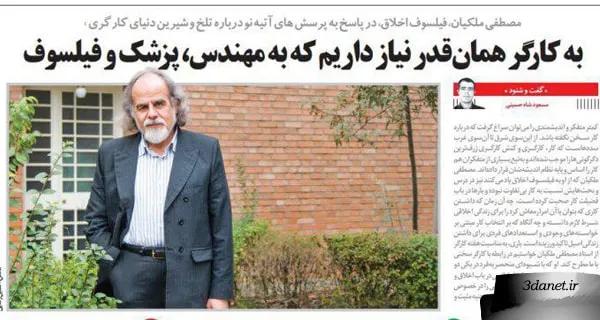
Interview with Mostafa Malekian by Atiyeh No Weekly
The Positive and Negative Dimensions of Being a Worker
We need the worker as much as we need the engineer, the doctor, and the philosopher
In my view, being a worker—not in the absolute sense of working, nor in the sense of that type of work we refer to as labor and whose practitioners constitute a specific social class, nor in the sense that all human beings work and, in the literal sense, everyone is a worker, i.e., one who works—but rather, I mean being a worker in the sense of that category of work which, in the social classification of occupations, is termed labor; being a worker in this sense has three very positive aspects and three distressing and negative aspects. As long as the three distressing and negative aspects are not eliminated—and their elimination in Iran, as in other countries of the world, is not easily possible—workers must, day by day and moment by moment, pay greater attention to those three positive aspects so that their lives may pass with less pain and suffering, so that their lives may become more bearable and even sweeter and more pleasant.
Being a Worker: Self-Sufficiency, Joy, and Delight in the Absence of Degradations
Of the three positive aspects that being a worker possesses, one is that the worker must constantly remind himself of the fact that, through working, he renders both himself and all those under his care free from need of others' help. When human beings are in need of others' help, these very material needs bring about numerous psychological afflictions and immense moral degradations; therefore, I, the worker, by working, insofar as I am able, exempt myself and the members of my household from material need of others, from stretching out a hand of need to anyone, and from looking to the hands of others. And as long as I exempt them from stretching out a hand of need to others and from looking to the hands of others, I am, in truth, saving them from severe psychological afflictions and immense moral degradations. For instance, I save them from losing their self-esteem and dignity. I save them from having to flatter and fawn upon others. I save them from losing their independence in life and from having their fate depend on this or that person. Scrutinizing and enumerating the immense moral degradations and severe spiritual and psychological declines requires more time and deeper reflection, but when I render myself and the dependent members of my family self-sufficient through working, I at least save others from affliction and degradation, and this brings with it great delight and happiness. If we knew how valuable the absence of moral degradations and psychological afflictions is in life, we would realize how joyful and delighted we should be that we work.
Being a Worker: Self-Actualization of Inner Talents
The second positive dimension is that when I work and am a worker, I am in the process of actualizing my inner talents. Of course, such a discovery depends greatly on how much I am interested in and love the work I am engaged in. In other words, it is very important that my work be in a field I love or in which I have talent. But even if my work is not exactly what I love most and have the greatest talent for, by working I nonetheless bring a series of my existential potentialities into actuality and cultivate a set of my talents. This self-fulfillment is a very important matter. The fact that you see people in the West, even knowing they would have a much higher income using unemployment insurance than during their period of work and employment, do not use unemployment insurance, goes back to this very issue. It is almost impossible in the West for someone who can be employed to use unemployment insurance. One reason is that work, even if it brings an income equal to unemployment insurance, gives a person a kind of self-fulfillment that never exists during periods of unemployment. Therefore, through working, we manifest our talents. That is, not only do we not allow our talents to remain dormant within us through working, but we also bring them out from a hidden state into a state of manifestation. This manifestation of talents is no trivial matter and is so valuable that I say in all honesty, if a day and age came when the situation was such that there was no work for which I would be paid wages, I would still be willing to go and work, even if they did not pay me. Because the very act of working, even without pay, cultivates talents. From this perspective, as one of the German mystics said, if a day ever comes when there is no work that pays you wages, and if society reaches a point where you have to pay money to be given work, go pay money and work. Because the cultivation of talents itself is important.
Being a Worker: Changing the World, Serving Society and Humankind
The third positive point is that through working, a person serves the society in which they live, in the specific sense, and the global community, in the general sense. Because work, in addition to giving us an income and cultivating my talents, also changes the world. In truth, working and changing are two concepts but have a single referent. Every action changes the world, and everything that changes the world is of the nature of action. In truth, through working, we change the world. Working and changing the world may, in a smaller circle, benefit my own society, the citizens of my society, and my compatriots, but on a global level and in a more general view, through the work I do, I also serve humankind. Because, after all, even the most invisible and smallest work I do, this working can benefit all of humanity. Suppose as I walk down the street, even if I pick up a small piece of trash and throw it in the bin, I am in fact helping the entire human community. Let alone if my daily and weekly work involves changing the world. These are great advantages, and the more a person reflects on these three aspects of working, the more their love for work increases. Especially when we are confronted with the three negative and distressing aspects of working. For this reason, and to make life sweeter and more pleasant, it is necessary for us to inwardly practice focusing on the three positive aspects of work.
Being a Worker: The Bitterness of Wages Less Than Deserved
Unfortunately, workers also see three negative dimensions in their work. The first dimension is that they see the wages they receive as not commensurate with the work they do. That is, they receive less wages than the work they do and the entitlement they acquire by virtue of that work. Meaning they feel they are not treated fairly. Whatever meaning we consider for justice, the reality is that there is a very high possibility that a worker will not be treated justly. Especially since, unfortunately, in the classification of social occupations, workers are the "lowest" stratum of the socially employed, and the lower they are, meaning they have less power in decision-making and settling affairs and play a lesser social role. Of course, it is necessary to mention that from an ethical standpoint and in terms of moral value judgment, there is absolutely no such perception of workers and their work. Therefore, the less power workers have, the greater the possibility that they will be oppressed and that justice will not be applied in their treatment. This is a pain and suffering that workers experience everywhere in the world, with differences and varying degrees. That is, they feel their rights are not fulfilled and they work more than the wages they receive. Such a state creates a kind of bitterness for workers. In some occupations, this is never the case, but in all different types of labor, this bitter reality exists.
Labor: The Sacrifice of Social Dignity
There is a second bitter reality, and that is that the social dignity of workers is undervalued from the perspective of other citizens in their society. This issue is separate from the low wages they are given. Society must understand that we need the street sweeper as much as we need doctors, and we need the technician as much as we need the engineer. Members of society must know that society is like a house that needs all its components. In other words, if any of the components of the house are absent, the remaining components cannot compensate for the absence of that component, and the lack of one component in the house deprives and prevents all other components of the house from functioning. Therefore, if the house lacks any of its components, it is no longer a house and one cannot dwell in it. By the same token, if society lacks any of its trades and occupations, it remains idle and becomes disorganized, and the disorder of society does not at all depend on its doctors, engineers, university professors, and jurists not working. If workers in the simplest occupations in any society do not work, that society will be subject to disruption. But this matter is not understood by all of us, and for this reason, workers may feel that among social occupations, the least social dignity, status, rank, and popularity is considered for them. Even knowing that if they stop working one day, society will be disrupted, workers still have this feeling. I certainly believe that if the street sweepers of a society stop working one day, the system of society will be disrupted more than the day the philosophers, theorists, orators, and speakers of that society stop working. As long as this importance is not understood, workers do not receive the social dignity, status, rank, and popularity that is worthy of them, and this may also become the source of their second pain and suffering.
Labor: The Neutralization of Effort and the Failure of Benefit to Reach Society
The third distressing and negative aspect of being a worker is that every worker is engaged in a single job. If this job is to benefit society, it must not be neutralized in its continuation. That is, if I am a self-sacrificing worker but my bosses, and my bosses’ bosses, and my bosses’ bosses’ bosses are corrupt and unhealthy individuals, the outcome of the work whose primary aim was to benefit society becomes impossible. That is, no matter how much I apply my knowledge, experience, wisdom, and abilities, my work is carried out at one stage, but the issue is that this work must be joined to thousands of other tasks for its effect to appear in society. Now, if my work is joined to the work of others who are working in my organization, or my institution, or my company, factory, farm, etc., and they perform their work poorly, then the result of my work will not reach those who are the recipients of that result. In this case, my effort is neutralized, and other people prevent the benefit of my work from reaching society. Especially if my bosses do not do their jobs properly. Because I, as a worker, always need the genuine cooperation of two groups. One group is those who are workers like me, and the other group is those who are my bosses, and my bosses’ bosses, and my bosses’ bosses’ bosses. Now, if there is corrupt management, the work of me, the worker, and all my fellow workers will not leave its effects on society. The reason is that a series of factors have blocked this effectiveness. This issue is extremely painful. Suppose I am a worker on a dam construction or building project, and I do my job well. If those who must perform the higher-level tasks in this dam or building do not perform equally well, my work and the work of thousands of other workers who have labored diligently on this project are completely ruined. This situation is very painful. Because I, the worker, had at least consoled myself that I was filling a void and a gap in society, but when I realize that despite having worked, the gap has not been filled, I then face serious bitterness. Because the poor performance of others, and the poor performance of my managers and my managers’ bosses, has prevented the gaps from being filled.
As long as these three negative aspects exist, the only way workers can preserve their mental health is to pay attention to the three merits that exist in their work and to know that these three merits are very great. However, the wish of every moral human being, and even every emotional human being, is to move slowly and gradually in a direction where, if those three negative points cannot be eliminated, at least the intensity of those three negative merits is reduced. Therefore, if we are not workers and fall into a category other than worker in the occupational classification, it is more ethical, when encountering workers, to at least show our understanding of the three important merits of workers, so that, to the extent of our own share, we reduce the negativity of being a worker in the workers’ eyes.
.
.
PDF file of the interview on the Positive and Negative Components of Being a Worker
.
.
The Positive and Negative Components of Being a Worker
Interview by Atiyeh No Weekly (Masoud Shah Hosseini) with Mostafa Malekian, April 30, 2017
.
.




Discussion3 comments
تیتر بی انصافی در حق کارگران است. به کارگر بیش از مهندس و پزشک نیازمندیم و البته بسیار بیشتر از فیلسوف.
منظورش واسه جنازه جمع کنی ست که قبلا توسط دکتر مهندس های آقازاده ای تولید شدن
با آقای علی موافق ام . نیاز به جامعه به کارگری که با وجدان کار کند و چرخ های تولید را بچرخاند، خیلی بیشتر از دکتر و مهندس و فیلسوف است. کارگری که با دست و پنجه نرم کردن با سختی ها یاد گرفته است که دارندگی در بسندگی است و بسا پزشک و مهندس و مدیر و وزیر و وکیل غوطه ور در دارندگی ها هرگز معنای داشتن در قناعت را درک نکند.