Political Science
Tejarat-e Farda Weekly Interview with Mousa Ghaninejad on “The Reasons for Corruption in Iran”
Drawing on David Hume, Mousa Ghaninejad argues that the root of corruption in Iran is not a lack of oversight institutions, but a structure designed around trust in specific individuals—a system meant to prevent corruption, yet in Iran ideological vetting has replaced structural reform.
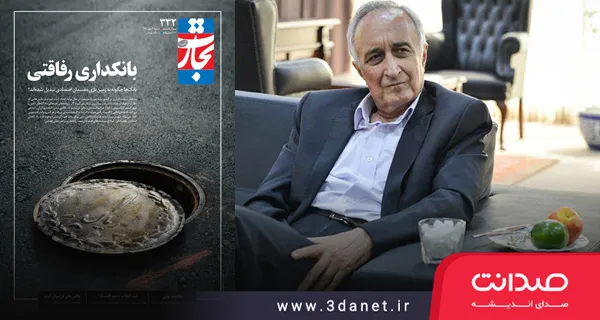
Why, despite the existence of numerous oversight institutions, has corruption become so widespread in Iran? Mousa Ghaninejad answers this question by drawing on the philosophy of the modern world, stating: A good political system is one founded on the assumption that its officials are all potentially base individuals pursuing their own self-interest, and the political system should be designed in such a way that even if the worst and most wicked people are placed in positions of power and responsibility, the system and structure do not permit widespread error and corruption. But what is the administrative system like in Iran? Ghaninejad says: We believe we can select committed and compassionate individuals from among our own, pass them through numerous selections and barriers, and then place them at the apex of the administrative and economic decision-making pyramid; these individuals, even if a breeding ground for corruption exists, will not gravitate toward it. He emphasizes that the problem of corruption in Iran is neither a shortage of oversight institutions nor necessarily too few or too many laws and regulations. The problem is that our systems and structures are primarily designed to rely on certain elites. On the other hand, there is no powerful opposition or independent media in the country to monitor their work, and the result is what we see.
Numerous institutions in Iran are responsible for addressing and combating corruption. From bodies within the Parliament and the Executive Branch to the Judiciary. But why, despite all these anti-corruption organizations and institutions, is the state of corruption in Iran so unfavorable?
David Hume, the eighteenth-century English philosopher, has a famous quote in which he says that a good political system is one founded on the assumption that its officials are all potentially base individuals pursuing their own self-interest. That is, the political system should be designed in such a way that even if the most villainous people are placed at the head of affairs, they cannot inflict significant damage on the public interest of the country. In the modern world, the political philosophers' contrivance for a desirable political system exemplifies David Hume's dictum. That is, the political system and administrative structure should be designed so that even if the worst and most wicked people are placed in positions of power and responsibility, the system and structure do not permit widespread error and corruption, and individuals cannot inflict serious harm on society and the public interest. Sound structures are the very factor that has kept the level of corruption low in the administrative and economic systems of advanced, democratic countries. In these countries, the structure is designed to be anti-corruption, and strong political parties and free media exist that prevent the emergence, appearance, and spread of corruption. But look at Iran. The thinking governing our economic system and administrative structure is precisely the opposite. We believe we can select committed and compassionate individuals from among our own, pass them through numerous selections and barriers, and then place them at the apex of the administrative and economic decision-making pyramid. The assumption is that these individuals are so good and incorruptible that even if a breeding ground for corruption exists, they will not be inclined toward it and will always defend and support the public interest of the country. Incidentally, in such an ideology-driven structure, the government makes decisions that create grounds for rent-seeking and corruption; on the one hand, there is no powerful independent political party, nor truly free media that, free from the wrath of the ruling power, can or will scrutinize those in power at all levels. The result is what we see. Administrative and economic corruption emerges and grows in the country. Our main problem is that our systems and structures are primarily designed to rely on certain elites and are then, in practice, left to their own devices. Of course, we have established oversight mechanisms and have supervisory bodies, but because their structural logic is the same as mentioned, the mere commitment of the oversight institutions not only does not solve the problem but sometimes exacerbates the complexity and fuels more widespread corruption. This is while we rightly claim to have a popular or so-called democratic system. But the existence of a democratic or popular system alone is not enough. Our problem is the thinking that governs our decision-making system. Our thinking is that within a specific ideological framework, committed individuals can be selected and entrusted with the work with peace of mind. But the issue is not that simple, and our main mistake lies precisely here. Generally speaking, the organization of our administrative apparatus and systems is poorly designed.
So, due to an ideological outlook and an unsuitable administrative system, corruption is on the rise?
Yes, I used the thought put forward by David Hume to answer your question about Iran. We have a state economy that is dependent on the government, and the government intervenes in all its affairs. On the other hand, we have a political system that operates in a completely ideological manner. Instead of expertise and competence, it only pays attention to individuals' commitment to a specific ideology. The result is what we see. We imagined that if good people passed through ideological and political filters and were selected based on certain criteria and values, they could rise to the top of the power pyramid and become defenders of the public interest without causing any problems. The notion was that good people at the head of public administration would manage things well. But look at the result. All the problems we have today are the result of this mistaken notion. Now our courts are full of state-owned automaker managers. How did these automaker managers get to the top? Didn't they all go through those specific ideological and political selections? Didn't they all have approvals? They were all apparently reputable and committed people. But why did this happen? This shows that the system and structure of government domination over the economy is the source of corruption and must be resolved. This shows that our structures are flawed, and until this flaw is fixed, the problem of corruption will persist.
So, in the modern world, the assumption is that everyone must potentially be considered corrupt, and the structure must prevent corruption, but in Iran, we have said that having good people in charge is sufficient and have neglected the system?
That is precisely the dominant view, and this must be corrected.
But some suggest forming an independent organization to oversee the activities of current institutions. But what guarantee is there for the success of a new institution?
Forming and establishing new oversight institutions without reforming the structure is a futile exercise. I return to David Hume's thought, which says the structure of modern governmental apparatuses must be anti-corruption and prevent corruption. They have realized that the existence of multiple oversight bodies not only does not solve the problem but is itself part of the problem. Suppose you appoint a supervisor to oversee a system. Well, who should supervise that person? So we must appoint another supervisor for that supervisor, and so on... By forming a new institution, we will be caught in an infinite regress that has no end point. Therefore, we must create a system in which oversight is carried out automatically and spontaneously.
Currently, there are numerous oversight bodies in the executive, legislative, and judicial branches. But why haven't they functioned properly so far?
We have established numerous institutions, laws, and regulations, but we have not observed the fundamental rule. That fundamental rule is that we need a modern anti-corruption structure. This structure has several components: a free competitive economy, genuine and independent political parties, a strong opposition, and finally, an independent press free from the pressure of political power. In principle, a requirement of a democratic political system is always the existence of a strong opposition equal in weight to the ruling power itself. But where is Iran's opposition? In Iran, we have a formal opposition dependent on the ruling power. Look at France. The opposition in France stands outside the government and is an observer and obstacle to any violation. Here, oversight is formal and not real. That is why it yields no results. We have imported a mock-up of Western democracy in the form of a popular electoral system and think we have a democratic system. Of course, to be fair, we are not like the dictatorial countries around us. We do observe some democratic principles of elected government. But, as it happens, a half-baked democracy is more prone to corruption. Furthermore, we need a free and independent press system. Alongside reforms to the governmental structure, the economic system must also be reformed, and we must move from a state-run, rentier economy toward a free economy. Our economic system is under the domination of political power. Even our private sector is heavily indebted to the state and lives in fear of the wrath of government officials and political figures. But if you have a competitive economy where the law rules, not the political will of individuals, free competition will solve a large part of the problem. All of this requires that the economy not be state-run, that there be no state monopoly, and that economic enterprises not be indebted to and dependent on political power, so that a desirable economic system can take shape that monitors itself. In this state, you do not need a supervisory body. The corrupt will automatically be eliminated. Which of these preconditions have we observed in Iran? We thought the problem would be solved by selecting individuals and the oversight of a few institutions. In Iran, the entire system operates based on the selection of insiders and outsiders. This insider-outsider system is what creates corruption. I repeat, selection must be based on the expertise and professional competence of individuals, not on a commitment for which there is no measure. Criteria that are often formal and only observed in the outward appearance of individuals. Much corruption originates from these very selected insiders. Therefore, if you ask what exactly must be done, I say that instead of these corruption-generating privatizations, we must genuinely liberalize the economy, create transparency, and allow the press to be free and a real opposition to form in the country; otherwise, under the current conditions, we will get nowhere and will not succeed in the fight against corruption. Some propose creating a new supervisory body under the highest authority in the country. In response, it must be said that we already have the Judiciary. We even have the Article 90 Commission in the Parliament, whose members are directly elected by the people. Why have they not been able to do much? Why have the Inspection Organization and other bodies not been able to? There are many supervisory bodies in the country according to the Constitution that have not been able to carry out a successful fight against corruption in practice; now, what is the use of adding another body to them? When the current institutions and organizations cannot solve the corruption problem, we must conduct a fundamental review to find the root of the problem. Not propose creating another supervisory body. Perhaps the new body will also become a source of further corruption. These are not solutions. The system must be reformed.
Some believe one of the problems of our supervisory organizations is their large structure. Among them is Mr. Tavakoli, who has proposed that a new, agile organization be formed from experienced individuals who have previously proven their mettle and are currently working in other organizations. These individuals would be selected and assigned to the new organization.
What he is saying is precisely the statement of the problem, not the solution. He says to put someone who has passed the test at the head of the supervisory body. Well, the problem is precisely these insiders. These same individuals have always been in this system and, for whatever reason, have been unable to prevent corruption and rent-seeking. What guarantee is there now that they can? How do we know they won't face a conflict of interest themselves? As I said at the beginning, our problem is the dominant thinking in our system of governance and decision-making. We constantly emphasize forming a circle of insiders to fight corruption because these individuals have passed their test and are committed. We are not saying they are not committed. We are saying the system is such that it generates corruption. We say the solution is to eliminate the grounds for golden signatures, not to give all the golden signatures to one person or group and say that because they are committed, no corruption will occur. We say let's make it so that there is no golden signature. The system must be reformed. Not to say let the corrupting structure and system remain, but put a committed individual at its head. Because then you have to put another person to oversee that committed individual. Will the problem be solved then? No, it won't. It will get worse.
Many believe that changing laws and regulations can solve part of the problem.
The laws are also written in relation to this same defective system. As I mentioned at the beginning, the laws also trace back to the mindset governing the country's administrative system. The idea that if good people become officials, the problem will be solved is an entirely false claim. If this mindset is reformed, the laws shaped by this mindset must also be reformed. This is where we must start. From reforming the prevailing thinking in the country. If we want to do fundamental thinking to solve the problem of corruption, formal methods and case-by-case confrontations are not the fundamental solution. We must return to the roots and reform the ideology and accept that we are part of humanity. We are not a breed apart, and we are not supposed to reinvent the wheel. The whole world has a specific experience that we must use. Not to say that we are different from the whole world. Let us accept that our system has been inefficient and reform it.
You said that in democratic systems, corruption is low due to the dominant system and structure. But in some countries of the world that have dictatorial systems, corruption is also not high, at least compared to Iran, their corruption is not high.
Yes, this issue is very complex. The relationship between corruption and democracy is multifaceted and complicated. In fact, if democracy is implemented half-heartedly and the requirements of real democracy are not observed, the possibility of corruption is much greater than in a dictatorial system. The communist system of China is a completely centralized and dictatorial system. The ruling Communist Party controls the destiny of the entire society. There is no democracy there. But its corruption is less. Or another example is North Korea.
So the political system is not necessarily important in fighting corruption. Another important factor besides the political system must be important.
We have created an eclectic system that, in the true sense of the word, is neither a democracy nor a dictatorship. The result is the current predicament. We have both the vices of democracy and the vices of dictatorship. We are not supposed to imitate China or become North Korea. We must find solutions appropriate to our own culture. We must create a more efficient and better democratic system. A system that is not based on ideology and whose criteria are professional competence and expertise. Another important issue is the existence of media and the press. One of the foundations of democracy and governmental and economic transparency is freedom of the press and media. We create obstacles for many things and say they require infrastructure, etc. What obstacle do we have for a free press? Perhaps one of the good and urgent steps would be freedom of the press. That is, instead of adding new supervisory bodies to existing institutions, we should free the media and guarantee the security of investigative journalism.
The concern about corruption is an important one, and everyone is concerned with fighting it. The solution to counter it is also clear, and we don't need to reinvent the wheel. But why isn't the problem being solved, and what exactly is the obstacle to fighting corruption?
The main obstacle is twofold: one is the intellectual problem of the country's management system, which was mentioned earlier. The other, which is tied to the first issue, is the vested interests of influential individuals and groups. Many people in our governmental system benefit from the current chaotic situation. It is clear that they outwardly chant the slogan of fighting corruption, but inwardly they oppose it.
How large and influential are these players, and how close are they to power?
We do not have precise information about what goes on behind the scenes, and there is no complete transparency. So, one cannot say how far corruption has advanced and to which levels of power it has reached. But the very fact that a serious confrontation with corruption cannot be carried out is the main reason that the octopus of corruption has infiltrated the higher levels. I state this not as news, but as analysis. The very inability to take effective action against corruption is proof that some individuals at the highest levels of officialdom are tainted by corruption.
.
.
Tejarat-e Farda Weekly's Interview with Mousa Ghaninejad on "The Reasons for Corruption in Iran"
Source: Tejarat-e Farda Weekly | Issue 332 - Crony Banking | Saturday, September 28, 2019
.
.


Discussion0 comments
No comments yet; let yours be the first voice.