Political Science
“Iran Is Right Here Where We Stand”
The session 'Iran Is Where We Stand' was held with scholars in attendance to honour Seyyed Javad Tabatabai and elucidate the 'Problem of Iran'. Speakers stressed the necessity of philosophical Iranian studies and preserving Iranian identity in the face of modernity.
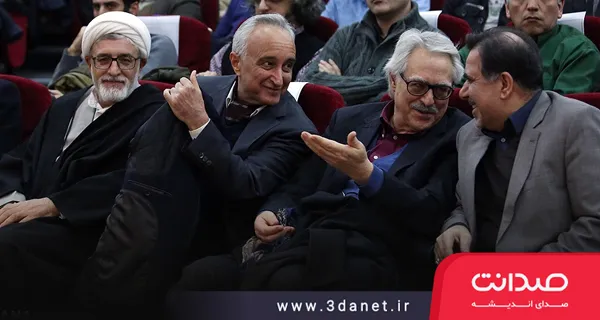
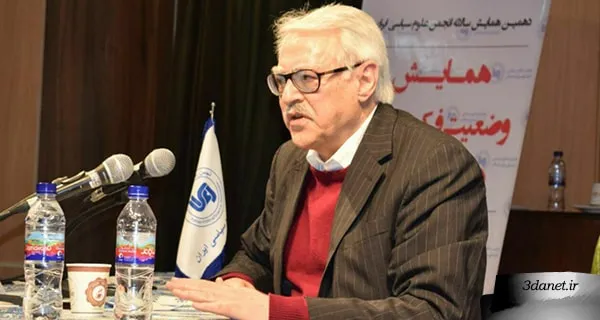
The session “Iran Is Right Here Where We Stand” took place with the presence of Mousa Ghaninejad, Seyyed Javad Tabatabai, Davoud Feyrahi, Hekmatollah Salehi, and Reza Davari Ardakani in the Ferdowsi Hall of the House of Humanities Thinkers on January 4, 2017.
.
.
Dr. Ghadir Nasri, faculty member at Kharazmi University: In mid-January 2017, the Iranian Political Science Association and the Intellectual Trends Group, together with Falat Publications, the Siyasatnameh Quarterly, and the House of Humanities Thinkers, organized and hosted a program titled: “Iran Is Right Here Where We Stand.” At this event, Dr. Hekmatollah Salehi (Professor of Archaeology at the University of Tehran) first spoke about the value of Seyyed Javad Tabatabai’s efforts in understanding Iran. After him, Dr. Davoud Feyrahi (Professor of Political Thought at the University of Tehran) recounted the intellectual-scientific atmosphere of the Faculty of Law and Political Science at the University of Tehran in the early 1990s. Following Dr. Feyrahi, Dr. Akhoundi, Minister of Roads and Urban Development, spoke of the “Problem of Iran,” and after him, Dr. Reza Davari (President of the Academy of Sciences and Professor of Philosophy at the University of Tehran) delivered a speech on the distinctions of Iranians in the realm of thought and philosophy. Then, Dr. Mousa Ghaninejad, in the absence of Dr. Ahmad Naghibzadeh (the invited professor for the session), made two points in praise of Seyyed Javad Tabatabai. At the end of the program, the main speaker of the session, Dr. Seyyed Javad Tabatabai, began to recount his concerns, the elaboration of which you have before you. What follows in this text is Ghadir Nasri’s (Director of the Intellectual Trends Group and Associate Professor of Political Thought at Kharazmi University of Tehran) account of the program held in honor of Iran.
Hekmatollah Salehi: Seyyed Javad Tabatabai is a Qalandar of Two Climes.
The program “Iran Is Right Here Where We Stand” was opened by University of Tehran archaeology professor Dr. Hekmatollah Salehi, who, describing the region in recent years as uniquely perilous, asserted that we are perhaps experiencing the most dangerous era in our history, one without parallel. In Salehi’s view, Javad Tabatabai is a Qalandar of Two Climes, meaning he is preeminent and profound in understanding climes. By one clime, he meant the science of modernity and the West, and by the second clime, the place where we stand, that is, Iran. “Deeply understanding one clime and accurately conveying it to the other clime” was the attribute Salehi ascribed to Tabatabai, and he described Tabatabai’s admonition to everyone as a virtue worthy of reverence. This University of Tehran archaeology professor’s counsel was that Iran, from Arvand to Hirmand and from the Persian Gulf to Atrak, is a unified whole, all parts of which exude a familiar scent, and we must all take care that this precious and enduring whole does not fall into peril, because we are experiencing the most unprecedented era of decline and destruction of heritage in our vicinity and our world. Although thousands of languages, cultures, and nationalities have perished throughout history, Iran still stands, and this glorious heritage must be guarded and protected, and Seyyed Javad Tabatabai has done and continues to do so.
Dr. Davoud Feyrahi: The founder and exponent of philosophical Iranology is Seyyed Javad Tabatabai.
The second speaker of the “Where Do We Stand? Iran” session was the professor of political thought at the Faculty of Law and Political Science of the University of Tehran, who, with a memoir-like account of Dr. Seyyed Javad Tabatabai’s scholarly-research conduct, asserted that Tabatabai, with his first authored book in the early 1990s, showed that he had a vast and valuable project in his quiver. According to Fihri, in the 1990s, most discussions about Iran and its issues were either a society-centered sociology, which, in the form of Dr. Hossein Bashiriyeh’s approach, dealt with explaining the social foundations (social classes) of political power, or a sociology of the type found in Dr. Ahmad Naghibzadeh’s book (An Introduction to Political Sociology), which highlighted the role and contribution of the state in the formation of social developments. In such an atmosphere, Seyyed Javad Tabatabai’s project, centered on philosophical Iranian studies, found numerous and passionate audiences, and Tabatabai, by inventing and elaborating on Iran as a philosophical problem, gave unprecedented expansion to the discussion of the modern state, homeland, and the image or picture of the modern state. Davoud Fihri’s final remark was that Dr. Seyyed Javad Tabatabai, by explaining the intellectual foundations of the state and devising a philosophical approach for this grand design, in fact transformed fantastical Iranophilia into philosophical Iranian studies. Dr. Fihri, at the end of his speech, as a seminary student, prayed for Tabatabai’s health and greater success. Dr. Akhoundi: The problem of Iran is a stranger in the country of Iran. The Minister of Roads and Urban Development, affirming that he attended this session out of his fondness for Seyyed Javad Tabatabai and his project on Iran, emphasized the point that in every approach, decision, and action, we must know where Iran is; a street in Iran must have an Iranian identity; five-year plans must keep Iran in mind and consideration; and it must not be that the volcano of modernity overshadows all Iranian values under the influence of development. Let all researchers and scientific strivers remember what Iran is and how much of a problem it is for us.
Dr. Davari: Iran in the East, on par with Greece in the West
The fourth professor to speak at the commemoration of Seyyed Javad Tabatabai was the president of the Academy of Sciences: Reza Davari Ardakani. This philosophy professor, who has researched philosophy for over 60 years, first recounted the memory of his acquaintance with Tabatabai: the writing of his dissertation on the philosophy of Farabi and Seyyed Javad Tabatabai's kind note about this dissertation around the year 1350 (Solar Hijri) at the Faculty of Literature of the University of Tehran. Davari described himself as having a spiritual bond with Tabatabai and specified that Farabi is the point of connection between him and Tabatabai, because both found Farabi important and spoke of the necessity of paying attention to this founder of political philosophy in Islam. Reza Davari, in line with the prevailing tone of the session, also spoke of the importance of Iran. In the opinion of the president of the Academy of Sciences, it was only the Iranians who learned the sciences of the Greeks and also developed them, and it was only in the cultural world of Iran that the philosophy of Socrates, Plato, and Aristotle was taken seriously, and great figures like Ibn Khaldun have also acknowledged this distinction of the Iranians. Another novel point that Davari mentioned was the importance and necessity of the homeland for human beings. He argued that "we should not be deceived by the term reason and rational virtue; reason is important, but these mechanical rational relations are never sufficient. People become something, become worthy or unworthy, through attachments (such as attachment to a homeland or a specific place). In conditions without attachment, immorality emerges. If the possibility of a cosmopolitan life existed, one could certainly live by reason, but such a thing is not possible because humans are connected through attachments, and without these attachments, decline begins." Davari, referring to Hannah Arendt's statement that human rights are linked to nationality, pointed to the situation of exiles and refugees, how they sometimes lack human rights due to not having a nationality. Davari, continuing his speech, spoke again of Farabi and reminded the audience that he has also set aside the discussion of Farabi because he has reached the conclusion that Farabi's discourse had and found no place in Iranian politics. But Davari's concluding remark was that Iran has taken root in the existence of each and every one of us, and the manner of my relationship with Iran is like my bond with my mother, meaning if one is severable, so is the other. Iranianness is not just these walls and doors; rather, Iranianness is this very sense and feeling of unity, and Seyyed Javad Tabatabai has engaged in philosophical reflection on this matter and holds a respected and lofty position, the counterpart of which is the massive presence of you, his admirers. Musa Ghaninejad: Seyyed Javad Tabatabai's philosophical understanding is that of a mujtahid and at a level beyond Iran. The professor of political economy at the Petroleum University of Technology, who has translated and published important works by economic scholars, was the final speaker of this gathering, and in the short time he had, he emphasized only two points. Ghaninejad's first point in honoring Seyyed Javad Tabatabai was comparing him with Mohammad Ali Foroughi (author of the important work "The Course of Wisdom in Europe") and mentioning Tabatabai's distinctions. According to Ghaninejad, considering all aspects such as scientific resources and research conditions, Javad Tabatabai's project, especially on the subject of the old and the new, is truly that of a mujtahid and at a level beyond Iran. Another point that, from Ghaninejad's perspective, constitutes Tabatabai's critical distinction is the posing of the subject of Iran in a way different from the discussion of nationality as it is raised in the West. Ghaninejad, at the end of his discussion, elucidated the point that liberalism in the West is summarized in components such as individuality, individual freedom, borderlessness, and cosmopolitanism. But it must be remembered that the cosmopolitan aspect of liberalism is only economic-political, not cultural-identitarian. In other words, a human being minus cultural-identitarian attachments is an abstract entity, not a real one. Individuality means having an identity and culture. Exiles and refugees, because they lack identity and cultural attachment, fundamentally have no rights either. Individuality is a social theory, meaning it exists in society or community, and the individual outside of society has no meaning. Ghaninejad, as his final word, emphasized that Seyyed Javad Tabatabai pursues Iranianness and the problem of Iran, and he should not be reduced to a nationalist. The ideology of nationalism has today become a shop on every corner for some to gain votes or support through it, and of course, the value of Dr. Javad Tabatabai's work is far beyond such matters.
Dr. Seyyed Javad Tabatabai:
Understanding the problem of Iran depends on a scholarly conceptualization and comprehension of the philosophical tradition (such as al-Farabi) and modernity (including Kant). The final and keynote speaker of the “Where Do We Stand? Iran” program was Seyyed Javad Tabatabai, who, at the outset of his talk, criticized the imitative identity of the university in Iran and its inability to connect with tradition and understand modernity, presenting his discussion as follows.
1_ The Iranians’ Encounter with the Russians as the First Beginning
According to the author of the “Theory of Decline,” Qa’em Maqam Farahani and, after him, Amir Kabir, were the first to realize the strange gap between Iran and the world of modernity. At a time when there was no jurist or political scientist familiar with the English language to write the text of the Treaty of Turkmenchay, it was the Russians and the British who had learned Persian, and Iranians had no grasp of the language of the new world to at least write the texts of the treaties. When Qa’em Maqam, addressing the British Minister Plenipotentiary, pointed out that “by fair means or foul, we will not allow you to take Iran for yourselves,” a beginning was made. On that basis, they wrote the Treaty of Turkmenchay in an ambiguous way so that they could reclaim the lost territories at an opportune time. But that situation and moment never arrived. Because Iran had not understood the logic of the new world. According to Tabatabai, “The ideologues in Iran, like Jalal Al-e Ahmad, have said a great deal about the evil of the university as a phenomenon, but alongside this, they have not mentioned the necessity that led to the formation of the university in our educational system. There was a time when our scientific system in Iran had been stagnant for 3 to 4 centuries and was not moving. At that same time, we were afflicted with the plague, which claimed a large part of our population, and it was then that it became clear that with Avicenna’s ‘Canon’ and similar sciences, and traditional science in general, people could not be saved from the grip of new diseases. It was here that the necessity of new sciences and the establishment of a university was understood. He added: The same thing happened in another form elsewhere, and that was when the two world powers, Russia and Britain, had fallen upon the country from the north and south like leeches, sucking its lifeblood. People like Qa’em Maqam Farahani and Amir Kabir thought at this juncture of confronting these powers. Because they were gradually coming to know what global relations were and realized they had to carve out a place for themselves within them. Qa’em Maqam Farahani knew that he was defeated in these relations and had no escape route. In those same days, he told the British ambassador: I am here to secure Iran’s interests, and I will not allow the imposed treaties to be implemented. Now, whether by fair means or foul. Tabatabai continued: This is almost the end of our traditional system of international relations. At that time, no one in Iran was fluent in a foreign language, and it was the Russians and the British who spoke Persian. Thus, it became clear that we had been defeated in the realm of thought at that juncture, and based on our traditional logic, we did not understand the logic of political relations, and this was a void between our traditional system and the new world that was different from us and was imposing itself upon us. This humanities researcher emphasized: With this background, we established the university and the Faculty of Political Science in Iran, a university that was born through imitation and died through imitation, meaning nothing will be produced by it. We were imitators in establishing the university, and our university, unlike all of the new world, was not built upon our seminary and, in other words, was not formed upon the output of our seminary. We did not understand what rupture caused the productions of the seminary to be of no use for the issues of the day, and subsequently, with the imitative formation of the university, we created something that is incapable of formulating our problem today. Tabatabai said: What I am actually proposing is that this university is imitation, and if we want to have a place for scholarly ijtihad, this place must belong to us. In other words, its problem must be ourselves, and if a knowledge cannot determine its own subject, one cannot hope for the production of science, and in Iran, the university moves based on subjects that are formed outside our environment, and its subject is not ourselves. If we cannot determine our own subject, we lack the capacity for establishment. He stated: Our university has two wings with which to fly, and these are the answers to these two questions: What is Iran? and What is the West? When we can, as mujtahids, answer these two questions, we have only then reached a point where we can delineate the coordinates of what produces science. Iran as a problem is a problem by virtue of being a complex external reality, and by this same virtue, science can be produced. I am absolutely not speaking within the framework of the humanities on this subject; rather, our discussion is a historical reality whose reality was created before its concepts were created. That is, the Iranian nation existed before the concept of the nation existed, or the Iranian state existed before the concept of the state existed. The long-time member of the Philosophy Department of the Center for the Great Islamic Encyclopedia added: I am not saying Iran should be the problem of our university because a problem has one or two definitive answers.
Iran is our problem in the sense that one can talk about it endlessly and engage in scholarly debate, while its enigma still remains unrevealed to us; thus our current humanities are composed of concepts produced elsewhere and of materials that are not our own. Many concepts about Iran, such as nationalism and so on, have been created elsewhere based on other materials. Science begins where we can formulate new concepts with the specific materials of Iranian history, and we have not yet classified those concepts. Nor can new discussions be opened with traditional concepts. He concluded by saying: In the same vein, if we cannot exercise ijtihad in the West, we cannot refine the concepts we hold, nor can we grasp them with ijtihad and apply them to our own history. Our university must be able to explain the problem of Iran with two wings from both sides of these two logics; in other words, we must exercise ijtihad regarding both al-Farabi and Descartes."
2. The Establishment and Continuation of the University Has Been a Sterile Imitation
Seyyed Javad Tabatabai, as a renowned political philosopher in contemporary Iran, critiquing Jalal Al-e Ahmad's statements about the university, asserted that the establishment of the university in Iran was an attempt to accept defeat in understanding the new world. Without having grasped the subtleties of the new world in the realm of thought, Iranians established a school of political science to perhaps compensate for this retreat. The university came into being under conditions where the system of ancient tradition produced no thought, and the new political system was not easily comprehensible to Iranians. The University of Tehran was not a continuation and completion of the seminaries; this university was founded as an imitation, and its sterile life in subsequent years was the product of this very imitative nature. If the University of Tehran, and the university in Iran in general, is not to be imitative, it must be Iranian; because if it is not Iranian, it will not become global either. The fundamental problem is that if a knowledge cannot explain its own subject, no science will be established. The university in Iran was founded based on subjects external to Iran (that is, based on current subjects in France, America, and recently very weak countries like Armenia, etc.), and because it has been unable to recognize its own subject, namely Iran, it cannot emerge from crisis and become global. The university must engage in investigating the subject of Iran, and such a thing is not easy. Because the university in Iran was created under conditions of crisis (similar to the case of Germany), it has been unable to find its own subject and think about it. It is under such conditions that Farabi, and attention to him as the founder of Islamic political philosophy, is important and necessary. In the absence of such an effort, the university will remain captive to an ontological predicament. That is, because it was not established for ijtihad, it will not succeed in putting forward a thought-provoking discourse on tradition and modernity. In general, we in Iran did not adopt the new world through ijtihad but approached it through imitation. This, at a time when thinkers like Al-e Ahmad and Ali Shariati, with an ideological gaze, had swept the ground from under the feet of Iranians, just like a flood that gathers everything in its path and carries it away, and after the flood, one cannot stand on bare ground. In the words of Rousseau, who said, 'Democracy is not created in a day, and there must be props or crutches (like a baby walker) to keep democracy standing,' we too must have a place to stand, and on flood-stricken ground, one cannot stand and think with ijtihad. From the second half of the 1340s and throughout the 1350s, an ideological onslaught on existing assets prevailed, and with the victory of this ideological approach, Iranians or the university in Iran succeeded neither in understanding Farabi nor could they understand anything of Kant. Therefore, settling accounts with ideology and the ideological gaze is the first wing for flight and the first step toward liberation from the impasse; otherwise, those who themselves suffer from an ideological gaze cannot transform the university. A farewell to ideology is the first step.
3. First, Conceptualization, and Then, Actualization and Objective Establishment
Another very important point in Professor Seyyed Javad Tabatabai's discussion was the relationship between concept and reality. He emphasized that before anything else, the subject of the discussion must be clarified, that is, the point of contention must be defined, which is: what is the problem, or better put, the predicament of Iran, and what is the West? Many years of experience show that the university has not addressed this preliminary discussion. Within this framework, the relationship between concept and reality is very important. The gist is that in Iran, before the necessary and essential concepts were created, realities emerged and took hold; for example, here the reality of the nation existed, but there was no concept of the nation. The reality of the state existed, but there was no concept of the state. It was reality that manifested itself in the absence of the concept. Within this same framework, the subject of nationalism has no place in my discussion. For me, this concept is entirely new and is not my topic. The precedence of realities over concepts and the establishment of concepts has forced us today to speak of the predicament of Iran, and this is a very great problem. No one has spoken about this problem, and this logical problem must be discovered and understood. The humanities in Iran, due to the lack of understanding of such a problem, are futile and have merely become a tool of business for some. Because the new humanities were created in a place and with materials that have no belonging or relation to us. If concepts are formulated whose materials belong to our history, those concepts will become effective; otherwise, they are useless. We must note that the Renaissance came before the Middle Ages. Today, we cannot speak in a modern and contemporary language with our traditional concepts because today's realities have not been based on our own materials. For this reason, the university cannot even train a good imitator and constantly trains bad imitators, and one cannot expect it to deliver a mujtahid on the subject of Western studies. Therefore, if I summarize, I can say that the two wings of flight, that is, becoming a mujtahid in tradition and also becoming a mujtahid in the West, are beyond the university's capability because it has not been built on our traditional materials and is a reality without a concept. The university must be able to turn the predicament of Iran into a subject of discussion from two sides (connection with the past and conceptualization + mujtahid-like reflection on modernity) and explain its logic. Globalization in Iran depends on exercising ijtihad regarding both al-Farabi and Descartes, and this is only the beginning of the path. As long as we have not understood the logic of knowledge production, we will not be able to produce knowledge because the ground has been cut from under our feet and the possibility of understanding the problem has been taken from us.
4_ A Key Condition for the Possibility of a Second Renaissance in Iran
The author of The Decline of Political Thought in Iran, continuing his speech, described his goal in writing thousands of pages of text as "linking the evolution of the logic of the ancient traditional system with the evolution of the logic of thought in the West" and expressed hope that the predicament of Iran would find the possibility of a solution under such conditions, though it is very difficult. Professor Tabatabai advises thinkers on the predicament of Iran: relying on the backing of al-Farabi and others, strive for ijtihad, which is itself a mujtahid-like task, meaning that posing the question correctly can be half the answer. Continuing his remarks, he spoke of the Iranian Renaissance and Iran's advantages over other Muslim countries, explaining: The fact that Hegel called the Iranians the first nation to have a state means that we had a state before the concept of the state was formulated in modern political philosophy. That is, we had this new concept in ancient times. Today, we should not be afraid of being accused of speaking of old things. What matters is what we say and what position we hold. Based on the history of Iran, one can speak of the new concept in the old, or the existence of the new concept of the state in the ancient history of Iran. The result of such an activity is that Iran, unlike all other Islamic countries, can experience another renaissance (that is, after the first renaissance which occurred in the 3rd to 5th centuries AH). It is worth recalling that many countries that are even modern are not truly modern because modernity was imposed upon them. If a rebirth occurs in Iran, it will be the first and perhaps the last country in the Islamic world that can undergo transformation. No transformation is possible in the Arab world. Wagner's famous phrase should not be underestimated where he says: The wound will be healed by the sword that caused it. My attention to constitutionalism and the constitutional period is because in those years, such an effort was undertaken.
5_ Transforming Fiqh into Modern Law: A Brilliant and Fundamental Step in the Constitutional Era
Seyyed Javad Tabatabai, who studied law at the University of Tehran in the 1960s, asserts that the transformation of fiqh into modern law was a very important and noteworthy event. This development can or could have been the beginning of a new political philosophy. We must discover by what logic and process fiqh was transformed into modern law. No one has yet entered this discussion; no one has addressed this transformation—how Iran was able to create a transformation in its old fiqh and kalam and turn it into law—which is a new phenomenon. The university is in a similar situation; if one day we can explain why the university failed, that would be the beginning of a new and fundamental path.
Final Word: Thinking in a Mujtahid-like and Founding Manner to Discover the Logic of Transformation
The author of the books "Ibn Khaldun and the Social Sciences" and "The Quarrel of the Ancients and the Moderns," in response to a question about what is to be done, emphasized the following three points:
First point: Iran, in comparison with other countries that only have a political identity and are members of the United Nations, possesses a cultural-intellectual life and lineage. Our important problem at present is understanding Iran's cultural history and becoming aware of concepts that once existed. There were people in our past whose work was to establish a new edifice, and the discussion of the past, or ijtihad in the past, is important in that they practiced ijtihad, and after some time, others realized the importance of their founding work. So the issue is who in the past established a new edifice or foundation upon which a new edifice can be built. Speaking of implementing tradition in the present time is not feasible and is meaningless. What makes Farabi a founder is that, like Plato, who in the treatise "The Republic" engaged in a philosophical discussion about democracy, Farabi also engages in a philosophical discussion about the crisis of the caliphate, and in the book "The Opinions of the People of the Virtuous City," he discusses the crisis of the caliphate and the complications arising from the transformation of the caliphate into monarchy, but through another path, namely by discussing the virtuous city, to show that the current city is errant and that according to the virtuous model, the current crisis can be understood. The beginning of thinking about the crisis is of great importance.
Second point: We must think about Iran's problem. Whenever we can expand the logic of this thinking about the said problem, we become universal. Hegel understood the logic of transformation in the early 19th century (a time that was a critical juncture in German history and several works on German Idealism were written). He only wrote about Germany, but because he understood the logic of transformation, he became universal.
Third point: The Constitutional era, especially the extraction of modern rights and law from fiqh, is a very important beginning. As I mentioned, if this neglected field is well understood, it can be a good beginning for a new Iranian political philosophy.
.
.
Full audio of the session "Iran Is Right Here Where We Stand"
.
.

Discussion0 comments
No comments yet; let yours be the first voice.