Sociology
Kaveh Behbahani's Interview with Shahr-e Raz Weekly on the City and Citizenship
Cities shape us, and the citizen is an active participant, not a passive resident. Kaveh Behbahani sees a city's cultural identity as emerging from the interplay between its inhabitants and space; for Shiraz, he considers pluralism and pedestrian-friendly sidewalks essential.
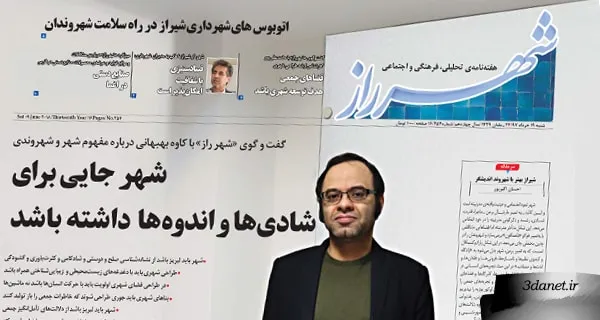
Kaveh Behbahani's Interview with Shahr-e Raz Weekly on the City and Citizenship
Saturday, June 9, 2018 - Issue 254
1— The city, in Robert Park's words, is "man's most consistent and, on the whole, his most successful attempt to remake the world he lives in." But what social and cultural implications does the city carry?
The city is a vehicle for the emergence of social and cultural behaviors, and at the same time, a factor that shapes culture and society. With a slight alteration to a phrase by Winston Churchill, I must say: we shape our cities, and then our cities shape us. To be honest, my interest lies in examining the city through works of art—the city in the visage of painting, cinema, and literature. If disciplines like urban sociology measure the city with quantitative metrics, art captures the qualitative soul of the city and expresses the subjective experiences arising from urban life. The city you live in provides a clue to who you are, how your social bonds are organized, and what characteristics define the cultural spirit of that city. Eighteenth-century London must be understood in the mirror of Blake's poetry, and early nineteenth-century Paris in the frame of Manet's paintings and Baudelaire's prose. To know what Moscow and St. Petersburg do to the souls of their inhabitants, read Dostoevsky! Polanski's Chinatown brings the spirit of early twentieth-century American cities before our eyes, and there are countless examples of this kind that show us the city is brimming with cultural and social implications. The modern Italian novelist Italo Calvino has a novel called Invisible Cities. This novel is a dialogue between the famed Venetian merchant and traveler Marco Polo and the Mongol ruler Hulagu Khan—the very ruler who overthrew the Abbasids and conquered Iran. In Calvino's time, Marco Polo describes imaginary cities to Hulagu Khan and recounts the state of the people in each city. For instance, there he describes a city named Perinthia, which is designed according to the arrangement of the stars in the sky and is meant to represent the order of the cosmos. The inhabitants of that city turned into crippled, hunchbacked creatures; the women of the city were very fat, had beards and mustaches, and the sounds of animal howls came from that city. You see, the issue is the design of urban space and its social consequences. This is where one can ask what kind of people a rational, harmonic, and geometric design produces—the same form of urban design whose lineage reaches back to Daedalus of Greek mythology and is embodied in the modern world through Le Corbusier-style designs. In short, cultural, individual, and social implications can be well perceived in the visage of art.
2— In this sense, what concept and position does the citizen hold in constructing the concept of the city?
The concept of citizenship is a very important one. It is not the case that every city dweller is a citizen. Citizens possess civil rights and, in turn, are responsible towards one another. A citizen is not merely an inhabitant of the city; rather, they have absorbed a set of customs, rules, awareness, and structures. Moreover, a citizen is not simply a passive, victimized spectator of the city but an active agent who creates change in the urban space. Power relations generally tend to turn citizens into mere inhabitants of the city—that is, to turn them into innocent, harmless onlookers who pose no danger to anyone.
3— What is the cultural identity of a city, and what are its components? Specifically, what is the cultural identity of Shiraz?
Identity is a collection of stories and narratives we use to explain who we are. Sometimes these stories pertain to our religion and construct our religious identity. At other times they pertain to our nationality and construct our national identity. We humans have ethnic identity, professional identity, political identity, sexual identity, and others. Nationality, ethnicity, religion, place of residence, and other factors create a cultural identity for us—both for us as individuals and for the community and society in which we live. A person has the sense of belonging to a particular culture and has internalized the social actions, norms, and ideas of that culture, explaining their selfhood with reference to that culture. The inhabitants of every city have their own cultural identity, and that cultural identity also permeates the city, and of course, the city also bestows a particular identity upon its inhabitants. The identity of the city's inhabitants and the identity of the city have an interaction, or as philosophers say, a dialectical relationship. The physical embodiment of this urban identity can be found in passageways and thoroughfares, bypasses, underpasses, memorable buildings, city entrances, murals, the architecture of hotels, bathhouses, and the city's religious and historical buildings, strategic points or urban nodes, and many such things. Well, this cultural identity of the city has many indicators. For example, legibility is one of the pillars of urban identity—that is, to what extent the urban environment can be recognized and one can find their way within it. Even the dominant smell in a city (as some urban thinkers put it, the city's smellscape) is important. For instance, Pennsylvania is famous for the smell of Hershey's chocolate, or we know our own Bushehr by the smell of fish and the sea. This olfactory signature is lost today in many cities, and the dominant smell is that of smoke, diesel, and gasoline. My point is to say that many factors are involved in constructing urban identity. Much can be said about the cultural identity of the city of Shiraz. But let me move past description and just offer one piece of advice. One of the pillars of Shiraz's cultural identity must be the welcoming of diverse cultures and cultural identities. Shiraz's cultural identity inherits Hafez's expansive banquet. In my belief, pluralism and elusiveness are two essential elements of this identity that must always be nurtured and further cultivated, and the design of urban space must also move in this direction. For example, the design of Shiraz's sidewalks should be such that it encourages everyone to walk in the city space—that is, sidewalks with high walkability, which is commensurate with the spirit of hospitality and pluralism of the people of Shiraz.
4. Is there a collective cultural memory? How does this cultural memory manifest in the city?
Yes, we certainly have a collective cultural memory. In the discussion of the city, social imageability is another pillar of urban identity that demonstrates this very cultural memory. That is, to what extent the urban environment has the capacity to evoke particular social connotations for the inhabitants of the environment, and this opens the way for one of the important pillars of urban identity, which is urban semiotics. Our perception of the city is influenced by signs that, historically and culturally, carry connotations and meanings for us. Society has made certain matters more prominent in its mind. Again, the extent to which city residents have a psychological and emotional attachment to the city is related to this social imageability. One technique for assessing this attachment is a technique called the "last walk technique." In this experiment, subjects are asked: if you were to be exiled from a certain city and had the chance to take a walk somewhere for the last time, where would you choose? Usually, the majority of people choose common sections on the map. For example, there are 3,500 streets in Paris, but the majority in this experiment have chosen the Champs-Élysées, the banks of the Seine River, and the Eiffel Tower. Although I do not have empirical research at hand, I imagine that in Shiraz, priority would be given to Hafezieh and Eram Street. Also, urban buildings should be designed in a way that reproduces collective memories. The city must be overflowing with thought-provoking collective connotations.
5. Considering the concepts of citizenship rights and civic culture, what kind of city should we want, and what kind of citizens can we be?
To be honest, this is a detailed and important discussion. The status of citizenship rights is still unclear. On the one hand, the logic of the modern city is the logic of spectacle and display; on the other hand, those who display themselves are rounded up from the city on charges of “tabarruj” (ostentatious display)! Urban space in Iran has turned into a mass of restaurants, and any form of individual or collective expression and manifestation is possible only in a controlled manner, and solely within restaurants. The city must have a place for the expression of joys and sorrows. Urban dwellers who have no place for the logic of carnival in their city transfer that carnival logic to mourning ceremonies during Muharram and Safar, performing Ta'zieh to blues and rock rhythms. The city must be overflowing with the semiotics of peace, friendship, happiness, pluralism, and openness, and this is particularly important in the case of Shiraz. Shiraz is a tourist city, not an industrial or agricultural one. You might find it interesting that Saadi Shirazi advised the Atabegs of Fars on precisely this matter: to treat tourists properly. In the introduction to the Bustan, Saadi counseled the king to “Be a friend to strangers and a lover of tourists / For it is the tourist who brings a good name.” He says it is the tourist, or traveler, who brings us renown. A love of tourists necessitates tolerance and even friendship with outsiders and strangers. There are, of course, more general issues as well. Environmental concerns and harmony with nature in urban design are very important. In his novel Hard Times, Dickens pathologizes industrial cities through the imaginary city of Coketown. Urban design must also be accompanied by aesthetic concerns. Injustice in urban design is a significant problem plaguing us today. Would you rather stroll down Eram Street or through the back alleys of the medieval fabric of Shah Cheragh and Saadi Street? Dickens’s novel Bleak House depicts the harms of this very injustice in urban design. In designing urban space, priority must be given to the movement of humans, not machines. Psychological concerns in city design are very important, and the emerging field of environmental psychology is significant in this regard. I have just mentioned a few things off the top of my head, and of course, more can be added to this list. But the citizen is precisely the one who, with an activist or proactive disposition, demands a better city from its custodians—though I hope the custodians will also provide the possibility for this demanding. Urban decision-making should not take place behind closed doors.
.
.
PDF file of this interview
.
.

Discussion1 comments
عالی بود جناب دکتربهبهانی. متاسفانه در کشورایران این اصول معماری درشهرها رعایت نمی شود.به نظرم تاوقتی شهرداری ها دید کثرت گرا داشته باشند ,شهرهایی خواهیم داشت نامتقارن,یکی از اصول زیبایی تقارن هندسی و وحدت است.چشم و حواس پنچ گانه انسان امروزی به عدم تقارن عادت کرده است.البته متاسفانه...