Sociology
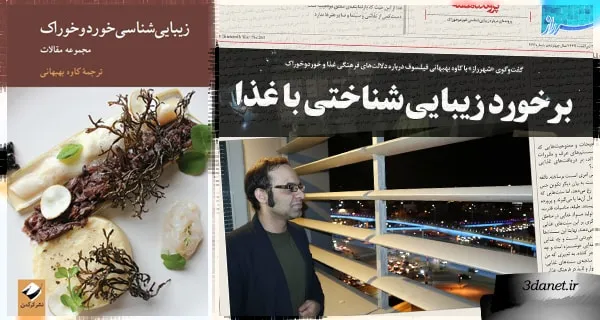
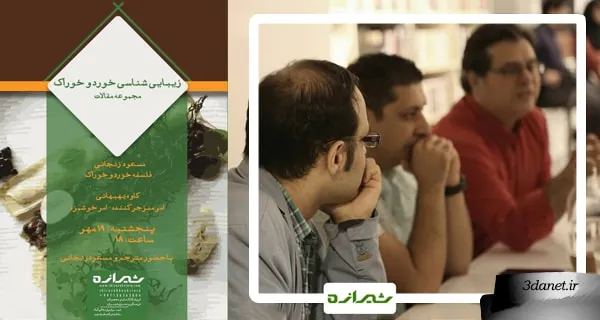
Introducing the Book 'The Aesthetics of Food and Eating' in a Conversation Between Shahr-e Raz Weekly and Kaveh Behbahani
Food is more than nutrition—it is a system of cultural signs and identity-making. Kaveh Behbahani argues that an aesthetic approach to eating cultivates the virtue of gratitude and sharpens awareness.
Can food be considered a cultural concept? In other words, does the culture of eating and cuisine play a role beyond mere nutrition, especially in its encounter and relationship with cultural concepts, human relations, and social structure?
Yes, there is no doubt that eating and cuisine are a cultural matter. In fact, food enters the realm of culture through cooking. The act of cooking, serving, and eating food fills it with cultural significations. Eating and cuisine are a system of signs. What you eat, how you eat, how you cook, where you eat, who begins eating first, and such things are a mirror of your culture. From the architecture of the kitchen to the seating arrangement around the sofreh or dinner table, everything is saturated with cultural and social significations. In this respect, as a representation of the logic of a situation, food is no less significant than painting, cinema, and other arts. The very phenomenon of the plate, which has entered our food culture, signals a new event. The fact that each person has their own plate of food indicates that everyone has found a private space for eating and that society is becoming more individualistic. In the past, in our own country, people would gather around a large pot and eat morsels together. Ali Parvin, the classic coach of the Persepolis team, once complained on television that his grandchild would not eat from the pot of yogurt he had dipped his spoon into. This means his grandchild, without knowing John Locke or John Stuart Mill, has become more individualistic. They probably have their own room, sleep in their own bed, and so on. If you eat from a plate at a table, you are more modern and individualistic than those who eat from a plate but sit around a sofreh. Eating around a sofreh indicates greater collectivism. People sitting around a sofreh are much more in each other's way than at a table. In short, through cooking and eating, humans do not merely sustain life but also negotiate cultures.
The French sociologist Fischler considers the symbolic value of food so important that he believes food can be used as a tool for expressing individual and collective identity. He believes that by eating any food, in addition to absorbing the nutrients necessary for survival, the ideological properties specific to that food are also absorbed by the body, and consequently, "we become what we eat." Does food have such a deep connection with individual and societal identity?
How interesting! Confucius, the ancient sage of China, said, "How you cut your meat indicates how you live your life," and the modern German philosopher Ludwig Feuerbach said, "Man is what he eats." A woman who cooks in the inner kitchen (matbakh) of a traditional house is worlds apart from a woman who cooks in the open kitchen of her apartment. Of course, I am not saying there is a necessary relationship between the type of kitchen and an individual's personality. But my words, like those of your esteemed sociologist, can be tested through various experiments and trials. I imagine these hypotheses would be confirmed with a good degree of approximation. Let me return to the example of Ali Parvin! Of course, I am sure—and thank God for it—that the legendary coach of Persepolis will not have spare time to read such things, and I am happy about that. But one day, in an interview on a family morning show, the host asked him if he helped his wife with housework, and he answered comfortably and very coolly, "No!" That collectivist culture of eating morsels from a single pot, remember? That culture considers cooking to be the primary and "natural" work of women. The "good woman" in this view is obligated (just like other family members) to sacrifice herself at the altar of the collective (the family). Of course, I have only described these two ways of life and have not made a value judgment about either. My intention is to show you how that way of eating transforms into a way of living?
Can food be a sign of social bonds and collective solidarity within a social system?
Of course! A family that eats dinner together around a table or a spread is simultaneously strengthening their emotional and spiritual bonds and conveying to one another that they enjoy eating together. Look at votive food ceremonies! In such ceremonies, cooking, distributing, and eating the votive food does not merely have a physiological and individual function, but, as Westerners say, a communal function, reinforcing solidarity within the community. For example, someone who has made a vow of shole-zard, by fulfilling their vow to their neighbor, sends the message that their wish has been granted, and in gratitude for this happiness, they will treat the neighbor's palate to that beautifully colored pudding. One American philosopher-chef recommends not even being ashamed of junk-food-eating in company. Junk-food-eating means eating foods that the modern diet considers harmful, like fatty, high-cholesterol foods that cause morbid obesity. But I believe that an aesthetic approach to food and eating also sharpens a person's moral intelligence. And note that by aestheticizing food, I do not mean luxury or gluttony. But what does aestheticizing food have to do with ethics? An important virtue for us humans is the virtue of appreciation. Appreciation means understanding the value of things. Paying attention to the value of what is valuable. An appreciative person notices the value of things and knows the difference between straw and saffron. Saadi said that even the fact that you were born a human and not a donkey is something to be thankful for:
Go, give thanks that you are not donkey-brained / For you are, after all, a human, not a donkey ordained
An appreciative person sees and recognizes the capabilities and virtues of themselves and others. It is interesting to know that in English, one of the equivalents for qadrshenasi is appreciation, and appreciation in English has two meanings: one is gratitude and recognition of worth, and the other is growth. Through appreciation, we nurture what is valuable. Saadi Shirazi perhaps intuitively grasped this ethical point when he said, "Gratitude for a blessing increases your blessings." A person, however critical and discerning, must be appreciative of every single moment of life. Moments that, often from sheer repetition, have become tedious, wearisome, and monotonous, losing their novelty and freshness. The human mind has the characteristic that after a while, it becomes accustomed to and familiar with things, no matter how new and novel, and gets used to them. One trait of the human mind is that it quickly becomes habituated. The virtue of appreciation tears the veil of this habit and addiction and restores the freshness of moments. This means that an appreciative person is more mindful. That is, they can create new distinctions and see things that they previously could not see due to their repetitiveness and the familiarity they had with them. This person pays attention to things to which they were previously blind. In short, the virtue of appreciation is an important virtue, and of course, the members of a community being adorned with this virtue will strengthen the bonds and ties among the members of that society. But I want to say that if we take an aesthetic view of food, we cultivate the virtue of appreciation, become more mindful, and live in the moment. Eating is also one of those everyday experiences that has become normal for us through sheer repetition. Aestheticizing this act precisely means extracting it from the predicament of habit, repetition, and tedium. Indeed, defamiliarization is one of the important mechanisms of art-making. An aesthetic approach to food and eating means defamiliarizing it. It means escaping the clutches of eating accompanied by inattention and negligence. It means eating with presence in the moment and mindfulness. It means refreshing the experience of eating. The Japanese have a type of tea ceremony that is exactly like an aesthetic meditation. In fact, the gist of my argument is that making food and eating artistic and defamiliarizing this repetitive act will make us more appreciative people and grant us the benefits of the virtue of appreciation, such as presence of mind and the strengthening of social bonds.
Is food and the consumption of beverages also a tool for social display through wealth, as Veblen argues in his book The Theory of the Leisure Class?
Yes, that is certainly the case. One of the important significations of food and eating is class signification. The renowned French sociologist Pierre Bourdieu speaks precisely of the "social critique of judgments of taste." Let me give another simple, handy example: people have always loved sweet chocolate, and unsweetened chocolate has never been to their liking. Essentially, the bitter taste has been a kind of warning in the course of evolution. The human palate, through the experience of bitter taste, warns that a poisonous or harmful food is likely about to enter the body. But the upper classes, in order to create distinction, go in search of a newer taste and develop a palate for dark chocolate, a palate that gradually becomes more widespread. In the "society of the spectacle," of course, the dinner table is a site of display. This kind of display through food took other forms in the past. Previously, a woman who was a good cook would show her husband's family, for instance, by preparing a proper dinner, how capable a housewife she was and how she looked after her husband. Or a host who spread a lavish table would announce his open-handedness and generosity. Today, however, the dinner table of the upper classes is an arena for displaying luxurious food services, novel and unfamiliar foods, and culinary adventures. You might serve "sushi" to guests at the dinner table, but not to say that the lady of the house knows how to make sushi—because the lady of the house might not cook at all and might have a chef—and not to show your generosity and magnanimity, but rather to show that you have more diverse experiences in terms of food and eating. I am different from you because I eat something else. In short, food and eating are undoubtedly linked to class.
How do the systems of priorities, preferences, and prohibitions, which are linked in various ways to systems of custom and social regulations, affect food perceptions?
In my belief, the human palate is a constructed thing. Taste is a product of evolution and society. In other words, the development of the sense of taste occurs within a tradition. But the traditions within which food, eating, and taste take root and are nurtured are not pristine and pure. Class, power relations, the market, religion, custom, the conditions of food production in various regions, and many other factors influence and direct these culinary traditions. Ultimately, these traditions determine what food is edible and what is not, as well as what food is delicious and what is unpleasant and even disgusting. In a phrasing I favor, taste is something constructed by culinary traditions. Some pleasant and delicious foods in my food culture are nauseating and revolting in another food culture, and vice versa. I find roasted cockroach disgusting, and another finds sheep's head and trotters disgusting. Even religion may give direction to these culinary traditions. For example, both Muslims and Jews do not permit the consumption of pork, and in this respect, neither Muslims nor Jews have a palate for eating pork kebab. The reason why pork is forbidden in these religions should be sought, instead of in ridiculous, science-struck positivist justifications, in the pork market at the time the prohibition was decreed, or in the situation of pigs in the livestock farms of that era in the lands where this decree was issued, or in matters of this kind. In short, the mode of cultivation and farming, the market, the method of cooking food, the cultural context of food, and matters of this kind all, all affect the gustatory experience.
You have recently published a book, a translation of a collection of articles about food, titled "The Aesthetics of Food and Eating." In your opinion, what connection exists between art and everyday life? For example, can food be included within the realm of the arts?
I cannot say enough about the importance of aesthetics and everyday life. Everyday life is full of aesthetic concerns that have serious effects on the quality of our lives. Numerous examples can be given. For instance, we humans consider the view of a waterfall or a mountain more pleasing to the eye and more beautiful than the view of a wetland or a marsh. That is why, for example, if you look at the pictures on wall calendars, you will never find a photo of a swamp or a marsh in them; instead, these calendars are adorned with views of waterfalls, rivers, or things of that sort. This aesthetic disregard for wetlands has practically led people and even government policies to neglect wetlands. As you can see, the death and destruction of wetlands in a country like America, or even in our own country, is rooted in aesthetic concerns. It is as if, when we do not find an object or environment aesthetically appealing and captivating, we become indifferent to it and neglect it. Let me give you another example. Today, we subject our consumer products to perceived obsolescence. That is, for instance, we discard our mobile phone, which works perfectly well, and buy a new one because we consider the external design of the newer generation phones to be "prettier" and "more attractive." For many consumers, the Apple iPhone 5 and the Apple iPhone 10 have the same function, yet they buy the iPhone 10 because they have the belief or perception that the iPhone 5 has become obsolete! A belief rooted in an aesthetic outlook. Let me give a more tragic example. The World Health Organization says that more than 16,000 children die of hunger every day in the world. But more astonishingly, in America and Europe, nearly one-third of fruits and vegetables are thrown away daily. Why? For aesthetic reasons! Cucumbers, eggplants, and other vegetables that are too large or have a crooked appearance are destroyed! One can give countless examples of the influence of aesthetics on everyday life. This is while aesthetics in the West has mainly focused on the fine arts. That is, arts such as painting, literature, theater, and so on and so forth. But in the twentieth century, developments occurred in the history of the philosophy of art that revived aesthetic philosophizing about everyday life. Aesthetics once again turned to reflection on the activities of everyday life, such as walking, bathing, interior design, eating and food, and many other things, and the aesthetics of the everyday became a new branch of aesthetics. But regarding your other question, whether food can be considered art or not, a broad debate has taken place in the history of thought. Many great philosophers, whether in the ancient world or the modern world, believed that unlike the sense of sight and the sense of hearing, which have their own specific arts (arts like painting and music), the sense of taste or gustation cannot yield an aesthetic experience. For example, Plato believed that cooks are a bunch of flattering sycophants who only want to feed their customers their tasty but harmful foods. He does not even consider cooking a skill (in the Greek sense of techne) and counts it as a lowly task, on par with knowing a kind of trick or knack for cooking food. In our own culture, Mawlana Jalal al-Din has always recommended eating little (or qillat-i ta‘am). His aversion to food and eating is so great that the sweet-tongued sheikh of Shiraz, Sa‘di, recounts that when he went to visit him in Rum with a few friends, he showered them with kisses but brought them no food to stave off their hunger. In an essay I wrote in the introduction to the book The Aesthetics of Food and Eating, I have spoken in detail about the reasons for philosophers' anti-taste and anti-food sentiments. That book is a collection of essays by modern American philosophers who defend the aesthetic status of food and taste in various ways. One of the most formidable aesthetic systems in which the sense of taste and eating are considered to lack aesthetic dimensions is the aesthetic system of the epoch-making German philosopher Kant. In the introduction to the book, I have tried to show why Kant's aesthetics in the Critique of Judgment does not allow for an aesthetics of food and what problems his view faces.
Are there also specific and unique nutritional and eating habits in Shiraz? If so, where do these habits come from, and what function do they serve in the city's social system?
To be honest, I don't really know about a specific dietary habit of the people of Shiraz! But I would like to say something about the discussion of food and eating and the social system of the city of Shiraz. In Shiraz, as in other major Iranian cities, an urban middle class has emerged whose home kitchens are becoming smaller and more decorative by the day. This shrinking of the kitchen means an explosion of suppliers of all kinds of food in every corner of urban environments. The urban space of Shiraz is overflowing with a variety of diverse eateries, most of which sell junk food. I live in Shiraz in a building on a thirty-five-meter-wide street that has dozens of restaurants and coffee shops, and this street is just one of the side streets off a larger boulevard with many side streets, all filled with restaurants and food shops. This means reducing the urban space to a bunch of food vendors. It can be said explicitly that the urban space of Shiraz is monopolized by food shops. This signals the elimination of the kitchen in the life of the urban middle class, which must be seriously examined as a pathology. Moreover, it has created a monotonous face for the city. As much as restaurants and café-restaurants have room to manifest in Shiraz, artistic institutions (such as street theater, street music, street lighting, and even cinema and other things) have no room to be present.
.
.
About the Book The Aesthetics of Food and Eating:
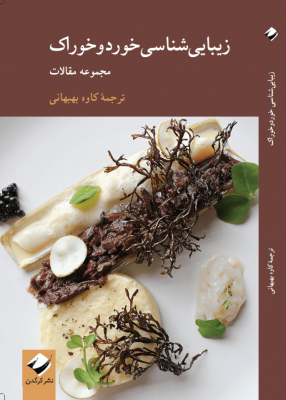
Is food art, by virtue of the fact that it enters a person's palate and engages their gustatory system? Do we have an art related to the sense of taste or gustation, an art whose artistic nature a person discerns with their palate? Can it be said that some foods are art in terms of taste?
– In her essay "Food as Art," Elizabeth Telfer argues that alongside visual aesthetic experiences of food, an aesthetic reaction to the taste and smell of food is also possible.
– In her essay "Delightful, Delicious, Disgusting," Carolyn Korsmeyer explains how a food might be both delicious and disgusting.
– In his essay "Can Food Be Art? The Problem of Consumption," Dave Monroe addresses the point that there is a problem facing the consideration of food and eating as art: "The impediment of consumption."
– In his essay "Can a Soup Be Beautiful? The Emergence of Gastronomy and the Aesthetics of Food," Kevin Sweeney asks whether some foods can be described with the attribute of beauty.
– In his essay "Food Fetishes and the Aesthetics of Sin," Glenn Kuehn speaks of eating in groups and even collective vulgar eating as a way to strengthen group bonds.
– In his essay "Dewey, Somaesthetics, and the Cultivation of Taste (Gustation)," Russell Pryba sees food as a vehicle for interaction between cultures.
Bibliographic Information:
Translator: Kaveh Behbahani
Publisher: Kargadan
Number of Pages: 264
Price: 30,000 Tomans
Format: Octavo
Year of Publication: 2018
.
.
PDF file of the conversation between Shahr-e Raz Weekly and Kaveh Behbahani
.
.




Discussion0 comments
No comments yet; let yours be the first voice.