Philosophy
Interview with Mostafa Malekian: Feminism and Feminist Philosophies
Malekian does not regard inherent differences as grounds for unequal rights, and attributes the decline in women's status in Islam of the second and third generations to jurists' neglect of the Prophet's reformist trajectory. He sees feminism as having entered epistemology and considers a feminine interpretation of religion essential.
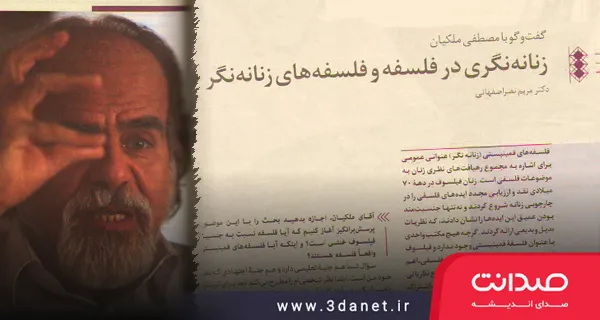
Abstract: From the constitutional differences between men and women, one cannot infer a special ethics or special rights for women or men. Due to jurists' neglect of the reform process that the Prophet of Islam was pursuing regarding women, the further we move from the primary Islamic sources toward the opinions of religious scholars and the culture of Islamic society, the more negative the perception of women becomes. Today, feminism is not confined to a political and social movement; it has extended into the domains of epistemology, psychology, ontology, and even the philosophy of the natural sciences.
In the modern world, are the physical and psychological differences between men and women reproduced in the sphere of their relations and rights?
One cannot infer a difference in value from the constitutional differences between men and women. By constitutional differences, I mean those biological and psychological differences. Therefore, one cannot prescribe a specific ethics or specific rights for women and a different ethics and different rights for men, with the argument that men and women are constitutionally different. At the same time, however, the reproduction, or better put, the reflection of that constitutional difference in the relations between men and women should not be denied everywhere. For example, if I were in charge of managing a society, I would have to pay attention to the psychological differences between its various social strata, including men and women, in regulating their relations. What is utterly indefensible is unequal opportunities; otherwise, in my view, roles may inevitably have some differences. When equal opportunity is created, due to the biological and psychological differences between men and women, women themselves may be drawn toward certain tasks and men toward others. There, too, no "ought" exists. As for ethics and rights, the reality is that I subscribe to a contractualist view. We must act according to the requirements of the contracts we have made with one another.
In your view, what differences and similarities exist in the image of women in Islam I, II, and III?
In my view, the similarity in the image of women in Islam I, II, and III is that in all three cases, there is no consistent and uniform view of women; that is, within these three perspectives, there are positions regarding women that are patriarchal, yet internally subject to apparent contradiction. Thus, you see that the similarity among these three perspectives lies in the heterogeneous gaze that all three cast upon women.
I can claim that the further we move from Islam I toward Islam II, and from Islam II toward Islam III, the more negative the stance toward women becomes. In my belief, what brought the situation of women in Islam II and, naturally, in Islam III to this point was a neglect of the "process" of Islam's movement. In fairness, the Prophet of Islam initiated a process to improve the condition of women. During the 23 years of his life, this process was always forward-moving and improving. However, some of our jurists forgot the process of his movement or paid no attention to it at all. They said that we rely on the Prophet's final endorsements concerning women and adhere rigidly to them. Had they considered the process of the Prophet's movement and progressed in accordance with the circumstances of the time, Islam II and, naturally, Islam III would not have reached this point. I have said many times that the only defensible reason for a Muslim to emulate a living jurist is precisely this: that the living jurist belongs to his own time and continues the process of the Islamic religion's movement.
The reality is that the change in the perception of religious scholars and the religious community regarding women and their issues also depends on the answer to these two questions: what is women's own perception of themselves, and what is women's perception of men's perception of women?
In my view, the feminist movement so far has emphasized only two points: first, "What is the definition of woman?" and second, "What is men's perception of women?" It seems that the depth and success of this movement depend on paying attention to other components as well; for instance, what is women's own perception of themselves? Or, what perception do women have of men's perception of women?
The second point I wanted to make is that women themselves must enter the fields of theology and philosophy so that they can develop their own understanding of religion. The feminist conception was initially a political movement, but it gradually transcended this limit, especially in the last two decades. At present, feminism means looking at the world through a woman's eyes, and in my opinion, its precise translation into Persian is 'zananeh-negari' (woman-centered perspective). It is not without reason that we now speak of feminist epistemology. One of the prominent women in this field is Sandra Harding, who is, in fact, one of the philosophers of science of our time. She believes that epistemology, up to the present day, has been influenced by masculine perspectives, but the time has come for a feminine epistemology, that is, a feminist epistemology, to emerge as well; because one can look at everything from a woman's perspective, and interpretations should not be confined to masculine interpretations. The Quran and narrations can also be interpreted from women's point of view. It is for this reason that I say women themselves must enter the arena with determination and seriousness, present their own perspectives, and influence the existing conceptions.
In my opinion, when the philosophical perspective changes, many of the old conceptions also change, especially in two domains: one is the conception that exists of human nature and the relationship between men and women, and the other is the conception that exists of the relationship between God and humanity. The conception that has existed of the relationship between God and humanity up to now has been a conception derived from the relationship of a chief or father of a family with its members; that is, a patriarchal conception. If this conception changes, it will certainly have an impact not only on jurisprudence but also on ethics.
You spoke of feminist epistemology. At what stage is this new field of epistemology currently?
At present, feminist epistemology is being advanced by feminist women in five areas; women who have full academic standing and are epistemologists or philosophers of science. As you know, until now, epistemology in the process of cognition has relied solely on the mind and has not considered feelings and emotions to be involved in it. One of the five areas that today's feminists have discussed very seriously is that cognition of the real world cannot be achieved solely through the use of the mind; rather, the mind and feelings and emotions must go together to encounter the real world. For this reason, they believe that all epistemological knowledge up to the present day has relied on a masculine, narrow-minded, and one-sided perspective; because men, compared to women, have weaker feelings and emotions, and furthermore, to prove their masculinity, they have constantly driven whatever feelings and emotions they did have out of the epistemological scene.
In my opinion, the feminist movement has entered very serious spaces, including epistemology, and has acquired two characteristics: first, it is approaching postmodernism; second, to some extent, existentialism, especially its phenomenological branch. Regarding the first, I must say that the feminist movement, as long as it only considers women's freedom and rights, is a modernist movement, but when it enters the space of epistemology, it becomes associated with postmodern phenomena. Regarding the second characteristic, it is also clear that when we endeavor to know the external world with our entire existence and involve our feelings and emotions in its cognition, we are in fact approaching existentialism.
Who are the women you mentioned, and in what areas have they worked?
Hilary Rose has worked on the union of mind, heart, and body in the process of knowing the world, and Nancy Hartsock on feeling, objectivity, and relativity in cognition. Jane Flax has researched the effects of social oppression on women in the process of cognition, and Dorothy Smith has investigated the consequences of women's alienation in the matter of cognition. Sandra Harding has also worked on the new conception of the female personality and its impact on epistemology. These five realms of new epistemology have taken on a completely feminist character and have also produced serious effects. It is even very interesting to say that we now also have a feminist philosophy of natural sciences.
Usually, when feminism is discussed, audiences, whether for or against, imagine that feminism is solely and exclusively a women's movement aimed at gaining freedom for women, or securing women's rights, or, even worse, at displacing men. The sensitivities and negative views that exist in public opinion or in religious circles regarding feminism stem from a lack of understanding of it.
Let me summarize: the discussion of feminism is about the fact that, until now, only men have looked at the world, both the outer world and the inner world; until now, only men have engaged with psychology, metaphysics, epistemology, ontology, and so on, and have reported their own interpretations of them. Now, women want to look at the world for themselves, offer their own interpretation, and place their report alongside men's reports.
.
.
Interview: Feminism and Feminist Philosophies with Mostafa Malekian
Zanan Magazine | Issue 12 | Aban 94
.
.
Download the PDF file of the complete interview "Feminism and Feminist Philosophies" with Mostafa Malekian from Server 1 | Server 2 | Server 3
.
.


Discussion1 comments
باسلام و عرض احترام خدمت همه دست اندر کاران این مبحث. در این متن جناب استاد ملکیان مثل همیشه به نقاط اصلی و حساس که معمولا پنهان از جامعه و علوم تربیتی و آموزشی بوده را، نشان و توضیح میدهند، و به باور نزدیک میکنند که فمنسیم را و یا زنانه نگری در کجاها از اذهان پاک میشود و یا تعریف نمیشود. در جوامع مدرن با دفاع های قوانین دولتی و حمایت تقریبا عموم هرچند ظاهری باز موجب نزدیک تر شدن فضای عمل بین مرد و زن ایجاد میشود. و تنها و بزرگترین مانع در سطح واقعی و عمومی خصوصا در کشور ما ، حضور منفی بانوان متکی به باور ها و تربیت ها هستند که سنگ انداز شده و اسباب و اهرم مخالفین یکسان بینی حقوق خلقتی و تکوینی انسان(زن و مرد) میشوند. بنظر من این فاصلهکهنه تاریخی را فقط حضور جمعی و انجمنی مردان، با استدلال و منطق منطبق بر گفتارهای غیر دینی و غیر ایدئولوژیکی و استمرار جمعی در تمام فضاهای حضوری و مجازی، موجب شکاف این اتحاد عادت شده مذکر میگردد و راه را برای زنان سخنور و فیلسوف و عالم بعنوان رهبران پیش رو ،وسیع تر میکنند و این اتحاد که از ماحصل اندیشه های مردان و زنان ونیز حضور نو و ناب عواطف خاصه که حقیقت بزرگ خلقت بالقوه زنان هست، نردبانی بلند بسوی آگاهی خواهد بود. نردبانی که بعدا عقاید دینی و آیئنی و سنتی و مدرن را در پله های آن تنها به جهت حرکت رو به جلو میتوان استفاده کرد. حرکتهایی که قطعا آزادی و صلح را ترسیم خواهد کرد.