Philosophy
Interview Series: “My Student Years” with Mostafa Malekian
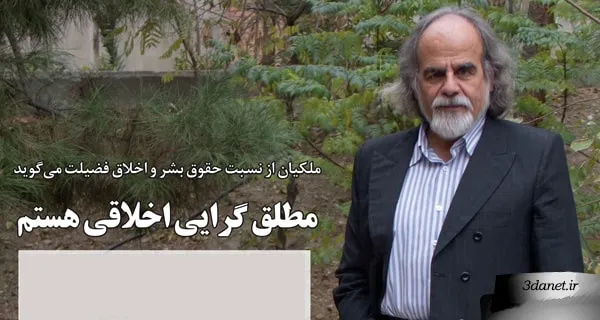
Mostafa Malekian, in an interview with Iran newspaper, reflects on his student years: from switching majors from engineering to philosophy under the influence of a lecture by Motahhari and his father, to the Faculty of Theology and professors like Mehrdad Bahar whose ethical conduct served as a model.
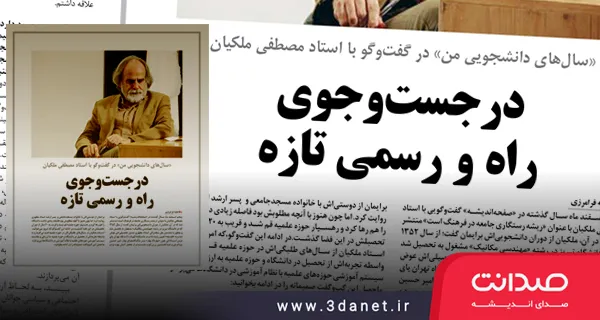
The present text is a collection of interviews entitled “My Student Years” with Mostafa Malekian, which was published in the Iran newspaper in two parts—dated February 24, 2015, and April 13, 2015—about his student years and his time as a seminary student.
.
.
Part One of the My Student Years Interview
A Conversation between Fatemeh Faramarzi and Mostafa Malekian
Iran Newspaper, Issue 5875, Page 17, Tuesday, February 24, 2015
It takes years to reach what you desire, but in the meantime, “love” and “effort” are the most important components that will help us attain our true goal. Perhaps these sentences are the best description for the scholarly life of a figure who, not only to benefit from the virtues of knowledge of the luminaries of this land but also for the companionship of the ethics and character of many thinkers, spent many days and hours as a student in their presence, so that today he is the inheritor of the ultimate purpose and goal of masters whose culture and history of this country can be recognized by leafing through their works. Professor “Mostafa Malekian,” born in 1956 in Shahreza, is considered one of the renowned researchers in the field of philosophy. He, who found the first sparks of interest in philosophical topics with his father, decided to base his education on this field of knowledge, although the circumstances of the time did not allow for such an academic choice, and he was forced, despite having learned part of the topics of Islamic philosophy from his father, who was a well-known cleric, to end up in a field that did not suit his temperament. But this was the beginning of the path, and a student with such an intellectual background would never give up, and as a result, the outcome of his years of presence at the university and the seminary created a personality in him that one can boldly say is one of the influential figures in the field of philosophy, and many students of this discipline refer to him to find answers to their countless questions, and he, just as was the practice of his masters, without stinginess in scholarly discussions, answers each and every one of their questions, such that he is famous for this: that he will leave no question without a precise and scientific answer. The Thought Group of “Iran” newspaper has this time sat down for a conversation with Professor Malekian with a different perspective to hear about his student years and his years of presence in the seminary; the first part of this conversation is dedicated to his student years. Read the first part of this intimate chat today. The other part of this conversation will be published in the coming days.
Professor Malekian! Let us go back to the early years of the 1970s, when you entered university as an engineering student. What was the story? Did this choice stem from your personal interest in this field, or did the circumstances of the time and the hand of fate simply lead you to study in this discipline?
In 1973, I began my university education in the field of “Mechanical Engineering” at the University of Tabriz (Azarabadegan), but I later changed my major.
The truth is that I was intensely interested in pure mathematics. For this reason, I studied mathematics in high school, but I had no interest in engineering, which is in fact a technique and not a pure science. Nevertheless, under the influence of the prevailing atmosphere of society and the insistence of some of my relatives, I chose the field of mechanical engineering. But at university, I realized that my main interest was philosophy, and I changed my major.
How many credits had you completed when you came to the conclusion that you had to change your major?
I do not remember exactly how many credits I completed in engineering, but about two years passed. In any case, I withdrew and took the university entrance exam again, and I was accepted into the field of philosophy at the Faculty of Theology and Islamic Studies of the University of Tehran.
From the perspective of the general public, philosophy is a difficult discipline, and some even consider the term “intimidating” to be a characteristic of this field. How did you become interested in philosophy? How did you become acquainted with philosophy in the first place, since your field was mathematics?
I should explain three points in this regard; first, from the time I began studying, I was interested in five areas, which included “philosophy,” “psychology,” “Persian and world literature,” “mysticism,” and “religion and faith.”
When it came to changing my major from engineering, I was torn between choosing “philosophy” and “psychology.” But then it seemed to me that philosophy was more fundamental compared to psychology.
The next point is that; during the very time I was hesitating between these two fields, I once sat in on a lecture by Mr. Motahhari in Tehran. I had read his books before this in-person encounter. I remember that in this lecture, he spoke about philosophy in such a clear and universally understandable language that philosophy seemed delightful to me right in that session, and it was after his lecture that philosophy became a “very captivating novel” for me. Even now, when I read a philosophical book, I derive the same pleasure that I get aesthetically from reading literary texts.
Of course, this lecture itself was a turning point in my life. Because if I had sat in on another thinker’s lecture, my decision and the path of my academic life might have changed, and I might have gone into psychology.
But the third point is that my father is a cleric, and among the various fields of Islamic sciences and teachings, he placed great emphasis on philosophy, and for this reason, from the age of fourteen, when I began studying under him, I mainly read philosophy.
Were you also interested, or were you studying philosophy under duress from your father?
Yes, I was interested, but not to the extent that this interest intensified in me later. By the time I was saying goodbye to the engineering field, I was enamored with philosophy. Moreover, I had previously read parts of the Manzumeh of Haj Mulla Hadi Sabzavari and the last three chapters of Avicenna’s Isharat wa Tanbihat under my father.
When you changed your major from mechanical engineering and experienced a different atmosphere in the field of philosophy, what was the mood of the Faculty of Theology at the University of Tehran like during your years there? With which academic figures were you able to establish a better intellectual connection?
To tell you the truth, apart from a few professors, I found nothing encouraging in the Faculty of Theology at the University of Tehran. It was at this stage that I became acquainted with the late Motahhari and benefited from his lessons in the field of Islamic philosophy. Of course, there were a few other professors from whom, in addition to learning knowledge to the extent of my mental capacity, I was more influenced by their personality and character.
Like whom?
The person whose character affected me the most was Dr. “Mehrdad Bahar,” the son of Malek al-Sho’ara Bahar. The truth is that the lessons he taught were mainly about the history of ancient Iran and its languages and religions, and I had almost no interest in these subjects because I was intensely passionate about philosophy; nevertheless, I attended his class as an auditor solely because his ethical and psychological personality and character captivated me. That is, I can say with absolute certainty that I have not seen anyone who placed so much importance on ethics and demonstrated ethics so objectively in their behavior.
The second figure, who was a professor in my faculty and whose course units I was also required to pass, but whose classes I attended far beyond the mandatory course units, was Dr. “Amir Hossein Yazdgerdi,” who was considered one of the most distinguished students of “Badi’ al-Zaman Foruzanfar.” From the second month of my arrival at the faculty, at his own request, I found myself in close contact with him, and for many days, at least three days a week, I would go to Dr. Yazdgerdi’s home and benefit from associating with him scientifically, especially in the field of Persian language and literature. Of course, he had a very ethical personality and at the same time a sensitive and touchy spirit, but on the whole, his demeanor had a great effect on me. I would attend upon him as a student; for example, if he wanted to know whether a certain poem was in the Divan of Khaqani or not, I would leaf through the Divan of Khaqani and search for him.
But the third figure, who perhaps influenced me the most both intellectually and morally, was Dr. ‘Abdolhossein Zarrinkoub. He taught at the Faculty of Literature and Humanities, but I would attend his classes. He possessed a lofty humanistic morality and was, in the truest sense, noble and magnanimous; for this reason, he left a profound impression on me, even more so than the two professors I mentioned earlier.
In my view, Professor Zarrinkoub was, in our contemporary history—that is, from the Constitutional Revolution onward—one of the very few individuals whose mastery of our culture was balanced and in equilibrium with his mastery of Western culture, in the fields of literature, history, and philosophy simultaneously. Therefore, firstly, he viewed everything from multiple perspectives, and secondly, he was truly fair in his judgments. Among the professors in whose presence I sat, I was never amazed by anyone’s breadth of knowledge as much as Zarrinkoub’s; even later, when I entered the Qom Seminary, no teacher there impressed me as much as Dr. Zarrinkoub did.
In what respect? Which characteristic of Dr. Zarrinkoub made you so fascinated and influenced by him?
Zarrinkoub was very humble, kind, and extremely helpful to those who were engaged in study and research. I never saw any intellectual miserliness in Zarrinkoub, and whenever I remember him, my soul is mingled with regret; because I always tell myself that one could have benefited from him far more than this. Of course, I benefited from his presence as much as I could and attended all the classes he held, whether at the master’s level or the doctoral level. But despite this, I still feel this regret.
I say with absolute certainty that those who are renowned today as top-tier professors of Persian language and literature have never written a single paragraph like Dr. Zarrinkoub, neither in terms of scholarly rigor nor in terms of the eloquence and fluency he possessed in writing.
Despite his fame, Professor Zarrinkoub still remained underappreciated, and I take this opportunity to advise my young friends that those who wish to know our culture well must certainly read through a collection of Zarrinkoub’s works and not dismiss any point lightly, for Zarrinkoub reflected and presented the result of his reflection; now, after reflection, we may accept or reject his word, but we must not take his word lightly or ignore it.
Now that the conversation has turned to Dr. Zarrinkoub, I think it is appropriate to know your analysis of some of the discussions raised about the late scholar. There are numerous discussions about Dr. Zarrinkoub, including a reference to his book Two Centuries of Silence, which, in the opinion of many, was written under the influence of a kind of “Pan-Iranism.” Regardless of the extent to which this assertion is correct or incorrect, what is your judgment of this book?
Despite all the ifs and buts raised about the book Two Centuries of Silence, and some saying that writing this work was more influenced by emotions, I must say that he, in any case, later apologized himself. I never saw him recant Two Centuries of Silence. Of course, one must always consider the pressures; in the face of these pressures, he always maintained a conciliatory and peace-seeking spirit.
In general, I believe that even if we accept that Zarrinkoub recanted in the book Two Centuries of Silence, firstly, the truths that exist in this book are undeniable. Secondly, it is, in fact, a sign of truth-seeking and scholarly fairness if an individual, at a point in his life, realizes that a statement of his was erroneous and accepts it; as Zarrinkoub did.
But all these matters aside, Zarrinkoub’s record is truly a brilliant one, and I am very saddened to see that his works have not received the attention they deserve in these years.
Let us return to your student days! Tell us about your classmates; are there people with whom you were friends during that time and with whom this association still continues today?
When I was an engineering student, I had three very close friends; unfortunately, I lost track of one of them, to whom I was very attached. But the other two became well-known figures.
One of them was “Hossein Alaei,” who later became one of the senior figures in the Islamic Revolutionary Guard Corps. He was a very ethical, simple-living, and of course, devout man. Another friend who later became a prominent figure was Dr. “Mehralizadeh,” who was also the head of the country’s Physical Education Organization for a time; I was very close with him. As for the third person, his face remains in my memory, but unfortunately, I have forgotten his name.
However, regarding the years I was in the Faculty of Theology, I might say that my closest friend in those years was “Mohammad Masjed-Jamei,” through whom I later became friends with “Ahmad Masjed-Jamei,” and this friendship dates back to 1975, meaning I have been friends with these two for exactly forty years. Of course, after the revolution, I grew somewhat distant from Mohammad Masjed-Jamei intellectually and emotionally, but in any case, both of these brothers were pure and refined human beings. After getting to know these two, I also connected with their honorable father and, of course, the youngest brother, “Alireza Masjed-Jamei,” and I always remember those years as one of the best periods of my life. In fact, one of the best events of my student days at the Faculty of Theology of the University of Tehran was my friendship with them.
Another friend of mine during my studies at the Faculty of Theology was the eldest son of the late Motahhari. He was admitted in the same year I passed the entrance exam and became my classmate; therefore, the very fact that I knew “Mojtaba Motahhari,” the brother of Ali and Mohammad Motahhari, brought me closer to the late Motahhari.
Let’s change the subject a bit. It seems you were never a political student; from these accounts you mention, it appears that during your student years you were either entirely engaged in studying, or if you had free time, you spent it on scholarly discussions or attending the classes of your favorite professors. Isn’t that so?
The truth is that during my student years, I was never a political student; I was never a member of any student group or party. Rather, I truly was not one for student activism and did not participate in any political student activities. Of course, I had friends who were active in student matters, but my association with them was mostly for scholarly topics, and if political discussions arose, I would leave the gathering.
I should also mention two points here: first, due to my family upbringing, I did not agree with the Pahlavi regime, but this disagreement was a heartfelt dissatisfaction and did not lead to any outward activity. The second point is that from 1977, when the people’s uprising began, I participated in the demonstrations, but this participation was of the kind of “the majority of the people’s presence,” and I rose up “with everyone,” not that I rose up before everyone as a sign of protest.
So, political issues were, in a way, a peripheral part of life for you.
Yes, now that I review the past, I see that what I have adhered to in recent years was also my belief in those years: “Politics, from my perspective, was subordinate to culture.” I always believed that the sole problem of any society, or the cause of all causes of a society’s problems, is the culture of its people, and politics is the fruit that appears on the tree of that society’s culture. If this fruit is unripe, foul-smelling, or poisonous, it stems from the root of this tree of culture. For this reason, I always value cultural issues, and friends who were my classmates in those years might know that whenever the discussion turned to cultural matters, I would enter the debate with a kind of passion, excitement, and zeal, taking it seriously and pursuing the discussion, and even when the session ended, I would read books on that subject. But as soon as political issues were brought up, I would leave, and I never had any inclination toward political discussions and issues.
You were a dormitory student. Tell us about the events and times that occurred for you while living in the student dormitory.
I was in the Amir Abad dormitory. At that time, the arrangement was that in the first year of the bachelor's program you were assigned a four-person room, in the second year a three-person room, in the third year a two-person room, and in the fourth year a single room.
I remember in the fourth year, when I had a single room, I would go and buy one or two cartons of eggs along with a large bucket of yogurt and twenty loaves of bread, and sometimes a few tomatoes and cucumbers, and I would go into my room and lock the door from the inside so that my friends would think no one was there, and you wouldn't believe it, I would stay there until all the food was finished!
Of course, apart from this, in the dormitory too, it was just me and myself, and I didn't mingle much with others, just as at present my nature is also suited to seclusion and solitude, although by the demands of my profession I deal with society a great deal. But the best hours of my day and night are the hours when I am in my own privacy.
.
.
Part Two of the My Student Years Interview
A conversation between Fatemeh Faramarzi and Professor Mostafa Malekian
Iran Newspaper, Issue 5903, Monday, April 13, 2015 - Page 17
On the fifth of Esfand last year, a conversation with Professor Mostafa Malekian titled "The Root of Society's Salvation Lies in Culture" was published in the "Page of Thought," in which Malekian told us about his student days; from the year 1973 when he began studying "Mechanical Engineering" at the University of Tabriz, and how attending a lecture by Professor Motahhari changed his academic path, leading him to switch his major to "Philosophy," and how in the Faculty of Theology at the University of Tehran he sat at the feet of professors such as "Mehrdad Bahar," son of Malek al-Sho'ara Bahar, Amir Hossein Yazdgerdi, and Abdolhossein Zarrinkoub, benefiting from their presence, and he recounted for us his friendship with the Masjed-Jamei family and the eldest son of Professor Motahhari. But because he was still far from what he desired, he also left the university and set out for the Qom Seminary, where nearly 20 years of his studies passed. In the continuation of this conversation, which you read today, Professor Malekian speaks of his years as a seminarian in the Qom Seminary and, by virtue of his experience studying at both the university and the seminary, evaluates and compares the educational system of the seminaries with the educational system of the universities. Read the outcome of this intimate chat below:
Professor Malekian! You spent many long years studying as a seminarian in the Qom Seminary. Given your interest in philosophy and that you were studying philosophy at the University of Tehran, what was the reason for this change and decision?
It seemed to me that I needed to become more acquainted with our cultural tradition from its Islamic aspect, and I saw that at the university I had not gained any sufficient knowledge of this matter; it was from this perspective that I came to the conclusion to go to the Qom Seminary and continue my studies.
Of course, my main interest, even after entering the Qom Seminary, remained Islamic philosophy, theosophy, and mysticism, but despite this interest, I had no choice but to study "fiqh" (jurisprudence) and "usul" (principles of jurisprudence) like everyone else, since these two are the most important sciences taught and learned in the seminary. That is, our seminaries, fundamentally in recent centuries and especially after the Safavid domination in Iran, strive to make a "faqih" (jurist) out of the seminarian; consequently, all their emphasis is on fiqh and usul al-fiqh, and philosophy, theosophy, and mysticism are, in a clear sense, placed on the margins of fiqh and usul al-fiqh.
It was from this perspective that I also studied usul al-fiqh and, in the terminology of the seminarians, reached the level of "advanced fiqh studies" (kharij dars-e fiqh) and "advanced usul studies" (kharij dars-e usul).
Did you find what you were seeking in the seminary courses?
The truth is that I gradually came to enjoy the science of usul, and some of the meticulous investigations of our usuli scholars, which are very similar to the studies and research of philosophers of language in the West, attracted me, and I am still interested in usul al-fiqh. But in that period, my main attention was on philosophy and mysticism.
What is your critique of the educational system of the seminaries?
I believe that even if the goals of our seminaries remain the same as those that Shia seminaries have pursued over the past 400 years, those same goals could still be achieved with far better means of education, research, and training.
Years ago (I think it was at one of the anniversaries of the passing of Professor Motahhari at the Faculty of Theology and Islamic Studies of the University of Tehran, where I was also teaching at the time), I gave a lecture comparing the educational system of the seminaries with that of the universities, and in that lecture, I recounted the strengths and weaknesses of each relative to the other, and I see no need to repeat it now; but I must say that I seriously believe that even those who still consider the educational, training, and research goals of the seminaries to be the same as those of centuries ago can still realize those same goals with far more rational, easier, more reliable, and less problematic means.
Nevertheless, I entered the Qom Seminary in Mehr 1358 [September 1979] and left the Qom Seminary in 1377 [1998]. However, in the meantime, in 1372 [1993], I decided to leave the seminary system and even took a house in Tehran and was on the verge of moving when some of my professors insisted that I stay in the seminary and dissuaded me from coming to Tehran. But in any case, five years after this episode, I returned to Tehran again.
Which part of the educational system of the seminaries is subject to your criticism?
My criticism is directed simultaneously at the "textbooks" that are taught in the seminary and at the "method of teaching" these books; my criticism is also directed at the research that students must undertake during and after their education. I believe that a different path and method can be pursued in this regard.
Given that you yourself were a student in the Qom Seminary for nearly 20 years, what do you suggest? In your opinion, what is the method and path for pursuing a different way in the seminary educational system, and how can it be achieved?
This is a long story, but let me mention one point: in our seminaries, from time immemorial, no distinction has been made between a textbook and a handbook. In fact, almost all of our books in the seminaries are handbooks instead of textbooks.
I sometimes refer to a textbook as a "lesson book," and I believe that several points must be observed in a "lesson book"; first, it must be clear which class's students are the audience of this textbook; you cannot teach the final year high school textbook to second-year middle school students. A textbook always has a specific and defined audience.
Second, no subject matter in a textbook should be taken for granted; for example, if a final year high school physics textbook takes a subject for granted, that subject must have been covered in the books of previous years; we cannot assume a point is certain and that our students are surely familiar with it when they have not encountered it before and it has not been taught to them in previous years; in other words, the "principle of gradual progression" must be observed in textbooks.
But another characteristic of a "lesson book" is that regarding every issue, subject, and problem, all opinions and views must be presented, not just the opinion and view of the textbook's author.
That is, if I am writing a textbook about physics and there is a difference of opinion on a topic, I must come and present the views of others. For example, if the subject is whether light moves as a "wave" or as a "particle," I, the author, might believe, hypothetically, that light moves as a wave, while some might believe that light moves as a particle, and others might believe that light moves in a third way.
As the author of the textbook, because I want to teach physics to my students, I should not present physics solely from my own perspective; rather, I must also give a place to the opinions and views of others and examine their opinions and views as well.
Another characteristic is that in a textbook, the psychology of education must always be observed. Because we know what age our audience is and at what stage they are in terms of knowledge, understanding, thinking ability, and mental experiences, we must take this into account in the manner of presenting the material.
But another topic concerns the "handbook." A handbook is not a textbook at all; rather, for example, I, the author, in the capacity of a scholar of a science, come and present and defend my views and opinions on a subject, and then confirm the views and evidence in my favor while refuting opposing views.
When a "handbook" is written, my assumption as the author is that I am writing for my peers, not for my students, and the assumption is that the book's audience knows as much as I, the author, do, and in this work, I am merely presenting my own view. Now, if we come and merely teach the handbook, I must say we have done nothing but waste time and drain the energy of the audience.
The situation is that in our Islamic seminaries, the assumption is that whatever a scholar or jurist has written must be used verbatim as a textbook, even though none of these works are considered textbooks.
Imagine how much energy students expend to learn these "handbooks." I say this truly out of goodwill; many hours are spent in our Islamic seminaries, and how much of the students' mental and intellectual energy and talents are expended on this matter, while little attention is paid to the important point that even if the person in question is the most important author in a field of knowledge, it does not mean we must teach their book; rather, we must write a textbook.
With no exceptions to this issue during your time in the seminary, or later and even in recent years, did you encounter works that truly had the characteristics of a "textbook"?
Of course, there have been rare exceptions, especially in recent years, such as the works written by the late "Muzaffar." He wrote a book on logic—the same traditional Aristotelian logic, of course—and also a textbook on the principles of jurisprudence, which are truly "textbooks," and students use this book with greater ease. Although, despite the late "Muzaffar's" extensive efforts, he did not observe all the points of a textbook. Nevertheless, students benefit more from referring to his book because it is more in harmony with the principles of a textbook and educational book.
If you agree, let us change the subject a little. During your time as a student in the Qom Seminary, which scholarly figures of the seminary did you become interested in, or who stood out to you intellectually and morally?
From 1979, when I entered the Qom Seminary, especially until 1989—that is, for a period of 10 years—I collaborated closely with Ayatollah Misbah Yazdi, but during this time, I only studied a part of Sadra Shirazi's "Asfar," namely Sadra Shirazi's "Psychology," under him.
Some individuals, with specific aims, have portrayed the time of my presence and collaboration with Ayatollah Misbah Yazdi as a teacher-student relationship, which I must say was not the case.
I have been a student more under Ayatollah Javadi Amoli. In terms of learning Islamic philosophy, I spent most of my time with Ayatollah Javadi Amoli. I learned philosophy and mysticism under him.
Of course, my references to these matters do not mean two things, including that I deny my collaboration and studentship with Ayatollah Misbah; rather, I am only saying that I studied one book under him and learned a vast volume of Islamic philosophy and mysticism under Ayatollah Javadi Amoli. Another point is that expressing these matters does not mean that I am, by this method, dissociating myself from Ayatollah Misbah and associating myself with Ayatollah Javadi Amoli; absolutely not.
اما در مورد سؤال شما که چه کسی در حوزه علمیه قم مرا به خود جذب کرد باید بگویم یکی از استادان که اتفاقاً استاد معروفی هم نیست مرا به لحاظ اخلاقی بسیار جذب میکرد که من بخشهای فراوانی از منظومه ملاهادی سبزواری و الاشارت و تنبیهات بوعلی را محضر ایشان خواندم. فقیهی به نام «انصاری شیرازی» که اتفاقاً از دوستان پدرم بودند. چیزی که من از ایشان یاد گرفتم اخلاق پاک و پیراسته و متدینانه بود و من از این جهت خاطره خوبی از ایشان دارم.
شخصیت دیگر، آقای «ستوده» بود که فقه را نزد او خواندم و ایشان تسلط بسیار خوبی به درس داشتند و بخش عمدهای از مکاسب شیخ انصاری را نزد ایشان گذراندم. من بسیار شیفته اخلاق ایشان بودم، چراکه بدون تکلف و تصنع حقیقتاً دلسوز طلاب بودند و من به ایشان علاقه داشتم.
موضوعی وجود دارد که بخواهید در این مجال باقیمانده نسبت به وضعیت دانشجویان امروز در مقایسه با دانشجویان همدوره خودتان عنوان کنید؟
سه نکته وجود دارد که دوست دارم بگویم، یک موضوع مسألهای است که در بسیاری از گفتوگوهای شفاهی و مطبوعات میبینم و آن مقایسه دانشجویان مثلاً سالهای 1355 تا زمان وقوع انقلاب با دانشجویان حال حاضر است. مطالب فراوانی در این باب میگویند.
وقتی که انقلاب پیروز شد من جوانی 22 ساله بودم. وقتی، خودم را به عنوان یک جوان 22 ساله در سال 1357 با جوان 22 ساله در سال 1393 مقایسه میکنم دو تفاوت بارز در آنها میبینم. یک تفاوت که گاهی به صورت نادقیقی به آن اشاره میشود و تفاوت دیگر که کمتر به آن میپردازند.
ببینید، به لحاظ آرمانهای اجتماعی و سیاسی جوانان آن سالها آرمانهای اجتماعی و سیاسی بسیار بلندتر و بارزتری داشتند. اما منظور من از آرمانهای اجتماعی-سیاسی، در واقع عدالت، از میان بردن فقر و از میان بردن نوعی جهل عمومی است.
منظورم از آرمان اجتماعی و سیاسی این است. جوان آن سالها بیشتر خود را متعهد میدید که در راه «عدالت گستری» و «آزادی پروری» در جامعه و ریشهکن کردن فقر حرکت کند و در راه رشد فرهنگ عمومی تلاش کند. اما امروزه جوانان ما حساسیت بسیار کمتری دارند، اما به این معنا نیست که آرمان ندارند، امروز آرمانهای جوانان ما اخلاقی شدهاست اما این آرمانهای اخلاقی بیشتر آرمان اخلاقِ فردی هستند و نه اخلاق اجتماعی.
جوان امروز در قیاس با جوان آن زمان فردگراتر و خودگراتر است، اما در جهت دیگر که علم، فهم و قدرت تفکر باشد من هیچ شک ندارم که جوانان امروز ما بسیار جلوتر از جوانانی هستند که همنسل من بودند یا دوران دانشجوییشان در سالهای قبل از انقلاب سپری میشد. جوانان امروز ما بسیار متفکر و ژرفاندیشتر هستند و با فرهنگ جهان و فرهنگ غرب آشناتر و کارآزموده ترند.
اما در این مجال میخواهم مقایسهای هم میان جوانان امروز ایران با جوانان امروز جهان اسلام اعم از حوزه ترک زبان یعنی ترکیه، حوزه عرب زبان یعنی کشورهای عربی و حوزه انگلیسی زبان مانند اندونزی، مالزی، هندوستان و پاکستان داشتهباشم که مواجهه نزدیک با آنان داشتهام.
من امروز میبینم که قدرت تفکر و فریب نخوردن جوانان ما و همچنین استدلالورزی و فلسفهگرایی جوان امروز ما بسی از سایر همنسلانشان در سایر کشورهای جهان اسلام بیشتر است که این مسأله مرا خوشحال و امیدوار میکند که مایل بودم در این مجال به این مسأله اشاره کنم.

Discussion0 comments
No comments yet; let yours be the first voice.