Religion
Lectures on the Origin of Religion by Mostafa Malekian
Mostafa Malekian's lectures on the origin of religion examine the factors behind the emergence of modern religious studies—from colonial expansion and Darwin's theory to discoveries in anthropology, archaeology, and linguistics that transformed the traditional understanding of religions.
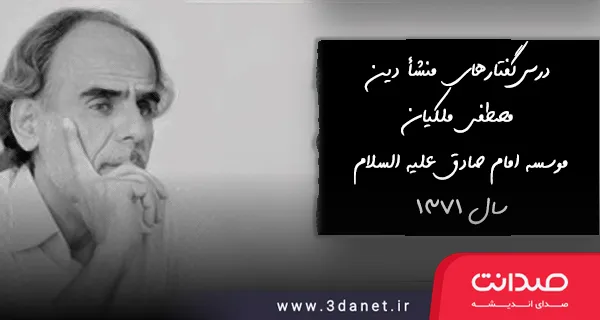
The lectures on the Origin of Religion, taught by Mostafa Malekian, were held in 1992 at the Imam Sadiq (a.s.) Institute. The full text of all twenty-six sessions of those lectures follows. A PDF file is also available for download at the end.
.
.
Session One: 1992/9/6
A Preliminary Discussion on the Term “New Theology”
Our discussion concerns theology (ʿilm al-kalām). However, since there is a series of ambiguities regarding whether
1- we fundamentally have a science called “new theology” or not?
2- and can new theology be considered a science independent of old, traditional theology or not?
3- and what is the relationship between new theology and the philosophy of religion?
4- and if these two are different, in religious studies do we only have these two sections or do we have other sections as well?
I must first delineate the scope of each. Especially since my opinion is that new theology is not an independent science, and we do not have a term called “new theology”[1].
New Religious Studies and the Factors Influencing Its Emergence
Introduction: The study of religion, or religious studies[2], in the West became very different from before starting in the nineteenth century. Of course, the roots of this transformation are generally traced back to the eighteenth century or the European Enlightenment.
This transformation in religious studies is the result of factors which I will list:
1- The Expansion of European Colonial Conquests
As you know, most European conquests by France, England, Italy, etc., took place in the nineteenth century. These colonial conquests caused them, who until then had little familiarity with the East and the Southern Hemisphere, to gradually become acquainted with these colonies. Naturally, in order to administer these countries, they had to become familiar with their native and local languages. Consequently, a widespread program of familiarization with Eastern and African languages began in Western universities and academies.
The Emergence of Comparative Religion
When this familiarity was achieved, in addition to that, another matter was also achieved, which was that Europeans also became familiar with religious texts, and consequently, they gradually became acquainted with non-European religions, i.e., other than Christianity and Judaism. After becoming familiar with Islam, Buddhism, Hinduism, etc., a comparison inevitably formed in their minds. For when two homogeneous things enter the mind, the human mind will inevitably make a comparison and assessment. The result of this comparison became what is today called comparative religion[3].
This comparative religion gradually eroded the absoluteness of a particular religion in people's minds. Consequently, one cannot treat other religions as if they are antisocial, or the insinuations of Satan, or the like. Westerners viewed other religions with these perspectives until the nineteenth century.
Some Misunderstandings of Islam in the West Before the Emergence of Comparative Religion
For example, a highly erudite person like Voltaire[4], who was fluent in several languages, we see that his early understanding of Islam was very distorted and ill-considered.[5] Or Leibniz, the famous German philosopher, in his very famous book called “Theodicy”[6], which he wrote on divine justice, refers to Islam as the religion of the Turks (due to Ottoman dominance in the nineteenth century).
Gradually, these views changed in the West, and it became clear that neither Christianity and Judaism were entirely correct and absolute, nor were other religions wholly ill-considered and unreasonable.
2- The Publication of Darwin's Theory
Darwin is the famous English biologist who, though not a philosopher or theologian, was a devout Christian. In his most important book, titled "On the Origin of Species"[7], he states that he is an orthodox Christian.
Religious Challenges Following the Proposal of Darwin's Theory
1- The Conflict Between Religious and Scientific Views on the Creation of Man
The publication of his theory led to a series of critical views regarding religion. For he states that man is the result of a very long biological evolution; in other words, man is descended from apes. And this matter contradicts the apparent meaning of the Book of Genesis[8], which is accepted by Christians and Jews. In the Book of Genesis, the story of creation is similar to what is found in the Quran, and of course, the apparent meaning of this story contradicts what the theory of "transmutation of species"[9] states.
Psychological Transitions of Darwin's Theory
But the matter did not end there. This theory also had a series of other implications that further entrenched opposition to religious views. To clarify the matter, I must mention a preliminary point.
When a statement or theory is proposed, in addition to its logical implications that take shape in the mind, a series of psychological implications also come to mind. This means that once that theory is accepted, the mind becomes prepared to accept a series of other matters, even though they have no logical connection. Humans, at all times, in addition to logical transition[10], also have psychological transition. [11]
2- Raising the Issue of the Temporality of Religion and its Change
Darwin's theory created a series of psychological implications in people's minds. People gradually began to say: perhaps, in addition to the body, society, the psyche, and current religion and culture are also the result of a long evolution over millions of years. In short, perhaps there is nothing constant in religion, just as there is no constant component in the body.
3- The Science of Anthropology[12]
What is meant by anthropology is the study and research of limited and vanishing societies. Such as certain tribes in Australia, Africa, and Asia whose populations, firstly, do not reach one hundred thousand, and secondly, are primitive societies[13] in the process of being absorbed into larger and more civilized societies.
The research of these scientists showed that Darwin's view seemed to hold true in the realm of society, religion, and culture as well. For they observed that a religious progression exists in societies.
The Religious Progression of Societies
The first stage that existed in societies was the era of animism[14]. This means that all things were considered to possess life and perception. They say that remnants of animism can still be seen in humans today. Such as when a person, upon a key not opening a door or a door not opening, angrily curses the key or the door, as if the key or door has understanding and feeling.
2- Polytheism or Worship of Deities
The second stage was that of polytheistic societies or the worship of multiple deities[15].
3- Monotheism and the Worship of One God
The third stage in the religious trajectory is monotheism and the worship of one God[16].
And finally, the fourth stage remains, which is irreligiosity and atheism[17].
If this trajectory is correct, it means that evolution and development have indeed existed in societies and cultures, and these stages emerged over time and in succession, not all at once.
4- The Advancement of Archaeology and Linguistics
Findings Presented in Archaeological and Linguistic Research
1- Confirmation of the Religious Evolution of Societies
The discoveries of archaeologists and paleontologists showed that a series of ancient remains belonged to animists, some to polytheists, and some to monotheists. When these were arranged according to date and antiquity, it became clear that the earliest societies were animistic, then polytheistic, and then monotheistic.
2- Demonstrating the Lack of Antiquity of Certain Sacred Texts
Furthermore, linguistic research[18] showed that most sacred texts do not possess the antiquity that was claimed. Rather, the time of writing for some parts or some books is three centuries later than what is claimed. For example, the Gospel of John, in whole or in part, does not date back to the time of John, and so on. Thus, the possibility of the distortion of sacred texts became very strong. It became clear that the authors of the four Gospels[19] are multiple, and many parts were written three to four centuries after Jesus Christ, peace be upon him.
Linguistic research is precise and not easily disputable. To clarify the matter and introduce this type of research, I will give an example:
An Example from Linguistic and Archaeological Research
If research shows that the infinitive wijdān in Arabic meant "finding" and was the opposite of fiqdān (loss), and that the infinitive wujūd in Arabic was not used in its current sense until the early second century AH, i.e., the time of Harun al-Rashid. Currently, wujūd (existence) is the opposite of 'adam (non-existence), and mawjūd (existent) is used in contrast to ma'dūm (non-existent). In Harun al-Rashid's House of Wisdom, when the translation of Greek and Hebrew texts began, the translators coined the word wujūd in place of asti and hasti, just as the practice of translators still is today: when they do not find an equivalent and synonymous word in the language, they create a new word.
Now, if in the Arafah Supplication of Imam Hussein, peace be upon him, we encounter this sentence: "How can one seek evidence of You through that which, in its existence, is dependent upon You?"[20] According to the previous hypothetical statement, it becomes clear that this prose, contrary to the claim, does not belong to the first century AH but to the second century. Such research has been extensively conducted on the sacred texts of Christianity and Judaism, and on our Quran and narrations, and today the authenticity of Christian and Jewish texts is severely questioned[21].
5- The Theory of Projection[22]
This factor relates to psychological, sociological, and philosophical research. Important thinkers in the 19th century across various sciences expressed a common belief that the idea of God and religion is a projection.
Projection means that a human being brings something into existence, gradually and then forgets that it is his own creation, and comes to believe that this thing has reality.
Marx and Freud's View on the Projection of the Two Concepts of God and Religion
Marx[23] and Freud[24] both consider the belief in religion and God to be a projection, in two different formulations.
Marx says that in the two periods of feudalism and capitalism[25], economic relations and the relationships between feudal lord and peasant, as well as between capitalist and worker, create economic and social problems that are insoluble, and in reaction to these problems, human beings construct a world where these problems do not exist and no one can oppress another, etc., and it is as if for every deprivation and failure, a religious belief has been created.
After this wishful thinking[26], when human beings are told that these beliefs are false and that they themselves have created them, they no longer believe it.
Freud also offers a psychological analysis according to his own school. He says that within the family sphere, each sex is inclined toward the opposite sex. That is, the son seeks the mother and the daughter seeks the father by nature, but social constraints do not permit this relationship. In his terms, the Oedipus complex, meaning the mother-seeking of sons, and the Electra complex[27], meaning the father-seeking of daughters, exist in human beings. The result of these constraints and limitations is that the son sees the father as an intruder, and the daughter sees the mother as one, and to soothe and alleviate this deprivation, they imagine a world where relationships are free and no one is an intruder.
On the other hand, during infancy and childhood, a human being considers his father to be like a superpower. But gradually, as the child grows older, the idol of the father is shattered, and he sees that his father, like him, is helpless and caught up in a series of limitations and regulations, and was nothing more than a paper tiger.
In this way, a heavenly father takes shape in the mind, a father who, firstly, does not interfere with free relationships. Secondly, he is not helpless and powerless like our fathers. Therefore, the term "heavenly father" in Christianity did not arise in vain.
Now, if such an individual is told that the heavenly father is your own creation and does not exist, he will not accept it.
In summary, according to this theory, when such instances were proven, some said that the belief in religion, God, and the resurrection might also be a projection and be null and void.
The result of the aforementioned factors in nineteenth-century Europe was that views toward religions were transformed, and they began to critically analyze the phenomenon of religion, and of course, criticism does not necessarily mean total opposition to religion.
.
.
Second Session: 71/6/22
It was said that from the mid-nineteenth century, for certain reasons, a transformation occurred in religious studies. The result of this transformation was the emergence of several different disciplines in religious studies, each of which looks at religion from a dimension, and of course, these sciences are also interconnected. To explain these various sciences, another preliminary point must first be clarified.
The Different Dimensions of Religion
Preliminary: Today, it is customary to consider six dimensions for any religion. This classification, although not precise, is, firstly, common. Secondly, nothing better currently exists. Therefore, we accept it for the time being.
First: The Doctrinal Dimension[28] or the Teaching Dimension or the Instructional Dimension
What is discussed concerning the essence of God, the divine names, attributes, and acts, and His relationship with all else, particularly with humanity, is called the doctrinal dimension of religion.
Examples of doctrinal propositions in various religions
For instance, it is said:
The world is dependent on God
God is one in three
Christ is both God and human, and so on…
Second: The Mythical Dimension[29]
The various meanings of myth and what is meant by it in this discussion
It must first be known that myth has two meanings:
A- Myth in the sense used by the Quran and some others, meaning fable and the illusory.
B- Myth in the sense applied to allegorical religious stories.
The collection of stories told in religion allegorically, so as to convey messages to the people, constitutes the mythical dimension of religion. For example, Westerners consider the story of the creation of Adam and Eve and the world, as well as the conversation of the angels with God or the conversation of Satan with God, and so on, as mythical. This is, of course, provided we regard them as containing allegory and metaphor; otherwise, if they are taken entirely at face value, they then fall within the doctrinal dimension. Mystics usually consider such stories mythical. Of course, the precise understanding of these allegories and allusions is difficult, and in principle, distinguishing whether a proposition is doctrinal or mythical is a difficult task in some cases.
Some criteria stated for distinguishing doctrinal from mythical propositions
Here, some have mentioned a criterion for distinguishing between these two categories of propositions.
They say a doctrinal proposition is one that can more or less be subjected to reasoning, such as the principle of God's existence, the proof of divine attributes and acts, general prophethood, and so on.
A mythical proposition, however, is one that is not susceptible to rational and philosophical reasoning, such as theories proving the existence of Iblis, angels, or jinn.
Third: The Ethical Dimension[30]
The set of oughts and ought-nots pertaining to outward or inward actions, with the exception of devotional acts in the specific sense, is called the ethical dimension.
Outward actions are those performed by means of the external limbs and senses, such as truthfulness and lying, and consuming the lawful or unlawful. Inward actions are those performed by means of a person's inner being, such as submission, trust in God, envy, humility, and so on. And what is meant by devotional acts in the specific sense are actions such as prayer, fasting, pilgrimage, and so on.
Fourth: The Devotional Dimension[31]
Devotional acts in the specific sense constitute this fourth dimension.
The reason for separating the third and fourth categories despite their common division
The reason these last two dimensions are separated, even though both belong to the set of oughts and ought-nots, is that religions usually do not differ in the ethical dimension and are very close to one another, to the extent that some have imagined they have no differences at all. However, in the devotional dimension, they differ greatly. For example, Christian ethics is very close to Islam, but in the devotional dimension, we have prayer, fasting, pilgrimage, khums, recitation of the Quran, and so on, whereas they have the Eucharist, baptism, and religious hymns.
The classification of religious propositions
The totality of religious propositions can be divided into two major categories:
1- Sentences concerning "is" and "is not"
2- Sentences concerning oughts and ought-nots
The second part is itself divided into two sections:
a- Pertaining to outward or bodily actions
b- Pertaining to inward or mental actions
The doctrinal and mythological dimension constitutes the first category, and the ethical and devotional dimension constitutes the second category.
Fifth: The experiential dimension[32]
When a person exposes themselves to a religion, they seek to attain an inner intuition and transformation, which is called the experiential dimension of religion. For example, Christians consider inner transformation to be when a person feels a union with Christ (peace be upon him). And mystics consider the ultimate end to be annihilation in God, and Buddhists consider the final goal to be feeling that there is a void in the world and that nothing exists but the self[33] and that all multiplicity is illusion.
Mystics and some religions say that if a religious person does not reach this stage, it is as if their life has been wasted, contrary to what many people understand from religion.
The experiential dimension is, in one sense, the origin of historical religion and, in another sense, the ultimate end of personal religion. That is, for example, Islam historically began with the revelation and intuition of Prophet Muhammad (PBUH), and on the other hand, the ultimate end of an individual's development is reaching the stage of intuition. Hence, in the philosophy of religion, this dimension is addressed in two discussions. In the discussion of the origin of religion, intuition and revelation are historically considered one of the origins of religion, and in the discussion of the shell and kernel of religion[34], the kernel of religion is considered to be the attainment of a discovery and intuition, which is the ultimate end of personal religion or the experiential dimension of religion.
Sixth: The social dimension[35]
The assumption of the last two dimensions is that in the experiential dimension, we examine the individual effects of the realization of religion, and in the social dimension, we observe the social effects of the realization of religion.
What is meant by the social dimension is that, firstly, for any religion to survive, it must create a series of social institutions, such as the mosque or the church, etc. Secondly, after its realization, religion inevitably entails certain consequences. For instance, the Crusades are among the consequences of the religions of Islam and Christianity, or the wars between Shia and Sunni over the centuries, and so on.
Or, for example, after becoming religious, a person divides all people into those of their own creed and those not of their own creed. People's views usually differ towards these two groups. Muslims, as a rule, side with a Muslim in an encounter between a Muslim and a Christian. Just as we now support the Muslims of Bosnia and Herzegovina. But if Muslims were oppressively killing Serbs and Christians, would we support the Christians? And if we did support them, to what extent?
Dispute over the stated classification of the dimensions of religion
And at the end of this discussion, the reason we do not consider this classification precise is that religion is the first four dimensions, and the fifth and sixth dimensions are the manner of religion's realization in the external world.
These various dimensions can be approached from different perspectives, from which various sciences are born.
.
.
Session Three: 71/6/28
We said that from the 19th century onwards in the West, and subsequently in countries like Japan, a tremendous transformation has occurred in religious studies. The word religion and the word study here carry a broad meaning.
What is meant by religion in discussions of religious studies
When religion is mentioned, we usually intend doctrinal systems originating from revelation, but in this topic, the discussion includes any doctrinal system. The study of religion
Religion here includes Buddhism, Hinduism, Marxism, Liberalism, and any intellectual-doctrinal system.
What is meant by research in the discussions of religious studies
Research here also has a broad meaning.
Types of research concerning religion
Concerning any religion, there are two types of research:
1- On the truth, veracity, and falsity of religions
All religions claim truth, and they also claim exclusive truth. Now we investigate which religion is true and which religion is not true. This is one type of discussion.
2- On the effects and consequences of religions
In the second direction, we do not consider the truth or falsity of religions. Rather, we want to say that when someone accepts a religion and when a religion comes into being, it entails consequences, both individually and socially. These include psychological, sociological, historical, and cultural effects.
Here, it should be noted that our fields have, until now, mostly worked on the first part and have worked less on the second part.
Human rational responsibility and its instances
We must also explain another preliminary point here, to clarify why two types of investigation are necessary. Human beings, insofar as they are rational and thinking animals, have a rational responsibility apart from other responsibilities. That rational responsibility is that they must accept only those opinions and theories for which they have sufficient and adequate proof. If we say A is B, we must have complete proof. "Rational Responsibility." Of course, if the claim is empirical, the proof must be empirical; if it is rational or transmitted, the proof must be rational or transmitted.
This matter is certain; however, no infallible human being can claim that for every word I speak, I have its complete and perfect proof ready. This has never been the case throughout history.
We humans, apart from this correct and logical path, also accept various matters through other ways, a few of which we will point out here through induction.
Incorrect responses to rational responsibility
Sometimes we humans accept an opinion because we have not heard the opposing opinion. And it is as if not hearing the opposing view itself becomes the reason for our acceptance.
Sometimes we accept a statement because we consider the opposing evidence to be insufficient and incorrect. And of course, this is not a logical path, because the weakness of the opposing evidence does not prove the correctness of the claim. Perhaps a third statement is correct, and assuming the two claims are contradictory, perhaps the opposing statement actually has a correct proof that the opponents simply did not understand or did not mention. In any case, every statement must have sufficient proof for its own establishment.
Sometimes we accept a statement because it cannot be traced or investigated. The speaker of the statement is not at all clear, as with anonymous writings and rumors. Humans show less resistance to such statements.
Sometimes we accept an opinion because not accepting it carries a penalty. For example, a person's social standing and reputation are destroyed, or a mother becomes upset with her child.
Sometimes we accept a matter because accepting it brings a reward.
توجه داشته باشیم كه پذیرش در اینجا شامل انقیاد و تسلیم شدن در مقابل كلام هم می شود.
بعضی اوقات كلامی را می پذیریم چون با مجموعة آراء سابق و ذهنیت ما هماهنگ است.
گاهی نكته ای را قبول می كنیم چون نیاز های روانشناختی[36] ما را ارضاء می كند. و اتفاقاً این بحث در مورد اسلام خیلی مهم است. وقتی می گوییم این كلام از فطریات است. یعنی به نیازهای وجودی[37] ما جواب می دهد. یا به تعبیر دیگر به نیازهای نفسانی ما پاسخ می دهد. بعنوان مثال از میان دو گزارة زیر :
انسان نابود شدنی نیست. و انسان نابود شدنی است، بر فرضی كه هیچ كدام دلیلی نداشته باشد، جمله اول موافق با طبع و مذاق انسان است و موجب اطمینان می شود بخلاف دومی كه موجب نا امیدی و نارضایتی و تشویش انسان می شود.
در مواقعی هم انسان نظری را قبول می كند، به خاطر اینكه شخص گوینده را قبول دارد و چون نظرات دیگر گوینده را صحیح دیده است، این مطلب را هم قبول می كند.
در مورد طریق هفتم مطلبی هست. یكی اینكه بسیاری از محققین در دین اعم از متدین و غیر متدین می گویند، اكثر پذیرشهای آدمی از همین راه است.
مطلب دیگر اینكه گزاره های دستة هفتم گاهی چنان است كه اگر دلیل كافی هم بر خلاف آنها اقامه شود، باز مقبول انسانها هست. البته دوست داشتن انسان بمعنی صحت رای نیست.
.
.
جلسه چهارم: 71/6/29
علت عام گرفتن معنای دین در دین پژوهی
ما چه از راه صحیح اخذ رای كرده باشیم كه راه منطقی است و چه از راههای غیر صحیح، به هر حال معتقدات آدمی در زندگی فردی و اجتماعی او تاثیر دارد. یعنی چنان نیست كه تاثیر و قوت یك رای در زندگی فردی و اجتماعی به صحت آن رای بستگی داشته باشد. از این رو در دین پژوهی فقط به دین یا دین های صحیح نمی پردازیم. گفتیم كه دین پژوهی شامل همة نظامهای عقیدتی می شود، لذا گاهی بجای كلمة دین، از كلمة نظام عقیدتی استفاده می شود. «belief system»
اقسام نظام های عقیدتی در دین پژوهی
بدین لحاظ دین پژوهی به دو دسته نظام عقیدتی می پردازد :
1- نظامهای عقیدتی سنتی «traditional» مثل اسلام، مسیحیت، یهودیت، بودائیسم، هندوئیسم، آیین شینتو، آئین كنفوسیوس و ...
2- نظامهای عقیدتی دنیوی «Secular» مثل : لیبرالیسم، ماركسیسم و ... برای تفكیك بین این دو دسته بیانات مختلفی شده است كه خواهد آمد. انشاالله
ملاک های تفکیک اقسام نظام های عقیدتی
عجالتاً یكی از نظریات را مطرح می كنیم. آقای اسمارت می گوید : اگر یك نظام عقیدتی نظر به بالا یا به درون داشته باشد، سنتی است. بعضی ادیان مثل اسلام و مسیحیت نظر به بالا و ملكوت دارند و بعضی دیگر مثل بودائیگری نظر به درون و باطن انسان دارند. و اگر یك نظام عقیدتی نظر به بالا و یا درون نداشته باشد و صرفا به فكر دنیا و زندگی فردی و اجتماعی باشد، دنیوی است.
And as for the question of whether worship can serve as the distinguishing factor between these two categories, it must be said in response that if by worship is meant the expression of helplessness and seeking refuge before the Lord of the universe, some traditional religions, such as Buddhism, do not believe in a god at all and therefore have no worship. However, if we take worship in a broad sense that also includes self-vigilance and inward concentration, it can be said that traditional religions do possess worship.
Of course, it should be noted that some secular belief systems also have specific customs, rites, and ceremonies, such as Freemasonry, but we do not count these as worship.
The Dispute over the Classification of Belief Systems in Religious Studies
Objections have been raised against this account and classification from both sides. Proponents of secular belief systems attack a project of religion, asking: why do you study traditional systems? These are fanciful and delusional. From the other side, they ask: why do you examine secular systems? Engaging with these systems is dangerous and gradually weakens religious and traditional faith.
The Types of Sciences Involved in Religious Studies
Religious studies encompass various sciences, which are divided into two categories:
1- Sciences concerned with the truth, veracity, and falsity of religions
The sciences concerned with the truth, veracity, and falsity of religions, which consist of the philosophy of religion and theology.
Sciences that have nothing to do with the truth and veracity of religions, which are examined under the title of worldview analysis[38].
What is meant by worldview analysis
Worldview analysis holds that religion is a social institution and, naturally, like other institutions, deserves to be examined. A social institution[39] means those pillars of human life that exist always and everywhere in society, despite the many differences between societies. Such as the family, the economy, and government, though there is disagreement about their number.
One who engages in worldview analysis says that another one of the social institutions is religion in the general sense. Therefore, it must be subjected to examination and inquiry.
Elements involved in the method of worldview analysis
The method of worldview analysis has three important elements:
1- Being comparative and contrastive
First, it is a comparative and contrastive inquiry. Both points of difference and similarities are observed.
Second, it is a historical discussion and has nothing to do with the current state of religion. Rather, the course of the historical evolution of religions, the mutual influences of religions upon one another, as well as their triumphs and defeats, are studied.
3- Being accompanied by empathy
Third, it is accompanied by empathy[40], in the sense that when we want to examine a belief system, we must at least try to put ourselves in the frame of mind of its adherents. Not that we become proponents and followers of that system of thought.
The worldview of Kavi is a kind of neutral and impartial study. And while studying and examining different systems, one must set aside religious zeal. For example, if a Christian wants to understand the Ashura ceremony and the religious feelings of a Muslim, they must enter into the intellectual and spiritual atmosphere of a Muslim. And conversely, if a Muslim wants to understand the Christian Eucharist, they must immerse themselves in their thoughts and beliefs.
We Easterners usually consider Westerners to be fleeing from religion and spirituality, but Westerners, even if their adherence to religion is slight, have tried and continue to try as much as they can to preserve their religion. For instance, in the West, many books have been written in defense of religion against Freud and the like. But because the arguments of the opponents of religion have been numerous, what they do not believe now is because they could not defend it and were compelled to do so.
Another expression of having empathy: Phenomenological examination
Some, instead of the term empathy, say we must have a phenomenological study[41]. This term was coined by a German philosopher named Edmund Husserl. [42]
The meaning of phenomenological examination
The phenomenological method means recognizing the phenomenon as it appears and approaching the phenomenon without imposing our own beliefs and preconceptions upon that phenomenon. Because if we impose them, we can no longer maintain an impartial stance. [43]
.
.
Fifth Session: 4/7/71
A review of the previous session's discussions
We said that the sciences categorized under religious studies are divided into two general groups:
1- Sciences concerned with the truth and falsehood of religions.
2- Sciences that have nothing to do with the truth, validity, or falsehood of religions.
1- Types of sciences unrelated to the truth and falsehood of religions
The second group includes the following sciences:
In this science, the discussion is about what psychological effects and outcomes religion has on the religious person.[44]
In this science, the discussion is about what social effects religion has in a society. Of course, social effects here also include economic outcomes.
An example of sociological examinations in religion
For example, Max Weber believed that capitalism in the West is an effect of the Protestant religion. Different Christian denominations lead to different views about the world and social relations. And if capitalism and the free market did not emerge before Protestantism, it was because of two great religious reformers, namely Luther[45] and Calvin[46]. And the Catholic religion was involved in this matter. Such discussions have also taken place regarding Islam. [47]
In this science, two tasks are performed.
First: Depicting the course of evolutions and transformations that have occurred in each religion, and
Second: it examines, even if briefly, the role of religions in history.
Here the discussion concerns the effects of religion on the emergence and spread of various arts.
An Example of Religion's Influence on Art
For instance, in Islam, due to the prohibition of sculpture, this art did not advance much, whereas the arts of calligraphy, architecture, and poetry advanced greatly. And in the cradle of Christianity, the arts of music, painting, and sculpture advanced.
In this discipline, too, the discussion concerns the influence of religion on literature.
An Example of Religion's Influence on Literature
For example, within the fold of Islam, novel writing and memoir writing did not advance, but they did advance in Christianity.
The effects and results mentioned are caused by factors including religious rulings and teachings and the historical period of that religion.
2- Types of Sciences Related to the Truth or Falsity of Religions
As for the first category of sciences, which deal with the veracity of religions, they are:
1- Philosophy of Religion
2- Theology
The word "Theo," which is Greek, means God, and the word "logy" means to know, and in translating this word, various equivalents have been used, such as 'ilm al-rubūbiyyāt, ma'rifat al-rubūbiyyāt, al-ilāhiyyāt, and athūlūjiyā, which is the Arabicized form of the word theology.
First, some explanations regarding the philosophy of religion will be mentioned.
Points about the Philosophy of Religion
1- The Philosopher of Religion's Lack of Commitment to a Specific Religion or the Principle of Religion
The first point is that a philosopher of religion may be religious or may not adhere to any religion at all. And they may also believe in the existence of God (Theist), or deny God (Atheist), or be an agnostic (Agnosticist).
In any case, insofar as they are a philosopher of religion, they are not bound to any specific religion. Therefore, the word religion in the philosophy of religion is absolute and is not restricted to Islam or Christianity.
2- Types of Issues Examined by the Philosopher of Religion
The next matter is that the philosophy of religion discusses two sets of issues:
1- Intra-religious issues
2- Extra-religious issues
For now, the discussion concerns intra-religious issues. Intra-religious issues are those that adherents of religions and denominations believe in and are based on holy scriptures. However, the philosopher of religion, from among these issues, only addresses the common elements among religions.
It should be noted that what is meant by religions in the philosophy of religion and theology is traditional religions.
Common Elements Among Religions
There is a set of elements and issues that all religions believe in. Among them:
1- Belief in an Existence Beyond Matter
All religions believe in an existence beyond matter and material things, even if they debate its particulars. That non-material being is either God, or Yahweh, or the Heavenly Father, or the Universal Spirit, or Ahura Mazda—respectively in Islam, Judaism, Christianity, Hinduism, and Zoroastrianism.
2- Belief in the Concept of Salvation
B- All religions subscribe to a concept called salvation, or felicity, or liberation. When they say that the desirable state is not the one you are in and that there is a better place elsewhere, this idea is called the doctrine of deliverance or redemption[48] or liberation or felicity.
No religion has ever said that the current spiritual and social condition of human beings is desirable and that you should preserve it; rather, religions always say: strive to reach the non-existent desirable state.
All religions subscribe to a non-material element in human beings called the soul.
The immortality of the human being
5- The Creation of Beings from Non-being into Being
The creation of beings from non-being into being. Creation ex-nihilo
The world has a goal towards which it is moving. Of course, there is disagreement as to whether this goal is intrinsic or extrinsic. That is, whether the world itself is purposeful or whether the maker of the world had a purpose in creation. [49]
7- The Moral Order of the World
The world has a moral order. That is, the universe has been created in such a way that it rewards good and punishes evil. In other words,
First: the world is cognizant of good and evil, and
Second: it gives them appropriate reward and punishment.
These mentioned elements are, in brief, common among religions, but of course, they differ in their details and particulars.
Thus, the philosophy of religion has nothing to do with the discussion of the Mi'raj, or the Trinity, or intercession. It deals only with common matters, and concerning these common matters, it discusses whether they are amenable to rational and philosophical argumentation and proof or not. Which rational argument proves or refutes a certain common religious matter?
And that is all.
.
.
Sixth Session: 71/7/5
Our discussion concerning intra-religious issues passed briefly.
Extra-religious Issues and Their Divisions
As for extra-religious issues, these are matters about which a believer in a specific religion finds nothing in their holy book and must adopt an opinion and stance from outside. Such as:
One of the important discussions in the philosophy of religion is whether the propositions that appear in sacred religious books and traditions are all declarative, or all performative, or some declarative and some performative.
Some hold that religious propositions, even if they appear declarative or performative, are all in reality declarative. And some, conversely, consider them all inherently performative. And some accept both types. Some say that "Indeed, Allah commands justice and good conduct"[50] even though it appears declarative, in reality means "Act justly and do good." The difference between the two sentences is that if it is in the performative form, its meaning is that we have such a command even if God does not exist. "Act justly" has meaning even without the existence of God. But if it is in the declarative form, its meaning is that:
First, it is subject to truth and falsehood.
Secondly, a God exists in the world.
Thirdly, God has commands and prohibitions.
Fourthly, one of the divine commands is "Be just," and one of the divine commands is "Do good."
If the propositions are performative, one can say, "I accept 'Be just,' but I do not accept the existence of God," as has indeed been said. Feuerbach envisions a religion without God in this way. But if they are declarative, such a statement is not reasonable.[51]
2- Arbitration between Religions
When two religions dispute with one another, who or what is the arbiter of this dispute?
Given that religions claim exclusive truth, if one religion says "A is B" and another says "A is not B," what is the ruling in this matter?
This question cannot be asked of the Quran, the Bible, or the Torah, because this question arises before choosing a religion. In a dispute between two historians, two physicists, or two literary scholars, the judge is clear. But what should be done in a dispute between religions?
Here, if the following objection is raised:
Firstly, the answer to this question must be sought from the sacred texts.
Secondly, the meaning of the challenge (tahaddi) in the Quran is that I am upon the truth and others are not, and once it is proven that the Quran is the divine word, the truthfulness of the Prophet of Islam, Islamic rulings, and the finality of the Prophet are established. Moreover, it becomes clear that the Torah and the Bible have been subject to distortion; therefore, in any dispute of rulings, Islam always takes precedence.
In response to this objection, we say:
Firstly, this very point you make, that "the solution must be sought from the sacred texts," is itself an extra-religious solution, and this point appears nowhere in the Quran or the traditions.
Secondly, the challenge (tahaddi) can only prove the truthfulness of Islamic rulings if we have previously established the authority of the challenge from an external source.
Thirdly, the meaning of the challenge is nothing more than that the Quran is divine speech, not human. And the meaning of finality is that no prophet will come after the Prophet of Islam. And
Fourthly, when some verses of the Torah and the Bible have been distorted, identifying them is difficult, and even assuming identification, we cannot reject the other verses. In any case, the discussion becomes extra-religious.
3- The Conflict between Science and Religion
The apparent conflict between science and religion is not something that can be denied. However, the religious person says the conflict is resolvable and is prima facie. Here, those who consider religious propositions to be performative say that scientific propositions are declarative; therefore, no real conflict between science and religion is conceivable. Hence, this group has no problem.
Yes, if we consider religious propositions to be declarative, or if we hold both forms to be true, then a conflict arises. For example, it is stated in the Quran that God created the seven heavens. [52] This theory of the seven heavens relates to Ptolemaic astronomy, and today this view has been rejected, and science says we do not have seven celestial spheres.
Now, how should the conflict between religion and science be resolved here?
Here too, if the answer given is that "the Quran is interpreted by its own parts"[53] and that in case of conflict, the answer must be found through other verses and traditions, then the matter becomes intra-religious.
Again, in response to this statement, we say that presenting this very solution is itself a judgment of reason and is extra-religious.
The criterion for distinguishing an extra-religious path from an intra-religious one is this: if somewhere in the Quran, the traditions, or the sacred texts, there were this meaning: "O people, in case of conflict between My decree and science, refer to My own statements and verses so that the conflict may be resolved," then the solution would be internal; otherwise, it is not.
It must certainly be noted that providing an intra-religious solution is possible, but in the aforementioned issues, such a solution has not been presented.
One of the solutions that has been offered in such cases is that the Quran's expression in these verses is dialectical, not demonstrative. That is to say, since the Ptolemaic system was prevalent at the time, and stating the falsity of this view was not possible, or was not expedient, or was not necessary, the Quran, in any case, spoke to the people in that same language. And what is important is that God created the heavens. Other paths have also been taken, which will be mentioned in their proper place.
The aforementioned topics were part of the discussions of the philosophy of religion.
The Method of Discussion in the Philosophy of Religion
The next point is that the philosophy of religion
Firstly, is single-method.
Secondly, its method of discussion is rational.
The methods of reasoning differ in various sciences.
1- In sciences such as physics, chemistry, botany, etc., it is empirical.
2- In sciences such as history, lexicography, etc., it is transmitted.
3- In sciences such as the philosophy of religion, mathematics, etc., it is rational.
The aim of the philosopher of religion is to rationally examine common intra-religious matters and extra-religious issues. In the course of this rational inquiry, it becomes clear that common intra-religious rulings have three forms:
Categories of Religious Propositions in Rational Terms
1- Rational: Reason undertakes to prove it.
2- Irrational: Reason undertakes neither to prove nor to refute it.
3- Antirational: Reason undertakes to refute it.
It will become clear in the future that the theologian always seeks to say that in my religion, there is no antirational proposition, and what exists is either rational or irrational. But the philosopher of religion may consider one of the common intra-religious rulings to be antirational, because he does not consider himself bound by religion in general or by a specific religion.
And peace be upon you.
.
.
Session Seven: 71/7/5
Differences Between Theology and the Philosophy of Religion
Our discussion in this session pertains to theology.
1- The first difference between theology and the philosophy of religion, as mentioned before, is that theology is always used in a qualified manner, such as Islamic theology, etc., but the philosophy of religion is used absolutely.
2- The second difference was that the theologian is always a believer in a specific religion, but the philosopher of religion may be a believer, may be irreligious, or even an atheist, and in any case, does not involve his own faith in the philosophy of religion.
3- Furthermore, theology and the theologian have an apologetic orientation (apologetics), unlike the philosophy of religion.
The Activities of the Theologian
The tasks that a theologian must perform are as follows:
1 – Systematization of religious propositions.
One of the differences between human and divine books is that human books have a specific order. Chapter one on... chapter two on... and so on, and each chapter contains sections. And each discussion is placed in a specific, separate location. Usually, however, sacred texts lack such an order; for example, verses on prayer or fasting are mentioned scattered across multiple surahs. Of course, the meaning of this statement is not an error or deficiency in religious texts, because this mode of expression has its own merits, a point to which some of our exegetes have also alluded.
Prescriptive propositions must be separated from declarative propositions. For the theologian qua theologian has nothing to do with prescriptive statements, and must then arrange the propositions of “is” and “is not” according to a specific order. For example, beginning with the discussion of God, His attributes, and His acts, and concluding with the afterlife. Or in another order.
2 – The Explanation of Religious Propositions
This part itself comprises three tasks.
1- To explain that the propositions themselves are consistent with one another (Consistency).
2- To interpret the propositions in light of the human sciences and knowledge of his time. (The theoretical dimension)
For instance, if Darwin’s theory in biology were hypothetically established, the theologian would then have to interpret the verses about the creation of the heavens in seven days and the creation of Adam (peace be upon him) from clay in a way that accords with this principle.
Or, suppose it were one day proven in criminal sociology that retribution (qisas) leads to an increase in murders, not a decrease; in that case, we would have to interpret the noble verse “And there is for you in retribution life”[54] in a different way.
3- To interpret the propositions in light of the practical problems and issues of today. (The practical dimension)
One of the reasons for employing the term “new theology” (kalam-e jadid) is that this dimension was less observed in old theology. At one time, we are told that Darwin has proposed such a theory in biology; what is your view on this matter? This pertains to the theoretical dimension. And at another time, we are told that today we have a practical problem called “environmental pollution”; what solution does your religion offer for this problem? This problem did not even exist a few decades ago. What is your religion’s view on preventing the rise in divorce rates? What is your religion’s view on the problem of the younger generation’s rebellion? And problems of this kind.
This kind of discussion is, of course, different from the work of the jurist (faqih). The jurist qua jurist only states that the religion of Islam holds such-and-such an opinion and ruling on a certain matter. But as to whether this opinion solves the problem or not? And if it does, whether it is the best solution or not? He has nothing to do with these matters. Even though, insofar as he believes in Islam and divine rulings, he says this is the best solution to the problem, he is not, however, in the position of proving this point. The entire concern of the jurist is to say that this ruling and opinion is based on the Quran and reliable narrations, and that there is no technical or jurisprudential flaw in my deduction. He has nothing to do with the problem-solving aspect of the ruling. Even in ‘ilm al-khilaf (the science of juristic disagreement), to which jurists like Shaykh Tusi (may God have mercy on him) paid attention and care, the sole concern was that the ruling of this jurist and this school of thought is correct and the opposing ruling is invalid. And as for the narrations found in ‘Ilal al-Sharayi’ (Reasons for the Religious Laws), they too pertain to the cause of legislation and the wisdom behind the rulings. But whether these rulings solve the problem of divorce, theft, hoarding, or adultery is another matter entirely. In other words, if a purpose is intended in the enactment of a law, it does not necessarily entail that this purpose will be realized in the best possible manner.
In old theological books, they only come somewhat close to this matter in the discussion of prices and compensations, and not in other chapters. But today, in theological books, the discussion of such problems is visible, such as the problem of rising divorce rates, the utilization of mineral resources, international relations, and so on.
Another of the theologian’s duties is to refute objections and problems raised by the theologians of other religions and others besides them. Such as: How is the Trinity possible? How is the Ascension (Mi’raj) possible? And other questions.
The spirit governing all three duties of the theologian is the defense of religious beliefs, and this defensive dimension has also become broader compared to the past.
And peace be upon you.
.
.
Eighth Session: 18/7/1371 [October 10, 1992]
Refuting Objections, the Primary Function of Theologians
The discussion concerned the duties of the theologian. We said that the theologian’s main task is to repel the doubts raised by other theologians. From ancient times, the method of theologians has been that
First: they would wait for the doubts of others in order to answer them.
Second: they were also constantly seeking to raise objections against others.
For example, a Christian theologian attacks the Muslim and asks, “How is the Ascension (Mi‘raj) possible?” And the Muslim theologian attacks the Christian, asking, “How is the Trinity possible?” And in addition to these objections, each also rises to answer the other. The Difference Between the Methods of Discussion of Ancient and Modern Theologians and Its Cause
A point: In ancient times, if a theologian approached a theologian of another religion or denomination, it was solely to criticize and refute his view. But today, there is another matter as well, which is that the modern theologian, in addition to the former concern, wants to acquire the strengths of others and discard his own weaknesses.
The main reason for this is two things:
1- The Irresolvability of Conflicting Religious Claims
In discussions of the philosophy of religion, one of the matters that, in the view of many theologians, has been established is that conflicting religious claims regarding fundamental beliefs are none of them provable, and the conflict between religions is irresolvable.[55] Therefore, one must move past such discussions, and in the midst of debate, one should seek out strengths and weaknesses. Neither can the Muslim invalidate the Trinity, nor can the Christian invalidate Tawhid (Divine Unity). But if, in the discussion, the Christian says, “Do you not consider the Prophet and the Pure Imams, peace be upon them, as manifestations of the Divine Names? Do you not say that they are similar to God, except that the right of creation belongs to Him and they are created, and so forth? We say something similar to your words regarding Christ, peace be upon him.” Here, the two sides have drawn somewhat closer to each other, and the Muslim sees that the other is not entirely on the wrong path, and so on.
2- The Intense Growth of Materialism
Today, global problems have become so great that human beings cannot be indifferent to one another. In the realm of ideological issues, contrary to the past when most people believed in spirituality and had differences among themselves, today materialist and atheistic schools have created so many problems that spiritual schools have come to think of helping one another to confront materialism.
After the Renaissance, and especially after the time of David Hume, materialist schools and their doubts have become so numerous that spiritualists feel it is not expedient to engage in conflict with one another; rather, they must all stand together against the devastating flood of materialism. Doubts such as those of Kant[56], Hume[57], the new positivists, and the atheistic existentialists—for example, when Hume raises six important objections to the argument from design, or writes a book about miracles and says that miracles are sufficient neither to prove the existence of God nor to prove the prophethood of a prophet, these objections are directed at all believers in design, God, and the miracles of prophets.
With this, it becomes clear that the primary adversary of the Muslim is not the Christians or the Jews, and vice versa, but rather the materialists.
Various Classifications of Theology and Their Differences
The next matter is this: Some Westerners have divided theology and religious issues into:
A- Revealed theology, or truths that human reason would not have attained had it not been for revelation and inspiration. “Revealed theology”
B- Natural theology, or truths that reason independently proves, without the confirmation of revelation. “Natural theology”
The first type includes things like the states of the Barzakh (the intermediate realm), the world of the Resurrection, and the unseen realms; the second type includes things like “God exists” and “God is one,” etc.
Question: If some truths are perceived by reason alone, why has revelation also expressed these matters? Western thinkers give two answers here:
First: Not all human beings possess the rational capacity necessary to perceive these truths.
Second: Not all human beings have the peace of mind and the opportunity to reflect on these matters.
The Classification of the Ancients
The ancients also had a classification regarding kalām, dividing it into
A- Rational kalām,
B- Transmitted kalām
While these two classifications overlap in many instances and have “partial coincidence,” they also have points of divergence.
Explanation: The ancients said that if we wish to use the Qur’an and the traditions and for them to hold authority for us, a series of matters must first be independently proven, which are:
1- God exists.
2- God is one.
3- God is absolutely omniscient.
4- God is absolutely omnipotent.
5- God is absolutely benevolent.
6- God intends a legislative intervention in human life.
7- This legislative intervention must be carried out through prophethood.
8- Muhammad (PBUH) is one of the divine prophets.
9- The Prophet is infallible in receiving, preserving, and conveying revelation.
10- What is contained in the Qur’an is the word of the Prophet and divine revelation.
11- We have the capacity to understand the Qur’an.
12- The apparent meanings of the Qur’an are authoritative.
The authority and validity of these matters cannot be proven by the Qur’an, because that would entail circular reasoning. For on the one hand, the authority of the Qur’an must be proven through these premises and depends on these matters, and on the other hand, we want to prove these premises and matters through the Qur’an.
According to the second classification, these propositions constitute rational kalām, and anything else is transmitted kalām, for which one can rely on the Qur’an and authentic traditions, even the issue of the Resurrection.
According to this explanation, the discussion of the immortality of the soul, for example, insofar as it can be proven by reason, is natural theology, and insofar as the authority of the sacred texts does not depend on it, it is not rational kalām but falls under transmitted kalām.
Examining the Term “New Kalām”
At the end of the preliminary discussions, it became clear that we do not have a science called “new kalām.” We do not have such a term, “New Theology,” in the West either. What is meant by this phrase is either topics in the philosophy of religion or new kalāmī issues. A new science always arises where either the subject matter, the method, or the goal changes, whereas none of these has changed. Of course, many topics and issues are discussed in kalām today that did not exist at all in classical kalām.
The emergence of this term dates back to when the sage and martyred theologian, Professor Motahhari (may God be pleased with him), chose this title for his course on new kalāmī issues, in contrast to courses on the Sharḥ al-Tajrīd and others. From then on, this compound “new kalām” became widespread and caused confusion in many minds.
.
.
Session Nine: 25/7/1371
The discussion of the origin of religion in the philosophy of religion
Our discussion is currently on one of the topics in the philosophy of religion. “What is the definition and origin of religion?”
Phenomena that have been created by human beings throughout history always satisfy one of human needs. Such as script, language, and the like, unlike stone and wood, which are not made by humans. And if this were not the case, either these phenomena would not have come into existence at all, or if they had come into existence, they would have later disappeared, at a time when they no longer satisfied a need. As has been the case with many human inventions.
Religion is also one of these phenomena. From the fact that religion has always been and continues to be among humanity, it becomes clear that it satisfies a need among human needs, which we refer to as the "origin of religion."
What is meant by religion in this discussion encompasses both traditional and secular religions. The reality is that none of the various definitions offered by thinkers and in different cultures regarding religion has been universally accepted. In this regard, two types of definitions of religion have been given, which are in fact pseudo-definitions and false definitions, and these two types are not within the scope of our discussion:
Categories of Definitions of Religion
The first group: Figurative definitions. "Figurative definitions," which indicate a figurative usage of religion.
For example, Bosanquet (H. Bosanquet) says that a person's religion is that thing for which that person would die and from which they would not desist.
According to this definition, if I, for instance, were to die for my book, child, wealth, or party principles and not desist from them, these would be my religion. This meaning, of course, is very far from the true definition of religion.
Or the Frenchman Ernest Renan says: Now, as always, my religion is the progress of reason. In other words, it is the progress of science. He, in truth, wants to say that he does not accept religions but rather accepts the progress of science.
The second group: Propagandist definitions. "Propagandist definitions."
For example, Marx says: Religion is the opium of the people, which is a view that propagandizes against religion. Or some have said: Everything good in humanity is religion, which is an example of favorable propaganda.
But as for the serious and true definitions that have been given of religion.
"James Leuba" has a book called "A Psychological Study of Religion." In it, he says: The serious definitions of religion can be divided into three categories. And this classification seems appropriate to us.
1- Intellectualistic Definitions
A- Intellectualistic definitions.
That is, definitions that present religion as a type of knowledge or a set of propositions that have a composite structure.
1- For example, some have said: Religion is the belief that our world has a purpose.
2- Or "Max Muller," who is the most accomplished translator of the sacred Buddhist texts (the Upanishads)[58] into English, gives a definition that is very similar to the Buddhist religion. And you know that the characteristics of one instance of a concept are never incorporated into the definition of that concept. He says: Religion is a faith that, independent of sense and reason, and indeed contrary to sense and reason, enables human beings to apprehend the Infinite.
3- "Herbert Spencer"[59] says that the essence of religion is the belief that all things are manifestations of a Power that transcends our knowledge.
The Common Thread of Intellectualist Definitions
The common thread among these kinds of definitions is that they consider religion to be a type of knowledge.
These definitions have only attended to one dimension of religion and have made no reference at all to the emotional and practical dimensions of religion. For every religion possesses three dimensions:
1- The cognitive dimension
2- The emotional dimension
3- The practical dimension, which is divided into two parts:
a- Ethical actions, such as honesty
b- Ritual actions, such as prayer
The second and third dimensions have not been considered in these definitions. What is meant by the emotional dimension is that there is no religious person who does not feel zeal and fervor toward certain matters, and who does not hold certain other matters in less regard.
.
.
Session Ten: 9/8/1371
Continuation of the discussion on the second division of religion
The first category of definitions was the intellectualist definitions, which have been set forth.
The Major Defect of Intellectualist Definitions
Such definitions have two general flaws, which are as follows:
1- They have not mentioned the emotional and practical dimensions of religion.
2- Even in the cognitive dimension, they have only mentioned one specific kind of knowledge and have neglected other kinds of knowledge.
2- Voluntarist or Emotionalist Definitions
Now, the second category: voluntarist[60] or emotionalist[61] definitions.
The most important definition from the second category is that of Schleiermacher[62], which has also been the subject of much discussion. He says: Religion is "the feeling of absolute dependence on something else."
This definition corresponds to a great extent with his own religion, for he is a Protestant Christian, and the hallmark of this denomination is the feeling of dependence on God. This feeling, of course, is very far removed from mere verbal profession. This feeling is also given some attention in other Christian denominations, but not to the extent it is in Protestantism, nor to the extent that Luther[63], the leader of the Protestants, attaches importance to it. And again, this feeling also exists in Judaism and Islam.
The Defect of Voluntarist or Emotionalist Definitions
This definition also has two major problems:
1- It has only attended to the emotional dimension of religion.
2- The aforementioned feeling is not common to all religions. For example, the Buddhist religion does not hold such a view.
Freud's Critique of Voluntarist or Emotionalist Definitions
One of the critics of this definition is Freud. In the sixth section of his book The Future of an Illusion, he says: "It is not this feeling of absolute dependence on another being that constitutes religion, but only the next step that constitutes religion; that is, the reaction to this feeling and against this feeling. The religious person is one who seeks liberation from this feeling of dependence. One who does not go further than this and humbly sees himself as dependent on another being is, on the contrary, irreligious, not religious."
This statement is not correct, but the criticism of figures like Freud indicates the importance of Schleiermacher's definition.
The Emotionalist Definition of Religion by the Sufis
Some Orientalists and Islamicists[64] have also said that the religion of the Sufis in the first and second centuries AH was confined to a feeling of fear of God, and later, from the third century onward, this feeling transformed into a feeling of love for God. In other words, Islamic Sufism began with fear and culminated in love. In short, there have been those who have reduced religion to a single kind of feeling.
3- Practice-Oriented Definitions
The third category: Practice-Oriented Definitions «Practical»
This category comprises definitions that confine religion to a specific set of actions. Anthropologists, that is, those who study peoples isolated from the main body of humanity, usually define religion in practical terms, because they only see the outward actions of people.
One of the well-known definitions in the third category is that of Lord Raglan. This famous Western scholar of religion says: Religion is the quest for life by means of a series of actions. By actions, he means ritual actions, not ethical ones.
Critique of Scriptural Supports for a Practice-Oriented Definition of Religion
Here, one might imagine that we have narrations stating that Islam is founded upon five matters,[65] or three matters, and the bulk of these matters are actions, such as prayer, fasting, pilgrimage, and alms. Therefore, can religion not be defined as the sum of these actions, as these narrations suggest?
The response to this is:
Firstly, in all these hadiths, in addition to actions, one or two cognitive and emotional matters are also mentioned. In some, the issue of wilayah (guardianship) is mentioned, which of course has both a cognitive and an emotional dimension, and in others, the issue of the two testimonies of faith (shahadatayn) and acknowledgment of what the Prophet (PBUH) brought is also appended.[66]
Secondly: Regardless of other objections, even if this point were valid, it would only be suitable for defining Islam, whereas our discussion concerns defining all religions with a single definition.
Point: It is appropriate here to note that no action, merely as an action, is considered religious; rather, every action is deemed religious because of its cognitive and emotional underpinnings. For example, mere bending and straightening up and placing one's head on the ground is not what we call prayer (salat). Rather, it is the cognitive and religious underpinnings that make prayer prayer. Therefore, if someone performs these actions with the intention of mockery, hypocrisy, or exercise, that action is not called prayer. [67]
There are also some definitions of religion that mention two dimensions of religion. For instance, Mr. Matthew Arnold says: Religion is a practical system blended with emotion. This definition also fails to consider the cognitive dimension, in addition to mentioning action and emotion in a general way without specifying them.
The Method for a Correct Definition of Religion
Question: If we want to define religion, what should we do?
At first glance, it might seem that we must first gather all religions, and then select those aspects of religions that:
Firstly, are common to all of them (comprehensive of all instances).
Secondly, these common aspects are not found in any other thing (exclusive of all others). Then, we should incorporate these mentioned aspects into the definition of religion.
The Problem of Circularity in the Discussion of Definition
But here a major problem arises. At the stage of collecting religions, if a school of thought like Marxism also says, “I am a religion and you must include me in this set,” on what basis do you accept or reject this school? If we want to admit every doubtful matter and every claimant into this set, we will ultimately have a vast collection of various things, some of which have nothing to do with religion at all. And if we want to bar the doubtful case, the other side says, “If you recognize religion and know its characteristics and say they do not exist in me, then why are you still seeking the definition and characteristics of religions?!” This is a case of begging the question and is impossible.
This problem exists in the definition of any other object as well. Such as the definition of a chair, a cat, a window, etc.
In other words, the definition of religion, cat, and window depends on collecting religions, cats, and windows, and collecting these depends on knowing the definition and characteristics of religion, cat, and window. So this solution entails the problem of circularity and is therefore an invalid and incomplete solution.
From this, it becomes clear that even the first indubitable entity we want to take into account is of doubtful religiosity and doubtful divinity. Unless we already know the definition of religion and cat.
Point: It must be noted that whenever we collect any number of different entities in one place, there is ultimately a common and comprehensive aspect among all of them. Such as corporeality, existence, or thingness. But these titles and commonalities are not useful for definition, do not provide a criterion for distinguishing between things, and every entity is submerged and dissolved within them.
To answer the question of how definition is possible, one must know the types of definition in ancient logic and other logics, a discussion that requires many preliminaries and extensive detail beyond the scope of our discussion. Therefore, we will set it aside for now.
There is a well-known solution here that we will examine in the next discussion.
.
.
Session Eleven: 10/8/1371
Continuation of the discussion on the problems of defining religion
The solution of collecting and extracting common aspects in definition was mentioned to have the fundamental problem of circularity.
The Second Problem and Its Critique
Another problem with this approach is that we do not have common elements among religions, so the problem of definition remains. And if someone says, “You previously enumerated common elements among religions, so how can you say defining religion is not possible?” The answer to this question is that the mentioned elements pertain to the cognitive dimension, and if we only incorporate those aspects into the definition, our definition will again be one-dimensional, and the practical and emotional dimensions of religion will be left out.
“Family Resemblance Theory”[68]
“Ludwig Wittgenstein”[69] has offered a solution regarding definition that is noteworthy. He says, suppose an object has four characteristics, and we name it x. Then, if we find a second object that has three of the previous four characteristics and instead of the fourth has another characteristic[70], here, because of one difference, we do not change the object’s name and give it the same previous name; otherwise, if we do not do this, we would have to give every specific object a separate name and coin names for as many objects as there are in the world. And so on for the third, fourth, and fifth objects.
1 X=a+b++c+d
2 X=b+c+d+e
3 X=c+d+e+f
4 X=d+e+f+g
5 X=e+f+g+h
When we look at the fifth object, we see it has none of the characteristics of the first object, yet they share the same name. The result is: It became clear that it is possible for a number of objects to have a single name and yet have no common characteristic. This statement applies to all objects.
As an example, he puts forward “game.” We have various games in the world, but no common feature can be found among all games. The point is the aforementioned statement.
If you say the common feature of games is competition, we reply that some games are single-player and without a rival. If you say the common feature is the intention of recreation, we reply that some games are played for the purpose of earning money or a prize, etc. If you say the common feature is winning and losing, we reply that in some games winning and losing are not at issue. If you say the common feature is being for two players, we reply that some games are not for two players. And so on... Thus it became clear that a single, uniform common feature is not necessary for a unified naming.
He called his theory “family resemblance,” because we see in the case of the children of one family that two brothers resemble each other in one matter, the second brother resembles the third in another matter, and the third resembles the fourth in yet another matter, and so on. Ultimately, we see that the first and the last are completely different. So, in family resemblance, as in other cases of definition, a universal common feature sometimes does not exist.
A Brief Critique of the Family Resemblance Theory
Point: If we find a common feature among individuals sharing the same name in some instances, this does not refute his theory; rather, one must prove that in all cases of semantic commonality, there is one general feature among all instances.
Question: If this argument is accepted, then all objects would have to have a single name, because every object, in any case, resembles one of the other objects. So how is the distinction between referents found? Here, Wittgenstein answers that there is no doubt that language is for interaction and conversation. If we had one word for all meanings, it would defeat the purpose and the exchange of thoughts would become impossible.
But the problem with this answer is that he did not specify the limit of this progression in naming. If its limit were specified, it would be precisely good, but when it is left vague, this answer is no longer sufficient.
And the reason this theory is put forward and given attention is this: to refute a theory from the arena of thought, we must always have another solution that has more advantages and lacks the previous weaknesses. And as long as we have not arrived at a more complete theory, we accept the previous one.
The complete and correct view is one that explains why different games, while having no common feature, are all called games, and likewise for pencil, window, religion, chair, etc., while also justifying the boundary between concepts. The point that must be noted is that a necessary consequence of this theory is the rejection of essences or an essence common to individuals of a single kind.
In the case of religion, if we apply Wittgenstein’s theory, it can be approximated in this way: if Religion 1 is composed of three elements, and then Religion 2 also has three elements with a difference, and then number 3, and so on... the existence of a universal common feature is not necessary.
Religion 1 = Belief in God + Belief in life after this world + Belief in salvation
Religion 2 = Belief in an evil spirit + Belief in life after this world + Belief in salvation
Religion 3 = Belief in God + Belief in reincarnation + Belief in salvation
Religion 4 = Belief in an evil spirit + Belief in life after this world + Belief in the triumph of evil over good
Religion 5 = Belief in an evil spirit + Belief in reincarnation + Belief in the triumph of evil over good
In summary, according to the aforementioned statement, one should no longer search for a common feature among all religions. But do we really not have a single common element in the case of religion?
Some Critiques of the Family Resemblance Theory Regarding the Definition of Religion
Some, like [71]John Hick, say that all religions subscribe to the idea of salvation, liberation, or deliverance. But the objection has been raised that this idea was not present in primitive religions. This objection is itself flawed, however, because primitive religions also possessed this element. Nevertheless, a complete definition of religion is not feasible, because the idea of salvation is only the common epistemic dimension, and the other two dimensions of religion remain.
The reason we say that all three dimensions of religion must be taken into account in its definition is that all religious adherents possess the emotional dimension as well as the practical and cognitive dimensions, and since these dimensions are universal, these characteristics must necessarily be included in the definition. However, defining religion as the sum of knowledge, feeling, and action is not useful either; rather, in defining religion, these three dimensions must each be mentioned individually. [72]
Summary of the discussion on the definition of religion
Summary of the discussion: Many definitions of religion have been offered, but we have not yet arrived at a comprehensive and exclusive definition.
What is meant by religion in the subsequent discussions
From this point forward, what we mean by religion are the following religions:
1- Islam
2- Christianity
3- Judaism
These three are referred to as the Abrahamic religions, or, in Western terminology, the Mosaic religions.
4- Buddhism
5- Confucianism
6- The religion of Laozi, or Taoism
7- Hinduism
8- Zoroastrianism
Other religions, however, are not so major or prominent.
An inquiry concerning the Sabians
There are three views regarding the Sabians:
1- Followers of Prophet Noah, peace be upon him
2- Followers of Prophet John (Yahya), peace be upon him
3- They are star-worshippers. The third view is certainly rejected, and in any case, they are not currently under discussion.
Wassalam (And peace).
.
.
Twelfth Session: 16/8/1371 [November 7, 1992]
The Causes of Humanity's Inclination Toward Religion
What has caused humanity to incline toward religion? This discussion is one of the topics in the philosophy of religion. And what is meant by religion, as previously mentioned, is one of the eight major world religions.
The Division of the World's Entities
The totality of things in the world can, in one respect, be divided into two categories:
1- Things that have come into existence through humanity. Such as: script, language, government, economy, politics, etc.
2- Things that exist even without the existence of human beings. Such as: stone, tree, water, air, etc.
The difference between the two categories is that the first category did not exist before humanity or humanity's inclination toward them, whereas the second category exists regardless of human existence and human inclinations. Furthermore, whenever humanity's need for and inclination toward the first category disappears, those phenomena also disappear; however, the second category continues to exist even if humanity turns away from it.
In other words, the first category depends on humanity and its needs both for its coming into being and its continued existence, but the second category depends on humanity neither for its coming into being nor its continued existence.
Religion has no realization without the existence of humanity.
Now we must see to which category religion belongs.
Religion also belongs to the first category. In the sense that without the existence of human beings, religion and religiosity are not realized, and of course, this statement does not contradict saying that religion has been issued from God. Just as water and trees are also His creations. In the respect under discussion, religion is no different from script, language, and sciences such as mathematics, chemistry, and physics; all of them had no meaning or realization before the existence of humanity and without the existence of humanity.
And if religion is of the first type, like script and language, as long as human beings need them, they will continue to exist. The fact that humanity has not yet abandoned religion shows that
First, the needs that led humanity toward religion still remain.
Second, no other way of satisfying those needs has been found elsewhere.
For example, since the need to express what is in one's heart still remains, and no object other than language satisfies this need, the phenomenon of language therefore continues to exist.
The possibility of reconciling the innateness and the human origin of religion
But if someone maintains that the issue of religion and religiosity is innate, this statement does not contradict our exposition, because if religion is truly innate, its meaning is that the need for religion is permanent, and therefore religion will always exist; however, in any case, without human beings, the existence of religion would be impossible.
The human needs that are the cause of religion's persistence.
Now the question is: what are those needs that incline humanity toward religion and still remain?
Opinions on this matter fall into three categories:
1- Social needs, or sociological views based on those needs. «Sociological»
2- Psychological needs, or psychological views. «Psychological»
3- Historical and mythical needs, or historicist views. «Historical or Mithical»
The discussion concerns the examination of these three categories of views.
Examining the needs of the first category
Examining the theories of Durkheim as the proponent of the first view
The most important view of the first category belongs to Émile Durkheim, the great French sociologist, who was Jewish and had devoutly religious Jewish parents. «Emile Durkheim» (1858-1917 AD)
To become acquainted with Émile Durkheim and his theories, refer to the following books:
1- The book "The Division of Labor in Society" by Émile Durkheim, translated by a) Dr. Hassan Habibi b) Bagher Parham (the latter translation is more accurate)
This book was his doctoral dissertation, which he later summarized and published under the title:
"The Rules of Sociological Method" by Émile Durkheim, translated by Dr. Ali Mohammad Kardan.
2- And the book "Philosophy and Culture" by Émile Durkheim, translated by Farahnaz Khamseh'i.
3- And his most important book on religion, entitled "The Elementary Forms of the Religious Life," which has not yet been translated.
You can also refer to books written about Émile Durkheim on this subject, including:
1- The book "Durkheim" by Anthony Giddens, translated by Yousef Abazari
2- And the book "Main Currents in Sociological Thought" by Raymond Aron, the famous French sociologist, translated by Bagher Parham. In this book, the views of seven great sociologists are examined.
3- And the book "Masters of Sociological Thought" by Lewis Coser, translated by Mohsen Salasi.
.
.
Session Thirteen: 71/8/17
Émile Durkheim's Theory on the Origin of Religion
Before presenting his own theory on the origin of religion, Émile Durkheim had written an article refuting the theory of Guyau, the French thinker.
An Explanation of the Theory of the Frenchman Guyau
Guyau presented a theory in which he held that two needs have drawn us toward religion:
Two Categories of Needs Driving Human Beings Toward Religion
1- The theoretical and intellectual need, meaning the need to understand the surrounding world.
2- The practical need, meaning the need for social relations.
Explanation and Critique of the First Category of Needs
Regarding the first need, which Durkheim rejected, an explanation must be given, namely that every human being, when born, apparently brings with them a series of needs that Westerners refer to as innate needs. These needs either emerge gradually, or they exist potentially within us and their actualization depends on a set of conditions. The second view seems correct. Among these needs is the intellectual need. "Intellectual"
This need to discover the real world has two aspects. If discovering the real world serves as a path and means for solving the problem of food, clothing, shelter, and so on, this instrumental aspect is accepted by all psychologists. However, if discovering the real world is to have intrinsic value in itself, this aspect is a matter of dispute. Some say that discovering the real world is not a need in itself, and some say that discovering the real world is a need in itself, like Guyau. This need is sometimes referred to as the intellectual need, sometimes the cognitive need, and sometimes the sense of truth-seeking or scientific curiosity or curiosity. This intellectual need is satisfied only when a person accepts propositions that correspond to reality.
The Initial State of Human Beings in Encountering Heard Propositions According to Intellectual Needs
Here a subsidiary discussion arises that is important from an epistemological perspective, and we will only allude to it, and that discussion is: What should our initial state be toward any heard proposition? Acceptance, rejection, or suspension of judgment.
What is meant by the initial state is: when a proposition is presented for the first time without any evidence being offered for or against it, what should our position be?
The aforementioned intellectual need branches into two:
1- We must be such that no true proposition escapes us.
2- We must be such that no false proposition falls into our hands.
If only the first matter were at stake, our position toward any proposition should be one of acceptance, lest a true proposition escape us; and if only the second matter were at stake, our position toward any proposition should be one of denial, lest a false proposition fall into our hands. But our problem is that we must reconcile both matters.
Returning to the Explanation of the First Category of Needs According to Guyau
Guyau said: Human beings gravitate toward religion because religion
Firstly, satisfies our intellectual need and gives us knowledge about God, the world, humanity, destiny, and so on.
Secondly, through religion we organize our social relations.
Durkheim's Critique of Guyau's Theory
Durkheim says in his essay, no, we address the first need through science and philosophy, and we have no need for religion in this matter. We only need religion to address the second need. Because for social relations to be ordered, no individual should transgress against the rights of others. On the other hand, we have a strong inclination within us called self-love. These two orientations are in conflict with each other. Self-love brings with it self-preservation, and self-preservation brings the attraction of benefit and the repulsion of harm. As a result, social relations are disrupted. So we need religion to moderate our self-love so that, consequently, social relations can be ordered.
Wundt's Theory on the Needs Driving One Toward Religion
After rejecting Guyau's theory, Durkheim turned to the theory of Wundt, the German psychologist and philosopher.
Wundt has a theory on this matter. He says: We have only one social need that has caused us to incline toward religion. And that is that reconciling self-love and healthy social relations is beyond human capability. If the individual continues his existence, society cannot continue. And if society wants to continue its existence, it requires the self-sacrifice of individuals. And this self-sacrifice contradicts self-love. Religion has come to reconcile self-love and the self-sacrifice of individuals.
Durkheim's Reinforcement of Wundt's Theory
To establish Wundt's view, Durkheim selected a series of premises and pillars.
First: No human being is so constituted that they can forget themselves and not love themselves, even for a moment.
This first pillar apparently accords with the view of our ancients as well. The ancients said that innate dispositions are of two kinds:
a- Theoretical innate dispositions: that is, what we know innately, or self-evident truths.
b- Practical innate dispositions: that is, what we innately love.
In theoretical innate dispositions, we have a mother of all propositions, which is the "impossibility of the conjunction and negation of two contradictories."
And in practical innate dispositions, we also have a mother of all propositions, which is the necessity of self-love.
Therefore, any system that denies self-love is rejected. Yes, of course, self-love can be moderated, guided, and controlled. But it cannot be denied.
Second: If self-forgetfulness and sacrifice are not achieved, society will not survive.
If a human being pursues self-love completely, they will want self-preservation and, inevitably, will want to attract benefits and repel harms, consequently causing the disintegration of society.
Critique of Durkheim's Exposition
The second premise of Durkheim's argument is incomplete. Because he equates self-love with love for the material aspects of the human being, such as sleep, food, clothing, sexual desire, and so on. If the human self were limited to these matters, his statement would be correct, because participation in material affairs is impossible.
Every material object always belongs to one specific person and not to others. If I have a book, this book is only under my possession, and other human beings have no share in it.[73] And this is one of the meanings of that statement the ancients used to say: "The world is a realm of conflict." And on this very matter, one of the English thinkers named Thomas Hobbes says: "Man is a wolf to man," and the existentialists say: "Man is a wall to man." That is, every human being is a barrier and obstacle between another individual and their goal.
If the human being were like this, their self-love would prevent the survival of society. But if we extend the self to include material desires and spiritual desires, then self-love does not entail the destruction of society. Consequently, the second premise is not absolutely acceptable and is flawed.
.
.
Fourteenth Session: 23/8/1371
Continuation of the discussion on Durkheim's views
The discussion was about Durkheim's theory on the origin of religion. The first and second premises of the argument were stated.
Further explanation of the first objection to the second premise of the argument
The first objection to the second premise was that if by self only material desires are meant, then undoubtedly self-love leads to the disintegration of society, but if by self both material and spiritual desires are meant, it does not lead to the destruction of society.
To clarify this point that human beings have two dimensions and the real self is usually neglected, we briefly mention an example that the late Martyr Motahhari, may he rest in peace, quotes from Rumi:[74]
A person buys a plot of land somewhere and toils for a long time to build a house on it, spending his hard-earned money on workers, builders, and materials, sending them at night to build the house. For some reason, they do not go to the work site during the day. After some time, when the house is completed, he intends to move in. The day he sets out to enter it, he looks and sees that the house has been built on someone else's land, while his own land lies bare and exposed beside it! What state befalls a person here? Rumi says: This is the state of that human being who enters the Resurrection and sees that his real, true, and higher self has remained deprived and barren, and he has spent his entire life and long years attending only to his imaginary, false, and lower self. Here he says:
Do not build a house on another's land,
Do your own work, do not do the stranger's work.
Who is the stranger? Your earthly body,
For which you are full of sorrow.
As long as you nourish your body with fat and sweets,
You will not find the gem of the soul to be fattened.
If the body is placed amidst musk,
At the time of death, its stench will become apparent.
Do not rub musk on the body, rub it on the soul,
What is musk? The pure name of the Lord of Majesty.
Considering that material interests are of two kinds:
1- Short-term, transient material interests (short run)
2- Long-term material interests (long run)
What necessarily leads to the dissolution of society is the consideration of short-term material interests. However, considering long-term material interests does not lead to the dissolution of society.
Here, Bertrand Russell[75], the famous English philosopher, gives an example. He says: Suppose a lady comes to your butcher shop to buy meat. If you think of short-term interests, you say it is good to sell the meat at a high price, and with overcharging in each and every shop, economic and social life becomes difficult. But if you think of long-term interests, you say, I will go to this lady's husband's shop now or tomorrow to buy cloth, for example, and he might also sell the cloth at a high price. So it is not certain that I will ultimately gain more material benefit. Thus, if self-love is considered in the long term, society endures.
One of Russell's critics objects that your argument is only valid if the power of individuals in society is equal, but if you, for example, overcharge by 50,000 tomans in a transaction and the other party overcharges you by 500 tomans, you still gain a material benefit.
This objection is valid, but at the same time, it cannot be said absolutely that material interests lead to the disintegration of society; rather, long-term material interests do not always entail the disintegration of society and in some cases are compatible with the survival of society.
Society must curb the unbridled self-love of individuals.
Different societies perform this function through written (explicit) and unwritten (implicit) means. Written laws are those that are drafted and enacted for the administration of society, such as constitutional, political, judicial, criminal, and civil laws, etc., while unwritten laws consist of social conventions, customs, and mores. This third matter had been proposed before Durkheim by the French thinker Jean-Jacques Rousseau as the "social contract."[76] That is, it is as if each individual in society says to the others: I benefit from all your products, and in return, I limit my freedom to some extent. In other words, in order to have suitable and customary food, clothing, housing, cars, and so on, we must forgo a measure of our individual freedom. This social contract is reflected in written and unwritten laws. And these indicate both the extent of social benefits and the degree of freedom each individual must relinquish.
The internalization of social laws. "Interiorization"
Durkheim says that social laws gradually become internalized. This means that external laws slowly penetrate a person to such an extent that the individual feels an inner force ruling over them.
For example, suppose that from childhood, my parents and those around me tell me: Respect the guest. Suppose, for instance, that from childhood, my parents and those around me tell me: Respect the guest. This external law is instilled in me once, twice, hundreds of times. Gradually, the matter reaches a point where if I do not respect a guest, I feel ashamed before myself, even if no one has witnessed my action. Here, a person might have the illusion that this shame is because I myself have imposed this law upon myself. Therefore, even if no one observes my action, I feel remorse. This reasoning is invalid because the law may have originally been external and then become internalized within the person. According to this view, no law originates from within the human being; thus, conscience and moral intuition lose their meaning.
After the internalization of laws, a person feels that there is a force within them against which they have no power to resist. But in truth, this force is the force of society.
Human beings call this force God. Thus, according to Durkheim, God is society itself. Wherever we imagine that God holds a command over us, this is, in reality, the command of society. All members of society gradually find themselves submissive before a nameless, faceless force. And they say that this force, its power is greater than that of the entire society. But this force, which they name God, is in truth society in disguise. Therefore,
First: God is, in reality, a construct of social laws,
Second: obedience to the commands and prohibitions of society ensures that our self-love is not unbridled. And in this way, society continues its survival. The implication of this theory is that, first, if a society does not exist at a certain point, then God and religion should not exist either. Second, the sole function of all religions must be to preserve the unity of society.
In addition to other social implications that are not relevant to our discussion.
There are objections to this theory, which have been raised by various individuals.
Objections to Durkheim's Theory
According to this view, prophets must first be non-religious, because, based on historical accounts both in the Quran and elsewhere, prophets, at the time of their emergence, opposed the existing order of society. And this consequence is untenable.
For example, from the noble verse “Mankind was one community, then God sent the prophets as bearers of glad tidings and warners”[77] it is inferred that, on the contrary, before the advent of religions, they were one community, and afterward, different nations came into being and were formed with the coming of the prophets. Or it is narrated from Jesus Christ, peace be upon him, who is known as the prophet of peace, that he said: “If your hand causes you to sin, cut it off, for it is better for you to enter heaven maimed than to enter hell with your hand. If your eye causes you to sin, pluck it out, for it is better for you to enter heaven without an eye than to enter hell with your eye. And if your brother opposes God’s command, destroy him, for it is better for you to enter heaven without your brother than to go to hell with your brother.” Based on this objection, which is historical and transmitted, it becomes clear that, contrary to Durkheim’s view, the bringers of religions did indeed oppose society and its prevailing norms.
.
.
Fifteenth Session: 24/8/1371
Continuation of the discussion on the objections to Durkheim’s theory of religion
Our discussion was about the objections to Durkheim’s theory concerning the origin of religion.
Second Objection: Failure to Account for Non-Monotheistic Religions
According to his view, all religions must believe both in God and in the unity of God, whereas neither is the case. His theory, even if correct, is only valid for monotheistic religions. But there are some religions that do not believe in God at all, such as Buddhism, or some that believe in two gods, as has been said of Zoroastrianism, and some believe in three or multiple gods.
When Durkheim or anyone else presents a theory, this cause and origin must be found in all religions. Yet this is not the case. In Buddhism, in what guise has society manifested itself?! In non-monotheistic religions, in what form has this force of society imposed itself?
Third Objection: Failure to Account for Rational Proofs of God’s Existence
Assuming that, in the discussion of proving God’s existence, we hold that there is a way of rational argumentation to prove God’s existence, if a religious person or a philosopher offers a rational argument for the existence of God, what do you do with this argument? Even on the assumption that all religions are false, a rational argument must be answered in a rational manner.
Fourth Objection: Failure to Account for Religions like Islam in Certain Doctrinal Principles
Even assuming you have justified belief in God, what do you do with the rest of religious beliefs? How did the issue of the immortality of the soul, the resurrection, and other religious beliefs come about? In other words, this justification, to some extent—though not completely—is useful for the religion of Christ, peace be upon him, because their beliefs are confined to the essence, names, and attributes of God. But it is not at all useful for justifying religions like Islam.
Fifth Objection: Failure to Account for Certain Motivations in Religiosity
In truth and fairness, not all religious people have turned to religion to preserve the unity of society. Rather, in many instances, the religious act contrary to the unity of society in order to preserve their religion. According to Durkheim’s view, this religiosity that goes against the direction of society cannot be justified.
The Projection of the Truth of God in Durkheim’s Thought
At the end of examining this theory, we will mention one point, which is that this theory posits a kind of projection regarding the belief in God. I do not oppose the regulations because I am afraid of others; you are the same, and so are the rest. Gradually we think that there is something within us, a compelling force that we all fear and that permeates all of us. We call that force God. So in reality, there is no God; rather, this belief is a construct of human beings themselves, subsequently attributed to the external world and reality. This is the very act of projection that was mentioned earlier. «Projection»
«Freud's Theory on the Origin of Religion»
An Explanation of the Unconscious and Its Role in the Human Being
Sigmund Freud is one of the world's renowned psychologists and the father of psychoanalysis. He himself was of Jewish background. Before Freud, all psychologists said that the human being is aware of everything that goes on within him. But Freud said that we are not conscious of a vast portion of our inner selves. There are many forces and interactions within us of which we have no awareness. He likened the human psyche to an iceberg, of which only ⅟10 is above the water's surface, and ⅘10 of the ice is always underwater. The human psyche, too, is for the most part unconscious and hidden.
In Freud's terms, we have a conscious psyche and an unconscious psyche; to use the correct expression, we have the conscious part of the psyche and the unconscious part. According to this view, regarding the motives for actions and statements, one cannot trust what people themselves say, and no matter how sincere the person is, their word is not a criterion for us. The method Freud used to understand these inner motives is called psychoanalysis. And this psychoanalysis must always be carried out by another person, not by me.
The methods of psychoanalysis, of course, came under much criticism after Freud, even from his colleagues and students. For instance, figures such as Adler[78], the famous psychologist, or Jung[79], the Swiss-born psychologist, or Erich Fromm[80] and Karen Horney deviated from Freud's view. But in any case, this school still remains and has its adherents.
A Methodological Point about the Claims of Psychoanalysis
An important matter to note is that if a psychoanalyst has expressed a statement or a theory, what is the method of evaluation and investigation in his view? What criterion do we have for the truth or falsehood of his opinion?
For example, if a psychoanalyst says that the reason you have such-and-such a moral trait is that you were beaten a lot by your father in childhood—how can one know whether this judgment is correct? Even supposing I understand that I was indeed beaten a lot in childhood, how is it clear that those beatings were the cause for the emergence of this disposition or action? Therefore, this opinion does not attain certainty. For this reason, psychoanalysis has not yet been recognized as an empirical science.
Now, regarding the origin of religion and God, Freud has a theory which, even if unproven, has many adherents; therefore, we will present and examine it.
.
.
Session Sixteen: 71/8/30
Continuation of the discussion on Freud's view
We said that Freud believed that we have a conscious part of the psyche and an unconscious part, and we are only familiar with a small portion of our psyche. Therefore, it is possible for a person to perform an action and not even know why they did it.
Some Muslim thinkers have also posited these two parts of the psyche, which should be discussed in its proper place.
Second matter: Rationalization
Freud believed that we may come to believe a proposition based on a series of psychological motives, without being aware of it ourselves. For example, “A is B”; then, so that people will not say we have accepted something without reason, we put forward a set of rational arguments to prove that belief, and then we think that because we have these arguments we have come to believe that proposition, whereas the cause of our belief was emotional and psychological motives.
For instance, a Palestinian who has lived from childhood in an environment of poverty, hunger, disease, killing and bloodshed, bullets and bombs, has a great predisposition to develop a pessimistic spirit toward the world and to hold that: “In the world, evil prevails over good”—contrary to the view of Aristotle and many others who say “good prevails over evil.” Then, to make his statement acceptable to people and well-reasoned, he searches for a reason and finds one somewhere. In short, Freud calls this offering of reasons subsequent to belief “rationalization.”
The Invalidity of the Arguments of the Religious Based on the Second Premise
Based on this point, arguments can no longer be given much weight, because they might in fact be rationalizations. Marx also believed this, which is also interpreted as the “dark chamber of ideology.”[81] Freud said that for this reason, the arguments of adherents of various religions cannot be given weight, because these are of the type of rationalization. And with this statement, he preemptively strips rational arguments of their rational value.
And thus, the objection raised against Durkheim’s theory—how do you answer the rational arguments of the religious and philosophers regarding religious beliefs—is deflected by him.
And now we turn to the theory itself.
The cause of humanity’s inclination toward religion is a set of wishes.
Freud says: The cause of humanity’s inclination toward religion is a set of wishes that have three characteristics. These wishes are the oldest, most powerful, and most enduring wishes of humankind.
Our first wish is to be free from the evil of natural causes and factors such as floods, earthquakes, storms, disease, and inevitable death. But we are incapable of warding off these dangers. And because if we consider these to be natural events, we do not know to whom we should appeal to remove them, we therefore attribute all these dangers to a single being, so that we may know to whom we should appeal and whom we should placate in order to be free from the evil of these calamities.
Example: Suppose a person in an office or workplace finds himself in a situation where all his colleagues, from the tea-boy to the head of the office, treat him with ill temper. He does not know what the cause of these behaviors is. If he does not know the cause of these hostilities, he remains bewildered as to whose favor he must win to escape this situation.
But if he finds the cause—for example, that it is something the head of the office has told everyone—he now understands that to escape this situation he only needs to placate one person, and that person is clear. Thus, he emerges from bewilderment and then goes to win the head’s favor through apology, weeping and lamentation, bribery, and so on.
Early humans did the same thing and gradually came to believe in a being with consciousness, power, and so on, such that if a calamity or evil befell them, it indicated his wrath, and if they were in comfort and health, it indicated his pleasure. Thus, humanity saw that psychologically it needed to attribute all calamities to a single being, so that it could then appeal to his court, through sacrifice, supplications, or other means.
Psychological Underpinnings in the First Formulation
The point here is this: if a person attributes all natural events to a single being, this act does not ward off calamities; nevertheless, psychologically, the person feels a sense of security and, in times of hardship, turns to God and laments. If these supplications prevent calamity from befalling the person, then the desired outcome is achieved. And if they do not prevent it, at the very least, the person has been spiritually fortified.
In other words, in times of trouble and affliction, there is a difference between a believer in God and a non-believer. For example, if both are under enemy bombardment, they differ as long as they have not been hit. The believer possesses a psychological security and says, "I am under God's protection," whereas the non-believer says every moment, "I am about to be killed. A bomb is about to fall..." Yes, of course, after the bomb strikes, there is no longer any difference, and both are killed.
In a final expression, the believer lives with peace of mind until the moment of death, whereas the non-believer is constantly dying throughout life and lacks psychological security.
Freud says: the cause of humanity's inclination toward God is this psychological need. And this psychological need is, of course, very important and effective in human life. For this reason, one sees that one should not abandon this belief. [82]
Some Confirmations from Religions Regarding the First Account
After stating his view, Freud says in confirmation that the reason Christians call God the Heavenly Father is that, in childhood, the father solves the child's problems, and gradually, as the child grows, the father can no longer resolve the difficulties; therefore, humans come to believe in a Heavenly Father. A father who is capable of preventing injustices and calamities from befalling humankind. Hence, if you tell a religious person that God does not intervene at all in people's lives, they will say, "Then what use is God?" It becomes clear that religious people take refuge in God and love Him for this reason: that He might come to their aid in hardships and afflictions, and this very fact shows that they feel unprotected.
Some Affinities Between Freud's View and the Views of Some Predecessors
The first account of Freud's theory is very close to a theory that was previously stated about religion. The theory of fear was first proposed by a Roman poet named "Titus Lucretius Carus," who died in 99 AD. In a poem, he says: "It was fear that first created the gods."
After him, many came to believe that this view is correct and that the cause of humanity's inclination toward religion and God is fear.
In truth, Freud also says that fear of natural factors caused humans to construct a common cause for them called "God" and to take refuge in Him.
This was a summary of the first account of Freud's opinion regarding the origin of religion. [83]
.
.
Seventeenth Session: 1/9/1371
Freud's Theory on the Origin of Religion "Second Account"[84]
In his second account, he refers us to prehistory[85], that is, before the invention of writing, and says that at that time, families were nuclear[86]. That is, consisting of a father, mother, and direct children, as opposed to extended network families.
An Explanation of Oedipus and Electra from Ancient Greek Mythology
Before continuing the discussion, a preliminary point must be mentioned, which is that in ancient Greek mythology[87] they say there was a boy named "Oedipus." He becomes jealous of his father—why does only he have the right to sleep with the mother, while I am deprived? Out of intense jealousy, so as not to assault his father and kill him, and on the other hand not to sleep with his mother, he leaves home and goes to a distant place. Years later, he encounters his father in a quarrel and kills him. And after that, in an encounter, he sees his mother, takes a liking to her, and without realizing it, sleeps with her.
Similarly, there was a girl in Greek mythology named "Electra" who was jealous of her mother—why does only she have the right to sleep with the father, and...
The Oedipus and Electra Complexes
In light of the above, Freud believed that there are two complexes[88] in humans. The Oedipus complex, or mother-desire, which exists within boys, and the Electra complex, or father-desire, which exists within girls.
This complex causes the boy to feel rivalry with the father and consequently to feel enmity, and likewise the girl; and the reason we see that every boy loves his mother more than his father, and every girl loves her father more than her mother, is because of this.
When these two terms are mentioned alone, both complexes or the general meaning of the child's desire for the parent is intended, and when they are mentioned together, each has its own specific meaning. [89]
The First Crime in History and Totemism
Freud goes on to say: In nuclear families, the sons gradually developed a feeling of jealousy toward the father and could not tolerate that only the father had the right to sleep with the mother.
On the other hand, if the father felt that a son had become too close to the mother, he would either banish him or kill and eat him, because at that time in history, humans were cannibals. "Cannibal." The sons, seeing that they could not confront the father alone, conspired together, killed their father, and then ate him. But after this act, they regretted it because they saw that the father had many claims upon them. Moreover, the father's actions were not entirely unjustified, for they realized that now rivalry and jealousy had arisen among themselves over possession of the mother, and each one wanted this right to be exclusively his.
Freud considers this event the first crime in history.[90] "Primal Crime"
After their regret, the sons could do nothing but honor the memory of the father. Therefore, they made objects and, in place of the father and in his memory, respected and sanctified them. These objects are called "Totem[91]."
Gradually, instead of external, concrete objects, they worshipped a series of invisible objects, and then these objects diminished and diminished until they were reduced to a single invisible object possessing infinite power, and all the previously scattered powers were manifested in this great God. This single being is the same one believed in by monotheistic religions.
In Freud's view, in the book "Moses and Monotheism," Judaism is the last monotheistic religion.
The Third Account of Freud's Theory
The third account[92] of Freud's theory, which is the most famous of all.
"Libido" and its Transformation in the Unconscious
He says that the sexual drive, “Libido,” is the mother of all instincts. This drive is our most important, indeed our only, instinct. The primary demand of the sexual drive is that whenever, wherever, and under whatever conditions it is aroused, we satisfy it. But from childhood, around the age of 2 or 3, parents and society continually tell the individual that not only does this absolute freedom not exist, but you must also cover your sexual organ.
As one grows older, social constraints increase. And when a person reaches intellectual maturity, they see that society imposes many conditions and limitations upon them. Yet, on the other hand, the individual does not submit to these constraints. Every time the sexual drive surges, one of these social constraints represses it. The sexual drive turns back inward. This state of constant rebellion and transgression[93] exists within the human being. Freud calls this the repression of the sexual drive. This process causes the sexual desire to move from the conscious psyche to the unconscious psyche. And there, after accumulating and finding no outlet to the outside, it is transformed into a different form.
Poets, artists, and prophets all emerge through this path. That repressed sexual drive manifests itself in the form of poetry, art, and religious teachings so that it will no longer be denied by society.
Thus, if social constraints were ever removed, we would have neither poets, nor artists, nor prophets. Freud has other accounts as well, which are not very important or well-known.
The Common Feature of the Three Accounts Presented
A point that must be noted after presenting Freud’s theory is that the three aforementioned accounts are, in fact, three different arguments, not three accounts of a single argument. The only common feature among the three accounts is that all three view religion as the result of a psychological need.
A Brief Critique of Freud’s View
The first thing to be said in response to Freud’s view is that we accept that fear can be a cause for turning toward God or intensifying that turn.[94] However, we do not accept that fear is the cause for the creation of God.
Freud wants to say that just as a person screams and shouts when afraid, the existence of God is also born of fear, and it is as if one of our shouts is “God.” But we say that God is not only not our creation, but rather our Creator, and fear cannot be the cause of creation; it only causes us to emerge from heedlessness and turn toward Him.
.
.
Session Eighteen: 8/9/1371
Continuation of the discussion on Freud’s theory regarding the origin of religion
Our discussion was about Freud’s theory on the origin of religion.
Some Critiques of the Scientific Foundations of Freud’s Theory
Some critics have denied the scientific foundations of Freud’s theory and, by rejecting these foundations, have deemed Freud’s theory invalid.
1- The Nuclear Nature of Families Before History
Some have said that the claim that families were nuclear before history is rejected and lacks evidence. Freud took this view from two other individuals: one is Darwin, and the other is Robertson Smith. However, anthropological research shows that their opinion is entirely incorrect. (Regarding the second account)
2- The Existence of the Oedipus and Electra Complexes
The existence of the Oedipus and Electra complexes in human beings is today entirely rejected. Many psychologists, even followers of Freud, do not accept this notion. Among them are "Adler" and "Jung[95]" and "Erich Fromm[96]" and "Karen Horney[97]", all of whom are considered followers of Freud. (Regarding the second account)
3- The unconscious mind as a repository of repressed desires
Freud's claim that whatever is repressed from the conscious mind retreats and enters the unconscious mind, and that this unconscious mind is a repository of repressed desires—this kind of relationship between the two parts of the psyche is not accepted today. (This objection pertains to the third account.)
The hypothesis of a paternal origin for God has a rival
Some have said that Freud's assertion that a person in childhood sees themselves as dependent on their father and later creates a heavenly father and takes refuge in him can also be expressed in another way. That is, a monotheist, contrary to Freud, can say that the heavenly God we believe in came and presented Himself to us in the form of an earthly father.
Since it is in our best interest to seek closeness to Him, and to seek closeness we must love Him, for this reason He has cast His love into our hearts. When our attention to the earthly father diminishes, we turn our attention to Him. In other words, this reality has two interpretations. And choosing one and rejecting the other requires a reason. If you interpret it that way, we interpret it this way. (Pertaining to the second account)
The lack of belief in God in some religions
The next objection is that, according to Freud's view, all religions must believe in God, whereas some religions do not. Here it is appropriate to provide an explanation regarding godless religions.
An explanation regarding non-theistic religions
1- On the categories of God's attributes in religions
The attributes ascribed to God in religion are divided into two categories:
1- Moral attributes, or attributes whose counterparts humans also possess. Such as knowledge, power, hearing, sight, anger, satisfaction, etc.
2- Metaphysical attributes, or attributes whose counterparts humans do not possess. Such as necessary existence, eternality, timelessness, etc.
In theology and divinity in the specific sense, there is a discussion about what is meant by the moral attributes that are applied to God.
One of the reasons for raising this question is that it seems if God is to possess these attributes, He must be subject to contingencies, whereas He is not a locus for contingencies.
2- Views on attributes common to God and contingent beings
There are three views in this discussion.
1- Equivocality between the meaning of knowledge or anger in humans and in God. Based on equivocality, some have held that we do not understand the meaning of God's knowledge and other attributes; this group is called the Suspensionists or Agnostics[98].
2- Univocality. According to this view, the meaning of knowledge and anger in humans and God is one. However, in applying these attributes to God, we must strip away the concomitants of contingent beings and aspects of deficiency.
3- Analogy. This view was not advanced among our theologians and is attributed to “Thomas Aquinas[99].” This view is an intermediate state between the two previous positions, the explanation of which lies outside the scope of our discussion.
Two Considerations Regarding Godless Religions
1- Lack of belief in moral attributes for God
Now we say that one of the meanings of a religion without God or a godless person[100] is a religion or a person that does not accept a God possessing moral attributes; rather, their God only possesses metaphysical attributes.
Because the God of religions usually possesses moral attributes. If a religion or a person does not accept these moral attributes, it is as if they do not believe in God at all. Hence, it is called a religion without God or a godless person. But in truth, they do not accept an anthropomorphic God, not that they deny God altogether.
2- Denial of the existence of God
The second meaning is that the religion or person denies the existence of God altogether.
A godless person in the first and second senses certainly exists. But do we also have godless religions?
Most religions affirm the existence of God. However, there are two religions, one well-known and one less known, that are subjects of dispute. One is Buddhism and the other is Jainism, which has followers in Southeast Asia and is close to Buddhism. Some hold that these two religions deny the existence of God altogether, and some interpreters of these two religions have said that they accept the principle of God’s existence, but deny an anthropomorphic God.
In light of the preceding discussion, we say that Freud’s image of God is an anthropomorphic God. Therefore, no religion should deny an anthropomorphic God, let alone the principle of God. And yet, Buddhism and Jainism certainly do not accept an anthropomorphic God, and the dispute regarding these two faiths is over whether they accept the principle of God’s existence or not.
In sum, the existence of Buddhism and Jainism, on either account, refutes Freud’s theory. (This objection applies to all three interpretations.) After Freud’s theory was invalidated from a scientific and rational standpoint, some Freudians sought to amend Freud’s theory and present a new theory free from this objection.
In future lessons, we will examine the theories of Erich Fromm and Jung. God willing.
.
.
Session Nineteen: 71/8/23
“Erich Fromm’s Theory on the Origin of Religion”
Erich Fromm says: First, religions must be categorized and then examined separately. He says religions are of two types.
Fromm’s Classification of Religions
1- Humanist religions
2- Totalitarian[101] religions
Briefly, it can be said that if in a religion the relationship between human and God is that of a slave and a master, that religion is called totalitarian. And if in a religion the relationship between human and God is that of a lover and a beloved, that religion is called humanist.
Differences Between the Types of Religions According to Fromm
There are differences between these two categories of religions:
1- The first difference: is that totalitarian religions constantly inculcate in human beings that you are a collection of vices, wickedness, and errors; they constantly say: See, you made a mistake there. See, you are a captive of lust and desire, and so on. But humanist religions constantly tell human beings: You are good, and if there is anything bad in you, it is accidental.
2- The second difference: In authoritarian religions, man is constantly reminded, both practically and theoretically, of his weakness and impotence. [102] But humanistic religions constantly point out his strengths and powers.
3- The third difference: Authoritarian religions say that before God you must adopt a stance of fear and dread, and subsequently a stance of submission. But humanistic religions say that you must be a lover of God and attain self-realization.[103]
4- The fourth difference: In authoritarian religions, man is beloved of God whether he is obedient or disobedient; just as a child's belovedness to its parents is not contingent upon obedience to them.
The upshot of the third and fourth differences is what was stated earlier. That is, in authoritarian religions, the relationship between man and God is that of slave and master, and in humanistic religions, it is that of lover and beloved.
5- The fifth difference: Authoritarian religions are full of law, and humanistic religions have little law. In authoritarian religions, there is a specific ruling for matters from the smallest to the largest, whether in the form of a command or a prohibition. But humanistic religions have few rulings. [104]
Erich Fromm says this division is not absolute and all religions can be interpreted in an authoritarian or humanistic way. But not to the same degree. For example, Buddhism is closer to humanism and Judaism to authoritarianism.
Erich Fromm names the religion of the mystics of the faiths and early Christianity[105] from the first category.
And he names Protestantism and the Jewish religion[106] from the second category.
The Place of Islam in Fromm's Classification
He does not mention Islam by name. But it can be considered among the authoritarian religions for two reasons.
Firstly, the characteristics of authoritarian religions almost apply to Islam.
Secondly, Protestantism, which he does mention, is, in the opinion of many, close to Islam, and some fundamentally consider the cause of this religion's emergence to be the encounter of Christians with Muslims in Spain and Portugal, etc.
The Causes of Humanity's Inclination Toward Religion from Fromm's Perspective
After stating this division, another point is that he says the cause of humanity's inclination toward religion is two major needs:
1- A shared frame of orientation
2- A focus of devotion
1- A Shared Frame of Orientation
As for the first need: If there is dispersion among viewpoints, social life disintegrates, and therefore, for mutual understanding and social connection, the members of society need a shared viewpoint.
And as for the second need: He says man is terrified of absolute freedom.[107] Because if he is completely free, he is responsible for whatever he does and must be accountable. But if he is subject to another's command, he casts the responsibilities onto the shoulders of the commander and prohibitor. Man flees from freedom because he does not want to fall into the trap of responsibility, which is a requisite of freedom. Hence, man seeks a focus of devotion.
The reason we see that throughout history people have more or less devoted themselves to dictators is that dictators, although they deprived people of freedom, at least did one thing for them: they took the burden of responsibility for actions upon themselves. The first need pertains to insights. And the second need pertains to inclinations.
A shared frame of orientation is given to us by the theology of religion. And a focus of devotion is articulated by jurisprudence and ethics.
Authoritarian religions, because they have more commandments, fulfill these two needs more and better. Hence, in reality, success belongs to them. But humanistic religions, even if they are in the right, are in fact[108] not very successful.
The background of Fromm's discourse in the words of Hegel
Before Erich Fromm, Hegel had stated that early Christianity was humanistic. But from the time the jurists took matters into their own hands and the Sharia was established, Christianity became afflicted with distortion. [109] And Christianity suffered from this through contact with Judaism. [110]
But the difference between Erich Fromm and Hegel is that Erich Fromm analyzes the matter more from a psychological perspective.
And that is all.
.
.
Twentieth Session: 5/9/71
Continuation of the discussion on Fromm's view
Our discussion was about Erich Fromm's distinction between religions. At the end, he also makes an evaluative distinction between the two categories. He says authoritarian religions are inferior and humanistic religions are superior, because, based on the previous explanations, authoritarian religions will lead to undesirable effects:
Reasons for the superiority of humanistic religions and the undesirable effects of authoritarian religions
1- Creation and reinforcement of autocratic regimes
The first effect and result is that when authoritarian religions say you humans are practically and intellectually incapable and God is omnipotent and omniscient, so you must submit to Him and must fear Him, then the reason for human submission to God is, as it were, His power and might. Based on these inculcations, humans submit to every superior and become despotic toward every inferior.
Thus, if a person is stronger than me, they have the right to my obedience and I submit to them, and if someone is weaker and more incapable than me, I demand obedience and submission from them.
When I submit to the stronger, I am in fact helping that person become a despot, and so on and so forth. Gradually, Hajjajs, Hitlers, and Stalins are created. All dictatorial governments take root for this reason: because authoritarian religions exist; otherwise, humans would never submit to any dictatorship.
So the psychology of the adherents of authoritarian religions is that if they see power, they submit, and if they see weakness, they rule. On this basis, a person like Hitler, while demanding obedience from all the German people, is like a mouse before his mistress and submits to her power. In short, you must either be a despot or obedient to a despot. Although being an oppressor and being oppressed are both bad, these people are raised this way. He says if we want autocratic regimes not to rule, we must reform people's religious beliefs and make religions humanistic.
2- Creation and consolidation of coercive relationships in society instead of loving relationships
The second result: Based on authoritarian religions, a person no longer falls in love, whereas, as Jesus Christ, peace be upon him, said, life is not just about eating and drinking but requires love and affection.
A person who is not a lover but a slave regards every command and prohibition from the master as a duty and a hardship and wishes to evade its burden. But a lover goes eagerly to meet the beloved and the beloved’s word. Hence some mystics say that the Beloved’s address: “O you who believe, fasting is prescribed for you as…”[111] compensates for, and indeed sweetens, all the toil and hardship of fasting. Consider this example: if two servants live in a person’s house, whenever the master calls Hasan, Husayn is happy and Hasan is upset. Whenever he calls Husayn, Hasan is happy and Husayn is upset. This is due to the duty and the master’s command and prohibition.
But if two people fall in love with the same person, whenever the beloved calls Hasan, Husayn is upset and Hasan is happy. And whenever she calls Husayn, Hasan is upset and Husayn is happy. And this is due to love and affection for the beloved.
In humanistic religions too, human beings go dancing and with open arms to meet the beloved’s wishes. And this relationship and perspective also emerges in relations between human beings, and relations in society become affectionate rather than coercive.
3- Limitation and the destruction of human beings’ power of action and initiative
The third consequence is that authoritarian religions terrify and intimidate human beings so that they lose the power of action and initiative, and must follow only a specific path. But humanistic religions say: blossom your talents and act however you wish, for that is also God’s will. Except, of course, for the limited instances where these religions have commands and prohibitions.
4- Creating a spirit of stagnation in human beings
The fourth consequence: authoritarian religions have a tendency toward stagnation, and there are rulings for every issue, great and small. Judicial, penal, individual, social, economic, political, cultural rulings, and so on. And the initiative for action[112] lies with God, and He alone is the ruler, but humanistic religions do not give the initiative for action entirely to God. Rather, human beings also share in life’s decision-making.
5- Promotion of immorality among human beings
The fifth consequence: authoritarian religions say that a good deed is one that has a reward, and a bad deed is one that has a punishment. Thus deeds have no intrinsic goodness or badness, and goodness and badness depend on reward and punishment. The result is that if a person can block the observer’s view, then performing any act is no longer problematic. And reward and punishment are also nullified.
In other words, such religions raise human beings to be deceitful. If there is an observer present, they do good deeds; otherwise, they do not. But humanistic religions say that some deeds have intrinsic goodness and some have intrinsic badness. And a good deed must be done and a bad deed must be avoided, even if there is no observer. [113]
Erich Fromm’s theory has two parts. The first part concerns the discussion of the origin of religion. The second part concerns the benefits and harms of the two categories of religions, which was mentioned for the sake of information and to complete the discussion.
Some points regarding Fromm’s views on the benefits and harms of religions
First we will address the second part of the theory, and then the first part.
1- The non-conventional nature of the effects of actions from the perspective of religions
The first point is that Erich Fromm considers the effects of good and bad deeds presented in religions to be credal and conventional. But these effects and results are existential and natural. Hence his division collapses by itself.
Every action can have two kinds of effects:
1- Natural and existential effects “Natural”
2- Posited and conventional effects “Conventional”
The Difference Between the Natural and Conventional Effects of Actions
These two types of effects differ from one another in three ways:
First: Natural effects do not depend on the presence or absence of an observer, unlike conventional effects. For example, a father tells his child, "Don't put your hand in the fan; if you do, your hand will get hurt, and you'll also get a beating."
Here, the child's hand getting hurt is a natural effect of the action and has nothing to do with the father's presence or absence. But receiving a beating is a conventional effect and depends on the father's knowledge or lack thereof.
Second: Natural effects are not subject to intensity or weakness, unlike conventional effects.
In the previous example, the severing of a finger is a natural effect and, in a single occurrence, is not subject to intensity or weakness.[114] But the child's beating and punishment is conventional and can be little or much, or even waived entirely.
Third: Natural effects are constant, unlike conventional effects.
In the previous example, the natural effect is the same for rich and poor, black and white, etc. But the conventional effect varies according to different conditions and circumstances—in the case of different individuals, different societies, and so on.
The second difference pertains to a specific external case, whereas the third difference concerns the type of effects.
If the effects and consequences of actions, as uniquely expounded in religions, are conventional, then Erich Fromm's detailed argument holds. But if they are natural, there is no room for such detail. However, from a religious perspective, are the effects and consequences of our actions natural or conventional?
.
.
Twenty-first Session: 71/9/21
Continuation of the Discussion on Fromm's Theory
The discussion was about Erich Fromm's theory. The classification of the effects and consequences of actions and the difference between the two categories of effects were explained. And it became clear that stating conventional effects is restrictive, whereas stating natural effects is, in truth, a guide to real matters and does not create restriction.
Further Explanations on the Difference Between Natural and Conventional Effects
Example: Consider a mountaineer climbing a rocky and dangerous mountain. Along the way, signs have been installed indicating "this area is dangerous, be cautious," "here the soil is soft," "here is a precipice," or "dangerous slope," etc. Any mountaineer becomes happy and reassured upon seeing such signs—the more, the better. Because the signs point to real matters.
When this same person enters the city, because they think that traffic signs and red lights are conventional and restrictive[115], they feel bothered and restricted and become upset.
An Objection to the Stated Distinction and Its Critique
Question: This distinction between the two categories of effects is good, but only in relation to anyone other than God, who is the Creator of the world of creation and nature. For He restricts us both through rulings and conventions and through natural matters.
Answer: If we also consider natural laws and nature as restrictive, then all the laws existing in the natural world, which are discovered and stated by natural scientists, must be restrictive, and the same argument would apply to them. But what Erich Fromm means, and the subject of discussion, are the religious commands and prohibitions that have been set forth in religions.
A Discussion on the Effects of Actions from the Perspective of Religions
The discussion in terms of the major premise is clear and certain, as was stated. But what about the minor premise: according to the view of religions, what is the nature of the effects and consequences of actions? Are they conventional or natural?
Evidence for the Naturalness of the Effects of Actions from the Perspective of Religions
Here it must be said that the purport of certain Qur’anic verses and some narrations is that the effects of actions are existential (takwīnī), not conventional (qarārdādī).
Such as the noble verses:
“And do not backbite one another. Would one of you like to eat the flesh of his dead brother? You would detest it.” (Al-Ḥujurāt / 12)
And the generous verse: “Indeed, those who devour the property of orphans unjustly are only consuming fire into their bellies.” (Al-Nisāʾ / 10)
And the verse: “And whoever does an atom’s weight of evil will see it.” (Al-Zalzalah / 8)
And many other verses and narrations that have been related concerning the embodiment of deeds and their situational effects.
The Impossibility of the Effects of Actions Being Conventional
Russell’s Argument for the Impossibility of the Effects of Actions Being Conventional
Now if someone were to say that many of the effects and consequences of actions are conventional, or were to imagine that there is no problem with their being conventional, the reply must be that the effects and consequences of actions cannot be conventional, as Bertrand Russell has maintained. Russell says that if punishment in the Hereafter were to be conventional, it would have to take one of the following three forms, on the basis of exhaustive disjunction, and since these three forms are impossible there, conventional punishment is therefore impossible.[116]
A) The Types of Motives for Conventional Punishment
The explanation of the matter is that the motive for conventional punishment is not devoid of three forms.
1- The motive of assuaging one’s feelings, or vengeful and retaliatory punishments.
For example, someone slaps me, and in response, to assuage my feelings and cool my heart, I slap him back; and since this slapping of mine is not a natural and existential reaction, it is considered conventional.
2- The motive of disciplining and reforming the other party, or rehabilitative punishments.
For example, a student does something improper and the teacher punishes him with the intention of reforming him, similar to many judicial punishments.
3- The motive of reforming society, or exemplary punishments.
Like cases where the party departs this world upon the execution of conventional effects; thus, reforming him is no longer meaningful because he cannot perform the act again. In such cases, the purpose is the reformation of society. Similar to some judicial punishments.
Of course, this division is not a logically exhaustive one. Rather, it has been derived inductively from instances of conventional punishments. And in some cases, more than one motive may exist.
Statement of the Impossibility of Conventional Effects of Actions in Relation to God
Russell says that, based on the aforementioned division, the God of religions cannot mete out conventional punishment in the Hereafter. For the vengeful motive is meaningless in the case of God, because this purpose stems from impotence, and He has no impotence and is not subject to contingencies. And the rehabilitative motive also does not apply in the Hereafter, because there is no longer any scope for action there, according to the belief of the religious.[117] The exemplary motive, again, has no relevance on the Day of Resurrection, because a society in actuality and a ground for action within society no longer exist.
Thus, the first path is impossible due to the Divine attributes, and the second and third paths are closed due to the characteristics of the Hereafter. The conclusion is that, according to this exposition, the punishment for actions must be in an existential (takwīnī) manner, not a conventional one.
Some Objections to the Aforementioned Exposition and Their Critique
Question: The aforementioned exposition only negated conventional punishment, but was conventional reward not negated?
Answer: First, with this very point, a significant part of Erich Fromm's argument is undermined.
Secondly, when punishment is not contractual, reward cannot be contractual either.
Question: Could the fourth motive in contractual punishments not be the appeasement of the wronged party?
Answer: Yes, we can accept the appeasement of the wronged party as a fourth motive. But this motive
firstly, is meaningful only for sins that are social, where there is a wronged party and a plaintiff.
Secondly, even for these sins, the appeasement of the wronged party is meaningless in the Resurrection, whether in Paradise or in Hell.
Question: Every act and sin has an effect on society, so all acts are social.
Answer: First, the claim that all acts are social acts is an unfounded assertion, and acts such as a person's glance at a non-mahram or one person's overeating have no social effect.
Secondly, even if they do have social effects, there is no plaintiff or wronged party in all cases.
In concluding this discussion, we note that the issue of repentance and intercession does not harm our claim. Because, according to our view, repentance and intercession are also among the conditions effective in the arrangement of the existential consequences of actions.
And peace be upon you.
.
.
Session Twenty-Two: 71/9/22
Continuation of the discussion on Fromm's theory of the classification of religions
The discussion was about Erich Fromm's theory and his classification of religions into humanistic religions and authoritarian religions. The presupposition of this division is the contractual nature of the effects and consequences of actions and, consequently, the limitation of human beings through commands and prohibitions. This presupposition is flawed, or at least unproven.
Continuation of the discussion on the quality of actions
The fifth motive in contractual punishments
Vindication of the wronged party's right
Question: Could the fifth motive in contractual punishments not be the vindication of the wronged party's right? For example, when I am slapped, I strike the other person to vindicate my own right, not for appeasement.
Answer: This is a good point, and we can accept it. But this motive also does not solve the problem in our discussion, because divine punishment in the Resurrection cannot be for the vindication of a right either. The vindication of whose right, and by what means?!
The necessary connection between accepting that actions follow intrinsic interests and harms and the existential nature of the results of actions
Here it must be noted that if we accept that religious rulings follow real intrinsic interests and harms, then we must also accept the existential nature of the effects and results of actions.
Critique of reformative motives in divine punishments
Question: It is possible that the motive for divine punishments is reformative, but the reformation is in this world, not in the Hereafter, so that it is not impossible. That is, God has threatened us with punishment so that by this means we do not sin in this world and are reformed.
Answer: This statement has two major flaws.
First, according to this explanation, the threat of punishment is reformative. But the punishment itself is no longer reformative, because in the Hereafter the opportunity for action has ended. Therefore, the punishment should not be carried out.
Secondly, according to this view, this world is the goal and the Hereafter is the means, whereas our conception of this world and the Hereafter should be the opposite. And therefore, any justification that contradicts the Hereafter being the goal and this world being the means[118] is flawed.[119]
Question: In cases of retribution and murder where the offender is eliminated, the motive of punishment is not exemplary, because if the victim's guardian forgives the murderer, the punishment for murder is lifted.
Answer: Since the consent of the victim's guardian is contingent and not certain in all cases of murder, the exemplary function is not entirely lost, even if in some cases retribution is commuted to blood money.
The Possibility of a Lack of Expediency in Conventional Laws
Question: Can a conventional law be absolutely devoid of expediency?
Answer: Yes, such as the rule to drive on the right side of the road, even though the purpose of order and avoiding accidents would also be fulfilled by driving on the left. Thus, the particularity of the right side is purely conventional.
In summary of past discussions, it seems that to resolve Erich Fromm's objection—why God has imposed so many constraints on human beings in law-intensive, monotheistic religions—there is no solution except to consider the effects and consequences of actions in the afterlife as existential (takwini).
Among recent Islamic thinkers, the late Allameh Tabatabai, in his commentary Al-Mizan[120], apparently accepts both categories of effects and states that in the Resurrection, both conventional effects and existential effects follow upon actions; indeed, we encounter the very essence of the act. For human actions have two faces:
1- The earthly and corporeal face, which is seen in this world.
2- The celestial and divine face, which appears in the Hereafter.
Professor Javadi Amoli, in his book On the Origin and the Return, in the tenth essay, also initially considers the effects of actions to be existential and then states that we see the very essence of the act.
Whatever the truth of the matter may be, in any case, the presupposition of Erich Fromm's division is the conventionality of the effects and consequences of actions. These points pertained to the second part of Erich Fromm's statement; as for the first part of his statement, it will be discussed later.
.
.
Twenty-Third Session: 5/10/1371
Our discussion was regarding Erich Fromm's view on humanity's inclination toward religion.
A Critique of Fromm's Statements on Religion
And now, the first part of his statement, which is the main subject of discussion. Fromm said: The origin of the inclination toward religion is that religion gives human beings a shared vision and a shared object of devotion, and since every society needs these two things, religion therefore serves the needs of society. Regarding the first part, some points come to mind.
First Point: A Critique of His Statements on Religion Providing a Shared Vision and Object of Devotion
The first point is that an objection similar to the one we previously raised against Freud also applies to Fromm. If religions aimed to create a shared vision and a shared object of devotion, they should have preserved the existing state of society and made it more cohesive, not destroyed even the commonalities already present in society. The prophets, who were the first adherents of religion, always rebelled against the state of society and its opinions, customs, and traditions.
Second point: Erich Fromm has left the matter unresolved and has not reached a final answer. What is the secret behind religion giving society a shared vision and a shared object of devotion? What is the secret of religion's irreplaceability? [121]
Why can't a political, ethical, or literary system do the work of religion? Why can't a philosopher or a scholar do this?
If this matter is deeply examined, the characteristics of religion become clear, and the secret of this art of religion is revealed.
A Critique of His Objections to Religion, Irrespective of Its Origin
Next point: Erich Fromm, at the end of his theory, quotes a point from Freud and accepts it.[122]
After various statements on the origin of religion, Freud says: now that the origin of religion is a bad thing, is religion itself also bad or good? Does the badness of the origin also spread to the thing originated? Are they necessarily connected? He says that in addition to its bad origin, religion itself is also a bad thing. And I consider religion bad because of three major flaws. The objections of Freud and Fromm, especially the second and third, are noteworthy.
Flaws of Religion According to Fromm and Freud
First flaw: Religion brings with it a series of consequences and corollaries that are unacceptable. Firstly, how many people throughout history have ruled over others in the name of religion, and what injustices they have committed against people in the name of being God's shadow.
Secondly, after accepting religion, a class known as religious scholars and clergy rule over people and gain cultural superiority. Moreover, they take alms and religious dues from people and exert economic pressure on them.
Thirdly, how many wars have arisen following the emergence of religions. Devotees of different religions and sects go to war against the opposing side in the name of God and to seek nearness to God. Religious wars are far more extensive and profound than ethnic and national wars, because they are based on belief and religious justification. The Crusades continued for 400 years between Christians and Muslims, as did the wars between Shia and Sunni throughout Islamic history. Freud says that since these consequences are unacceptable, religion itself is therefore bad and unacceptable.
The ultimate point of his argument is that religion has been greatly abused, but this does not compel us to renounce religion. As one Westerner said, by this logic we should also renounce money, since the greatest abuses are committed with money, such as overcharging, shortchanging, bribery, usury, etc. Would you be willing to give up money? To renounce such phenomena, two things are possible:
a- We choose another object in its place that is not susceptible to abuse and possesses the same properties.
b- We prove that we fundamentally have no need for this phenomenon.
The first flaw had been raised by others even before Freud. This flaw is not very significant.
Question: Someone might say that the benefits and advantages of religion are fewer compared to its corruptions and harms, so following religion is not in the interest of human beings.
Answer: If our interlocutor were not Freud, this claim might have merit, but Freud and Fromm do not accept that the corruptions of religion outweigh its benefits.
Second flaw: In every religion, there is a source beyond question—an "Authority"—whose word must be accepted without question, called God or the Lawgiver, etc. If this source says "A is B," no one has the right to ask, "On what grounds do you say this?" and "Why is A B?" [123]
The defect of this is that it gradually opens the way for the unquestioning acceptance of others' statements, and critical thinking[124] in human beings weakens and gradually declines. Especially considering that this unquestionable source pertains to the most important matters of human life. When a person does not inquire into these matters, they will, by even greater reason, not inquire into other, more trivial matters of life.[125] In this way, reasoning and logic are gradually forgotten. And a human being without thought and logic merely has the form of a human. Evidence for this is that throughout history, those known as religious scholars have considered themselves spokesmen for God and have deemed opposition to them as opposition to God.
.
.
Twenty-Fourth Session: 6/10/1371
Continuation of the critique of Fromm's objections
The second critique of the acceptance of religion, according to Freud and Fromm.
The discussion concerned the second critique of the acceptance of religion, according to Freud and Fromm.
Response to the second critique: The submission that Freud points to is not so unquestioning and absolute. To explain: Someone who says, "God is a being whose word must be accepted unquestioningly," must, prior to this proposition, accept that "God exists." How is this simple affirmative proposition and complete existence proven? We must first discover and prove His existence by means of a principle called reason, before the above proposition comes into play.
The Intrinsic Authority of Reason
Reason itself is a source beyond question, and the measure of this is that the authority and validity of reason are intrinsic. For the proposition "Rational argumentation reveals reality and is authoritative" cannot itself be argued for. Because we have no measure other than reason in this matter, and if reason were to argue for this claim, the validity of this argument itself would be the very point in question.
In other words, rational argumentation for the authority of rational argumentations is circular and impossible. For as long as rational argumentation is not complete and valid, the proposition "Rational argumentation reveals reality and is authoritative" cannot be argued for. Because we have no measure other than reason in this matter, and if reason were to argue for this claim, the validity of this argument itself would be the very point in question.
In other words, rational argumentation for the authority of rational argumentations is circular and impossible, for as long as rational argumentation is not complete and valid, the proposition "Rational argumentation reveals reality and is authoritative" is not proven. And as long as this proposition is not correct, our rational argumentation is not complete and valid. Thus, the validity of rational argumentation depends on the authority and validity of rational argumentation. And that which is dependent is the very thing upon which it depends.
Critique of Descartes' View on the Intrinsic Authority of Reason
René Descartes, the famous French philosopher, says: The proposition "Rational argumentation has authority" has a reason, which is that reason is a God-given faculty, and since God is absolutely omniscient, omnipotent, and benevolent, it is therefore impossible for a God-given faculty not to be reality-revealing. If reason were to consistently err, humans would fall into error and ignorance, and this is not good for humans. It is like me giving you a watch as a gift that always shows the wrong time and leads you into error. In this case, it is impossible for me to have good intentions and be benevolent toward you.
However, this theological argument of Descartes is sterile. Because the propositions "God exists," "God is absolutely omnipotent," "He is absolutely omniscient," and "He is absolutely benevolent" all require proof and rational argumentation. Until these propositions are proven by reason, Descartes' argument for authority is not complete.
So the response to Freud is that our primary source beyond question is reason. And if submission to a being causes critical thinking to weaken and disappear, then you must say the same about submission to reason, and this submission is not exclusive to the religious. In summary, the critique is turned back upon reason itself. And there is no difference between the two cases.
Question: If we have submission to reason, we have submission to ourselves, not to another, and this is the difference between reason and God.
Answer: If this is the difference, why do you single out reason from among your inner faculties as the standard and judge? Why do you not follow your faculty of imagination? Or the faculty of anger, or of lust?
So the standard is another matter, which is intrinsic authority and inherent validity.
The next point is that regarding the propositions "Reason is authoritative," "God exists," and also "God is a being whose word must be accepted," we are not submissive to God. Furthermore, at the next level, there are many claimants to deputyship from God. But whose word should be accepted? How should a true prophet be distinguished from a false one? In this matter too, we must turn to reason and cannot be submissive to God. Because it is impossible to ask God the answer to this question. For the medium conveying the divine answer is again the person claiming prophethood. And we do not know which answer corresponds to reality.
It is like asking a person of doubtful veracity whether they are truthful or not. Whatever they answer is itself questionable.
Question: In reality and externally, religious people do not follow this path. Who can claim to have traversed these stages through reasoning? For example, we are all Twelver Shia Muslims because our parents were, not based on proof.
Answer: The point is that this fault and defect does not pertain to religion, and the mantle of religion is pure. So the problem is not with religion but with the religious; moreover, this problem also applies to the non-religious.
Conditions for Accepting Transmitted Sources
After traversing these stages, we say that accepting the words of God is not unconditional but has at least two further conditions.
Internal Consistency
The first condition for accepting the words of any speaker is that they possess internal consistency.
What is the reason we say the existing Torah and Gospel are not acceptable? One of the reasons is that there is no consistency within the book itself. Therefore, due to a lack of consistency, we set aside the apparent meaning of some verses of the Quran. Such as the following verses:
"And your Lord comes with the angels, rank upon rank" (Al-Fajr / 22)
"The hand of God is above their hands" (Al-Fath / 10)
"Faces on that Day will be radiant, looking toward their Lord" (Al-Qiyamah / 22 and 23)
"The Most Merciful established Himself upon the Throne" (Ta-Ha / 5) and numerous other verses.
In some cases, it even appears that a single verse is internally inconsistent.
Like the verse "And you did not throw when you threw" (Al-Anfal / 17), meaning you did not throw when you threw.
Did I ultimately throw or not? If I did not throw, what does "when you threw" mean? And if I threw, what does "you did not throw" mean? Hence, we interpret the meaning of the first and second phrases differently so that consistency is achieved.
Even though we accept that everything in the Holy Quran is true, we must prove for each and every verse that no inconsistency exists. So, we do not accept even the word of God if it entails a contradiction or combining two opposites (a self-evident rational judgment).
Consistency with Human Existential Needs
Why do we not accept some statements in the existing Torah and Gospel, such as that wine was lawful for previous nations or that celibacy is a sacred matter?
Because it seems these cannot be divine words. For God cannot command something inconsistent with our existential needs. For example, if someone says God has decreed, "O people, do not eat at all," you would never accept their statement. Because you know it is impossible for a human not to eat, while the human body constantly has an existential need for water and food.
Today, this matter is referred to as the "clash of ideology with reality."
Question: The implication of your statement is that we are aware of all our existential needs, whereas it is possible that a human being is not aware of all their existential needs.
Answer: Firstly, if we hypothetically have 1000 existential needs and are only aware of 10, if God issues a command or prohibition that contradicts these very 10 needs, we cannot accept it.
Secondly, it is impossible for a human to have a need and not be aware of it; it is like someone saying, "My hand has been hurting since morning, but I am not at all aware of it."
Entities that are perceived are of two types:
1- Entities whose existence is identical to their being perceived, such as pain, hunger, and thirst.
2- Beings whose existence is separate from the perception of them. Like the perception of things such as a door – a wall – water – food. You cannot say, “I am hungry, but I do not feel hunger.” Because unless you feel hunger and thirst, it cannot be said that you are thirsty or hungry, assuming that hunger is the perception of hunger.
Of course, it should be noted that not feeling a need for something is different from knowing what fulfills that need. A person may feel an existential and spiritual void but not know what fulfills it.
Furthermore, it should be noted that existential needs also include the intellectual needs of the human being.
The final point, in response to Freud, is that there is no necessary connection between accepting the view of the aforementioned source and the views of others. Hence, his objection is flawed. Of course, a person’s psychological readiness cannot be denied.
.
.
Twenty-Fifth Session: 9/10/1371
Continuation of the discussion on the objections of Freud and Fromm
The discussion concerned three objections by Freud and Fromm to the acceptance of religion. The first and second objections and their responses have passed.
Freud says that accepting religion destabilizes morality, because if you accept religion, you are told:
X is good because God has commanded it, or because it is commanded.
Y is bad because God has forbidden it, or because it is forbidden.
Thus, if it is ever proven that there is no God; or that He exists but has sent no prophet; or that He sent one but His reports have not reached us, in any case, morality also disappears. Because when He is not there, His command and prohibition are also meaningless. Consequently, lying, slander, drinking wine, adultery, and theft are unproblematic and not ugly. Honesty, fidelity to promises, and trustworthiness are also unnecessary and not good. Therefore, morality should not be placed on a foundation such that if it collapses, morality also disappears. We must separate the boundary of morality from God and religion so that whether God exists or not, morality is preserved in society.
A point that must be known is that, contrary to what is imagined, Freud attached great importance to moral issues in individual and social life. And it is from this perspective that he raised such an objection.
In all religions, the majority of people (and in Freud’s view, all people), if they understand that no God exists, will no longer have this restraint and devotion they hold toward obligations and prohibitions. Hence, religious insinuations and doubts always have a practical effect on the human being, even if they are scientifically refuted.
Note: When religious beliefs are called into doubt, two aspects of the discussion must be separated. For example, if someone says that a miracle does not prove prophethood, or that the argument from design does not prove the existence of God, and so on...
One dimension of the objection is the logical and scientific dimension, which must be confronted with logic.
The other dimension of the matter is that the casting of doubts has a psychological effect on the human being, and in practice, people gradually become weak.
Response to the Third Objection
The first point that must be said in response to Freud is that his conception of religion and morality is similar to that of the Ash‘arites, and this objection, if valid, holds true on the Ash‘arite basis. But on the basis of the Mu‘tazilites and the Imamiyyah, the objection does not apply.
In summary, not all religions and all different sects and denominations accept this basis.
Explanation of the Difference Between Ash‘arites and Mu‘tazilites on the Goodness and Badness of Actions
Explanation: The Ash‘arites have two statements in this regard:
First, they say: X is good because it is commanded by God, and Y is bad because it is prohibited by God.
In other words, goodness and badness revolve around divine command and prohibition.
Second, they say: X is good because God does it. Y is bad because God does not do it.
In other words, goodness and badness revolve around divine commission and omission.
The second formulation is not very important or well-known. And because it is very weak, we will not concern ourselves with it. In a word, if the second view were correct, we would have to consider many actions we deem good as not good, such as prayer, fasting, pilgrimage, and other acts that are meaningless in relation to God.
Against the Ashʿarites, the Muʿtazilites say: X is commanded by God because it is good, and Y is prohibited by God because it is bad.
In other words, commands and prohibitions revolve around the goodness and badness of things.
Thus, in any case, God commands good deeds and prohibits bad deeds, but the two groups differ in their justification. The Ashʿarites say that being commanded is the cause of goodness, while the Muʿtazilites say it is the effect. The Ashʿarites say that being prohibited is the cause of badness, while the Muʿtazilites say it is the effect.
This issue[126] was first raised in one of Plato's books called Euthyphro. Plato, quoting his teacher Socrates, relates that Socrates asked his interlocutor: Is an act commanded by God because it is good, or is it good because it is commanded by God? And likewise for a bad act?
The conclusion is that the Ashʿarites say that apart from the existence of God, the sending of messengers, and the delivery of revealed books, we cannot discern or identify good and bad deeds. The Muʿtazilites, however, say that even without these things, we are capable of perceiving the goodness and badness of things. Therefore, according to the Ashʿarites, the goodness and badness of things are divine and religious, while according to the Muʿtazilites, goodness and badness are intrinsic and rational.
The distinction between the context of proof and the context of reality in the stated disagreement
The qualifier "divine" stands in contrast to "intrinsic" and pertains to the context of reality. Divine ↔ Intrinsic
And the qualifier "religious" stands in contrast to "rational" and pertains to the context of proof. Religious ↔ Rational
Explanation: One time we speak of the reason in reality (limm al-thubūt), that is, what the cause of a phenomenon's existence is, and another time we speak of the reason in proof (limm al-ithbāt), that is, what the cause of our understanding is.
For example, regarding the proposition "Hasan and Husayn are not on speaking terms," one time we ask, "Why are they not on speaking terms?" meaning, what is the cause of their estrangement? The answer is given: because they quarreled over inheritance and property.
And another time we ask, "Why are they not on speaking terms?" meaning, how did you realize they have fallen out? The answer is given: because they ignored each other and did not greet one another.
Thus, the quarrel over inheritance is the cause of Hasan and Husayn's estrangement, and Hasan and Husayn's estrangement is the cause of their ignoring and not greeting each other. So, with a little latitude, we can say that what we give in answer to the reason in reality is the cause of the phenomenon, and what we give in answer to the reason in proof is the effect of the phenomenon, and neither answer can substitute for the other. In our issue, one time we ask, "What is the cause of a thing being good or bad?" The Ashʿarite says its cause is divine, and the Muʿtazilite says it is intrinsic. And another time we ask, "How did you understand that a certain thing is good or bad?" The Ashʿarite says it is religious, and the Muʿtazilite says it is rational.
Of course, the Ashʿarite view is certainly invalid, and the Muʿtazilite view is also a matter of debate, but for now, we will not concern ourselves with that discussion. Incidentally, it is worth knowing that in Christian theology, a view similar to that of the Ashʿarites is attributed to the followers of Saint Thomas Aquinas, and a view similar to that of the Muʿtazilites is attributed to the followers of Saint Augustine.
Thus, Freud's third objection can only be raised on one basis.
The second point in response to Freud: even if we were to accept the foundation and your objection were to apply to us, the very same objection applies to you and your foundation. For either the goodness and badness of things is self-evident, in which case there is no dispute; or it is theoretical, in which case, if the premises and foundation of your theory concerning the goodness and badness of things were one day to be undermined, your edifice would collapse as well. So you too must construct your edifice in ethics in such a way that it remains sound with or without the foundation, and this is impossible. If something is the foundation of a theory in the true sense of foundation, it is no longer possible for the edifice and the theory to remain correct and stable without that foundation.
The third point against Freud is based on premises pertaining to the philosophy of ethics, which require elaboration. Here we will only point out that we must consider where we obtain value concepts and the notions of good and bad. When we look at external objects, we obtain concepts such as color, smell, size, and specific shape, but goodness and badness are not among the concepts obtained from external objects alone. We ask Freud: from where do you arrive at good and bad? Setting aside lying and truth-telling, from where do you say that truthfulness is good or lying is bad?
.
.
Twenty-Sixth Session: 20/10/1371
"Jung's Theory on Religion"
Carl Gustav Jung, the German-born American psychologist, has another theory on religion. His view is more or less similar to those of Freud and Fromm, but they also have differences with one another.
He holds two views regarding religions, which we will first state, and then we will address the benefit he attributes to the acceptance of religions.
Jung says that all religions are equal to one another and all equally fulfill their purpose. No religion has any advantage over any other religion; therefore, comparison between religions is not valid.
Some other thinkers, contrary to Jung, consider some religions preferable to others. For example, Fromm considers humanistic religions preferable to authoritarian religions.
Jung says: religious propositions are not true. Propositions such as "God exists," "God is one," "Evil is non-existence," "Good prevails over evil," and other religious propositions have no correspondence in reality.
After mentioning these two points, he says: nevertheless, religions are very beneficial.
Jung's Defense of the Usefulness of Religions
To explain, religion can be viewed from two perspectives:
1- The realist perspective (Realism), meaning whether religious propositions are true or false.
2- The pragmatist perspective (Pragmatism), meaning regardless of the truth or falsity of the propositions, whether believing in these propositions has a positive or negative effect.
One should not suppose that if the answer in the first part is negative, the answer in the second part will also be negative; rather, it is possible for a proposition not to correspond to reality, yet still have a positive effect on life.
Consider, for example, the book Kalila and Dimna by Nasrallah Munshi, or Anvar-e Soheili, or Golestan and Bustan by Sa'di, or Baharestan by Jami, and other books of sermons, counsel, and moral tales.
The propositions in Kalila and Dimna, from beginning to end, are logically non-factual: the discussion and dialogue of one jackal with another jackal, the story of such-and-such a mouse with such-and-such a pigeon, and so on. Yet at the same time, if my child or yours believes what is written in the book, it will have a positive effect on their life. They will become truthful; they will keep away from greed and avarice, and so on. Thus, although these stories are false, they bring about positive consequences. And no one accuses or condemns the author of Kalila and Dimna or Golestan and Bustan of fabricating falsehoods.
Many philosophers of religion hold a similar view regarding religious propositions. For instance, Jung, or the American thinker Braithwaite[127], who says of religion: Religion is a long, humanizing story.
So the judgment of religion is negative from a theoretical standpoint, but positive from a practical one.
The Educational Effects of Religion According to Jung
Now, what are these positive educational and practical effects of religion? Jung says: Religion has three great educational effects.
The non-religious person is constantly at risk of allowing one of their instincts to dominate the others. But religious people can, with the help of religion, establish a balance among their desires and instincts.
2- Prioritization among desires.
Religions and denominations establish a hierarchical order among human desires and dispel human bewilderment. The Danish mystic Kierkegaard[128] says: Every human being, spiritually and mentally, may be in one of three stages:
a- The aesthetic stage
b- The moral stage
c- The religious stage
For now, we are not concerned with investigating and examining his theory, and we will only briefly explain the first stage. He says the aesthetic stage is when a person desires all material wants—such as food, clothing, shelter, power, popularity, fame, knowledge, might, and so on. Gathering all these desires together is impossible, for the world is a realm of conflict. The desire for power issues one command, the desire for popularity another; the desire for knowledge one command, and the desire for wealth yet another. Hence, the person becomes distressed—like a honeybee that constantly lands on one flower and, before it has even properly settled, moves on to another flower, and so on.
On this same subject, a thinker named Stanisław Lem gives another example. He says that in the past, when televisions had only one channel, a person would watch that channel and its program and enjoy it. But now, when some countries have around 40 television channels or fewer, contrary to what one might imagine, a person derives less benefit. They have not yet finished watching one channel before they move on to another, and then to a new channel, and so on. Ultimately, the person does not make sufficient use of any of the programs. He says that the more technology advances, the less human enjoyment becomes, and the greater human deprivation grows.
Kierkegaard says the result of this stage is that a person does not fully and completely enjoy any material blessing. This state gradually leads to restlessness and anxiety. To remedy this state, two ways are conceived:
First, to choose one from among all the blessings and pursue it, and to always bow one's head at a single threshold.
Second, to establish a hierarchical order among these desires, and in the event of conflict, to prefer A over B, B over C, and so on. Religion and denomination give a person the possibility of this prioritization.
The difference between the first and second effects is that in balance, we want all human desires to be fulfilled. But in prioritization, we want to avoid conflict and bewilderment while fulfilling our instincts.
After adjustment and preference, a person attains unity of personality. And all of a person's stances in thought, temperament, action, and speech become consistent with one another. From a psychological perspective, some people adopt incompatible stances in the scenes of life; such individuals are called fragmented. But in Jung's view, the religious person possesses unity of personality.
Another of Jung's statements is that every religion is a collection of myths and rituals. Of course, his precise definition of these two words is not clear. This was Jung's view on religion in brief. [129] Jung's words contain ambiguities. Here we will mention three points in response to him.
A Critique of Jung's Statements
What is the proof for the claim that "religious assertions are not true"? Just as the religious must provide proof for the truth and correspondence to reality, you too must provide proof for the lack of correspondence to reality. Yes, we accept that the correspondence or lack of correspondence to reality of some religious propositions cannot be obtained through ordinary means of knowledge. A more detailed explanation and examination of this matter will come at length in the future discussion, God willing.
Your statement that a book like Kalila and Dimna, despite all its propositions being false, has positive practical effects, is not correct. A positive educational effect cannot be conceived unless those propositions are rooted in reality. The stories of Kalila and Dimna are false, meaning the quarrel of the cat and the mouse and the reconciliation of the rabbit are false. Or the conflict between the lion, the wolf, and the donkey. But the statement that lying humans will one day suffer harm from their lies—if this statement were also false, it would not have a positive effect. Likewise, it must be said that religious propositions necessarily possess a reality that produces positive effects in human lives. [130]
We accept your claim, but what proof do you have that these three effects can only be obtained through religion? Perhaps someone else might also claim that a person without religion or creed can also attain adjustment, preference, and unity of personality.
After presenting the views of Freud, Durkheim, Fromm, and Jung, one important and common point must be noted. And that is that they say religious propositions are not provable, and therefore they have sought to discover the psychological and social motivations behind these matters. But what is the proof for this presupposition?!
If an object exists such that we can show it to anyone who wishes to see it, then we should not seek the motivation for believing in the existence of that object. Yes, if it were not provable, then we would seek its psychological motivations.
But can the principles and beliefs of religion truly not be rationally proven?
Here our discussion on the origin and nature of religion comes to an end. And from the next session, we will turn to the second topic in the philosophy of religion, namely the discussion of proving the existence of God.
And peace be upon you.
.
.
[1]-Neo theology
[2]- The study of religion
[3]- comperative religion
[4]- Voltaire is his pen name. French philosopher, historian, writer, and thinker (1694-1778 AD) Valtaire
[5]- Refer to the book "Islam from the Perspective of Voltaire" translated by Dr. Javad Hadidi
[6]- Gottfried Wilhelm Leibniz (1646-1716)
[7]- There is another translation of Darwin's book, titled "The Origin of Species."
[8]- Friends are strongly advised to study the Journey of Creation in this discussion.
[9]- Transformism
[10]- Logical passage
[11]- Psychological passage
[12]-Anthropology
[13]- Primitive
[14]- Animism
[15]- Polytheism
[16]-Monotheism
[17]-Atheism
[18]- Linguistics has a broader and deeper meaning than language learning.
[19]- The Four Gospels are: a- Mark, b- John, c- Luke, d- Matthew
[20]- Mafatih al-Jinan, near the end of the Arafah Supplication of Imam Hussein, peace be upon him.
[21]- On this matter, refer to the book The Concept of the Gospels by Cary Wolf, translated by Mohammad Ghazi, and also the book Foundations of Christianity by Karl Kautsky, the first volume of which has been translated by Abbas Milaniyan.
[22]-Projection
[23]-Karl Marx, German economist and sociologist
[24]-Freud, Sigmund (1856-1939), Austrian psychologist and psychoanalyst
[25]- Marx posited five periods for societies throughout history: a- Primitive communism, b- Slavery, c- Feudalism, d- Capitalism, e- Socialism
[26]-Wishful thinking
[27]-Oedipus, Electra
[28]-Doctrinal
[29]- Mythic
[30]-Ethical
[31]- Ritual
[32]- Unveiling and intuition = Experimental – Experiential Experience
[33]- Emptiness = Nirvana
[34]- In The Shell and the Pearl of Religion, the discussion concerns which is the shell, the outward form, and the husk of religion, and which is the core and pearl of religion that must always be preserved.
[35]-Social
[36]- Psychological needs
[37]- Existential needs
[38]- Word view analysis
[39]- Institution
[40]- empathy
[41]- phenomenological
[42]- Edmond Husserl
[43]- Many different books have been written using this method. See
A- The book The Brothers Karamazov by the famous Russian author Dostoevsky, translated by Saleh Hosseini
B- The book A Passage to India by the English writer E.M. Forster, translated by Dr. Hassan Javadi.
C- The book Darkness at Noon by Arthur Koestler
In these books, the beliefs of a Muslim, a Christian, a Hindu, and a Marxist are well portrayed.
[44]- See the book Psychology and Religion, translated by Dr. Fuad Rouhani, written by Karl Gustav Jung, the American psychologist.
The book Psychoanalysis and Religion, translated by Mr. Nazarian, written by Erich Fromm
[45] -Luther
[46]- kalvin
[47]- See the book Islam and Capitalism, translated by Mohsen Thalassi, written by Maxim Rodinson, the French zoologist and Marxist thinker, in which he explains the theory of Max Weber (1864-1930), the German sociologist and economist.
[48]- Liberation =/ Salvation, Redemption =
[49]- Sometimes the discussion is whether a certain thing has a purpose in itself or not. This purpose we call intrinsic. And sometimes the discussion is whether the maker of that thing had a purpose or not. This purpose we call an external purpose.
[50]- Surah An-Nahl / Verse 90
[51]- The answer to this question and discussion cannot be sought from sacred texts. For, firstly, it is not in religious texts, and secondly, even if it were found, that answer itself would be subject to this same question.
[52]- Surah Al-Baqarah / Verse 29
[53]- And some parts of it speak with other parts, and some parts bear witness upon others... Nahj al-Balagha / Sermon 133
[54]- Surah Al-Baqarah – Verse 179
[55]- To bring it closer to mind, one might loosely say that the relation of philosophy of religion to theology is like the relation of the principles of jurisprudence to jurisprudence, where in the former, opinions and foundations are adopted, and in the latter, constructions are built upon those foundations.
[56]- Immanuel Kant, the great German philosopher (1724-1804)
[57]- David Hume, Scottish philosopher, historian, and man of letters (1711-1776)
[58]- Upanishads
[59]- Herbert Spencer, English philosopher (1820-1903).
[60]- Voluntarastic
[61]- affectivistic
[62]- Friedrich Schleiermacher, the great German Protestant theologian (1768-1834)
[63]- Martin Luther, German religious reformer and leader of the Protestants (1483-1546)
[64]- Such as Nicholson in his book and Iqbal Lahori in “The Development of Metaphysics in Persia”
[65]- Refer to the noble book Al-Kafi, vol. 2, chapter on the Pillars of Islam. The first narration is as follows: From Abi Ja‘far (a.s.), who said: Islam is built upon five: upon prayer, alms, fasting, pilgrimage, and guardianship (wilaya), and nothing has been proclaimed as guardianship has been proclaimed.
[66]- Al-Kafi, vol., chapter on the Pillars of Islam, narrations 2 and 6 and other narrations; and also refer to Mizan al-Hikma, vol. 4, chapter 1873
[67]-Mathew Arnold
[68]- family Resemblance (1889-1951)
[69]- Ludwig Wittgenstein, the famous Austrian philosopher
[70]- Whenever a thing loses one characteristic, it is always concomitant with gaining another characteristic. For example, a human being loses the characteristic of youth and old age takes its place. They lose strength and weakness takes its place, and so on.
[71]- John Hick, the famous contemporary philosopher of religion
[72]- In our narrations, there are various expressions. Some present the main pillar of religion as action, some as emotion, and some as knowledge, and combinations of these have also been mentioned. Refer to Mizan al-Hikma, vol. 3, under the entry “Religion,” chapters 1293 to 1302.
[73]- In cases where several individuals, for example five people, are partners in a house, land, car, etc., here the house truly belongs to the first person, exclusively to the second person, and so on, but because each one’s share is joint and undetermined, each thinks that the whole house belongs to all five. And it is mistakenly thought that one thing belongs to five people.
[74]- Philosophy of Ethics by Morteza Motahhari, Sadra Publications, pp. 178 and 179
[75]- Bertrand Russell, English mathematician, logician, and philosopher (1872-1968)
[76]- Social contract
[77]- Al-Baqarah / 213 and also refer to Az-Zukhruf / 22 and 23 and other verses in this regard.
[78]- Alfred Adler, Austrian psychoanalyst and psychiatrist (1870-1937), was a student, colleague, and friend of Freud.
[79]- Carl Gustav Jung, Swiss-born psychologist and American citizen (1875-1961)
[80]- Erich Fromm
[81]- Refer to “The Darkroom of Ideology” written by Sarah Kofman and translated by Setareh Hooman
[82]- Much attention has been paid to the psychological and spiritual effects of actions in Islam. As an example, consider the life conduct of Imam Ali (a.s.), where although his humble, non-aristocratic lifestyle did not solve the problem of poverty and the poor, he nevertheless chose an ascetic way of life so that at least the poor might have psychological peace and bear poverty more easily, seeing that their Imam and leader’s food, clothing, and house were like theirs.
[83]- For more information, refer to Freud's book entitled The Future of an Illusion, translated by Hashem Razi, which was published in 1927 and in which he made predictions about religion.
[84]- For further explanation, refer to his book entitled Totem and Taboo, translated by Dr. Iraj Pourbaqer, published in 1913. Freud's other books include Moses and Monotheism, The Ego and the Id, and Civilization and Its Discontents, which have not been translated into Persian.
[85]- Pre-History
[86]- Nuclear-family
[87]- Such as Ferdowsi's Shahnameh; for more information, refer to the books of Homer.
[88]- Complex
[89]- When they meet, they part, and when they part, they meet.
[90]- This term is similar to the Christian term for original or innate sin, "Original sin." They say that eating from the forbidden tree was the first sin of Adam and Eve, and this sin afflicts all their descendants. Jesus, peace be upon him, came to cleanse that sin. The crucifixion of Christ is the atonement for that great sin. From then on, the followers of Christ were purified, but other people remain sinful.
[91]- Or, in other words, sacred beliefs, such as the soil of Imam Hussein's tomb, peace be upon him, which, although it is dust, is sacred to us. And similar to what the polytheistic Arabs did, carving wood into idols and then worshipping them because they considered them as intermediaries and attributed to the deity. "We only worship them that they may bring us nearer to Allah in intimacy" (Surah Az-Zumar /3).
Taboo also means doctrinal prohibitions. Something that gains sanctity or prohibition based on beliefs is called a taboo, like eating pork for a Muslim or beef for a Hindu.
[92]- For further explanation, refer to Freud's book A General Introduction to Psychoanalysis, which has three translations: the first by Farid Javaher Kalam, the second by Mohammad Hassan Naser al-Din Saheb Zamani, and the third by Dr. Hassan Safavi.
[93]- Arabs call a mouse "fuwaysiqah." A mouse's burrow has several holes, and when the mouse sees an enemy, it goes into a hole, but then pokes its head out again; if the enemy is still there, it goes back into the hole and repeats this action continuously. This state of the self constantly peeking out is called "fisq" by the Arabs.
[94]- Surah Al-Ankabut / 65: "And when they board a ship, they supplicate Allah, sincere to Him in religion. But when He delivers them to the land, at once they associate others with Him."
[95] - To become acquainted with his views, refer to Psychology and Religion by Jung, of which two translations have been published in Persian, and the book Memories, Dreams, Reflections by Jung, translated by Parvin Faramarzi.
And the book Four Archetypes by Jung, translated by Parvin Faramarzi. These two books are published by the Astan Quds Razavi Publications. And the book Man and His Symbols by Jung and colleagues, translated by Aboutaleb Saremi.
[96] - See the book Psychoanalysis and Religion by Erich Fromm, translated by Arsen Nazarian, and the book Escape from Freedom, translated by Ezzatollah Fooladvand, and the book Sigmund Freud's Mission, translated by Farid Javaher Kalam.
[97] - See the book The Neurotic Personality of Our Time by Karen Horney, translated by Dr. Mohammad Jafar Mosaffa.
[98] - Agnosticist
[99] - Thomas Aquinas, known as the Angelic Doctor, the famous Italian philosopher (1225-1274 AD)
[100] - This expression is not an insult to God. For when a relation such as similarity or distance and proximity exists between two things, it makes no difference to which of the two we attribute the matter. When man was in the divine form, God will also be in the human form.
[101] - The term 'totalitarian' is taken from political philosophy, meaning political regimes that claim the government must dominate everything, such as the economy, art, literature, law, etc., similar to Marxist governments. These governments are called totalitarian or comprehensive.
[102]- This meaning comes to mind from numerous verses in the Quran, such as "And you have not been given of knowledge except a little," and "Man was created weak," and anxious, and withholding, etc.
[103]- Self realization
[104]- The aforementioned content is a summary of the book "Psychoanalysis and Religion."
[105]- By early Christianity, meaning before the emergence of the doctrines of the German Luther and the French Calvin, which constitute the Protestant denomination.
[106]- Judaism, regarding jurisprudence and rulings, has voluminous books of more than 70-80 volumes, containing the most minute rulings of life.
[107]- One of Erich Fromm's greatest works is titled "Escape from Freedom."
[108]- There is a difference between the terms 'de facto' and 'de jure,' which are used in politics and elsewhere. For example, it is said that a certain country accepts Israel 'de facto,' meaning as a reality, while another accepts Israel 'de jure,' meaning it considers it rightful.
[109]- For further explanation, refer to the book "The Establishment of the Law in the Christian Religion" by Hegel, translated by Baqer Parham.
[110]- Some criticisms of the laws of retribution and the like stem from the thoughts of Hegel and Erich Fromm. And it seems they wanted to make Islam, instead of being totalitarian and having many rulings, a humanistic and less law-oriented religion.
[111] - Al-Baqarah/183
[112] - initiation
[113] - The aforementioned content is a summary of three books by Erich Fromm: 1- Psychoanalysis and Religion 2- Escape from Freedom 3- Man for Himself
[114] - The fact that a wound's severity increases or decreases with the application or absence of a salve differs from the increase or decrease of conventional effects. This action is, in truth, a remedy for the wound and is itself another action that has its own natural effect.
[115]- Of course, these very traffic signs and lights are, in many cases, guides to natural matters, but some people imagine them to be mere limitations and conventions.
[116]- Russell, with his statement, wants to deny the punishment of deeds entirely, but in our opinion, another form remains, which is ontological punishment.
[117]- "Today is for action, not reckoning, and tomorrow is for reckoning, not action." It is narrated in a hadith from the Messenger of God (PBUH) that he said: "Verily, you are in a day of action wherein there is no reckoning, and soon you will be in a day of reckoning wherein there is no action..." Mizan al-Hikmah, Hadith No. 3827.
[118]- "How good a help is the world for the Hereafter," said Imam al-Baqir (AS). Mizan al-Hikmah, Hadith 5744
And Ali, peace be upon him, said: "I marvel at the one who builds up the world, the abode of transience, while he is a tenant of the abode of permanence." Mizan al-Hikmah, Hadith 6035. And he also said, peace be upon him: "O people, the world is but a passage, and the Hereafter is the abode of settlement; so take from your passage for your settlement." Hadith 6038
[119]- Avicenna, in his book "Al-Isharat wa al-Tanbihat" (Remarks and Admonitions), vol. 3, the ninth section, p. 371, and in the tenth chapter of the Metaphysics of the Shifa (The Book of Healing), as well as in the Kitab al-Najat (The Book of Salvation), has an exposition whose summary is as follows:
Social life requires law, and human beings wish to shirk its burden; therefore, a supervisor must be appointed over them. If this supervisor is of the same kind as human beings, people can escape the supervisor's sight and sin in private. Hence, God places an internal policeman within human beings. In this way, He says that if you violate the divine laws and commands, otherworldly punishment awaits you. Thus, He must send a series of prophets, and then they convey the divine commands and prohibitions, delivering promises and threats to the servants so that, out of desire for Paradise and fear of Hell, they obey the laws, so that social life may endure in this manner.
The gist of the Shaykh al-Ra'is's (Avicenna's) speech here is that the Hereafter, Paradise, and Hell are a means, and the world and social life are the end. According to his exposition, the world is like a country, and the Hereafter is like the prison and park for this country. Sinners go to prison, and the righteous go to the park and recreation. Whereas the view of a believer and a religious person should be the opposite of this opinion.
[120]- See Al-Mizan, vol. 3, p. 149, and vol. 6, pp. 374, 675, etc.
[121] - The irreplaceability of religion is a matter acknowledged by figures such as Freud, Erich Fromm, and Jung.
[122] - Refer to the book "The Future of an Illusion" by Freud, translated by Hashem Razi.
[123] - The noble verse: "He is not questioned about what He does, but they will be questioned." Al-Anbiya / 23
[124] - The difference between critique (naqd) and criticism (enteqad) is that in critique, both strengths and weaknesses are presented, whereas in criticism, only the weaknesses are stated.
[125] - For instance, if I ask you, "Why are you sitting on this chair?" and you say, "By chance." I ask, "Do you choose a chair by chance?" You say, "I also buy books by chance." I ask, "Is buying books also by chance?" You say, "I also buy a house by chance. I also take a wife by chance, and so on...!!!"
[126]- The Euthyphro problem
[127]- R.B. Braithwaite
[128]- Søren Aabye Kierkegaard (1813-1855 AD)
[129]- Refer to "Psychology and Religion" by Carl Gustav Jung, translated by Nezhad Rouhani
[130]- The educational effect and message of a story is not caused by that story in such a way that when the story is gone, the effect also disappears. For we see that different stories sometimes carry a single message.
.
.
The Origin of Religion:
Date: Year 1371 (1992/1993)
Number of Pages: 134
Download PDF from Server One | Server Two
.
.





Discussion0 comments
No comments yet; let yours be the first voice.