Philosophy
Malek Hosseini's essay 'What Have We to Do with the Battles of Our Ancestors?!'
Malek Hosseini suggests that instead of fixating on our ancestors' battles, we should take pride in a shared philosophical and humanistic heritage; in his view, the ideas of Aristotle and Saadi transcend time and place, forging a bond deeper than the wars of the past.
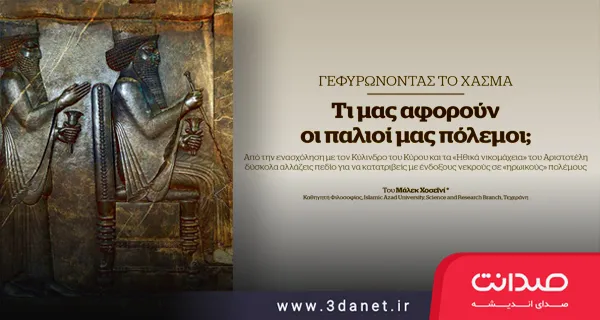
What Have We to Do with the Battles of Our Ancestors?!
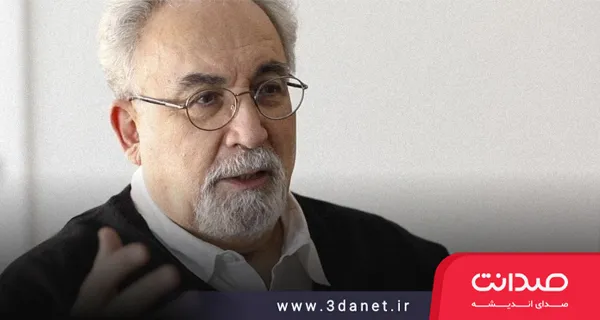
Malek Hosseini
Malek Hosseini: The journal Documento in Athens (7 November 2020), in response to those who celebrated the 2500th anniversary of the Greek victory over the Persians in the battles of Thermopylae and Salamis, has published a collection of articles, including a short note from me; this note was written in German and then translated into Greek. I did not see the almost simultaneous publication of the Persian translation of this short note as untimely.
I am not a historian, so I am neither permitted nor inclined to speak about historical facts or historical claims – whether their subject is the battles of Thermopylae and Salamis, or other related matters – and defend a particular position.
I am also not a linguist, so I am not going to talk about the word barbaros and, for instance, discuss the question of whether, and if so from what time, the Greeks themselves understood this word not (or not only) as "a foreigner who does not know Greek," but (also) as "an uncivilized human being." (A similar case existed among the Arabs: ʿAjam denoted "a non-Arab who is mute / an Iranian who does not know Arabic").
Nevertheless, as an Iranian, I could, for example, cite Amir Mehdi Badiʿ (Les Grecs et les Barbares, 1963) to say many things about the subject under discussion. But I will not do this either. I only wish, from the perspective of someone who has been involved with philosophy in some way for nearly thirty years, and that mainly with Greek-Western philosophy, to speak very briefly about a few points.
1_ It is hard for me to imagine how cultured Greeks could see a people as barbarian Persians – "barbarian" in the negative sense – who even at that time possessed a great civilization. (Here one could refer to the Cyrus Cylinder, which was created decades before the Battle of Salamis and which some consider the "first public declaration of human rights," although others dispute this assessment.) How can one imagine that civilized Greeks could not see and recognize another civilization in their neighborhood?! The very civilization that was later to receive the last head of the Neoplatonic school in Athens, along with other Neoplatonists – who had in fact fled the Christian Eastern Roman Empire – in its security. It is only the denial or ignoring of another civilization that causes the people of that civilization to be called crude and uncultured barbarians; and this is precisely what is not expected of cultured and refined Greeks!
2_ When I first encountered a Greek (a cultured Greek) in the truest sense of the word, that is, we had the opportunity to speak with one another and indeed build a friendship, I did not think for a moment about Alexander the Great and his conquest of my ancestors' land (even though this Greek friend happened to be named Alexander and was of great stature!) and, a fortiori, I did not think about the other battles between my supposed ancestors and the supposed ancestors of my Greek friend either. This Greek did not appear to me for even a brief moment as a representative of the ancient enemies of my land; I could see as much enmity in him as I could in my close friends in Tehran and Isfahan!
So what did I think about when I first encountered a Greek? In truth, perhaps at first, nothing; but gradually, albeit somewhat unconsciously, only of Aeschylus, Sophocles, Euripides, Socrates, Plato, Aristotle, ..., Nikos Kazantzakis, Theo Angelopoulos..., that is, of figures of whom my Greek friend could and should be proud – exactly as I am proud of Ferdowsi, Saʿdi, Hafez, Rumi, Khayyam, Farabi, Avicenna, Sohrab Sepehri, Abbas Kiarostami, Mohammad-Reza Shajarian..., but by no means of those among my ancestors who made conquests centuries and millennia ago. And how can one be proud of some of their conquests? If anything is to be done, one should rather be ashamed! (And truly, who knows that they were those very ancestors of mine?)
3_ It is true; I, for instance, take pride in Ferdowsi or Avicenna; but, yes, no less so is my taking pride in, say, Aristotle (even if the story is true that he was the tutor of the young and tender-aged Alexander, who later, in his maturity and adulthood, conquered the lands of my ancestors and overthrew the greatest empire of the era; though, as sources say, he learned more from the Iranians than he conquered). And who in the entire world cannot take pride in Aristotle? When I read Aristotle, it is not uncommon for me to ask myself (surely like many others) how it was ever possible for a human being like Aristotle to enter the world of humanity? And this happens a great deal when I am reading the Nicomachean Ethics. I would like to speak a little about this.
Aristotle's work, despite all its dependence on the Greek culture of its time, contains subjects and thoughts that transcend any culture, and also any time; it speaks of the happiness or good life of each and every human being and also of every society. I do not intend to speak about this, but I want to briefly raise a point about a part of this work that certainly holds appeal for individuals outside the field of philosophy as well: about Aristotle's treatise on friendship, that is, Books VIII and IX of the Nicomachean Ethics.
It is not far from the truth when it is said that for Aristotle – who has put forward many influential and still-valid conceptual clarifications and opinions about friendship – friendship is more a phenomenon that emerges and manifests in small circles of friends, in the family, and in its broadest form among the members of a polis. Nevertheless, at the very beginning of his treatise on friendship, Aristotle speaks of friendship "among creatures of the same stock, as a feeling of belonging to one another; and especially among human beings, which is why we praise and recognize universal philanthropy." From Aristotle's entire lengthy treatise on friendship, this alone suffices to carry it beyond all places and times and create a bond among all people.
So it is no wonder that Aristotle, particularly his Nicomachean Ethics, has had such a tremendous influence on various cultures. Philosophical ethics in Islamic culture has also been heavily influenced by Aristotle, and regarding Iranian thinkers – and their works on ethics, whether in Arabic or Persian – it must be said that they were simultaneously influenced by pre-Islamic Iranian thought, a thought whose influence on Greek thought is itself a subject and must be understood and discussed under the broad topic of Greco-Iranian relations; I cannot and am not supposed to speak about this, and good sources exist on this subject (to readers familiar with the English language, I recommend this article, which consists of many parts and has been written by numerous prominent scholars and is easily accessible: https://iranicaonline.org/articles/greece).
4_ Aristotle and his book on ethics is just one example – perhaps the best example – of why we should take pride in such human beings and such works, and not in our ancient conquerors and the wars they won. It is entirely clear why, for example, Aristotle and Saadi are still relevant to us today, both to me and to my Greek friend. But it is by no means clear what relevance the ancient battles of our ancestors have to us; rather, it is entirely doubtful that they are still relevant to us today, and I go even further and say: our ancient battles and our ancient conquerors have no relevance to us whatsoever!
5_ But how is it that some suppose the battles of our ancestors are still relevant to us today? If we look optimistically, among them there is an absence of recognition of what truly is still relevant to us. And if it is not this, then what is it but an ideological-political misuse of past history by those who are incapable of participating in the making of humanity's present history through legitimate means?




Discussion1 comments
سلام. از دکتر مالک حسینی که دلبسته حکمت انسانی است، جز این انتظار نمیرفت که چنین حکیمانه و فارغ از هویتهای تاریخی و ملی، انسان امروز را به یکی از نقاط ضعف بزرگش متوجه کند.