Philosophy
Mostafa Malekian on Darwinism and Virtue Ethics
Mostafa Malekian sees no contradiction between an evolutionary account of morality's origins and a mystical virtue ethics in practice: the former explains the survival of the species, the latter explains individual commitment. Darwin's view does not necessarily entail any particular worldview.
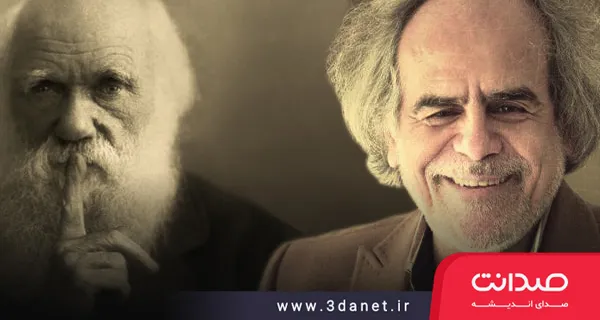
Mostafa Malekian
مصاحبه شوندهQuestion: Professor, I recall that in the discussion on the origin of the moral institution, you favored moral Darwinism. I even asked you this question on another occasion, and you answered in the affirmative. Now my question is this: are these two compatible—believing in moral Darwinism regarding the origin of the moral institution on the one hand, and, on the other, among ethical systems, having the greatest affinity for the mystical virtue-oriented system?
Mostafa Malekian: These two are not contradictory. One discussion concerns “why is the human being now such that moral values are valuable to them?” and another discussion concerns “how can one adhere to these moral values in practice?” These are two separate discussions. Regarding the first discussion, I have no objection to moral Darwinism. Humankind now values living morally. Whether one lives morally or not, both value living morally. I will clarify this discussion with two examples:
First example: If I tell a lie (while having violated the criteria, rulings, and rules of morality for the sake of benefits I sought), I feel pangs of conscience within myself, and if my lie is exposed, I feel shame before others. The pangs of conscience a person feels within themselves and the shame they feel before their fellow human beings both indicate that we truly value moral values, even when we ourselves violate them in practice. That is, I have lied in practice, but it was for the sake of benefits I thought I would attain through lying. Yet, for that very lie I told, as long as it remains unexposed, I suffer pangs of conscience within myself, and when it is exposed, I feel shame before others. Why, despite being a liar, do these two (pangs of conscience as an individual nudge and shame as a collective nudge) exist within me? Because humankind is now such that morality is valuable to it. By “now” I do not mean 5 or 10 years ago. I mean as far back as we have written history, or even prehistory.
Second example: If I were to tell you: “You can attain all the benefits you desire, without the slightest difference, both by telling the truth and by lying (that is, suppose you list and declare all the benefits you wish to attain. On that supposition, I tell you that, without the slightest difference, you can attain all those benefits both by telling the truth and by lying). In that case, which would you prefer?” If you were to attain exactly the same benefits both by lying and by telling the truth, you would certainly choose telling the truth. You would say: “If lying brings me not an iota more benefit than telling the truth, and telling the truth brings me not an iota more harm than lying, and it makes no difference whether I tell the truth or lie, naturally I will choose telling the truth.”
I gave these two examples to show that in this historical period—whose beginning roughly dates back to 20,000 years ago and extends into the not-too-distant future—we value moral values. Now the question is: why do we consider moral values to be valuable? I say it is not at all unlikely that the answer to this question is the same as Darwin’s answer. In response to the question of why giraffes have long necks, Darwin said it was because the lineage of long-necked giraffes survived. I say perhaps it is because that portion of humans who valued morality survived. That is, the secret of their survival was that they valued moral criteria. And if you had brothers or sisters, or male or female cousins, or relatives in that era who did not value morality, their fate was similar to that of the short-necked giraffes, which became extinct. So, it can be said that the secret of morality’s persistence is that living morally ensured the survival of humankind. Darwinism always considers the species, not the individual. Indeed, it is possible that if I, as an individual, wish to live morally, I may face numerous harms. The survival of humankind is guaranteed by living morally.
But there is a second discussion as well. Now that we have understood that, according to moral or social Darwinism, the survival of the human species has been ensured by adherence to moral values—much like the role of the giraffe’s long neck or the webbing between a duck’s toes—a second question arises. These values ensured the survival of the human species, but when can I, as an individual, also practically commit myself to these values?
In the realm of theory, if I violate values, I still hold them in esteem, but if I violate them in practice, then I would say: “If you wish not to violate moral values in practice and to remain committed to them, then virtue ethics with a mystical narrative provides you with greater facilities to actually remain committed.” This discussion is akin to saying that the human species has survived through marriage, and had there been no marriage, the human species would have become extinct. But now, even though the human species has survived through marriage, you cannot be convinced that you must necessarily marry. You could say: “I know the human species has survived through marriage, but allow me not to marry.” If I wish to apply to you the very thing that ensures the survival of humanity, I can no longer satisfy you by appealing to the survival of the human species. Because you would say: “I only wish not to marry for myself; let the rest of the human species go and marry, for humanity will not become extinct just because I do not marry.” So I must tell you something additional. In the same way, I say that morality has preserved the human species, but because it has preserved the human species, we value the preservation of the human species to that same extent. Now, if they want to make me moral as well, they cannot suffice by saying that living morally preserves the human species. They must create motivations within me, or remove obstacles within me, or establish certain requirements within me. In that case, I would say: “These can be better provided through mystical virtue ethics.” Therefore, these two types of statements are compatible with one another, and I subscribe to both.
Question: It seems that the origin and the ethical method an individual adopts arise from an ontology that first determines their stance on worldview and existence. In your view, wouldn’t someone whose ontology is closer to Darwin be more inclined toward consequentialism or deontology among ethical theories?
Answer: This question has occurred to many. I believe Darwin was a biologist, and because he was a biologist, he was a scientist of the empirical sciences. A scientist of the empirical sciences can hold any philosophical view. Regardless of what philosophical view Darwin held, we have only accepted his opinion in biology and then generalized it to sociology. Therefore, a Darwinian can be religious or non-religious. Just as there has been much debate over whether Darwin was religious or not. Many have said Darwin believed in Christianity, and some have said he was Christian at certain periods and not at others. Since I accept Darwin as a biologist and an empirical scientist, and at most I have generalized his discourse from biology to sociology and psychology, and I am indifferent to Darwin’s personal philosophy, any philosophy can therefore be attached to this.
I do not believe that even if we accept Darwin’s theory itself in biology, we are necessarily forced to change our opinion even regarding Adam and Eve. What I mean is that no non-empirical implications follow from Darwin’s empirical discourse. That is, you can also fully believe in God. You can even adhere to one of the Abrahamic religions whose holy books speak of Adam and Eve and the first human, yet still be a Darwinian. Just as over the past 200 years, there have been thinkers in the Islamic world who, while adhering to Islam, have preferred Darwin’s theory of creation, namely the theory of Transformism, over the theory of Fixism held by Darwin’s opponents and rivals. Therefore, I believe that since Darwin did not consider himself a philosopher and did not pin his biological opinion to any particular philosophy, I can accept this biological opinion and at the same time not be committed to Darwin’s philosophical opinion (if he had one).
.
.
Darwinism and Virtue Ethics
Mostafa Malekian, An Analysis of the Ethical System of Virtue Ethics, Negah-e Aftab Magazine 1, Soroush-e Molana Institute, Interviewer: Ali Varamini
.
.




Discussion0 comments
No comments yet; let yours be the first voice.