Philosophy
Mostafa Malekian Responds to Critics' Questions – Part One
Critics say Malekian has reduced modernity to rationalism and religiosity to dogmatism. Malekian says he is speaking about modernism, that rationalism is only one of its components, and that religiosity entails unquestioning acceptance.
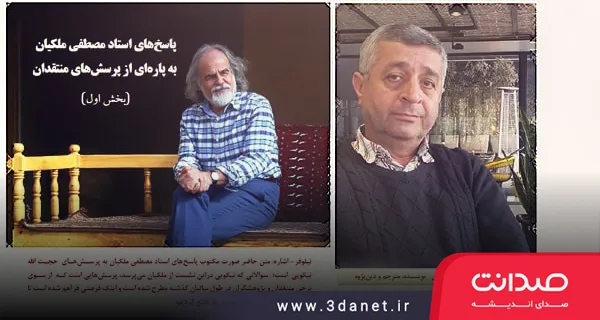
The present text is the written form of Mostafa Malekian's responses to the questions of Hojjatollah Nikouei (writer, translator, and scholar of religion). The questions Nikouei poses to Malekian in this session are questions that have been raised by some critics and researchers over the past years, and now an opportunity has been provided for us to learn of Malekian's answers to these questions.
Hojjatollah Nikouei: One of the common questions is that they say you have reduced modernity to rationalism, and by such a reduction, you have in fact committed the fallacy of essence and aspect. They say the same about religion; that is, you have reduced religiosity to dogmatic adherence, and this is another instance of the fallacy of essence and aspect. You say: the pillar of religiosity is dogmatic adherence, but it seems that here you have in mind a specific type of religiosity, which is livelihood-oriented religiosity. Whereas, from the critics' perspective, this is only one type of religiosity alongside other types. We also have other religiosities, such as knowledge-oriented and experience-oriented religiosity. Is your claim not an instance of reductionism or the fallacy of essence and aspect?
In explaining this critique, it has been said that both modernity and religiosity have had different readings and forms throughout history, and have had various styles and manifestations. From the critics' viewpoint, instances and manifestations are of the family resemblance type. To put it more precisely, we have modernities, not modernity or true modernity. Likewise, we have intellectualisms, we have democracies, we have liberalisms, we have secularisms, and similarly, religiosities. Just as there is no such thing as true democracy, there is also no such thing as true religiosity; we have religiosities that are the result of different readings and various styles of religiosity. This claim also holds true for modernity. What is your explanation in this regard?
Mostafa Malekian: The first point I wish to make here is that my discussion concerns modernism, not modernity. There is a great difference between modernism and modernity, or, to use the French expression, between modernisme and modernité; my discussion is about modernism, not about modernity or modernité. My precise claim is that one of the components of modernism is rationalism. First of all, I have never said, regarding either modernity or modernism, that the whole of modernity or the whole of modernism is confined solely to rationalism. I reiterate that my remarks are entirely about modernism, not modernity. Nevertheless, I will now take a broader view and say that, regarding neither modernity nor modernism, have I ever said that the whole of modernity or the whole of modernism is reducible to a single component, namely the component of rationalism. Rather, I have said that one of the components of modernism is rationalism. That is, in order to be a modernist, you must possess several characteristics, one of which is the characteristic of rationalism. The fallacy of 'essence and aspect' occurs when you confine the whole of a phenomenon to one of its aspects, and I have never said that the whole of modernism is summed up in rationalism. Modernism has several characteristics, all of which I have enumerated in my lessons on traditionalism, modernism, and postmodernism. There, too, my discussion concerns tradition-alism, modern-ism, and postmodern-ism. By using these '-isms,' I intend to convey that my remarks are about modernism and postmodernism, not modernity and postmodernity. In fact, in those very lessons, I emphasized that modernity is different from modernism, just as postmodernity is different from postmodernism. But now, setting aside that precision, I will say that even if my remarks were about modernity, I have never said that modernity or modernism has only one component, namely rationalism, for you to then say I have committed the fallacy of essence and aspect. I say modernism has several components; one of its components is rationalism, in the sense of rationalism—not, of course, rationalism as opposed to empiricism, that is, experientialism. Because sometimes when we say rationalism, it is in opposition to empiricism. For instance, they say Descartes, Spinoza, and Leibniz were rationalists, while Malebranche, Francis Bacon, Hobbes, David Hume, George Berkeley, and John Locke were empiricists. That is not what I mean. In fact, I believe that what constitutes one of the components of modernism is that rationalism, regardless of whether the reasoning is rational reasoning or empirical reasoning. Therefore, I have absolutely and utterly not committed the fallacy of essence and aspect. That is the first point. The second point, however, is that regarding the meaning of a word, one must refer to linguistic intuition, as Searle puts it. One must refer to the linguistic taste of the people who use that word. We cannot simply come and assign meanings to words ourselves. Yes, there is something in science called a stipulative definition, which means I declare that from now on, whenever I use a certain word in my speech and writings, I intend this meaning. This certainly exists, but I myself have not made a stipulative definition or specified my intention. I am saying that we must refer to linguistic intuition, or in more conventional terms, to the common usage of the speakers of any language, and see when they use this word, whether they consider this component in the application and predication of that word or not. We cannot prescribe for the speakers of a language; we can only report what the speakers of a language say about the meanings of words. When you use the word 'chair' in the Persian language, you must see in what sense Persian speakers use 'chair.' You cannot say that they use it in whatever sense they wish and we have nothing to do with their meaning. I say I am speaking in the Persian language. When I speak in the Persian language, I must either stipulate that, sir, in my speech and writings, I intend to use 'chair' in a different sense, or, if I do not stipulate, I must use it in the sense that the speakers of that language understand. Now, I ask the speakers of the language: suppose, in Iran, someone says, 'I do not accept any of the sayings of Christ recorded in the Gospels without question; rather, I demand a reason from Christ for each and every one of them.' Would people in Iran call such a person a Christian? If someone says, 'I demand a reason for every single sentence of the Quran, and unless a convincing argument is presented in its favor, I will not accept any of it,' would people call such a person a Muslim or not?
ما داریم به شم زبانی رجوع میکنیم به عرف اهل هر زبان رجوع میکنیم. بودایی به کسی اطلاق میشود که سخنان بودا را بی چون و چرا میپذیرد. اگر من سخنان بودا را بی چون و چرا نپذیرفتم و گفتم بودا هم مثل هر کس دیگری باید برای یکان یکان سخنانش استدلال اقامه کند، کفر نگفتهام و اعدامم هم نباید کرد. اتفاقاً سخنی پذیرفتنی گفتهام، اما دیگر به من بودایی گفته نمیشود. بودایی یعنی کسی که سخنان بودا را بی چون و چرا میپذیرد، قبول میکند که بودا درست گفته است. اگر این نباشد، من از آقایان میپرسم: مسلمان را تعریف کنید. بودایی را تعریف کنید. مسیحی را تعریف کنید. تعبد که من میگویم یعنی سخن کسی یا کسانی را بی چون و چرا پذیرفتن، من از آقایان میپرسم اصلاً بروید به کتاب لغت رجوع کنید. به فرهنگ معین رجوع کنید ببینید مسمان و بودایی را چه معنا میکند. مسیحی را چه معنا میکند. به فرهنگ لغات وبستر مراجعه کنید و ببینید در مقابل مازلیم چه معادلهایی گذاشته و آن را چگونه معنا کرده است. ما که نمیتوانیم عرف اهل هر زبان را به فراموشی بسپاریم. من میگویم در هر کتاب لغتی و به هر زبانی که نوشته شده باشد، معادلهای الفاظی مثل مسلمان، بودایی، مسیحی و هندویی، وقتی در این معنا و بیان کردن دقت میکنید، میبنید یک نوع پذیرش بی چون و چرا وجود دارد. شما به من بگویید که آیا ایرانیان، به کسی که در سخنان بودا مناقشه میکند، بودایی میگویند یا نه. اگر مسلمانی گفت من برای پذیرش جمله به جملهی قرآن باید استدلال داشته باشم وگرنه نمیپذیرم، ببنید آیا ایرانیان به چنین کسی مسلمان میگویند یا نه. من هرگز نگفتهام که تدین فقط یک مؤلفه دارد و آن هم تعبد است. ولی گفتهام که تعبد مؤلفهی گریزناپذیر تدین است. ممکن است تدین به جز این یکی، دو تا، سه تا، چند تا مؤلفهی دیگر هم داشته باشد، ولی از مؤلفهی تعبد، گریزی وجود ندارد. و معلوم است که در اینجا دارم به شم اهل زبان استناد میکنم. اما نکتهٔ سوم: پارهای از دوستان به نظریه شباهت خانوادگی ویتگنشتاین اشاره کردهاند. اولاً شباهت خانوادگی ویتگنشتاین اگر به جد گرفته شود، هیچ فرهنگ لغتی نمیتوان نوشت. چون فرهنگ لغت در برابر واژهی "خانه" یک معنایی مینویسد. معنایش این است که هر چیزی که بخواهید لغت خانه را بر آن اطلاق کنید، باید این چند تا ویژگی را با هم داشته باشد. نظریه شباهت خانوادگی، نظریهای نیست که بشود در باب جمیع الفاظ و مفاهیم، آن را پذیرفت. یعنی اگر شباهت خانوادگی درست باشد، باید در هر کتاب لغتی برای مثال در برابر خانه بنویسند "شیئی که از این ۱۰ ویژگی لااقل ۳ تا از آنها را داشته باشد. آن وقت ۱۰ تا ویژگی ذکر کنند و بگویند اگر چیزی ۳ تا از اینها را داشت، حالا هرکدام از این سه تا را، آنگاه به آن میگوییم خانه. اما چنین چیزی ما نمیبینیم. شباهت خانوادگی میخواهد بگوید برای اطلاق یک لفظ بر یک شیء، باید از میان n تا ویژگی، mتایش را آن شیئی داشته باشد، که نه n اش معلوم است، نه m اش. یعنی نه معلوم است که از میان چند تا ویژگی و نه معلوم است که از میان آن چند ویژگی چندتایش را باید شیئی داشته باشد. اگر این طور باشد پس ما کتاب لغت نداریم. چون کتاب لغت این را نمیگوید. کتاب لغت میگوید مردم در زبان فارسی وقتی میگویند ایمان، منظورشان حالتی است که دوتا سه تا ویژگی را داشته باشد. نه اینکه حالتی که از این ده تا ویژگی سه تا ویژگیاش را داشته باشد، چهارتا ویژگی را داشته باشد. بنابراین اولاً دوستان فرض را بر این گرفتهاند که نظریه شباهت خانوادگی کاملاً صحیح است، یعنی در باب همه الفاظ و مفاهیم صدق میکند. با این که این طور نیست. این نظریه اگر بخواهد در باب همهی الفاظ و مفاهیم صدق بکند، آن وقت باید همهی کتابهای لغت بعد از نظریه ویتگنشتاین در باب شباهت خانوادگی از نو نوشته شوند. اما چرا با این که از زمان طرح نظریه شباهت خانوادگی نزدیک هشتاد سال میگذرد و ما از آن باخبریم، هیچ کتاب لغتی عوض نشده است. برای این که این نظریه، نظریهای نیست که در باب همهی الفاظ و مفاهیم درست باشد. اگر درست باشد، فقط در باب بعضی از الفاظ و مفاهیم درست است. وگرنه لب نظریه شباهت خانوادگی این است که همهٔ اشیائی که دارای نام واحدی هستند، اینها از میان n تا ویژگی، m تایش را دارند. یعنی همهی اشبانی که به آنها پنجره گفته میشود، اینها هیچ ویژگی مشترکی ندارند، مثلاً ده تا ویژگی هست که هرکدام از آنها دو تا سه تا پنج تایش را دارند. اما نه اینکه همهی پنجرهها دارای یک، دو یا سه ویژگی مشترک باشند. For example, consider a set of ten items; anything that possesses three of these ten features is then a window, even if the three features it has share no commonality whatsoever with the three features that another window has. This theory is simply wrong. Friends treat Wittgenstein's family resemblance theory as if it were divine revelation. Yet this theory is simply wrong, and the reason dictionaries have not been changed—those who understood the family resemblance theory better than I and these gentlemen still write dictionaries the same way—is that they do not accept the family resemblance theory. You should not treat me as though the family resemblance theory is my cherished belief. No, not at all. I simply cannot accept the family resemblance theory for most words and concepts.Nikoui: So, in practice, the linguistic usage of words and phrases contradicts this theory.
Mostafa Malekian: Yes, if that were the case, every dictionary would have to say that a house is something that has at least three of these ten features, a window is something that has at least four of these fifteen features, a human being is a creature that has at least seven of these twenty features. Has such a dictionary ever been written? It hasn't, because the family resemblance theory is simply not a correct theory. The family resemblance theory holds true for some words and concepts, but not for all words and concepts. Does a chemist now say that water is all substances that are H2O, or do they say all substances that have two out of n features?
Nikoui: Meaning, even in the world of empirical sciences, this theory is not accepted, nor is it observed.
Mostafa Malekian: Absolutely not. Water means any substance that has the molecular composition of two hydrogen and one oxygen. So, these gentlemen have latched onto the family resemblance theory and think I am bound by it. Yes, in Iran, I was the first to teach the family resemblance theory. But that doesn't give me any credit either. I was the one who first discussed this theory, but that doesn't mean I accept it. They speak as if everyone in the world must accept and adhere to the family resemblance theory. I declare that this is absolutely not the case. The family resemblance theory is either completely incorrect or is only correct for some words and concepts. Water, meaning H2O, is not something that possesses n features out of m features. Water means all objects that share one common feature. Their molecular composition is two hydrogen atoms plus one oxygen atom. Therefore, I am not at all bound by that theory for them to hold me to it. But even if we accept the family resemblance theory, the statements of these gentlemen still do not turn out to be right and correct. They want to say that religiosity is confronted with the family resemblance theory. I say, very well, you define religiosity with the family resemblance theory. Then refer to the common usage of the speakers of the language and see whether they accept your definition or not. Lexicography, both lexicology itself and philology, is not a prescriptive science. It is a descriptive science. It says that Arabs call this object 'māʾ' (water), not that Arabs should call this object 'māʾ'. Lexicology and philology are two descriptive sciences. They report that English speakers call this object 'well' and Iranians call it 'chāh', not that Iranians should call this object 'chāh' and English speakers should call this same object 'well'. Now I say, let's assume that family resemblance is correct. You come and define religiosity with the family resemblance theory. See whether the common usage of the speakers of the language accepts your definition, which is inspired by the family resemblance theory. If they don't accept it, your definition is wrong. Because you cannot tell the people of Iran that this thing means such-and-such; you must say what the people of Iran call such-and-such and what they call so-and-so. That is another point.
اما نکتهی دیگری که میخواهم بگویم این است. اینکه میگویند دموکراسیها داریم، لیبرالیسمها داریم، بنده عرض میکنم البته همین طور است. حق با شماست.. اما به شرطی که همهی این دموکراسیها در دموکراسی مشترک باشند. لیبرالیسمها در لیبرالیسم باید مشترک باشند، وگرنه اگر شما گفتید که ما لیبرالیسمها داریم، دموکراسیها داریم، من می تواتم توتالیتاریانیسم را هم از مصادیق دموکراسی بدانم. می گویید نه؟ میگویم چرا نه؟ پس معلوم میشود که لااقل یک چیزی در همگی این دموکراسیها مشترک است که توتالیتاریانیسم آن را ندارد و به همین جهت اجازه نمیدهید که توتالیتاریانیسم بیاید خود را از مصادیق دموکراسی تلقی کند. مثال برای شما بزنم : شکی نیست که ما در عالم گلها داریم. یک گل که نداریم. میلیاردها گل داریم. اگر این دسته صندلی آمد و گفت که من هم یکی از مصادیق آن گلها هستم، قبول میکنید یا نه؟ قبول نمیکنید. چون می گویید گلها باید لااقل یک چیز مشترک داشته باشند تا گل بودنشان احراز شود. حالا از این چیز مشترک که گذشتم در هر چیز دیگری هم که با هم تفاوت داشته باشند، به گل بودنشان لطمه نمیزند. اگر وقتی که داریم می گوییم گلها داریم که بنده هم مثل هر کس دیگری قبول دارم که گلها داریم، اما اگر این دسته صندلی آمد و گفت آقا مگر شما نمیگویید که ما گلها داریم؟ خوب من دسته صندلی هم یکی از آن گلها هستم. می گوییم نه، گلها با این که هزار اختلاف با همدیگر دارند، اما لااقل در یک یا دو ویژگی با هم شریکاند که توی دسته صندلی آن ویژگی را نداری. به این جهت در زمرهٔ گلها راهت نمیدهیم. اگر این طور بود و لیبرالیسمها داشتیم، پس باید سوسیالیسم هم یکی از انواع لیبرالیسم به حساب میآمد. اما اجازه نمیدهیم.
نیکویی: یعنی مرزهای میان مفاهیم شکسته میشود.
Mostafa Malekian: Yes, in that case any phenomenon could be applied to any other phenomenon. Yes, when we say there are liberalisms, it means that the liberalisms we have do not share all the same features. But they must at least share one or two identical features by virtue of which we can say we have liberalisms. This is a very clear point, and I am surprised that friends either do not understand or feign inattention. Look, when we say we have liberalisms, it means that all instances of liberalism are not identical; they differ in n number of features, but they must at least share one or two features. Otherwise, socialism and anarchism would also stick their heads into this tent and say, 'Count us among the instances of liberalism too.' By what authority do we say we won't let you in? Suppose we want to see what common feature the wolves of the world have. The gentlemen's argument is like saying: to find out what the definition of a wolf is, let us gather all the wolves of the world in a desert to see what common feature they have, and then make that common feature the criterion for defining a wolf. I say, if you gathered all the wolves of the world, and then a fox came along and said, 'I also want to join this gathering,' would you let it in or not? You certainly would not let it in. It asks, 'What sin have I committed?' You say, 'Because we gathered the wolves of the world, and you are a fox.' It replies, 'Well, you had gathered the wolves of the world, so you must have already established at least one feature of wolves before gathering them. If you had not established any feature of wolves and you want to gather wolves in a desert to see what common feature they have, then look at me too.' If you did not let the fox in, it becomes clear that before gathering the wolves in the desert, you had established at least one feature of wolves, saying that those who want to gather in the desert must at least possess this one feature. If you had not established even this, you would have to let the fox and the donkey in too. But you do not let them in. Because you have established at least one feature in them, by which you tell the fox, 'Get out of this line.' And you tell the donkey, 'Get out too,' because we only gathered the wolves. I mean to say that whenever we want to gather the liberalisms in one place, we must have established at least one component of liberalism; otherwise, socialism, anarchism, and oligarchism will also stick their heads into this camp. To exclude them from our count and census, we must appeal to something in which liberalisms must be common, and you anarchisms, socialisms, etc., lack that thing and therefore must leave. There must be something to appeal to so we can tell them not to enter. So, we have liberalisms, we have democracies. But this means that democracies do not share all their features, not that they share none of their features. Otherwise, anything else could come and say, 'I want to be counted among democracies.' We say, 'No, you lack this feature.' And this very theory—that when we want to gather the liberalisms, they must have something in common—is a rejection of Wittgenstein's theory of family resemblance.
Nikouei: When you speak of a common feature and, for example, consider a common feature for democracies such that if a system of government lacks it, it can no longer be called a democracy, or when you emphasize that the pillar of religiosity is ta'abbod (devout submission) and that without ta'abbod, religiosity is not realized, is this not a form of Aristotelian essentialism?
Mostafa Malekian: No. That is a good question. Look, regardless of whether essentialism is a defensible position or not, these gentlemen again have a presupposition, which is that if a claim entails essentialism, then that claim is false, because essentialism is false. Whereas it is not certain that essentialism is false. Essentialism is a viewpoint. It may be correct and it may be incorrect. It is not necessarily the case that you should think essentialism is an insult or a term of abuse. That is, it has been completely proven that essentialism is refuted, and if a statement entails essentialism, that statement is also refuted. Essentialism is a viewpoint in metaphysics and the philosophy of metaphysics, in a sense a viewpoint in philosophical ontology, and it may be correct or incorrect. But now let me suppose that essentialism is also incorrect. Still, my statement does not entail essentialism. Because essentialism says that all things that have a single name, in the external world, have at least one common characteristic; essentialism wants to say that all things that have one name, all the waters of the world, or all the boxes of the world, or all the democracies of the world, or all the liberalisms of the world, or all the religions of the world, these must have at least one common characteristic in external reality, and this common characteristic must be both fixed and unitary. If you believe that all the pieces of wood in the world, in actual reality, in external reality, have a single, unitary, fixed common characteristic, then you subscribe to Aristotelian essentialism. But my point is not in the sense of essentialism. Because I do not want to say that all the pieces of wood in the world necessarily have a single, unitary, fixed common characteristic in actual reality. Rather, I want to say that when we Iranians use the word 'wood,' we consider a single, fixed, unitary common characteristic and apply the name 'wood.' We say this in linguistic usage. If we still considered essentialism incorrect, and also considered my statement to mean essentialism, then if essentialism were incorrect, dictionaries should not have been written. Even though essentialism means that in actual reality, without our naming, without our beliefs about things, in actual reality without our naming, without our consideration regarding things, all the pieces of wood in the world share a single, common, and fixed characteristic. This is called essentialism; we do not want to say this necessarily, regardless of the correctness or incorrectness of essentialism, my point is something else entirely. It is not necessarily incorrect either. I want to say that regardless of the correctness or incorrectness of essentialism, when we Iranians apply the word 'wood,' we apply it to things that we think share a common characteristic; this is very different. To put it another way, let me give an example: In the dictionary, how do they define 'Isfahani'? They write: someone who was born in Isfahan or has spent more than half of their life in Isfahan. This is the definition of Isfahani. But it is possible that right now, as you are talking to me, I neither know where you were born, nor do I know where you have spent most of your life. But from your accent, I realize that you are Isfahani. Now, applying 'Isfahani' to you is not based on actual fact; I understand from your accent that you are Isfahani. There is a difference between when we apply the word 'Isfahani' and what 'Isfahani' means in the ontological world. These are two different statements.
Nikouei: That is, nominal essentialism, not real essentialism.
Mostafa Malekian: Yes, we certainly subscribe to nominal essentialism, and I have said this many times. Regardless of whether we accept real essentialism or not, we accept nominal essentialism; as they say, we subscribe to Nominal Essentialism. That is, when a name is to be applied, all the things to which we want to apply a name must, in our view, share a common characteristic.
Nikouei: Otherwise, language itself would not be realized. Because the boundaries of concepts would disappear.
Mostafa Malekian: Precisely, from this perspective, I subscribe to nominalism, or better put, to nominal essentialism. That is, essentialism when we want to apply a name. Let me give you an example. The ancients called anyone who had what we today call schizophrenia a divaneh or majnun, meaning possessed by a jinn or a demon. Therefore, they applied the name majnun and divaneh to someone who, in their own view, was certainly possessed by a jinn or a demon.
Nikoui: Although in reality, perhaps there is no such thing as demonic possession.
Mostafa Malekian: Yes, in reality, there is no demonic possession. But in any case, they did not call just anyone insane; they did not call everyone they saw on the street insane. They would say, if we want to use the Persian word divaneh or the Arabic majnun, we must have established demonic possession or being possessed by a jinn in him. Even though we now know that those with schizophrenia are not possessed by demons or jinn. Therefore, although their ontological presupposition was wrong, they still considered a specific characteristic; otherwise, they would have had to call all human beings insane, but they did not call all human beings insane. So, they called all human beings who, in their own imagination and opinion, were possessed by jinn, majnun and divaneh. But in their own opinion, not in reality. In a lecture I gave about Ibn Arabi, I said that one cannot extract ontological facts from linguistic facts. But ultimately, this linguistic fact exists that if we are to consider people majnun, there must be a common characteristic.
Nikoui: It has been said that the modes of Muslim life, or religious life in general, have varied throughout the history of religiosity. For example, suppose we have had livelihood-oriented religiosity, knowledge-oriented religiosity, and experience-oriented religiosity. Among these, which one do you consider religiosity in its practical sense? When you say that the foundation of religiosity is submission (ta'abbud) and it cannot exist without submission, and you consider argumentation and rationality as opposed to religiosity, what do you do with philosophers like Richard Swinburne, Alvin Plantinga, William Alston, John Hick, Robert Audi, or in our own world, philosophers like Avicenna and Mulla Sadra? These individuals were also argumentative, deeply rational, and philosophically inclined, yet at the same time considered themselves religious. Is there a contradiction here?
Mostafa Malekian: That you mention we have types of religiosity is not something I deny. Although I have many doubts and misgivings about these three categories you named, and I do not consider this classification correct. But there is no doubt that we have types of religiosity. It is just that these types must share one thing, and that is religiosity. They must be types of religiosity. That is, when I speak of types of religiosity, I am not then saying that Thomas Hobbes or Bertrand Russell also possess one of the types of religiosity. So, we have types of religiosity, but these types must be common in their being religiosity. Now, I say that this common element is their submission (ta'abbud). You ask, where did you get this definition? I say, go and refer to the common usage of the speakers of the language. See if people in any language call someone who has no submission to a person religious. If they do, I will take back my words. I want to say, yes, we have types of religiosity; Rumi's religiosity certainly differs from that of Mohammad-Baqer Majlesi. Allameh Tabatabai's religiosity differs from Mr. Khomeini's, and the religiosity of these two also differs from Mr. Behjat's. But all of these share submission. Therefore, we have types of religiosity, and in the books of philosophy of religion, sociology of religion, and psychology of religion, types of religiosity have been mentioned. I myself have discussed types of religiosity extensively in university courses. And even years ago, I wrote an article about types of religiosity in Haft Aseman. But types of religiosity require a difference between religiosity and non-religiosity. Otherwise, we would have to say that one of the types of religiosity is the religiosity of Hobbes, Marx, or Russell. Why do you set these aside? Why do you set aside Engels and Lenin? Because you say they do not have religiosity. Now, they do not have religiosity, meaning what do they lack? That thing is submission (ta'abbud).
Nikoui: So, you propose a characteristic and criterion called submission (ta'abbud), without which religiosity is not realized.
Mostafa Malekian: Yes. I say that this deference was held by both Rumi and Majlesi; I am not concerned with its ontology. In linguistic usage, someone who lacks deference is not called religious. That is, if Rumi had said, “I do not accept the Prophet’s word because it is the Prophet’s word,” or the late Majlesi had said, “I do not accept the Prophet’s word on account of his being a prophet,” we would no longer call them religious. They would not be infidels; we would not execute them. That is one point, but regarding the discussion they raised, I must give two answers, and I am very, very surprised that friends say such a thing. First, concerning Avicenna, for example, and concerning other figures of our past—that is, those who lived in the age of tradition—there is one answer. Concerning those who live today, there is another answer. I want to separate these, that is, to separate the Richard Swinburnes from the Avicennas. In the age of tradition, the human sciences and learning said exactly what the revealed texts said. There was no conflict between what the sacred books of religions and sects said and what science outside the sacred book said. That is, Galenic and Hippocratic medicine, which had nothing to do with the sacred book, spoke of moisture and dryness, heat and cold, spoke of the four humors, spoke of temperaments. The sacred book said the same things. Ptolemaic astronomy spoke of the seven heavens; the sacred book also spoke of the seven heavens. Botany and zoology outside the sacred book said that every plant or animal has male and female, and the sacred book also said that every plant and animal has male and female. Aristotelian physics and biology said exactly what the sacred book said. For instance, Aristotle in his biology said that the woman’s womb is solely and exclusively a vessel that nurtures that seed, or sperm. That is, the seed is only the man’s seed, and the woman’s womb is merely a container that nurtures this seed. Aristotle explicitly held this view in his book on animals. Well, our sacred book also said the same thing. Therefore, what I want to say is that they should pay attention to the fact that until 1799, when Napoleon entered Egypt, the secular sciences of the Islamic world were identical to its religious sciences. That is, what its freethinking thinkers had arrived at was exactly what was in the Quran. When Napoleon entered Egypt and brought a huge delegation of scientists, technicians, artists, and philosophers into Cairo and said, “Go and acquaint this Islamic world with the new sciences and techniques,” then we saw that now the Copernican system, the Tychonic system, the Galilean system, the Keplerian system, and the Newtonian system—the systems of these five—say something that our sacred book does not say. That is, our sacred book until that time spoke the words of Ptolemy in astronomy. But now that the science of astronomy had advanced, we saw that Copernicus, Kepler, Tycho Brahe, Galileo, and Newton interpret the world in a way different from our sacred book, and then we saw that modern medicine depicts the world and the human being in a way different from what Ptolemy and Galen said. It is now that the conflict between rationality and deference occurs. Now let me return to Avicenna, who was in the gentlemen’s example. Avicenna himself, as a physician, also subscribed to the same medicine outside the realm of religion (because he accepted Galenic and Hippocratic medicine) that the Quran also espoused. The prophetic hadiths also said the same thing. No conflict arose for him between his rationality and his deference. His rationality, that is, the latest achievements of his secular science, that is, the latest achievements of his freethinking science, said exactly what the Quran and prophetic hadiths said, or what the Quran and the hadiths of the Shiite infallibles said. Therefore, for him, there was no difference between his rationality and his deference in terms of the product. The product of revelation was the same as the product of Galenic and Hippocratic medicine; therefore, for him, no conflict between rationality and deference arose in terms of the product. But today, the modern-day Avicenna—his medicine, his secular medicine, the medicine that is the result of human endeavor—says one thing, but his sacred book says something else. His biology says that not every plant and animal necessarily has male and female, but his sacred book says that every plant and animal necessarily has male and female.
Its sacred text says the sky has seven layers. But modern astronomy does not say this. Here, in terms of the product, a conflict arises. So, regarding the philosophers who lived in the pre-modern era, because the products of revelation were not incompatible with the products of secular, free-thinking science, no one was forced or compelled to choose or prefer one over the other, since both said the same thing. It is I who, today, my secular astronomy depicts the cosmos in one way and the Quran depicts it in another. Modern medicine depicts the human body in one way and the Quran in another; now I see an incompatibility between the products. I now have a problem. They did not have this problem. So the first point I wanted to make is that in the traditional era, when the sacred texts were written—whether Hindu sacred texts, Buddhist sacred texts, Christian, Jewish, or Islamic, it makes no difference—the sacred texts of the world's ten religions, namely Judaism, Islam, Christianity, Zoroastrianism, Confucianism, Daoism, Jainism, and Shinto, their sacred texts were written in the traditional era, before the modern era. Therefore, things were said in them that were not incompatible with the secular science of the day. We now have a problem. Our physics, our chemistry, our biology, our psychology, our sociology, our economics, our philosophy, our history—all of these have achieved findings in the secular world that have counterparts in the sacred text that are incompatible with each other. This is in terms of the product. But in terms of the process, even in Avicenna's time, "Hasan says A is B, therefore A is B" was not a valid argument. That is, the likes of Avicenna and Farabi had no problem in terms of the product, but if we consider it in terms of the process, they accepted that "A is B because A is C and C is B" is a valid argument, but "A is B because X has said that A is B" is not a valid argument. Was "A is B because X has said that A is B" ever considered a valid argument in the logic of Farabi, in the logic of Khajeh Nasir al-Din Tusi? Do you have any logic book surviving from Farabi or Avicenna or Al-Kindi or Khajeh Nasir or Mirdamad or Mulla Sadra or Sheikh al-Ishraq in which they said that one of the methods of correct reasoning is to say "A is B, not because A is C and C is B, but because X has said that A is B"? So, in terms of the product, they had no problem, but in terms of the process, they did have a problem, and it was from this perspective that I claimed that I consider Muhammad ibn Zakariya al-Razi the only philosopher of the Islamic world, because everyone other than Muhammad ibn Zakariya al-Razi sometimes said something as if "A is B because X says A is B" is correct.
Nikouei: Like the matter of bodily resurrection regarding Avicenna?
Mostafa Malekian: Yes, hence I said these are theologians, not philosophers. I did not insult them either. Being a theologian is not an insult. I want to say that these individuals were walking in the realm of theology and kalam, not in the realm of philosophy. But regarding Zakariya al-Razi, it is not like this. Zakariya al-Razi says, "I did not decide for myself from the beginning that God definitely exists. I go to the proofs to see whether the proofs affirming God are stronger or the proofs negating God, the proofs affirming life after death or the proofs negating life after death, and so on."
اما درباره فیلسوفان دوران مدرن مثل ریچارد سوئین برن و پلانتینگا و امثال ذلک که اینها میگویند ما استدلالگراییم و استدلال هم دارند و بعضی هم فیلسوف تحلیلی هستند، اما میگویند ما متدین هستیم. درباره اینها من دو نکته باید بگویم: یکی اینکه اگر حاصل فلسفه ورزی من اثبات وجود خدا شد، و من معتقد شدم که پس خدا وجود دارد، من را باید بگویند یک فیلسوف قائل به وجود خدا، نه یک متدین. مثل اینکه پیشفرض این دوستان این است که اگر کسی فیلسوف باشد حتماً باید ملحد باشد. آن وقت میگویند ریچارد سوئین برن یا پلانتینگا هم فیلسوف است و هم ملحد نیست. ببنید این که من از راه فلسفه به این برسم که خدا وجود دارد، حرفی است، و این که از راه تعبد یا از طریق ایمان آوردن و کشف و شهود عرفانی به این برسم که خدا وجود دارد، حرف دیگری است. اگر تو به عنوان یک عارف، که دارای تجربه عرفانی هستی بگویی خدا وجود دارد و من به عنوان یک فیلسوف قائل شدم که خدا وجود دارد و یک کسی از راه ایمان گفت که خدا وجود دارد و یک کسی از راه تعبد گفت که خدا وجود دارد، هر چهار تایمان معتقدیم که خدا وجود دارد، ولی این هر چهارتای ما را متدین نمیکند. فقط آن کسی را که از راه تعبد گفته خدا وجود دارد، متدین میکند. اینها فکر کرده اند که فیلسوف به محض اینکه فیلسوف شد حتماً باید به «خدا وجود ندارد» برسد. یک کسی هم ممکن است با استدلال فلسفی برسد به اینکه «خدا وجود دارد.» اما هیمن طور که اگر کسی با کشف و شهود عرفانی رسید به این که خدا وجود دارد، فرق میکند با کسی که ایمان آورده به اینکه خدا وجود دارد و فرق میکند با کسی که از راه تعبد گفته که خدا وجود دارد؛ خوب به همین ترتیب فرق میکند با کسی که از راه استدلال فلسفی رسیده به «خدا وجود دارد.» بنابراین اول چیزی که میخواهم راجع به این آقایان بگویم این است که اینها فیلسوفانی بودهاند که به زعم خودشان ادله اثبات وجود خدا یا ادله اثبات زندگی پس از مرگ به نظرشان قانع کننده بوده است. بنابراین اینها میشوند فیلسوفان قائل به وجود خدا. فیلسوفان قائل به زندگی پس از مرگ. ما از راه های عدیده ای میتوانیم به وجود خدا قائل باشیم. مگر در فرهنگ خود ما فرق نگذاشتهاند بین عین الیقین و علم الیقین و حق الیقین؟ گفتهاند کسی که در فیزیک و زیستشناسی به او یاد داده اند که آتش نسوج بدن را میسوزاند این علم الیقین دارد. کسی که میبیند که دست کسی در آتش سوخت، این عین الیقین دارد. و کسی که دست خودش در آتش رفت، این حق القین دارد. هر سه تا به یک گزاره قائلاند، اما فرق است که من از راه ذهن و در کلاسهای فیزیک و شیمی و بیوشیمی و زیستشناسی یاد بگیریم که آتش با دمای ۱۴ درجه این نسوج را از بین میبرد و کسی که ببیند که کسی خدای نا کرده در آتش میسوزد و وقتی که خودم دارم در آتش میسوزم. اینها یک فرآورده به من میدهند اما از سه راه این فرآورده را به من میدهند. و از این نظر میگفتند که فکر نکنید هر کسی که علم الیقین دارد عین الیقین هم دارد. و هر که عین الیقین دارد، حق الیقین هم دارد، با اینکه فراورده اش یک چیز بود. خوب به همین ترتیب در باب وجود خدا یا زندگی پس از مرگ، یک فیلسوف، یک عارف و یک متعبد، هر سه میتوانند معتقد باشند که خدا وجود دارد، زندگی پس از مرگ وجود دارد. ولی همهی اینها متدین نمیشوند. متدین یکی از اینهاست. بقیهشان عارف قائل به وجود خداست. فیلسوف قائل به وجود داست و به همین ترتیب.
اما نکته دوم که حتی برای خود این آقایان یعنی خود ریچارد سوئین برن، خود الوین پلانتینگا و امثال ایشان فکر میکنند که دو سه تا گزارهای درشت را وقتی در آن با کتاب مقدس وفاق داشته باشند، دیگر کار تمام است، این شد دیندار، بله من هم فرض کنید یک فیلسوفم که به "خدا وجود دارد" قائلم. به "زندگی پس از مرگ وجود دارد" قائلم. اما من قائل نیستم که "علیها تسعه عشر"، قائل نیستم که "جهنم ۱۹ تا دروازه بان دارد". اگر بخواهم متعبد باشم، باید "علیها تسعه عشر" را هم قبول داشته باشم. من به پلانتیگا میگویم به زبان حال و قالی، تو فکر کردی تا
You prove the existence of God, and then you prove life after death, and you become a Christian? If you are a Christian "philosopher," you must also prove transubstantiation in the Eucharist. You say that the bread and wine we consume in the Eucharist, as soon as it goes down our throats, the bread turns into the body of Jesus and the wine turns into the blood of Jesus. You (if you are telling the truth that you are both a philosopher and religious) must prove the Trinity. These people think that just because a few neat, clean, and tidy propositions—like life after death, the nature of free will for humans, and the moral order of the world—are proven, you accept everything else. I say to the religious intellectual: Do not think that once you prove the existence of God through rational means (even though I think it cannot be proven through rational means), but let us grant that you have proven it, you must also prove the existence of jinn. You must also prove the existence of Satan. You must also prove the existence of angels, you must prove the prophethood of the prophets, you must also prove the barrier of Gog and Magog, you must also accept the Companions of the Cave. Prove these things, then say you are religious. Which religion are you? You thought that by proving a few neat, clean, and tidy propositions, you are then religious. A religious person is someone who says, "I accept all of this holy book." Yes, my interpretation may differ from another's interpretation. That is a different matter which I will discuss later in my talks. But ultimately, you must accept the holy book. You must also accept jinn, you must accept the Companions of the Cave, you must accept the seven heavens, you must accept God's command to Abraham to behead your son. You must provide a rationale for the killing of that young man by the righteous servant, that is, Khidr. You thought that by reasoning out a few neat, clean, and tidy propositions, the job was done? Even though I believe there is no rational argument in favor of those few clean and tidy propositions either. Now, let us grant that there is. What do you do about the rest? The mere fact that you share a few statements with the bringers of religions and sects does not show that you are a believer in what they said or a devout follower of what they said; it does not show this. Back when Plantinga came to Iran, I never rallied under the banner of these people. To those who would go and take photos with him and publish their pictures here and there, I said: tell him that you must also rationalize transubstantiation in the Eucharist. Why don't you? Therefore, I cannot accept these things. I say, Plantinga, you are a Christian only when you can also rationalize the Trinity; then you can say you are a philosopher. Otherwise, you must say that you are a philosopher who holds a few propositions that are exactly the same as the propositions of the holy book. That is all. Or if you say, no, I accept all of it, you cannot make this claim by proving two or three propositions; you must prove all those strange and wondrous propositions that appear in the holy book of you Christians. You also accept the Old Testament, so you must accept all of its content too. You must accept that at Joshua's command, the sun in the sky did such and such, and you must accept the story of David, and you must also accept the story of Solomon.
Nikouyi: Dr. Abdolkarim Soroush, in his critique of your view, has said that when you say the essence of religion or religiosity is taʿabbud (dogmatic adherence), you want to draw a line between the realm of religion and rationality, but this line-drawing is almost impossible. In all other realms, such as science, philosophy, and elsewhere, you see a mixture of taʿabbud and taʿaqqul (reasoning). We do not have such a thing as a place of pure taʿabbud and a place of pure rationality; that is, in the world of science, in the world of philosophy, and in the world of religion and religiosity, in all of these there is a mixture of taʿabbud and taʿaqqul. He has also raised this objection that your claim that religion is taʿabbudi is a strange statement. So what were all these theologians doing? They were reasoning. You may not accept the theologians' arguments, but their process was a rational process. That is, even if they made errors in reasoning, we cannot say that they were dogmatic adherents. This is in the world of religion. But in the world of science, he has also said that, well, the most objective product of reason is this very modern science, which is even more analytical than analytic philosophy. There, too, we have taʿabbud. We have both taʿabbud and taʿaqqul. There is both truth and superstition. It is a mixture. Mr. Soroush has pointed to the concept of taʿabbudi science, where perhaps a scientist acquires knowledge, is learning from the very beginning, and his work is solely taʿabbud, and his work proceeds in this way, and we call him a scientist of empirical sciences, not a dogmatic adherent. In short, the boundary line you are drawing has no basis in reality, and placing a thick distinction between the realms of religion, philosophy, and reason is somewhat difficult. I wanted you to provide an explanation.
Mostafa Malekian: Well, I have objections in both directions. Regarding the first direction, where they pointed to theologians and said that they used to reason—yes, the difference between theological or kalām reasoning and philosophical reasoning is that in theological and kalām reasoning, the claim is accepted first, and then the person turns to their intellectual and scholarly arsenal and extracts materials and resources from it to prove that previously accepted claim. This is different from philosophical inquiry, where if you are truly a philosopher, and you are asked at the outset whether A is B or not, you say, “I don’t know yet. I must go and see what the arguments are of those who say A is B, and what the arguments are of those who say A is not B. Whichever set of arguments I find stronger, I will commit to the conclusion of those arguments.” In other words, rationality is the free movement of thought. But what theologians do is not the free movement of thought. They have determined their claim first. That is, a Christian, Jewish, or Muslim theologian first knows that they want to defend “God exists.” Then they turn to their intellectual arsenal, and whatever they see as suitable and favorable to “God exists,” they pull out, organize, and, in their own view, reason for the existence of God. This reasoning is not reasoning; it is pretext-making, that is, reasoning in name only. If you are reasoning, you must not determine what the claim is from the beginning. Now, why do I say this? I say this because if you take away all the arguments of a Muslim theologian, they do not abandon their religion. At most, they say, “The arguments I had in favor of my religious claims were not adequate or successful.” Right? But a philosopher, insofar as they are a philosopher, if you take away their reasoning, they abandon their claim. Right now, addressing Dr. Soroush, who made this point, I ask: If I take away from you the arguments you have for proving the existence of God, proving life after death, proving general prophethood, and proving the prophethood of the Prophet of Islam, will you, from that moment on, abandon your commitment and adherence to Islam? Or will you at most tell me, “So it turns out my arguments were not adequate”? The sign of whether you are a philosopher or a theologian is what you do when your reason is taken from you. A philosopher, when their reason is taken from them, says, “How strange! Until now I believed in the existence of God, but now that I see the arguments of the deniers of God’s existence are stronger, I no longer believe in the existence of God. I am either agnostic or I now believe in the non-existence of God.” But a theologian, at most, says, “How strange! So the arguments I have for my religious claims are not adequate; I must go look for other arguments to somehow prove them.” I once said before, suppose someone takes away Dr. Soroush’s arguments for proving the existence of God. If they are a philosopher, they say, “Very well, then from now on I either do not believe in the existence of God, or I am agnostic, or I come to believe in the non-existence of God.” But if they say, “So it turns out these arguments were not adequate,” in that case they cannot say, “I am a philosopher”; rather, they must say, “I am a theologian.” They must say they still hold a devotional commitment to what the Quran has said, but, well, my reasoning is incomplete. The theologian, insofar as they are a theologian, reaches at most the point of “the quality is unknown, and the question is an innovation.” They say, “We do not know how the Resurrection exists, but we know that it exists.” Let me put it more clearly. I say, very well, right now let Dr. Soroush provide a reason for the claim that the number of the gatekeepers of hell is nineteen. He says we have reasons. Very well, let him provide the reason. Let him provide a reason for the existence of Satan. I am demanding a reason right now. Provide a reason for the existence of angels. Provide a reason for the prophethood of the Prophet of Islam. If you do not provide a reason, or if your reason is weakened, if you are a philosopher and rational, you must abandon the claim itself.
Nikouei: Although you may not reject it either, but at the very least you must adopt an agnostic stance.
Mostafa Malekian: Yes, at the very least it is agnosticism. Of course, if those claims for which you cannot provide a reason in their favor, or your reason is weak, if they are counter-rational or reason-averse and are outweighed, then you must abandon the claim altogether and turn to its contradictory opposite. Here, agnosticism is meaningless. You must believe in the contradictory opposite of the claim. But let us assume that the counter-rational or reason-averse are not outweighed; the utmost is that you become agnostic. But if they say that at most we say we do not know its answer, yet we still believe that Muhammad ibn Abdullah is the prophet of God, I say the difference between a philosopher and a theologian becomes apparent right here. But they said something else regarding modern science. There are two major errors here. In modern science, we have two other phenomena, neither of which is dogmatic adherence. One phenomenon, of course, is consulting a specialist. There is no doubt that in science, fundamentally, we have recourse to a specialist. It also exists in ordinary life. In your everyday life, when your car needs repair, you go to a mechanical engineer or a technician, and if he picks up a hammer and hits the car, you do not object at all, because you consider him a specialist. Or when you go to a setar master and he tells you to hold the setar like this in your hand and pluck it like this, well, you accept his word. This is called consulting a specialist, which exists in the custom of all scholars of the human sciences and also exists in the custom of us ordinary people, that for everything we consult its specialist. But consulting a specialist is different from dogmatic adherence. About 16-17 years ago, I said that there are three differences between these two, and this was published in that interview I did with Kian back in those years. I say this addressing the clerics as well, who always say we, the clergy, are specialists in the religious sciences, so you should heed our words. We say that you are not specialists in the religious sciences in the sense I just mentioned. You demand dogmatic adherence from us. When you consult a specialist, three things are considered. One is that when the music teacher says hold the setar in your hand like this and pluck it like this, and you accept, there is rationality in your acceptance for three reasons.
One reason is that ten, twenty, a hundred, or a thousand people have graduated in music under this gentleman. They are an indication and evidence that what he says is the word of a specialist. Because you know that five or six of your friends have become capable setar players under his tutelage.
The second point is that his colleagues also say that yes, he has the competence to teach and instruct.
And the third point is that no matter how else you hold the setar and no matter how else you pluck it, you yourself see that such a pleasant sound does not come out of the setar.
These three things make someone a specialist. First, we know that those who have come out from under his tutelage have themselves become great musicians. Second, that colleagues attest to it, and third, that we try other paths but do not reach the result. But when you refer to the founders of religions and denominations, we cannot say you have referred to a specialist. Because, firstly, we cannot understand what success or achievement those who are the graduates of this school have attained. Why? Because as long as there is an eschatology and they say that after death it will become clear that these are people of salvation and those are people of perdition, we cannot understand who was successful and who was unsuccessful. Second, the founders of religions and denominations do not confirm any of their colleagues. Buddha does not confirm Muhammad. Muhammad does not confirm Buddha. Unlike twenty music teachers who confirm their colleague, saying yes, we confirm and attest to him, we certify that he is a master of this art. But they do not attest because their claims are incompatible with one another. Muhammad believes in resurrection, Buddha believes in reincarnation, the Hindu tradition believes in reincarnation. They reject resurrection, these reject reincarnation. One of them does not believe in a personal God at all. Absolutely does not believe in a personal God. Like some sects of the Hindu tradition, the entire Buddhist tradition, and the entire Daoist tradition, they cannot confirm one another. They always reject one another. Even in the religious traditions of the Western religions, which appear to have some similarities, they do not accept each other's claims. The Trinity that exists in Christianity was not accepted by the founder of Islam. The monotheism that the founder of Islam accepted is not accepted by Christians. That is the second point.
But the third point: you say that however we played the music, we saw that the sound our teacher spoke of did not come out of it. This also does not exist regarding the founders of religions and denominations. Why? I have also seen other ways of life, that those who did not heed the words of Muhammad ibn Abdullah pursued those paths, and we have not seen anyone say that these were unsuccessful, that when they held the musical instrument differently, a pleasant sound did not come out of it. It absolutely and utterly does not exist in this way. If we have these three conditions somewhere, we have a referral to a specialist. When, in physics, you currently accept the word of Einstein, even though you have not yet reached that lofty rank where you can independently verify his word, you see these three in him. You see Einstein's protégés, what great physicists they are; you know that other physicists also accept that Einstein is a great physicist; and you see that if you do not want to accept Einstein's word, you will fall into a vicious regress. This is also true of an automobile mechanic. If your automobile mechanic, if a surgeon, every surgery they have performed has led to the death of that patient, meaning you see the result of their work is unsuccessful, you do not say that they are a specialist and I am referring to a specialist. You entrust your life and that of your spouse and children to a surgeon, because, firstly, out of every hundred surgeries they perform, ninety-five have been successful.
five have been unsuccessful. So you see the product of his work. Then other surgeons confirm that he is a surgeon. If one surgeon does not confirm another surgeon, you do not trust him. Suppose someone comes and says, "I am a neurosurgeon." If no doctor or surgeon confirms that he is a surgeon, you would never readily entrust yourself and your body to him. Thirdly, you have had other surgeries that were unsuccessful, but you have seen that his surgery is successful. Therefore, I do not consider referring to a specialist to be a matter of ta'abbud (blind deference), because these three conditions exist in it. But when we refer to Buddha, to Jesus, we do not have these three conditions to say that we have understood these three conditions and that, in this respect, our reference to Jesus and Buddha is also a reference to a specialist. There is a second thing in this context that differs from ta'abbud, and that is faith. We have faith in axioms, postulates, and self-evident principles, not ta'abbud. That is, right now, you and I do not live as if Berkeley's claim—that perhaps the entire external world is a construct of your and my mind—were true. Right now, I consider your existence to be independent of my mind, my mental perceptions, and my beliefs. I say that even if my mind were to perish, and my mental perceptions were to perish, and my beliefs about you were to change, you would remain in your place. That is, I consider you to be independent of my mind, my mental perceptions, and my mental beliefs. I consider you independent. This is despite the fact that I may still have no proof to refute Berkeley's claim. I can almost say that all seven billion people on earth consider the external world to be independent of their minds, mental perceptions, and beliefs.
But they have faith in this point. And I have said many times that in equipollent propositions, there is always room for faith. But this is not ta'abbud. We have not said that we believe in the existence of an external world independent of our minds because a certain person said so. No, we have arrived at this position ourselves. I have said many times that, according to the ethics of belief, reason-affirming propositions must be accepted, reason-contradicting propositions must be rejected, and reason-eluding propositions have three states: preferable reason-eluding ones, which are annexed to reason-affirming ones and must be accepted; non-preferred reason-eluding ones, which are annexed to reason-contradicting ones and must be rejected; but we also have equipollent reason-eluding ones, and these are the domain of faith. We have faith in equipollent reason-eluding propositions. But faith is different from ta'abbud. Ta'abbud said: I believe A is B because so-and-so said A is B. No, here there is no "because so-and-so said." Because I myself have arrived at the position that I am dealing with an equipollent reason-eluding proposition. An equipollent reason-eluding proposition means that theoretical reason does not incline one iota more towards either side. So whichever side I accept, I have not acted contrary to theoretical reason. Because theoretical reason is completely silent and has not issued a judgment that I have acted against. Here, practical reason says: consider that side as true (not know it to be true) which better fulfills your psychological needs. If we consider the external world to be independent of our perceptual faculties, mind, and beliefs, our psychological needs are better fulfilled than if I think that I am constructing you in my own mind right now.
Therefore, I have faith in the independent existence of the external world, but I have not practiced ta'abbud; rather, I have faith in this. The place for faith is when we are dealing with an equipollent, equal reason-eluding proposition. In the sciences, of course, we have faith. In the sciences, we have faith in axioms, postulates, and self-evident truths. But faith differs from ta'abbud. I have never said that faith is incompatible with rationality. I have said that ta'abbud is incompatible with rationality. Ta'abbud is incompatible with rationality, but neither referring to a specialist is incompatible with rationality, nor is faith incompatible with rationality. In the sciences, we have reference to a specialist, and we also have faith; usually, the scholars of any science have faith in the first principles of their own science.
Nikouei: You said that when we refer to a specialist, we look at the students nurtured in his school. Now, someone might say that in the realm of religion, we also look at the students of this prophet's school, and we see that from the embrace of Islam and in the light of following the teachings of the Prophet of Islam, great spiritual and ethical figures like Rumi, Muhyiddin, Hafez, and the like have emerged. Does this not correspond to what you said about the conditions for referring to a specialist?
Mostafa Malekian: I have two answers. The first is the same one I gave about 20 years ago in an interview with Soroush Andisheh magazine. First, regarding the great figures whom you yourselves consider great, you must see whether the greatness you attribute to them arose because of their adherence to the founder of the religion or because of their deviation from his teachings? Yes, I accept that our poets are among our sources of pride, our great architects are sources of pride, our great philosophers are sources of pride, and our great mystics are also among our sources of pride. But the great poets you have, namely Ferdowsi, Nezami, Hafez, Saadi, and Khayyam, became great poets at the cost of deviating from the teachings of the Prophet of Islam. Otherwise, a religion that says "Ash-shu'ara yattabi'uhum al-ghawun" (And the poets—the deviators follow them), and "Hum fi kulli wadin yahimun" (And that they wander in every valley), and "Wa ma 'allamnahu ash-shi'ra wa ma yanbaghi lahu" (And We did not teach him poetry, nor is it befitting for him)—this is in the Quran. If someone persisted in composing poetry and his work culminated in becoming Ferdowsi, Nezami, and Khayyam, we should not say this is the result of the teachings of the Prophet of Islam. This is the result of deviating from the teachings of the Prophet of Islam. On the other hand, we had great architects. Yes, but in a religion where they said you have no right to raise a grave more than a handspan, these magnificent mausoleums and mosques that have been built in the Islamic world came about at the cost of deviating from the Prophet's standards, not by following them. Where in the religion do you have it that philosophers are endorsed? Ali ibn Abi Talib says in Nahj al-Balagha that disbelief has four pillars. One of them is ta'ammuq, meaning curiosity. And indeed, muta'ammiq (one who delves deeply) has a negative emotional connotation in our hadiths. Philosophers became philosophers at the cost of their ta'ammuq and curiosity, and at the cost of their saying 'qultu qultu' (it is said, it is said) and 'lam wa la nasallim' (we do not concede).
Nikouei: And their products are mostly incompatible with the teachings of the sacred text.
Mostafa Malekian: Read the letter that Imam Hadi wrote to al-Kindi, which is recorded in Allamah Majlisi's Bihar al-Anwar and Sheikh Abbas Qomi's Safinat al-Bihar. We consider al-Kindi to be the first philosopher of the Islamic world chronologically. Read this letter and see if they endorsed him? Fundamentally, the great figures of religion were always opposed to philosophizing. When Ali ibn Abi Talib was faced with the question of qada wa qadar (divine decree and predestination) and jabr wa ikhtiyar (determinism and free will), he would say, "Bahr 'amiq la taliju" (It is a deep sea, do not enter it). Do you see? They were always opposed. A religion that says when God and His Messenger have decreed a matter, "Ma kana lahum al-khiyarah" (It is not for them to have any choice), you no longer have any choice or free will, and this is incompatible with philosophizing. The philosophers who emerged came at the cost of deviating from these teachings, not at the cost of following them. That is the first point. Regarding the mystics of the Islamic world who are a source of pride for you and me, like Rumi and Attar of Nishapur, and let's say Muhyiddin Ibn Arabi, are their teachings the teachings of the Quran? Which verse of the Quran has Ibn Arabi interpreted in a way that "ma yarda bihi sahibuhu" (its author would be pleased with)? All of it is "ma la yarda sahibuhu" (what its author would not be pleased with). Doesn't Ibn Arabi say that Hell does not exist at all? When we ask why, he says 'adhab (punishment) comes from the root 'adhb, and 'adhab means palatable. Do you believe that someone who believes Hell does not exist and everything there is 'adhab and palatable is following the teachings of Islam? The Quran says about the people of Noah, "Fa bima khati'atihim ughriqu" (So for their sins they were drowned). He says khati'at comes from khatinah, whose singular is khatwah, and khatwah means step. Well, first of all, this is ishtiqaq kabir (major derivation), their ishtiqaq saghir (minor derivation) is two letters. That is one mistake, and then, well, let's assume it is khatwah, meaning step. But why do you say they took steps in the path of God? The verse only says step. Where did you get this 'in the path of God'? Then the verse says 'ughriqu,' they were drowned. He says yes, but they were 'ughriqu fi bihar rahmat Allah ta'ala' (drowned in the seas of God's mercy).
Does the Quran say this? That is the first point. The second point is: let us suppose, for the sake of argument, that all of them followed the founder of Islam to the letter and arrived at this point. Well, did those who followed the Buddha end up in a bad place? Did Ramanuja and Shankara, who followed the Buddha, end up in a bad place? What difference is there between Shankara and Ibn Arabi? If that is the case, all religions and denominations can flaunt products at one another that are in no way inferior to our own or anyone else's. On the other hand, there is no religion or denomination that does not have products from which one feels hatred and disgust. That is to say, if we want to flaunt products, first of all, which of the religions and denominations lacks first-rate products? What does Meister Eckhart lack compared to Ibn Arabi? In my view, he is far superior to Ibn Arabi. Yet he says, 'I am a Christian,' and a Catholic Christian at that. What does Shankara have that is less than Ibn Arabi? This is regarding the good products. As for the bad products, which religion is without them? Take this very religion of Buddhism, which places so much emphasis on compassion and kindness—have we not had plenty of Buddhist clerics who were more predatory than any beast of prey? They have existed in the Islamic world and the Christian world too, in abundance. Therefore, products do not settle anything either. Because the positive products of every religion compete with the positive products of another religion, and the same goes for their negative products. I can never say that in the Islamic world we have a disciple—setting aside my first objection—who has no parallel in other cultures. Truly, in my opinion, Shankara and Meister Eckhart are greater than Ibn Arabi. Not to mention that all these great figures were influenced by cultures other than Islam.
In Islamic culture, we do not have annihilation in God and subsistence through God. They learned these things from figures like Shankara. Therefore, contrary to the view of people like Ninian Smart, who believe that products can also demonstrate the merit of a school, in my opinion, neither the positive nor the negative products have any decisiveness in proving anything.
Nikouei: You said that they reached these heights by trampling upon the teachings of the Quran and the Sunnah. But the question might arise that fundamentally, we are dealing here with the understanding of religion. With your own presuppositions, you can say that they trampled upon the text of religion, and with other presuppositions, this claim might not hold true. We approach religious texts with presuppositions, and those presuppositions cast their shadow over our understanding of religion. It is clear that a philosopher approaches the text of the Quran with philosophical presuppositions and arrives at one understanding of it, while a mystic like Muhyiddin arrives at another understanding with different presuppositions. And because a traditional individual or a jurist, who lacks those presuppositions and approaches with other presuppositions, arrives at a more exoteric understanding that differs markedly from the understanding of the philosophers and mystics, they accuse them of deviating from the teachings of religion and say that if they have gained a personality and a name and reputation for themselves, it has been by trampling upon religion.
Mostafa Malekian: Let me say that I have two points in response to this question. One is whether there exists a set of preliminary conditions for me to be considered an interpreter of the Quran or not. Let me give an example, stepping outside of religion altogether. Can I consider myself a commentator on Kant's works and then use a word in Kant's works with a meaning that this word has absolutely never had in the German language? There must be a minimum. If we say we are interpreters of the Christian Bible, or interpreters of the Quran, or interpreters of the Dhammapada of the Buddha, it is true that we may not arrive at a single interpretation, but there is a set of methods that we must all follow, and even if we adhere completely to those methods, we may still not arrive at a single interpretation. However, a necessary, though not sufficient, condition for the validity of interpretation is that we follow certain principles. If no Arabic speaker has ever said "‘adhab means palatable," we cannot take ‘adhab in the Quran to mean palatable. In other words, my argument is that the science of textual interpretation is not an anarchic science. No science can be chaotic. The science of textual interpretation also has a set of rulings, rules, criteria, and laws that anyone who wishes to interpret must adhere to. We must not be like Ibn Arabi and Abu Madyan. Ibn Arabi relates that someone asked Abu Madyan, my teacher, or I myself asked Abu Madyan, "Who is a murid?" Who is a murid, which is spoken of so much in Sufism and mysticism—murid, murad, murshid, shaykh, pir. Abu Madyan said, "Al-murid man yastakhriju min al-Qur'an ma yurid," the murid is one who extracts from the Quran whatever he desires. This implies that the interpretation of texts, whether it be the Quran, the Dhammapada, or even a text by Kant, is supposedly anarchic. That is, as if textual interpretation has no rules or criteria whatsoever. Anyone can extract whatever their heart desires. In my view, this is not the case; no intellect can accept that we have a science called hermeneutics and textual interpretation that has no rules or criteria. That would no longer be a science. If that is the case, we must say hermeneutics is a matter of taste and subjective preference. You have been left to your own devices, told to go and extract whatever your heart desires from texts. I say no sound mind accepts that I can interpret a text by Kant without observing the rules of interpreting the German language.
Therefore, it requires a set of rules. And it is based on those criteria that we say Ibn Arabi's statement is erroneous. It is based on those criteria that we say there is no fana fi'llah and baqa bi'llah in the Quran. Yes, if you say that one need not observe pure Arabic, nor Arabic grammar, nor vocabulary, nor philology, nor the rhetorical sciences—that none of these are necessary to observe, and with all this one can still be an interpreter of the Quran, then you are right. But apparently, no rational person says that one can
One cannot interpret a text without regard for the morphology of its language, its syntax, its semantics, rhetoric, and stylistics, its lexicon and philology. Yes, of course, there is one thing: among hermeneuticists, there is disagreement about some hermeneutical rules and principles. This is also the case with physicists—do they all hold a single opinion? Why do we call them all physicists and say that physicists disagree with one another? It is because they all accept a vast common context, but they have some disagreements on the margins. Hermeneuticists also have disagreements among themselves, but this is after they have all accepted a huge portion of these principles and rules, and it is by virtue of this that we call them all hermeneuticists. But to take 'adhab (torment) to mean 'gavara' (palatable)—this means trampling upon the morphology, syntax, lexicon, and philology of the language. How, then, can we say you are an interpreter of a book that was written or revealed in Arabic? Therefore, I cannot accept it. Yes, I can accept that even if you and I observe all the rules of interpretation, we might still derive two meanings from a single verse. It was from this perspective that I said observing the rules of hermeneutics is a necessary condition for the validity of interpretation, but it is not a sufficient condition. Thus, when you and I observe the rules of interpretation, our differences of opinion regarding interpretation diminish, but they do not reach zero. Even with the observance of all the rules, you might still say this verse means this, and I might say no, another meaning emerges from it. That is, regarding 'baqiyyat Allahi khayrun lakum,' we both must accept that 'baqiyyat Allah' means 'ma yabqi Allahu lakum'—that which God leaves remaining for you. So that we have not deviated from its Arabic, and then, regarding what this 'ma yabqi Allahu lakum' is, you and I might disagree. One might say 'ma yabqi Allahu lakum' pertains to economic matters, meaning do not consume usury, do not shortchange or overcharge, and God will leave something remaining for you; and another might say 'baqiyyat Allah' refers to the Imam of the Age as believed by the Shiites. But ultimately, 'ma yabqi Allahu lakum' cannot be extracted from 'baqiyyat Allah' because 'baqiyya' is an object. That is, that which God preserves or leaves remaining for you. But if someone comes and says that 'baqiyya' does not mean the remainder and that which is left behind, and gives it another meaning, we say you are not interpreting at all. Everyone must take 'kitab' in the Quran to mean a written text. Now, what kind of written text this is can create disagreement between you and me, but we cannot take 'kitab' to mean a kettle, a teapot, a table, or a chair. So, we must observe a minimum—the minimum rules of morphology, syntax, lexicology, philology, eloquence, stylistics, and rhetorical sciences. These, at least, must be observed, and even if they are observed, differences of opinion in many cases may still not reach zero. Texts are inherently such that the degree to which their interpreters reach consensus varies. In the interpretation of books on logical and mathematical sciences, differences of opinion occur least frequently. Then, in the interpretation of texts of the natural empirical sciences, differences occur less frequently. In the human empirical sciences, differences occur less frequently in the next rank. Then historical sciences in the next rank, philosophical sciences in a further rank, mystical sciences in an even further rank, and religious and doctrinal sciences have the most of all. That is, the degree of difference of opinion that arises among the commentators and interpreters of a text differs across different sciences. Two mathematicians can hardly interpret a mathematical text in two different ways. But in religious and doctrinal sciences, this is not the case.
.
.
PDF file of Mostafa Malekian's Responses to Some Critics' Questions – Part One
.
.
Mostafa Malekian's Responses to Some Critics' Questions – Part One
Source: Niloufar Website
..
Related Content:
Mostafa Malekian's Responses to Some Critics' Questions – Part One
..


Discussion11 comments
با سلام خدمت اساتید ،استاد ملکیان فرمودن برای تفسیر قرآن باید زبان قرآن را بلد باشیم یعنی علم صرف ونحو وبلاغتوووو را بدانیم آیا برای فهم عرفا وسخنان ایشان نباید زبان عرفان را بدانیم؟ مثلا جناب ابن عربی اگر میگوید جهنم نداریم ایشان منظورش جهنم در خارج است چون جهنم هرکسی با او سنخیت دارد چون عمل هیچ دو نفری مثل هم نیست جهنم هیچ کسی هم مثل هم نیست بنابراین یک جهنم خارجی نداریم که همه را در آن عذاب کنند ومعنای عذبی که ایشان مبفرمایندبسیار معنای بالایی دارد وباید زبان عرفان بدانیم تافهم سخنان ایشان کنیم بعنوان مثال اگر کسی بخواهد به مهمانی بزرگی برود ونیاز به حمام داشته باشد اگر چه حمام داغ است وشستن تکلف دارد ولی این حمام با سختیهایش برای او عذب میشود وهکذا علی قس بقیه حرفهای عرفا از این جنس است که باید زبان آنها را بدانیم در ثانی مگر ایشون به مقامات همه عرفا وفلاسفه علم احاطی دارند که اینهارو باهم مقایسه میکنند ویکی را هم ردیف یا بالاتر وپائینتر میکنند این قیاس ایشون با دقت نظراتشون منافات وتناقض دارد.
استاد ملکیان بیان شیرین و جذابی دارند، اما سخنان و گفتارهای ایشان در جاهای مختلف با هم ناسازگار است. مثلاً در مقاله «انسان سنتي، انسان مدرن و مسئله تعبد» در مجله ائین. تمام این افرادی که در اینجا شکوفایی آنها را در خارج از دین دانسته، انسان های دین دار و متعبد دانسته است و به طور ویژه از مولوی و بوعلی سینا در آنجا یاد کرده است. یا در مقاله تقریر حقیقت و تقلیل مرارت، رسیدن به آرامش تنها در دست یابی به واقعیت دانسته است، اما در اینجا ایمانی که موجب آرامش می شود را در صورت نرسیدن به واقعیت (شک داشتن) دانسته است. یا اینکه مثلاً می گوید تمام آموزه های دین را باید با عقل اثبات کنی تا انسان متعبد نباشی، نه اینکه تنها برخی مدعیات دینی را با عقل اثبات کنی، در حالی که خودش می پذیرد که اگر با عقل اثبات کردی که می توان به سخنان کسی اعتماد کنی و سخن او درست است، در این صورت تبعیت از تمام سخنان او عقلانی است پس اگر خدا را اثبات کنی و او را عالم مطلق بدانی و سخنان او را راست و حقیقت بدانی، دیگر نیازی نیست که با عقلت اثبات کنی موکلان جهنم 19 هستند، بلکه همین که اثبات شود که خدا گفته است و خداوند صادق و راستگو و عالم مطلق است، در این صورت باور کردن عدد موکلان جهنم کاملا عقلانی است. مثلاً اگر ثابت کنم یک مورخ یا جغرافی دان راستگو و عالم و انسان محققی است و سخن دروغ نمی گوید. اگر بگوید که در فلان جزیره چنین انسان هایی زندگی می کنند و من خود به آنجا سفر کردم و دیدم، حال اگر من به سخن او اعتماد کنم و بپذیرم، آیا کار غیر عقلانی انجام دادم؟ آیا حتما باید خودم آنجا سفر کنم و ببینم تا باور کنم؟ در این صورت این همه علم های تاریخی، جغرافی ها و... همه باطل یا اعتماد به آنها غیر عقلانی خواهد بود.
همینقدر بگم من نوشتههای بسیاری از استاد رو خوندم و نکته جالبه اینه ک در برخی دقت استاد بسیار بالا و نظراتشان عمیق است اما بعضا مثل اینجا بنظر خیلی عجولانه حرف میزنند، نظراتشان درباره نظریه شباهت خانوادگی، ذات گرایی، اسلام و... اگر بخواهم مثل خودشان تحلیل کنم باید بگم که چون برخی نظرات را مفروض گرفتن، دلایل سستی برای اثباتش میآورند، همان حرفی که ایشان درباره فیلسوفان مسلمان میزنند. بطور مثال خیلی واضح متناقض است که هم ذاتگرای اسمی بود و هم قائل به امر مشترکی در واقع نبود
با سلام راجع به شعرا: آن چیزی که ما می توانیم از حافظ، خیام و مولانا بفهیم، کاملاً(در برخی موارد) در تضاد با قرآن و احکام اسلام است؛ واقعیت را نمی توان انکار کرد؛ خیام صراحتاً روز قیامت را انکار کی کند؛ حافظ مجوز گناه پنهانی را صادر می کند و قس علیهذا... من خودم زمانی عاشق اشعار ایشان بودم؛ اما باید توجه کنیم که کلام خدا بالاتر از اشعار پریشان این آقان است؛ شما اشعار حافظ را بخوان ببین چقدر پریشانی در آن هاست؛ چون بر اساس احساس است و نه تعقل! حقیقت را انکار نکنیم.
صحبت فعلا روی محتوای اشعار نبود، کلام استاد مربوط به شعر گویی بود. ایشان فرمود: قرآن، گفتن شعر را نمی پسندد ولی اینها امده اند شعر گفته اند. اما درباره محتوا اشعار مولانا و حافظ و.. بحث در مرحله بعد قرار میگیرد. یعنی یکبار کلا شعر گفتن خوب نیست، یکبار اصل شعر گفتن خوب است اما باید دید محتوایش چگونه است. نکته دوم درباره اشعار شعرا باید حتما پیشینه معرفتی و تاریخی و رشد عقلانی شاعر را بشناسیم. در این صورت اگر یک فیلسوف و عارف بگوید من آرامش را دوست دارم باید مطابق با مقام معرفتی او جمله او را تفسیر کرد. اما اگر یک چاله میدونی بگوید من آرامش را دوست دارم باید بنا به مقتضای روحیات او با کلامش مواجه شد. بدین راحتی نمیتوان با عبارات آنها معامله حقوقی کرد چون آنکه بناست رمزی حرف بزند باید به رمز کلام او پی برد. و الا باید آیه «یضل الله من یشا» را در نگاه اول بر ظاهرش حمل کنیم.
در باب سخن دوست عزیز آقای سجاد در مورد تعبد، به نظرم اینکه استدلالی در دل تعبدهای عرفی وجود دارد درست است اما بحث آقای ملکیان این نیست اگر مقصود ایشان را در باب تفکیک فرایند از فراورده به دقت بر رسید متوجه می شوید که درین فقره نگرش ایشان تاکید بر به کارگیری و درگیری با روش های عقلی است یعنی اینکه من صرفا با اتکا به استقلال عقلانی خویش به وجد خدا برسم خب این با قبول استدلالی نهفته و بعضا ناآگاهانه در دل تعبد که شما فرمودید سازگار نیست دقت بیشتری بفرمایید
با سلام. از ظرافت و دقت همیشگی جناب ملکیان مشعوف شدم. به نظرم جناب استاد بسیار اهل تفکیک ساحت ها و تنقیح و استخراج گونه ها، حالت ها، انواع، برداشت ها، به شکل حرفه ای و مسحور کننده هستند، که به نظرم در جریان روشنفکری ما جای چنین نگرش قدرتمندی خالیست و بحمدلله ایشان این جای خالی را پر کرده اند و تا حد زیادی آشفتکی های موجد درین باب را سروسامان بخشیده اند. با این حال اینچنین به نظر می آید که اساسا و در حال حاضر و البته با نگاه توصیفی و عنایت به آنچه که هست، جریان روشنفکری ما در زمینه باروری، خلاقیت و نوآوری در بحث روش شناسی معرفت یا به قول فهیمانه استاد در فرآیند معرفت ورزی بسیار موفق عمل کرده است، و اتفاقات خوبی افتاده است اما این تنوع در روش به نوعی حیثیت فرآورده را خدشه دار نموده چراکه فرآورده های یک روشنفکر که با فرآیندهای خود به آن رسیده به راحتی توسط روشنفکر دیگری با فرآیندی دیگر از دور خارج می شود و این تنوع در فرآورده ها و خروجی های جریان روشنفکری به اندازه تنوع آن در فرآیندهایش شیرین و پذیرفتنی نیست چراکه مخاطبان این جریان که به قول استاد با عرف زبانی قرین اند، کثرت در فرآورده را بر نمی تابند و کم کم دلزده و واپسگرایانه روی ازین جریان بر می تابند...
سلام با تشکر از سایت و از استاد عزیز و گرانمایه. بنده استاد را دوست دارم واقعا دارای ذهن جوال و دقیق النظری هستند اما علی رغم قوت ایشان در کلیات و ملازمات در امور جزئی و تتبعات باید بیشتر کار کنند. معمولا ایشان در قضاوت از یک شخص یا دیدگاه به پاره ای متشابهات از کلام آنها استشهاد میکنند و نتیجه میگیرند. از مجموعه کلمات شخص و حالات و برخوردهای او استفاده نمیکنند یک برخورد را میگیرند و میگویند کلا فکرش و فرهنگش اینگونه است. مثلا اینکه میگویند اصلا روایات ما با تعمق نمیسازند معارض است با این همه روایاتی که رجوع به تعمق و درایت داده اند. و اصلا امامان برخی را سفارش به تعمق میکردند. اما گاهی یک آدم کار نکرده و ساده و تاجر که قدرت تحلیلش پائین بود را از خوض در مطالب سنگین بر حذر میداشتند. باید با مجموعه روایات برخورد کرد نه یکی آن هم متشابه را گرفت بعد نسبت به مجموعه داد. افلا تعقلون افلایتدبرون ها . روایت: همة السفها الرواية و همة العقلا الدراية. را هم بايد دید. با مجموعه باید به جمع بندی رسید. ضمن اینکه همانطور که یکی از کاربران گفتند فقط با آن آیه نمیتوان رد شعر کرد. و شعر در زمان جاهلیت جنبه حکیمانه نداشت و لهو بود و شعر تحت این عنوان مطلوب نیست. و کلام مولانا شعر به این اصطلاح نیست بلکه سخن حکیمانه در قالب منظوم است. اما اینکه تعبد را به صرف پذیرفتن بدون دلیل گرفتند دو اشکال دارد: اول اینکه شما به عرف همین مسلمانان مراجعه کنید بلاخره درست یا غلط خدای بی دلیل ندارند. معمولا حتی از جوانهای مسلمان متدین بپرسیم به چه دلیل خدا وجود دارد نمیگوید چون پیامبر گفته یا قرآن گفته بلکه -درست یا غلط- دلیل دارد؛ برهان نظم دارد، به شگفتیهای آفرینش استدلال میکند. با این پیچ دادنها به مسائل نه تعبد همان تعریف شما میشود ونه ایمان و نه استدلالگرائی. دوم انکه: خود تعبد ریشه برهانی دارد یعنی متعبد میگوید چون خدا ثابت شد و قرآن ثابت شد و پیامبر ثابت شد و دروغ از آنها منتفی شد دیگر من حرف او را عمل میکنم و بدان پایبندم. حال اگر شما در دلیلش در اثبات خدا یا پیامبر یا قرآن تردید دارید حرفی نیست اما سخن روی این است که او بر پایه استدلالی که برای او یقینی است تعبد ورزیده. حال استاد گرانمایه دوست دارند معنای دیگری از تعبد را جعل کنند سخن دیگری است. و سلام بر پویندگان عقل و عقلانیت
بادرود؛1)جناب ملکیان میفرمایید که مدرنیسم و تدین با استدلال گرایی و تعبد برجسته میشود و ازسوی دیگر در پاسخ آقای نیکویی میگویید که برای اینکه من به تدین و تعبد هدایت شوم(نقل به مضمون) دین داران بیایند و موبه مو اشارات قرآنی را برای من نوعی "ثابت"کنند خب اگر تدین با تعبد تعریف و شناخته میشود برابر فرمایش خودتان پس چرا از متدین متعبد برای به رسمیت شناختن منش او که ضد استدلال گرایی است درخواست دلیل میکنیم؟شخص دیت دار اینجا به شما میتواند بگوید که بنا به گفته خودتان من متعبد لایعقلم و دلیل بر عهده من نیست شما که در جبهه مدرنیسم هستید و استدلال را برمیتابید برای رد عقاید دینی من دلیل آورید و اینجاست که گره کار گشوده میشود یعنی من باورمند به استدلال؛ با اتکا به روش معرفتی خودم آن دیگری را رد میکنم .....باسپاس و پوزش از استاد گرامی ملکیان گرامی
با تشکر ازاین مصاحبه ولی به جناب ملکیان عرض میکنم خب در دین آمده إن من الشعر حکمة و خود پیامبر ص هم شاعر حسان بن ثابت را داشتند و شعر های او در تقویت اسلام نقش داشت و نیز شعرهایی از امیرالمومنین ع رسیده است و اصلا فصاحت نهج البلاغه کمتر از شعر نیست انصافا و اینکه بدون ملاحظه های دیگر یک آیه از قران را برداریم در مذمت شعرا بعد بگیم نظر دین این است واقعا درست نیست و کذا علوم دیگر و انصافا مثنونی تفسیر احادیث نبوی نیست؟ آیا حافظ که وامدار قران است در تمام زمینه ها به قیمت عدول از قران شده حافظ؟ و بیرونی و بوعلی و خیام؟ اصلا خیلی عجیب است این حرف ها که تکرار می کنند استاد. قرار نیست کلام عرفا را به ظاهرشان در هر مورد حمل کنیم که برادر عزیز محی الدین اموزه هایش را نفهمیدی حمل نکن به اینکه چیزی ندارد و بی ربط حرف میزند... عارفان در لایه های بالاتر از فهم من و شما سیر می کنند و سعی بکن در آن لایه حرفشان را بفهمی. کذالک درباره نامه امام هادی علیه السلام به کندی پاسخ های فراوانی نوشه شده است و اصل نامه مشکوک است و اینکه حضرت گفته اند بحر عمیق فلاتلجوه خب چرا در جای دیگر بارها و بارها در باره قضا وقدر و جبر و اختیار صحبت فرمودند و راهنمایی کردند ؟ قطعا باید اینها را باهم دید و تفسیر کرد و شما عجولانه برخورد میکنید و یا نگاه خاص خود را تقویت میکنید. از کجا فهمیدید که صدرا و بوعلی متکلم اند نه فیلسوف؟ شما به صدرا دلیلی بر الحاد ارائه کردی و از ادعایش دست نکشید؟ همان حرف در باره پلنتینجا به طریق اولی در باره صدرا و بوعلی صادق است. درباره تعبد هم واقعا عجیب حرف میزنید. تعبد مال مقام عمل است نه فهم اگر درباه گزاره خدا یکی است تعبد بورزیم یعنی نفهمیدیدم تعبد در مقام فهم مساوی نفهمی است و لذا از ما خواسته اند در اصول دین بفهمیم و استدلال گرا باشیم چون تعبد راهی به معارف ندارد و فقط مال گزاره های عملی فقهی است
نکته مهمی که جناب ملکیان و دوستان دیگری که نظر داده اند- در مورد ارزش شعر در قرآن-از آن غفلت کرده اند، اینکه در آیه مورد استشهاد استاد بعد از آنکه می گوید "الشعراء یتبعهم الغاوون" به دنبال آن استثنائی را می آورد که مشخص می کند مذمت قرآن از شعرا ء درباره همه آنها نیست:"الا الذین آمنوا و عملوا الصالحات و ذکروا الله کثیرا..."یعنی بدگویی قرآن تنها شامل شاعران بی ایمان و یاوه گوئی می شود که حتی خود به سخنان خود عمل نمی کنند.بنابراین-بر خلاف سخن استاد- شعر و شاعری را به طور مطلق نفی نکرده است.