Literature
Motarjem Quarterly's Interview with Mostafa Malekian on Translation
Mostafa Malekian grants words their due rights and enumerates his criteria for desirable Persian; he also analyses the six main causes of the weakness of the Persian language in the speech and writing of clerics and Islamic seminaries.
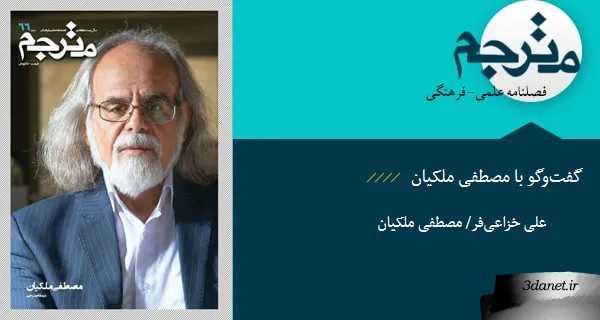
Khazaeefar: Mr. Malekian, your field of work and expertise is ethics, religion, philosophy, and psychology. Nevertheless, apart from your numerous authored works, you also have many translations, and through your translations and writings, you are inevitably engaged with the written Persian language and its expressive capabilities. Tell us about your relationship with the Persian language; when did your attention to the Persian language first arise? What kind of Persian do you favor?
Malekian: My late father, may his soul rest in peace, had an abundant love for Nezami, Saadi, Rumi, and Hafez, and during much of the time he was at home, he was occupied with studying the works of these great figures, occasionally reading them aloud and sometimes even singing them. From the age of six or seven, when I still did not know how to read and write, I became interested in these works and memorized some of the poems of these greats, even though I did not understand their meanings very well. From those days, my attention was drawn to the written Persian language. Thus, I first became engaged and acquainted with Persian poetry and verse, and then with Persian prose. My encounter with Persian prose began with reading the works that, in those days, were the only books accessible to children and adolescents, that is, by reading books such as Amir Arsalan-e Namdar, Hossein Kord-e Shabestari, One Thousand and One Nights, and Faraj ba'd az Sheddat. Let me also add, although it is not related to your question, that for me, from that very childhood, language held a fascination far greater than merely being a means for expressing one's inner thoughts. I attached such importance to the pronunciation of words, the morphology of terms, syntax, sentences, and the rhetorical subtleties and delicacies of language that, in the view of my friends and those around me, it seemed like a kind of pedantic nitpicking, pretentiousness, and obsession, and of course, in my own view, it seemed like rendering the due of words, phrases, and sentences, as if these too possess individuation, personality, and rights that determine our moral duty towards them.
And as for the Persian I favor: a Persian that, firstly, as much as possible (and of course, not more than that limit), is free, distant, and untainted by foreign words and the syntax of those languages; secondly, again as much as possible, in it, only one word is used to convey each meaning and concept, and each word is used only to impart one meaning and concept, and, in other words, a one-to-one correspondence between signifiers and signifieds is established within it; thirdly, it is clear and eloquent, meaning it is not subject to ambiguity, double entendre, and obscurity, in such a way that the audience of the speech or writing grasps the intention of the speaker or writer by expending the least cerebral, mental, and psychological energy; fourthly, it is graceful and articulate, meaning it casts the intended meaning in the mold of the most beautiful expressive form; and fifthly (and this fifthly is, to some extent, the result of combining the secondly and thirdly), in it, the grammatical status of words and phrases is made as clear as possible, so that, for example, the audience does not mistake an adverb for the subject, or an adjective for the noun it modifies, or a noun for something else. If the grammatical status of words and phrases is not clear, speech becomes devoid of logic, and language tends to deviate from logical laws.
Khazaeefar: As you know, one of the functions of language is oratory. An orator must be familiar with the emotional and evocative power of language at a high level in order to create the intended effect on the audience. It seems to me that in the seminary, the Persian language, whether in its spoken or written form, does not shine much. It is as if the linguistic and literary taste of the students is not much cultivated. On the other hand, perhaps the audiences of sermons are also satisfied with ordinary orations. At the written level, the situation is no better. The prose of the seminarians is typically ordinary prose, a prose in which language is used at a minimal level. Is this perception of the state of the Persian language in the seminary correct?
Malekian: You are absolutely right; the generality of clerics and students of the religious seminaries, both in speech and in writing, do not possess correct, expressive, and eloquent Persian. And this defect and shortcoming, in my opinion, is caused by several factors: first, the only language instruction these individuals receive is the teaching of Arabic, and that too, old Arabic (not modern Arabic), and again, the Arabic that was and is used mostly by Persian-speaking (and not Arabic-speaking) clerics and religious scholars. They receive absolutely no instruction in the Persian language. Even the teaching of books such as Saadi's Golestan, Kalila wa Dimna, and Anwar-e Soheili, which was once customary, has now long been abandoned and obsolete in the religious seminaries. A fortiori, not a single line from the modern prose and poetry texts of Persian writers and poets is ever taught. Second, the educational system of these seminaries itself in no way necessitates that clerics and students refer to texts that are written or translated into Persian in, for example, the fields of knowledge such as logic, philosophy, psychology, sociology, economics, politics, management, education, ethics, law, history, religion and creed, mysticism, and literature; consequently, clerics and students are not compelled to read Persian books either, so as to, by force of necessity and exigency, learn the Persian language as well. Third, the training of students in these seminaries is such that it makes them, just as it makes them suspicious and fanciful towards non-written arts like music, painting, photography, theater, and cinema, also lukewarm and disbelieving towards the written art, that is, literature, in such a way that students not only do not read books of poetry, novels, short stories, plays, and the like, but if they see such books in your hand, on your desk, or in your library, they doubt your orthodoxy and the soundness of your beliefs. Fourth, the graduates of these seminaries consider and desire their audience to be mostly the common people, and there is no doubt that addressing the common people does not necessitate possessing an expressive, eloquent, lively, and beautiful language. Fifth, the vocabulary treasury of the religious and creedal texts of the scholars of these texts is very narrow in scope, and, as everyone knows, the more extensive the speaker's vocabulary treasury, the more expressive and eloquent their language. And sixth, the language of the clerics is the language of decisiveness, certainty, omniscience, command, prohibition, decree, and fatwa. In the speech and writing of clerics, "perhaps," "it might well be said that...," "it is quite possible that...," "apparently," "I doubt that...," "it seems that...," "my words have serious opponents...," "I am not so certain that...," "I guess that...," "I do not know" are almost never used. Such a language leaves no room for doubts, comings and goings, fluctuations, and intellectual, ideological, and epistemic vacillations, let alone allowing expression to the ups and downs, emergences and declines, highs and lows, and twists and turns of feelings, emotions, desires, ideals, and wishes, and it is evident that a language this dry, soulless, artificial, and unreal cannot be engaging and impactful.
Khazaeefar: I believe one of the reasons for the weakness of translations in Iran is a theoretical reason, in the sense that the translator does not have a correct theoretical understanding of the nature of the work of translation, and consequently does not act consistently. If we define translation as: the re-creation of a text written in one language into another language, the meaning of re-creation in another language naturally implies that it should be written with the capabilities of that language, in such a way that no interference occurs between the two languages; otherwise, the purpose is defeated. If we overlook exceptional cases, that is, cases where interference is unavoidable or desirable, the rule is to consider translation as the re-creation of a text in another language, and this re-creation is different from word-for-word translation and, worse still, structure-for-structure translation. In Iran, unfortunately, perhaps because re-creation is a difficult task, in the realm of theory, they support a kind of literalism under various pretexts and consider deviation from the author's wording as a deviation from fidelity and a betrayal of the author, whereas translation is, in its essence and principle, re-creation, and re-creation is inevitably accompanied by linguistic minutiae and details. The only thing that must not be lost is the meaning and the intent of the speaker. How do you see the state of translation, especially the translation of books done in your field of expertise?
Malekian: In my opinion, in the epistemic domains of philosophy, psychology, mysticism, and religion, the state of translation is not very desirable; and one of the aspects of this undesirability is precisely what you pointed to, that is, in your own words, literalism. But other aspects are also at play. Among them, one is that many translators have no familiarity or intimacy with the old and new prose and verse texts of Persian, and consequently, they are unaware of both the breadth and richness of this language's vocabulary and its capacity and capability for word-formation. Another is that they do not have complete and thorough mastery of the subject of the text they are translating. Furthermore, the translator must possess an ample share of what we refer to as "general knowledge," which is not the case for many translators. There is no shortage of translators who read no other books besides the ones they translate, and finally, the lack of a strong, vigilant, and lively work conscience, which leads to carelessness, laxity, hastiness, and laziness, must be considered an important factor in the weakness of translations. If the translator's work conscience has not fallen asleep, they will pursue and advance their work with deliberation, patience, and tolerance, will be strict with themselves, will become the executioner of their own disposition, and will not move on to the next sentence until they are certain they have translated a sentence correctly and precisely. This absence of a vigilant work conscience is, in my view, the most important factor in the deplorable state of translation in Iran; because if a translator is not afflicted with such a calamity, they will feel obliged to remedy all four of the aforementioned flaws, and of course, this calamity is not exclusive to translators and has become widespread in today's Iran. Few are those who have devoted their hearts to their work and take it seriously.
Khazaeefar: What is your general view on editing? Is editing, as it is practiced in Iran, not itself indicative of an ailment? If authors and translators were sufficiently capable in their work, would there be a need for an editor? If authors and translators are not sufficiently capable, how can one find editors who can remedy the deficiencies in the work of authors and translators?
Malekian: In my view, no matter how capable and successful an author or translator is in their work, they are still not immune to error, and the possibility of mistakes in their work remains. On this basis, what harm is there if their possible error or mistake is corrected and rectified by a competent editor before it finds its way into the minds of readers through the publication of the book and causes them to fall into compound ignorance? If I am right, it can be said that we are never without need for knowledgeable and adept editors; although I agree with you that editing, in the form it takes in present-day Iran, indicates that authors and translators do not have sufficient mastery over their work. For an unqualified author or translator to refrain from undertaking authorship or translation, they must either fear God, or, if they do not believe in the existence of God, possess a vigilant and strict moral conscience, or, if their moral conscience has been suppressed and fallen asleep, at least fear disgrace before the people; and this third option is only possible with a thriving market of scholarly, fair, and truth-seeking criticism; and alas, a hundred times alas, that such criticisms are also rare and non-existent in our cultural media.
And regarding that part of your question: "How can one find editors who can remedy the deficiencies in the work of authors and translators?" I must say that until now, all our editors have been self-taught individuals; but it seems better that a university discipline be established for teaching the "art of editing" so that the graduates of this field can engage in editing authored and translated works in a more scholarly and methodical manner.
Khazaeefar: Your prolific record shows that you have edited nearly forty translations. Considering the specialized subject matter of the books, my assumption is that these translations were entrusted to you for the purpose of scientific editing and not necessarily literary editing. Please tell us, what is your method in editing? Do you read the translation word for word, in the style of Iranian editors, and insert corrections? Or, like editors in the West, do you simply read the book from the perspective of a reader and point out notes? Do you compare the translation with the original text?
Malekian: Regarding translations, yes; I collate the translation with the original text and read it word for word, inserting corrections and emendations. Only in the last six years, during which I no longer accept editing in the sense of word-for-word collation of translations with the original texts, has it sometimes happened that, at the translator's insistence, I have read a translation, as you put it, purely from the perspective of a reader and have suggested and pointed out certain things. My method in editing in the sense of collation was that if a word, phrase, or sentence was translated incorrectly, I would cross it out and replace it with the correct form, and if the translation was not wrong but was inferior and could be rendered in a better way, I would underline it and write the better form, leaving the choice to the translator to either keep their own translation or prefer mine. In matters of taste and personal preference, I never deemed interference permissible, so that the color, character, mark, and stamp of the translator's translation would not be lost and would be preserved, and the translator would still see their own taste and preference manifested in their translation. Furthermore, if I saw that the cause of an error in the translation was the translator's neglect of a general point, I would write that point inside brackets in the margin of the translation.
Khazaeefar: You have said somewhere that translation and thought are connected in five respects: acquainting the people of a country with the latest achievements of human sciences and knowledge; preventing repetitive research; providing raw materials for thought; rescuing society from intellectual and cultural monophony; and revealing the theory of the non-manifestation of truth in society and providing the groundwork for lasting global peace. This view of yours on the role of translation is a positive and very optimistic one, and the historical role that translation has played in the transformation of societies also confirms this view. My question is about the relationship between thought and translation. You believe that three types of relationship are possible between thought and translation: 1. general compatibility; 2. general incompatibility; 3. partial compatibility and partial incompatibility.
Mr. Morad Farhadpour has proposed a theory stating that in the contemporary era, translation, in its broadest sense, has become the only true form of thinking for us. This view, which, unlike your view, is pessimistic, is probably what you would place in the category of "general incompatibility between thought and translation." What I understand from Mr. Farhadpour's words is that in Iran, given our position vis-à-vis the West, thinking of the kind that leads to the creation of new works within the text and context of Iranian history does not take place. In other words, our thinkers, since they are under the influence of imported thoughts, do not reflect upon their own historical situation so as to be able to formulate it correctly and arrive at new concepts relevant to the cultural and historical space of Iran. According to this view, translation does not provide raw materials but imports pre-fabricated and packaged thought. Of course, this claim, like most general claims, is an exaggerated one, but again, like most claims, it contains a grain of truth. Both historical and philosophical thinking and conceptualization take place in Iran, thanks to our familiarity with the intellectual and philosophical achievements of the West or independently of it, and translation-obsession runs rampant. One example of this translation-obsession is the state of research and thinking in the humanities in Iranian universities; a place where authored works are often translations, and translations are often inadequate. In your opinion, where does this claim that translation has closed the path of thinking to us hold true, and what is to be done?
Malekian: In accordance with the five respects you have quoted from me, I consider translation not only compatible with thinking, but, indeed, an inescapable means of reaching the stage of thinking, and therefore, I see the translation movement as not only beneficial, but necessary, for the quantitative and qualitative increase of thinking. If translation had an inherent and universal incompatibility with thinking, the process of translation would have to fall into opposition and conflict with the process of thinking in all societies and historical periods, whereas, as you have also pointed out, such opposition and conflict has not been ubiquitous and perpetual. Neither does the process of translation, in and of itself, prevent the translator from thinking, nor does its product prevent the readers of the translated work from thinking. Both the translator and the readers of his translated work can think about what is in the work, and they can also refrain from thinking. Both translation and the translated work are innocent and blameless. If there is a fault—and there is—it belongs to the translator or the reader of the translated work who, due to positive prejudice or bias towards the author, or due to mental and intellectual laziness, or due to a feeling of inferiority and lack of self-confidence, abandons personal thinking and contents himself with parrot-like repetition and the inculcation and suggestion of what the author has said, and places himself in the ranks of the author's imitators. Instead of condemning the translation movement and depriving ourselves of its blessed works and results, we must educate and nurture our compatriots so that, from childhood and youth, they avoid prejudice (whether positive or negative) and bias, become accustomed to mental and intellectual effort and diligence, gain self-confidence, and dispel and eliminate feelings of inferiority from themselves. As I have repeatedly and emphatically said in several other places, our educational institution (not just the Ministry of Education, but all those who, consciously or unconsciously and willingly or unwillingly, engage in our education and upbringing) has at least five major and devastating flaws and defects, two of which, relevant to our current discussion, are that these institutions, firstly, emphasize memory over understanding, and secondly, insist on dogmatism instead of reasoning. The result of this situation is, of course, clear: most of us are constantly adding to our memorized knowledge, while we have almost never correctly and deeply understood any of it, and we are dogmatic and imitative towards our teachers and educators (in the broadest sense of "teacher" and "educator"), whereas we should, by resorting to the power of reasoning, distinguish the wholesome from the unwholesome, separate the pure from the impure, and, on every issue, arrive at a personal, independent, and reasoned position for ourselves. There is no doubt that, in such a situation, we are predisposed to swallow the intellectual morsels made available to us through translations, without the slightest consideration or reflection upon their material and contents. But, I repeat, the way out of this highly undesirable situation is not unkindness towards translation, but rather the reform of our flawed and defective educational institution. Those who have enjoyed a proper education, that is, a rational and ethical one, do not consider any translated text to contain ready-made and packaged thinking; they consider it only to contain raw materials that must be attended to, reflected upon, theorized about, correctly understood, and rejected or accepted. The reality is that one of the major cultural problems of our contemporary society is that a part of us, to which most clerics and scholars of religious sciences belong, unreasonably fears modern Western culture and struggles against it, and another part, to which many university graduates belong, is, again unreasonably, infatuated with this culture and imitates it. It is time to have a scholarly and truth-seeking, profound and meticulous, and, naturally, critical approach to the very rich culture of the West, and not to ignorantly and foolishly deprive ourselves of its blessings or become its mere imitators; and this purpose is not achieved by closing the door of translation or by condemning and vilifying the translation movement. It should also be noted that the highly undesirable state of research and thinking in the humanities in our country has nothing to do with being translation-struck and is the result of ten causes that I have addressed elsewhere.
Khazaeefar: I call the state of translation in Iran the “banality of translation,” and this term is, of course, not unrelated to Hannah Arendt’s concept of the “banality of evil.” It is obvious that many translators in Iran have rendered service, but my point concerns the general state of translation. A general characteristic of this state is that in Iran, compared to Western countries, many people, without having the qualifications and with various motivations, engage in translation in all fields of the empirical sciences and the humanities, in such a way that their weak or repetitive translations cannot be considered a service to science or culture. The reason the term “banality of translation” is linked to the concept of the “banality of evil” is that we cannot consider all such translators to be ill-intentioned individuals. Surely many of them think they are rendering a service. Society is at fault for having no mechanism to prevent their entry into the field of translation. One of the mechanisms that exists in the West is copyright law. But perhaps even if this law did not exist, the moral and scientific conscience of individuals would prevent such banality. In your opinion, what should be done so that only qualified translators can enter each field, so that translation can play the positive role you envision? Can this matter be left solely to the conscience of individuals?
Malekian: While a living and awake moral conscience can prevent a person from undertaking a task for which they lack the necessary knowledge and skill, it goes without saying that the reform of the state of translation in Iran cannot be entrusted solely to the moral conscience of translators. In addition to this, the publication of journals and periodicals specifically dedicated to translation criticism, in which knowledgeable and well-intentioned critics, without seeking any individual or group benefit and with complete fairness and compassion, out of a love of truth, subject published translations to the test of criticism, can greatly help improve the situation, especially if, when it becomes clear through such criticisms that a translator truly lacks competence, people of culture abandon disputation and sycophancy and show an appropriate reaction toward them; for example, what if publishers, from then on, were to refuse to contract with such translators? You will probably accuse me of excessive optimism and even naivety for making such a suggestion in a society where professors whose scholarly plagiarism has been proven are still engaged in teaching at universities, as if they had committed no error.
But the most fundamental task is to change the state of education, upbringing, and research in our schools, high schools, and universities, which today apparently consider themselves to have no mission or duty other than the production and distribution of academic degrees. Is it not a matter for question and regret why the knowledge of university graduates in the field of the Persian language, a foreign language, and the domain of knowledge in which they translate is so scant and negligible? What have they been taught in the universities? A tree must be known by its fruit. A tree whose fruit is this must surely be afflicted with pests and diseases. Let us be honest and frank and, however painfully and regretfully, accept and confess that our schools, high schools, and universities give our children neither a proper education nor a proper upbringing. They give our children degrees instead of understanding. The gravity of this situation in the humanities, compared to the natural sciences, engineering, and medicine, is far greater; and among the results of this situation is that qualified translators are scarce among us.
Khazaeefar: One of the questions that translation professors are regularly asked is to what extent a translator has freedom. This question itself indicates the fact that the person asking it lacks a correct theoretical understanding of the different natures of languages, the nature of the act of translation, the extent of the translator’s legitimate freedom in the translation process, and a correct understanding of translation as an independent text with textual characteristics, for a different audience, and for a specific purpose. The result of this lack of knowledge is the eclectic method that translators adopt; in your opinion, what should the method of translation be? What principles should translators observe? How do you define the concept of fidelity?
Malekian: Fidelity in translation, as many have said, means that the translator does not omit or alter one iota of the author's intent and purpose in transferring it to the target language. The assumption is that the author wishes to express their intent and convey their meaning using the materials and resources of the target language. Up to this point, it seems I have said nothing new, nor anything particularly contentious. However, an important point must not be overlooked, and that is that the author can convey their intent and purpose in the source language, with the materials and resources of their own language at their disposal, in numerous ways. And if, from among those numerous ways, they have chosen one for whatever reason, the translator must also use the materials and resources of their own language, i.e., the target language, in a way that is as close as possible to the author's chosen manner. Let me give an example: an English-speaking author, to convey George's love for Helen, can use many sentences; for instance, they could write:
George loves Helen George is in love with Helen. George is very fond of Helen George adores Helen. George is devoted to Helen. Helen is beloved by George! George is Helen’s lover.
Can I, as a Persian-speaking translator, render all these sentences and other sentences with the same meaning into the single sentence "George is in love with Helen"? I think not. If the author, to express their intent, has chosen one of these sentences, they must have had a specific consideration in this choice, that is, an eye to a subtle and delicate point, and this point holds all the more true the more literary and artistic the author's disposition. I mean to say that since the author's linguistic possibilities offer them numerous modes of expression for conveying any single intent, and this matter applies exactly to the translator as well, a faithful translation is one that conveys the author's intent and purpose to the readers of the target language, but with words, phrases, and sentences that have the greatest affinity with the author's words, phrases, and sentences, insofar as is possible and destined.
Let me put this matter in another way. Every author (or speaker) seeks to communicate an intent and purpose to their audience. This intent and purpose answers this (first) question: "What does the author want to say?" But regarding any author, two other questions can also be posed: one (the second question) is: "To whom does the author want to say it?" and the other (the third question) is: "Why does the author want to say it?" The answer the author themselves gives to the second and third questions determines and clarifies the fate of the fourth question: "How does the author say it?" That is, a single purpose, depending on to whom we wish to convey it and why we wish to convey it, can be cast into numerous expressive forms. The diversity and multiplicity of the manner of saying (how to say it) is a function of two variables: one, the identity of the audience (to whom one is saying it), and the other, the speaker's motivation/goal/intention (why one is saying it). A faithful translation must respect both "What does the author want to say?" and "How does the author say it?" I pointed this out and emphasized it because, in my opinion, many consider fidelity in translation to be conditional only upon the first condition and imagine that if they convey the author's intent, it no longer matters in what manner of speech they have conveyed that intent, and that, in any case, they have been faithful to the author's text. In my view, this opinion is erroneous, and observing the manner of speech, alongside the intent of the speech, is also important. One of the consequences of this view of mine is that the translator's stylistic flourishes must be completely subordinate to the author's stylistic flourishes. For now, I will not elaborate further on the consequences of this view.
Khazaeefar: In your own field of expertise, how do you see the state of translation and translated books? Are experts engaged in translating these books? Have the major works of this discipline been translated? Is the quality of the language of the translations acceptable?
Malekian: In the fields of philosophy, psychology, religion, mysticism, and ethics, which I am interested in, I do not see the state of translation as favorable. A significant portion of translators either lack the knowledge and ability necessary for translation work or are afflicted by hastiness, sloppiness, and carelessness, which, with a thousand regrets, it must be said, are the common currency and fashion of the day. It goes without saying that there are also translators who possess both the requisite knowledge and skill and are free from these unbecoming flaws and defects.
The majority of the major books in these fields have also either not been translated into Persian at all or have not been rendered in a fitting manner. One of the problems of these five fields is that their specialized and technical terminological sets, in comparison with the terminological sets of mathematics, logic, economics, politics, sociology, and law, are not established and stabilized, and this matter both gives free rein to the whimsical coinages and incorrect, careless word-making of some translators and narrows the field for the understanding of readers. Another problem is that since these fields are not directly related to art and literature, translators do not, in any way, see it as their duty to offer eloquent and expressive translations, as if eloquence and expressiveness are conditions only for the translation of literary texts.
Khazaeefar: In your specialized field, has censorship had a noticeable impact on the selection of books for translation and on translators' self-censorship?
Malekian: I can claim that, in a rank after art and literature, these five fields have suffered the most damage from the censorship of governmental and state authorities. In these fields, there are very useful, eye-opening, and problem-solving works whose translation the fear of censorship kills and destroys the desire for in the minds and consciences of translators. The tale of this separation and this heart's burning / Leave for now, until another time.
Khazaeefar: In your opinion, what characteristics should a fair critique of translation have? In the first place, in a situation where criticism in the press generally does not have an established position, is translation criticism even possible?
Malekian: It seems that a fair critique should at least have these characteristics: a) It should only deem errors and mistakes as rejectable and not reject a word, phrase, or sentence merely because it does not accord with the taste and preference of the critic; b) It should observe the principle of charity (in one of the interpretations of this principle), meaning it should be sympathetic, in the sense that it should not consider the translation incorrect as long as a justification for its correctness can be conceived; c) It should also make known the strengths of the translation, in addition to its weaknesses, and even in a more expressive and manifest way; d) It should also draw attention to the ambiguity, equivocation, obscurity, and difficulty of the original text so that readers do not attribute every unevenness in the translation to the ignorance and inability of the translator and hold it against them; e) It should not be contaminated by insult, humiliation, and mockery, and should safeguard the good reputation and the respect of the translator's honor and not overstep the bounds of courtesy.
.
.
PDF file of this interview
.
.
Interview of Motarjem Quarterly with Mostafa Malekian on Translation
Typing and editing: Ms. Samira Rahimi
Issue 66, Winter 2019
.
.
Discussion2 comments
با درود گفت و شنودی بسیار سودمند بود دو جا در پرسشهای دکتر خزاعی فر خطای نوشتاری دیدم یکی فعل غلط ورود کردن و دیگری چگونه می بینید به جای چگونه ارزیابی می کنید با سپاس
گفتگویی دقیق و موجز بود در باب ترجمه و استلزامات آن. با تشکر