اندیشهفلسفهخردگفتگوحکمتمعناپرسشفرهنگ
Philosophy
On the Uses and Disadvantages of History for Life; by Friedrich Nietzsche
The book *On the Uses and Disadvantages of History for Life* is the second essay in Friedrich Nietzsche’s collection *Untimely Meditations*, exploring the relationship between history and human life. In this work, Nietzsche shows that history is valuable when it serves creativity and living, rather than trapping human beings in the accumulation and imitation of the past.
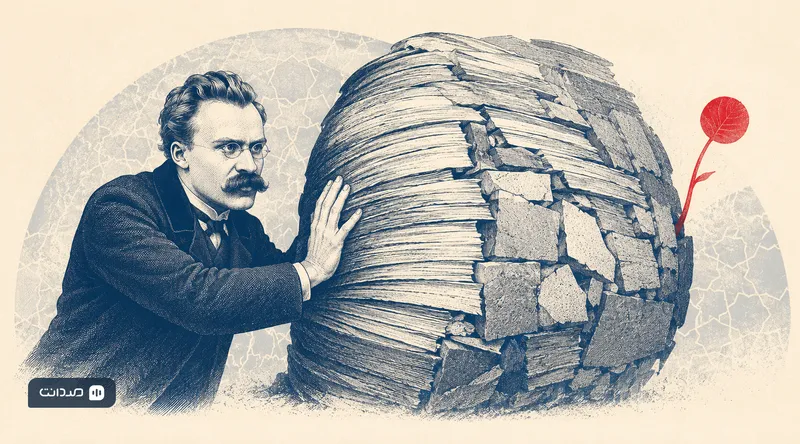

Friedrich Nietzsche
Author
Morad Farhadpour
Translator“On the Uses and Disadvantages of History for Life” is the second essay in Friedrich Nietzsche’s four-part collection “Untimely Meditations”, published in 1874. This work is considered one of the most important writings from Nietzsche’s early period of thought; a period in which he appeared less as a system-building philosopher and more as a critic of modern culture and a diagnostician of the intellectual condition of his time.
This essay addresses a fundamental question: When is history beneficial for life, and when does it become a force against life? From Nietzsche’s perspective, the human ability to remember and create history is one of the sources of culture and human identity, but this very ability can become a heavy burden when the past limits the possibility of creation and action in the present.
In this work, Nietzsche criticizes the excesses of historicism and argues that modern human beings have become excessively immersed in the past. A history that, instead of serving life, becomes an independent goal can weaken the creative power of culture. For him, the value of history lies not in the accumulation of knowledge about the past, but in its ability to strengthen human life and creativity.
One of the most famous sections of this essay is Nietzsche’s threefold classification of the ways in which history can be used: monumental history, antiquarian history, and critical history. Monumental history, by recalling great figures and moments of the past, inspires action and creation; antiquarian history helps preserve traditions and cultural roots; and critical history enables the critique of the past and liberation from harmful legacies. Nietzsche emphasizes that none of these approaches is sufficient on its own, and that a healthy life requires a balance among them.
Another part of the book is devoted to a critique of nineteenth-century German culture. Nietzsche believes that the society of his time had fallen into a kind of “historical saturation”; a condition in which people, instead of creating new values, content themselves with collecting and interpreting the past. He considers this condition one of the causes of cultural weakness and the decline of the creative power of modern human beings.
At the end of the essay, Nietzsche seeks a way out of this historical illness through attention to forces beyond history itself, such as art and religion; forces capable of establishing a new connection between the past, life, and creativity. He regards the Greeks as an example of a culture that had succeeded in creating a balance between tradition and innovation.
The present Persian translation is a translation of a section of this essay carried out by Morad Farhadpour. This translation makes available to Persian-speaking readers a portion of one of Nietzsche’s most important early writings; a work in which the question of history is not merely a theoretical subject, but becomes a question about the way human beings live: Is the past at the service of our life, or is our life at the service of the past?
This work is an important and thought-provoking text for those interested in the philosophy of history, cultural criticism, Nietzsche’s thought, and the question of the relationship between human memory, identity, and freedom.



Discussion0 comments
No comments yet; let yours be the first voice.