اندیشهفلسفهخردگفتگوحکمتمعناپرسشفرهنگ
Literature
Read the Novel Ayyār-e Nātamām
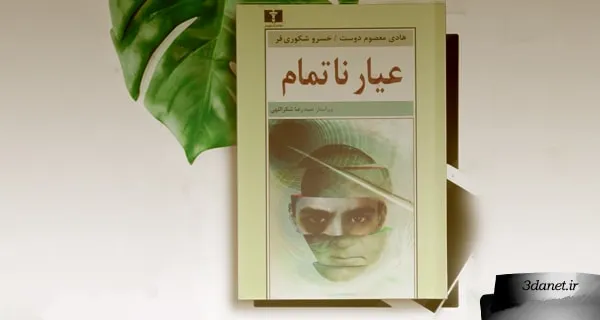
The Unfinished Rogue, a novel by Hadi Masoumdoust and Khosrow Shokourifar, is a narrative of contemporary politics and history: from Shariati and the 1979 Revolution to the war fronts and the bitter year of 2009. Published by Niloofar Publications, it is a tribute to a generation whose aspirations never came to fruition.
“He could hear the television from the shower. One of the satellite channels was showing yesterday’s protests and the people’s slogans. It was blood that was being washed from his body and snaking toward the drain. He had seen this image in many films too. He thought the world no longer has anything new to say.
He wrapped the towel around himself and as soon as he came out of the bathroom, he saw on the television the bloodied face of a girl whose head a man was holding in his lap. He heard the voice of someone who was in shock, wailing and lamenting.
He switched the channel to the BBC. Static played across the images. Again, it was the face of the same girl and the voice of a reporter identifying her as Neda Agha-Soltan. A girl who had been killed by a single bullet today on Amir-Abad Street. The BBC anchor, whose voice had choked up upon seeing the image of the girl, continued the news with a trembling voice. Ali was still looking at the television with wet eyes, which now showed nothing but static.
Mohsen picked up a lighter and a pack of cigarettes from the table and went out onto the balcony. He placed the cigarette at the corner of his aching lip and lit it. He could still taste blood in his mouth. He swallowed the smoke. The taste of blood and smoke intertwined. His suppressed tears burst forth. He leaned against the balcony wall. His back throbbed from the places he had been struck. He began to sob. His lip split open again and the taste of blood settled in his mouth.”
This is a fragment from the novel Ayyār-e Nātamām (The Unfinished Standard) written by Hadi Masoum-Doust and Khosrow Shokouri-Far, which was published a few days ago by Niloofar Publishing. A novel set against the backdrop of our politics and history, both past and present. Ayyār-e Nātamām begins during the era of Dr. Ali Shariati’s fiery speeches. It draws the story’s characters, from the Marxists of the 1960s to the revolutionaries of the 1970s, into the height of the events of the 1979 Revolution, and in extensive sections, tears the thread of their lives to shreds on the war fronts and in the Iraqi prisoner-of-war camps for Iranians, until it reaches the bitter, historic year of 2009 and the confrontation between a Revolutionary Guard commander, a war veteran, and young people from a generation whose eyes are all fixed on the elections.
Hadi Masoum-Doust himself says: “For me, the novel Ayyār-e Nātamām is a debt repaid to myself and my generation, who suffered greatly in 2009, and to the dreams that went unfulfilled and the loves that were lost, and to us, who spent part of the best years of our lives in absolute darkness and despair.”
Instead of delving into the story of Ayyār-e Nātamām, which you have not yet read, let me tell you my own story with this book. Nearly 10 years ago, publishing unedited stories in Khabgard (The Sleepwalker) was a modest effort, a drop in the ocean, to record the ongoing, living narratives of the bitter year of 2009. In those days, I prayed to God that a writer or writers could swallow all this bitterness and commit a narrative of that year to paper within a novel, so that a narrative which unfortunately has no place in official accounts might come to life and be immortalized. Years passed until the early months of 2016, when the first draft of the novel Ayyār-e Nātamām reached my hands.
As a fiction editor, fortune has favored me, at least in recent years, that I have never taken on a book for editing out of professional obligation. The choice has been my own. Ayyār-e Nātamām was also my own choice. Like the authors of Ayyār-e Nātamām, I too felt that my shoulders must bear wounds once more, so that perhaps this time I might contribute more than a mere drop. And well, the robust plot and especially the authors’ effort to give this historical-political novel a polyphonic quality redoubled my motivation.
A few nights ago, when Hadi Masoum-Doust unexpectedly sent me the cover photo of Ayyār-e Nātamām, I was happy. Happy at the thought of the countless people left behind, worn down, and helpless, who over the past decade have crept into a thousand corners of Tehran, Iran, and the world, and now all of them, in a cold, dark corner of the night, are connected once again through the novel Ayyār-e Nātamām; with a glimmer of light and a little warmth, and perhaps a tiny bit of hope for all of us who are, as it were, “the heirs of our fathers’ unfinished paths.”
More talk about the merits and flaws of the novel Ayyār-e Nātamām, its literary aspects, and especially its mythological substructure—"filicide in the presence of today's suffering Tahminehs"—can wait for another time. Perhaps later you will write about its merits and flaws for me and us to read. For now, I will only say: read Ayyār-e Nātamām. Pay no attention to my name appearing on the cover. For, until recently, I was unaware even of the possibility of its publication, let alone the details of its release. Reza Shokrollahi
I include another excerpt from the seventeenth chapter of the novel Ayyār-e Nātamām below so you can become more familiar with its atmosphere, prose, and language:
"The redness of the sunlight had spilled onto the earth. The sun was setting. It had sunk into the ground up to its knees. A few others who always helped him were standing near the container office, watching Amir, who was not himself today. He always stopped working before it got dark, but today he was relentless.
When he pushed the soil aside, his body flushed with heat. An earth-colored garment had emerged from the heart of the soil. His knees gave way. He sat down right there in the pit. He was panting. His tears involuntarily traced lines down his dust-covered cheeks. He threw the shovel out of the pit. It took a while for his weakened limbs to regain strength. He shouted at the few young men sitting near the container office to come over. They ran toward him. Another person positioned himself in the pit, which resembled a grave, and began pushing the soil aside with Amir. A tattered, threadbare garment with a few pieces of bone and a skull with a bullet mark on it. Everyone was crying. The few people standing above the grave kept repeating 'la ilaha illa Allah.' Amir had broken into sobs, just like a child. He lifted Ebrahim's skull, held it before his face, looked at it, brought it close to his face, closed his eyes, smelled it, and gently kissed the bullet mark.
The sound of the crowd's whistling and cheering grew louder. The young people on Enghelab Street had blocked the entire street with green flags. A car was stuck among the crowd. They were slowly clearing a path for it. Masoud dried his tears with the back of his hand. He turned to Amir, whose lips were white and dry. He bought a bottle of mineral water from the newsstand, opened it, and handed it to Amir. Amir's throat burned with thirst, just like when he had held Ebrahim's head in his hands in the pit and was kissing it."
.
.
The novel Ayyār-e Nātamām, written by Hadi Masoumdoust and Khosrow Shokourifar, has been published by Niloufar Publications in five hundred pages, priced at 59,000 Tomans.
Author of the introductory text: Seyed Reza Shokrollahi
Source of the introductory text: Khabgard
.
.

Discussion0 comments
No comments yet; let yours be the first voice.