Religion
The Afterlife as a Moral World by Amir Divani
In the realm of action, human beings must choose between conducting life according to the laws of nature or the laws of the afterlife as the moral world—a choice rooted in the struggle between reason and the carnal self, and one that defines their existential situation.
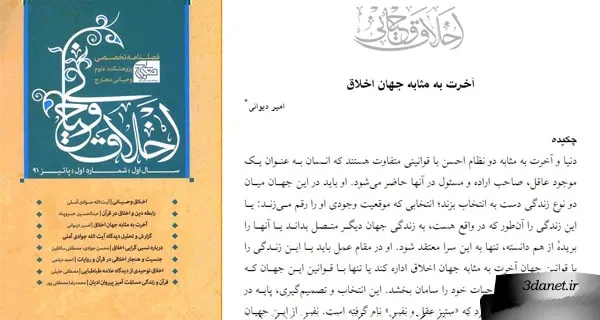
This world and the afterlife are like two optimal systems with different laws, in which the human being, as a rational creature possessing will and responsibility, is present. In this world, he must choose between two kinds of life; a choice that determines his existential position: either to consider this life as it truly is—connected to the life of the other world—or to regard them as severed from one another and believe only in this abode. In practice, he must either govern this life by the laws of the afterlife as the moral world, or organize his existence solely by the laws of this world, which are the laws of nature. This choice and decision-making is rooted in a struggle within the human being called the “conflict between reason and the soul.” The soul belongs to this world and reason to that world, and each draws the human being, through the application of its own laws, to its appropriate world.
Even if we were to assume the removal of reason, the human being would still fall within the scope of these intelligent creatures—albeit at a higher degree—and could, like them, benefit from life, its pleasures, survival, and the preservation of his species. Yet all human beings, whether they act according to rational-practical laws or not, know that merely through the natural laws governing their existence—which are limited to sensory and empirical perceptual experiences and encompass all their inclinations, motives, and desires—a collective life pleasing to reason cannot be achieved. At the same time, his inner apparatus corresponds perfectly with what exists in the natural world, and in such a state, if any trace remains of the powers of the rational faculty, that is, the supernatural dimension of the human being, it is all directed toward aligning the entities of nature with the desires arising from the non-rational faculties within the worldly human being. Now, whether the faculty of reason determines the will or the non-rational faculties do—that is, whether the human being acts based on moral laws or on non-moral instructions—the natural world applies its laws to every human being and makes no distinction between them. Reason’s conception of the moral world is one whose action and reaction are determined by moral laws; a world in which any form of oppression and corruption against any being—even if it is the oppressor—is negated, and the relations among its beings are based on mercy, security, and well-being; a world where every faculty attains its desired ends through rational laws, and no obstacle or conflict threatens it on its path.
.
.
Abstract [English]
This world and the other world are the two best Divine Order with different rules that human as a rational creature and the owner of the will, find himself responsible in both. He must choose between two worldviews of life, the choice which specifies his existential status: either he should believe in the connection between this world and the other world - as it is indeed – or believe in separation and confine himself to this transitory world. He should practice in this world under the rules of the other world, which are the same as the norms of ethics, or organize his life merely under the natural rules of this world. This choice and decision making is based on conflict in human inward, which is called “Intellect and Soul Conflict”. Soul belongs to this world and intellect belongs to the other world, each of which leads human to its own direction. This research is to introduce and prove the other world as the ethic rules.
.
.
References
1_ The Holy Quran. 2_ al-Ḥarrānī, Abū Muḥammad al-Ḥasan ibn ʿAlī, Tuḥaf al-ʿUqūl, Qom: Muʾassasat al-Nashr al-Islāmī. 3_ Shīrāzī, Muḥammad ibn Ibrāhīm (Mullā Ṣadrā), al-Ḥikma al-Mutaʿāliya fī al-Asfār al-ʿAqliyya al-Arbaʿa, vol. 1, Qom: Manshūrāt Muṣṭafavī. 4_ Shīrāzī, Muḥammad ibn Ibrāhīm (Mullā Ṣadrā), 1381, al-Mabdaʾ wa al-Maʿād, vol. 2, Tehran: Bunyād-i Ḥikmat-i Islāmī-yi Ṣadrā. 5_ Fayyāḍ Lāhījī, Mullā ʿAbd al-Razzāq, 1364, Sarmāya-yi Īmān, Intishārāt al-Zahrā. 6_ ——— , 1383, Gawhar-i Murād, Nashr-i Sāya. 7_ al-Qummī, Mīrzā Abū al-Qāsim, al-Qawānīn al-Muḥkama fī al-Uṣūl al-Mutqana, Muʾassasat Iḥyāʾ al-Kutub al-Islāmiyya, vol. 3.
.
.
PDF file of the article "The Afterlife as a Moral World"
.
.
Source: Revelatory Ethics, Fall 2012, Year 1 - Issue 1 (20 pages - from 55 to 74)
.
.


Discussion0 comments
No comments yet; let yours be the first voice.