Religion
Religion as Power or Religion as Morality?
Religion can be a vehicle for ethics and empathy, or an instrument of power and exclusion. To move beyond sectarian violence, Mohammad-Amin Ghaneirad proposes an Islamic Westphalia—a pact among Iran, Saudi Arabia, Egypt, and Turkey within the Muslim world.

Mohammad Amin Ghaneirad: The discussion of religion as morality, as well as religion as power, is among the most complex topics. Very different and broad dimensions can be brought up in this discussion. The general question is whether religion carries moral messages or messages of power. Was the goal of the emergence of religion and the sending of prophets the spread of morality in human societies, or the construction and elaboration of a power? Both of these orientations have been realized in the various, and even the same, tendencies of religions, and faiths have played both of these roles throughout their history.
The discussion of religion as morality, as well as religion as power, is among the most complex topics. Very different and broad dimensions can be brought up in this discussion. The general question is whether religion carries moral messages or messages of power. Was the goal of the emergence of religion and the sending of prophets the spread of morality in human societies, or the construction and elaboration of a power? Both of these orientations have been realized in the various, and even the same, tendencies of religions, and faiths have played both of these roles throughout their history.
But what do we mean by morality, and what is meant by power? Morality and power are two types of interaction or two modes of relationship. In morality, this interaction is an empathetic relationship based on accepting the other's difference. Self-sacrifice or performing a good deed are forms of moral action; but the essence of morality is something else. The essence of morality is that you have empathy with the other and can accept their difference; this is the most important foundation that constitutes morality. In the power-oriented mode of relationship, an exclusionary interaction with the other is established, and the individual there strives for homogenization, for making the other similar to oneself, and for placing them under the shadow and domination of one's power.
But what does the state of morality or power in religion mean? The saying of the Prophet of Islam, Innamā buʿithtu li-utammima makārim al-akhlāq, is a famous statement: 'I was sent to perfect noble moral character.' Islam was able to spread as a collective call when the Prophet was able to establish a pact between the Aws and Khazraj in Medina. He created a pact between them, and it was with this pact that Medina actually took shape. Yathrib became Medina. Medina means city. A city takes shape when different people belonging to various tribes can coexist alongside one another. Therefore, the realm of the city and the meaning of the city is nothing but the representation of differences and diversities, and at the same time, pacts. This was what the Prophet did as a reformist approach, and with this act, Islam began its movement—that is, on one hand, an emphasis on morality, and on the other hand, an emphasis on peace. Reformism also means striving to establish peace between conflicting parties. There is a semantic link between the two concepts of reform and peace, and the Prophet's own approach was to draw different groups into interaction with one another and try to establish peace among them.
Islam, on the other hand, has in the contemporary world become an ideology justifying human primitiveness. The strangest and most horrific violence, the worst kind of savagery in the Middle East, is carried out by terrorist and Daesh groups in the name of Islam. Our world is subject to religious fundamentalisms in its various forms. Jewish fundamentalism, in the form of Zionism, Christian fundamentalism, Islamic fundamentalisms, Buddhist fundamentalism, and other forms of fundamentalism have subjected the contemporary world to violence. One is left wondering, in this current violence-ridden world, in which direction is religion truly acting, and is it lessening human suffering and pain, or adding to their afflictions?
The Transformation of the Religion of Morality into the Religion of Power
How does the “religion of morality” turn into the “religion of power”? This transformation of religion holds true for different religions. How did the religion of love in early Christianity lead to the violent Crusades, the witch hunts of the Middle Ages, and also the Thirty Years’ War in Europe (1618–1648)? A large part of Europe’s population was killed in the Thirty Years’ War between Catholics and Protestants; among them, the population of Germany fell from 21 million to 13 million. How could the religion of love of early Christianity, which was accompanied by compassion and heartfelt tenderness, produce such large-scale massacres that three hundred thousand of its own co-religionists could be murdered in a single day? In many European countries, between 20 and 50 percent of the population perished as a result of Christians confronting one another, and it is strange that the greatest wars and massacres always occur among people who are closest to one another. The Thirty Years’ War took place between Catholicism and Protestantism, which, as two interpretations of Christianity, are close to each other. This situation also holds true for the two Islamic denominations, Shia and Sunni, which, despite their fundamental closeness, are now entangled with one another in the Middle East.
The Peace of Westphalia and the Decline of Religious Violence
What happened after the Thirty Years’ War in Europe was that they established a treaty known as the Peace of Westphalia; this treaty was the recognition of nation-states. Within Europe, they said that from now on we would not concern ourselves with whether the religion of the princes and the people of the lands was Protestant or Catholic. We would say that here is an emirate, a principality, or a royal domain, and an emir or a king is present there; it belongs to a certain people, and we will safeguard this, and religious issues will no longer intrude. The Peace of Westphalia, as an institution and as an agreement, was able to regulate the relations of European countries with one another, and it is after this that we witness the Scientific Revolution in Europe in the seventeenth century. In the eighteenth century, we witness the Industrial Revolution. In the nineteenth century, we witness the growth of modernity. After Westphalia, Christian civilization as a whole was able to grow; without the Peace of Westphalia, it is unclear what state Europe would have been in.
In proportion to this experience, one can raise the discussion of an Islamic Westphalia. As long as Shia and Sunni countries cannot move beyond this violent duality, the formation of an Islamic civilization will essentially be impossible. The most important challenge of development in Islamic countries, until further notice, is this very challenge related to the conflict between Shia and Sunni, which must be resolved in some way. Four countries—Iran, Saudi Arabia, Egypt, and Turkey—can sign a treaty with one another to resolve this issue and move beyond these sectarian conflicts. These four countries are historically and culturally influential countries among Muslims. Throughout history, they have enjoyed the tradition of the caliphate or religious rule; centers of fatwa exist in all of them. If these countries can somehow engage with one another, they can create an organization that makes development possible. From this perspective, the success of development plans in Islamic countries is conditional upon resolving the political conflicts between Shia and Sunni, and it is only by moving beyond these violent dualities that the horizons of development will open up in these countries.
Many benevolent motivations and efforts, as long as these horizons are not provided, will be efforts that are not very fruitful. If Islam is the religion of morality, it must first be able to resolve the issue of morality among the multiple Muslim groups. Morality consists of accepting the diversity of the other; in the first instance, this diversity must be accepted between Shia and Sunni. These capacities must be strengthened and their social organization must take shape, then the issues related to development will be resolved.
Two Types of Salvation Army
How do Muslims of the religion of mercy, in the form of the ideology and organization of ISIS, commit the most catastrophic acts of violence? How do Buddhists who oppose killing lice end up killing the Muslims of Myanmar? Buddhists are opposed to killing lice. When a louse falls from their head onto their lap, they pick it up and say: O pearl of God, return to your place and go about your feeding! One of the great figures of Sufism brought a load of wheat from Mecca to Basra, and when he opened his load in Basra, he saw an ant in his wheat; then he said to himself, I have displaced this ant from its own home, and it is stated in the Holy Quran that those who displace others from their homes will be punished by God. He returned the ant to Mecca and released it there. See how much morality and compassion there is, not only toward humans but also toward animals! Now, how is it that these tolerant and loving Sufis, in the Safavid era, turned into the bloodthirsty and violent Safavid soldiers who walked through the streets saying, “Curse be upon the enemy of Ali (AS),” and whoever did not say “May it increase” would have their neck struck on the spot; then they started those wars that you yourselves know about—how can this contradiction be resolved? How do Hindus, who emphasize the plurality and multiplicity of the world, carry out violent conflicts against Muslims within India itself? Jews were also oppressed in Nazi Germany, and when they themselves came to power, they engaged in killing and violence against the indigenous people of Palestine. Many sociologists are at a loss to explain these leaps and bounds. A leap from compassion for an ant to engaging in the killing of humans, and both in the name of one religion and not two different religions! At times in history, reclusive ascetics, isolated from social life, submissive and politically indifferent, suddenly transform, to the point of bloodshed, into active opponents of states and governments. “Non-political” individuals suddenly become “meta-political” activists. Silence on one hand, extremism on the other.
This process of transformation can be seen in many religions. You suddenly observe that a group that has formed the “Army of Salvation” becomes the “Army of Salvation.” What does that mean? The “Army of Self-Salvation” after a while turns into the “Army of Saving Others.” They take up the sword and say, why should we only save ourselves and not others too! This is where the Army of Salvation type one turns into the Army of Salvation type two. Throughout history, we have many examples and cases where the ideology and initial social organization of a religion is open and gradually becomes closed. That is, the organization of religion undergoes a kind of closure, and it is in this closing that prejudice is also created. For example, in Islam itself, when they asked the Prophet (PBUH) about matters unrelated to religion, he would say, you are more knowledgeable about the ways of your world than I am. But gradually, a situation arises where Muslims extract all worldly knowledge, from medicine to sociology, from the hadiths of the Prophet.
Violence and the Realization of Religion in Social Forms
Why do some individuals who believe in compassion engage in widespread bloodshed? Such events have led some to say that intellectual content does not matter at all. Whether you are compassionate in your thinking or not is unimportant. The ideology of religions does not matter; rather, the social organization of religion matters and can have an impact. This is why some Christian theologians opposed any kind of social organization of religion. They believed that when religion is placed within a social organization—for instance, forming a sect, church, circle, ethnic group, or a secret society—this free spirit of religion, when placed within a limited social organization, becomes violence-producing and exclusionary due to the closure and prejudice it creates. Therefore, some Christian theologians believed that Christianity should not be placed in any mold, because every social mold creates its own kind of prejudice. But the enigma is that those who said Christianity should not be placed in any kind of mold, when they gathered together to defend their beliefs, turned into a closed group that again created prejudice within itself.
This conflict can also be seen in mysticism. Mysticism is critical of collectivism and critical of people. In mystical texts, cutting oneself off from creation and separating oneself from people is considered a value; people are caught up in social prejudices and their own standards, and they act based on the judgments of others; people are sensitive to the judgments of others; therefore, from a mystical perspective, one must separate oneself from people as much as possible. The khānqāh is a place for separating oneself from people. In the khānqāh, too, a group of people gather around one another and form a circle, which itself, in another way, becomes a basis for judging behaviors, and the khānqāh gradually plays the very roles that mysticism opposed.
So there is one view that holds that the intellectual content of religion is important. There is another view that raises the importance of "social form" over "epistemic form" and believes that whatever intellectual content and belief you hold, when you find yourself within a social form characterized by exclusion, you will fall prey to violence.
The Interdependence of Love and Hatred
Some question ideas and epistemic content, saying that religious feelings and beliefs themselves are ambiguous. Two things we think are separate are always interconnected; like love and prejudice, which are intertwined. Morality and power, attraction and repulsion, exclusion and inclusion; these are all connected because that which is love from an internal perspective is prejudice from an external one. Look at their examples, for instance, nationalism or familism in the sense of emotional attachment to the nation and love of family, or schools of brotherhood and love in their various forms. When we look at the other side of this attachment and friendship, we see that nationalism and familism have an aspect of power that devalues or repels other nations and families. Love is mixed with a kind of hatred. It seems the more intense the love, the more intense a hatred lies behind it. Every great love has a great hatred behind it. Thus, nationalism means hatred of other nations. Familism also means hatred of other families. The concept of love in the Iranian tradition needs revision. Many religious intellectuals—from Shariati to Soroush—and non-religious ones have used the concept of love in their literature and thought in its traditional sense, without revising it.
Love is not only friendship with one and the elimination of another, but sometimes the elimination of the very one who is loved. The morality of love enigmatically entails friendship and, at the same time, the elimination of the beloved. The lover, in fact, rejects the beloved as a different other and embraces them as a part of themselves. Whatever you are in love with, you want to destroy its differentness, destroy its specific identity, and then embrace it. Unity is the same. Unity or becoming one and assimilation means the rejection of the other or the rejection of difference; when I desire unity, I want others to become like me. Thus, the most important concepts that form the basis of traditional morality—that humans should love one another and should not be divided—have an exclusionary aspect. Therefore, morality in its traditional sense is power itself and easily turns into oppressive power.
The Dehistoricization of Ideologies
Do people's ideas and thoughts cause their actions and behaviors, or do their interests and benefits? According to idealists, ideas such as liberty, equality, and fraternity influence our behaviors, whereas materialists consider people's behaviors to be influenced by their interests, desires, and wants. Another view is that ideas and interests have an effect not in themselves, but through the mediation of social organizations. If you are a member of a closed group, no matter how much you talk about love within this group, your organizational affiliation creates limitations for your behaviors. It is these organizations that are influential. Now one can understand the behavior of that Buddhist monk in Myanmar, why he resorts to violence. There, it is the organization of the state and the army that acts, and Buddhist ideas have merely become appendages to those organizations.
Usually, ideas and religions that move toward power undergo specific processes. A moral organization and ideology, under certain conditions, metamorphoses into an organization and ideology of power. In these conditions, ideology, as a cognitive framework, becomes ahistorical; it is stripped of history and distances itself from it. It severs its connection with the tangible history that society is engaged with. In the face of this tangible history, ideology connects itself to a spiritual, mythical, and a priori history.
For example, why did the Islamic Revolution occur? Because groups of people felt marginalized in terms of power, wealth, or even culture, and their values and beliefs were not respected. Now, if it is said that the Islamic Revolution took place in line with the struggle between Abel and Cain throughout history, a historical matter becomes an ahistorical one. A pure, one-sided, and unidirectional narrative of history is presented; the ideology's connection with real history is severed. The revolutionary person grows weary of history. Revolutionary forces that are tired of history and want to create anew tend to set history aside and ignore it, feeling that history must be eliminated. But this process is the production of violence. Those who pursue ahistoricization consider realities banal; for them, the ideal and the belief are what matter, and with their help, one must transcend historical appearances. For this reason, ideologies enter the process of ahistoricization. Ideology must have a relationship with history, and to the extent that it has a relationship with history, it can distance itself from the production of violence.
The Formation of the Totalitarian Organization
Revolutionary and guerrilla organizations may also invent a form of social life called the "totalitarian organization." The task of this totalitarian organization is, in a sense, the desocialization of its supporters—within the camp, the safe house, and so on. People live in that safe house, and an individual is formed who has no private sphere, and if they wish to marry, they must have an organizational marriage. An organizational marriage means a marriage in which the expediency of the organization and the expediency of the struggle are paramount. Marriage, like everything else, becomes a tool in the service of the organization so that you can fight. Organizational marriages, the suspension of social dialogues, the assumption of individual responsibilities in such a way that no individual is responsible for themselves. Every individual has a superior. Such a situation existed in the guerrilla organizations before the revolution. This is a type of isolated life, separate from society, within the framework of a kind of artificial and organizational relations. Here, the individual no longer moves under the influence of society but under the influence of the organization and its exigencies. The organizational man, in the most negative sense of the word, takes shape.
The safe houses, with the spaces and mentalities they created for individuals, drove them toward two things: obedience and a readiness for violence. Religions, too, may construct a form of social life that differs from the everyday life that practically flows through society. Monasticism has done just this throughout history. Throughout history, whether in Christianity, outside Christianity, or in Islam, monasticism separated people from the ordinary context of their social lives and took them to another institution and organization called the monastery or khānqāh. There was a belief that human beings could only be formed within these organizations. Plato advised the leaders of the ideal city to take children from their families and raise them in something like a boarding school or orphanage. Children are important and are the capital of the future, and for this reason they must be educated for society. Iran's education system, in a different way, also de-socializes children. Even the establishment of a series of schools named for top talents, gifted students, and brilliant talents, claiming that these individuals will be trained for a scientific future so that the country can progress. All kinds of de-socializing techniques are applied in schools to transform children from a 'social being' into a 'test-taking animal.' The test-taking animal, through the evolution of a part of its brain, in the realm of knowledge, has only the talent to choose one option among four. These children are growing up with this kind of upbringing. Of course, school has always been somewhat distant from society and has tried to transmit other ideals to children. But this form ultimately leads to the 'racialization of social life.' This talk of the 'good gene' originates precisely from here: we are people who are superior, we take the university entrance exam, we get good grades, and we are accepted; therefore, we have the right to use better facilities in society. This good-gene outlook, these segregated schools, from that safe house to that monastery where the monk seeks solitude from social life, can, in the short and long term, be a producer of violence.
Techniques of De-historicizing Thought and De-socializing the Individual
There are various techniques for de-historicizing thought. One technique is the call to purity. This call manifested in the West as Puritanism. A Puritan means a pure and genuine believer. The Puritans were, in fact, the sincere ones. The concept of returning to the roots and the call to a single-foundational knowledge arises from this very thinking. When the Prophet of Islam says, 'Seek knowledge, even if it be in China,' this shows that one can go somewhere else and acquire knowledge, because knowledge is not single-foundational, and one cannot say that only what grows here is correct. In the Prophet's words, wisdom is the lost property of the believer, wherever it may be, and it must be pursued. Wherever you see thought and knowledge exist, you must approach it with openness and accept it. A single-foundational thought system creates problems. Knowledge and learning must be regarded as global and as the heritage of humanity, and one must have receptivity toward it.
De-socializing the individual also means severing the individual from society and isolating them. The combination of the two techniques of 'de-historicizing ideology' on the one hand and 'de-socializing the individual' on the other causes an infinite greatness to emerge on one side and an infinite smallness to take shape on the other. When ideology becomes de-historicized, a total and all-encompassing ideology emerges around concepts such as nation, class, history, ethnicity, or God. Ultimately, these absolute concepts leave no room for history to breathe. A Nazi says that the Germanic race, throughout the ages, made and advanced history, and today it is this race that must rule. Stalinist thought says that class is the most important actor in history, and it is class struggle that has determined everything and given shape to everything throughout history. Ideologies cast aside anything else that manifests itself as illusion and dream. Ideologies, through de-historicization, create the infinitely great, and on the other side, the individual, in a totalitarian organization, is de-socialized and transformed into an infinitely small entity. God is no longer closer to human beings than their jugular vein, and an unbridgeable gap exists between Him and His servants.
Great Insecurity and Readiness for Obedience and Violence
The categorical imperative confronts a very small human being who feels himself to be a speck, or indeed nothing. In this, a void is created that forms a great insecurity within the individual, and the person feels insecure. In the confrontation between a very great absolute and a very small, indeed nothing, human being, a great insecurity takes shape. How can this great insecurity be resolved? By connecting this infinitely small being to that infinitely great one. But between the two, there is an impassable bridge and an unstitchable gap. How can the infinitely small connect to the infinitely great? Through an organizational mediator. A specific organization—such as a religious organization or a party organization—can play the mediating role. Thus, it seems that absolute obedience to the organization is the same as absolute obedience to God or History. A God with whom one cannot communicate without a mediator. The conditions and feeling of great insecurity drive individuals toward the search for a mediator to console and calm themselves. In this way, totalitarian organizations and totalitarian personalities are created to mediate so that the infinitely small can connect to the infinitely great.
Readiness for obedience and readiness for violence are two facets of a single reality. In conditions of peace, we obey; when peace comes to an end, we are, in addition, ready to commit violence. This is how, through certain ordinary tactics and techniques, a religion is dragged from the realm of morality and empathy into the realm of power. Totalitarian ideologies and totalitarian organizations—the characteristic of totalitarian ideologies is their ahistoricity; they are based on a myth and a general idea and try to absorb and reduce all other realities into that idea. This idea becomes so pervasive that it encompasses other domains of social life and, by absorbing them into itself, renders them ahistorical. On the other hand, the totalitarian organization empties the individual of himself, causing him great insecurity, and then seeks, through its own mediation, to connect him to the infinitely great, thus giving him personality and meaning, and in return demands from him obedience or readiness for violence.
.
.
Audio of this lecture
.
.
Religion as Power or Religion as Morality?
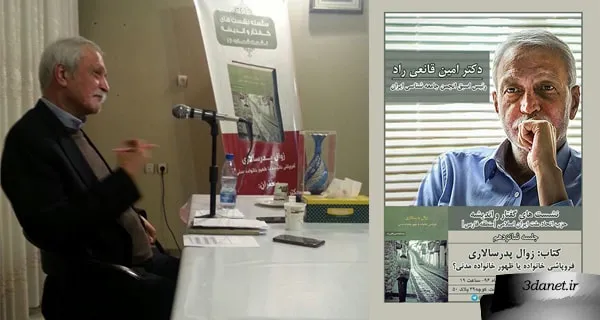
A lecture by Dr. Mohammad Amin Ghaneirad among a gathering of cultural and intellectual figures
Transcription and editing of the text: Hadi Tabatabaei
.
.

Discussion1 comments
دلیل خشونت ورزی در اسلام ومسلمین وجود چنین ظرفیتی در منابع دینی میباشد قران که یگانه ستون اصلی اسلام است پراز ایاتیست که فرمان قتال با کفار ومشرکان ومنافقان را میدهد وچون مسلمین قران وایات انرا تخته بند زمان ومکان وقوع متن نمیدانند ومعتقدند که این ایات در پس تاریخی بودن خود پیامی فرا تاریخی دارد که مثلا غلبه اسلام بر کفر وگستراندن اسلام در تمام کره زمین است از اینرو میپندارند که بعنوان یک مسلمان موظفند در این جهت بکوشند وهر کدام بنا به وضعیت وموقعیت خود راهی را جهت رسیدن به چنین هدفی برمیگزیند یکی با توان تبلیغی دیگری با نظامیگری در جهت یکسان سازی دینی در تمام کره زمین حرکت میکنند