Religion
The Functions of Religious Rituals and Rites, Mostafa Malekian
Mostafa Malekian examines the individual functions of religious rituals across five dimensions of personality and enumerates nine functions for prayer. The meaningfulness of these rituals depends on the more pronounced presence of these functions in one's relationship with God.
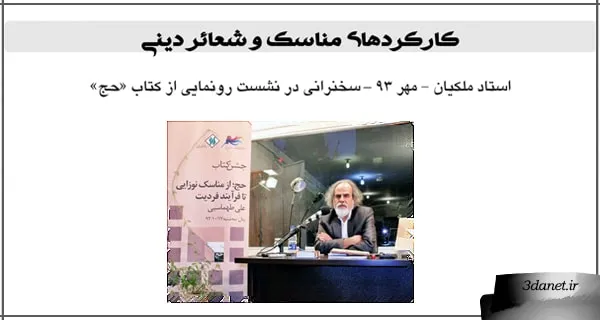
“Prayer” in particular, and “rituals and rites” in general, have a series of social functions that I will not address on this occasion. Here, I will confine my discussion solely to the individual aspects, or better put, the individual functions of prayer and the performance and observance of religious rituals and rites. To give my exposition a logical structure, I will refer to a simple point in psychology.
The personality and character of every human being is composed of five domains; the first three are called “inner domains” and the last two “outer domains.” The fact that each of us has a unique and irreplaceable aspect is because we differ from one another in these five domains.
.
The Inner Domains of the Human Being
- The domain of opinions and beliefs: Certainties, suppositions, doubts, conjectures, estimates, assessments, arguments, and so on, all represent the first domain of the human being.
- The domain of feelings, emotions, and affects: Loves, hatreds, friendships, enmities, tranquility, anxiety, worries and concerns, hopes, despairs, joys, sorrows, angers, satisfactions, fears, terrors, and in short, anything within our being that ultimately deals with “pleasure and pain”—that is, ease on one hand and suffering and torment on the other... The feeling, emotional, and affective aspects of the human being represent his second domain.
- The domain of will and wants: The human being’s goals, ideals, motives, intentions, and desires represent the third inner domain of the human being.
The Outer Domains of the Human Being
In addition to these three, the human being also possesses two outer domains:
- The domain of speech
- The domain of action
These five domains constitute the unique personality and character of “you, him, and me.” On the other hand, every human being, in their “normal or ordinary moments of consciousness” (as psychologists put it), is engaged in one of these four relations: either in relation with “God,” or in relation with “the self,” or in relation with other “human beings,” or in relation with the surrounding “nature.”
These relations are “mutually exclusive in absence” but not “mutually exclusive in presence.” That is, it is possible that at a single moment we are engaged in two, three, or four of these relations, but it is impossible for a moment to exist in which we are engaged in none of these four relations. Of course, the fact that we are engaged in at least one of these four relations depends on the conditions of the “normal consciousness” of the human being. (A state in which we possess one of these four characteristics: first, we are alive and not dead; second, we are awake and not asleep; third, we are conscious and not in a state of coma or unconsciousness; and fourth, we are not dead drunk.)
In addition to this one state of “normal consciousness,” psychologists have sometimes referred to 18, sometimes 19, sometimes 20, and sometimes 21 states of “abnormal consciousness.” For example, when we are asleep, when we are dreaming, when we are being hypnotized, when we suffer from epilepsy, when we are in a state of mystical unveiling and intuition, and so on... all of these are abnormal states of human consciousness, and here “abnormal” only means “unusual” and carries no negative value judgment beyond that.
The human being, under conditions of normal consciousness, with his “five domains” in confronting these “four” parties, can have 20 types of relations. That is, with “God” five types, with “the self” five types, with other “human beings” five types, and with the surrounding “nature” he can also arrange five types of relations. In our discussion, however, disregarding the three other parties of relation, we will speak only of the relation with “God.”
Because the subject here is prayer and rituals and rites, in which we establish a relation with “God”; sometimes a doctrinal relation, sometimes a feeling, emotional, affective relation, sometimes a relation of the category of want, sometimes a verbal relation, and sometimes a relation of action.
On the other hand, psychologists today sometimes refer to the three inner domains of the human being as the "mind" and the two outer domains as "behavior." Hence, it is observed that in textbooks, "psychology" is defined as "the science of studying and investigating the 'mind' and 'behavior,'" where mind and behavior here refer to those three inner and two outer domains.
I, too, for the sake of brevity, will use these expressions here and say: Thus, in rituals and rites, and in the state of praying to God, we sometimes have a mental connection (cognitive, or emotional-affective-sentimental, or volitional) and sometimes a behavioral connection (verbal or active).
The Nine Functions of Prayer
With these explanations, to now examine the functions of prayer, it must be said that the addressee of a person's prayer—whatever name we call it (whether God, Being, the Soul of the World)—has four functions in the "mental" area and five functions in the "behavioral" area.
If this criterion is correct, according to the opinion of researchers in the psychology of religion, in this examination we can understand to what extent our prayers are meaningful or meaningless. The less these nine functions are present in my prayer, the more meaningless, unfounded, futile, and absurd my prayer is; and the stronger, more intense, and deeper the presence of these nine functions, the more meaningful my prayer, or fundamentally the rituals and rites I perform, will be.
The "Behavioral" Functions of Prayer
I will first address the behavioral functions:
1. Confession
The first thing a person does in prayer is "confession." Not only in the sense used in Persian today regarding error or sin, but in a broader sense: namely, recognizing and recounting one's own state and condition.
One type of this recognition is, of course, recognizing one's sins and errors and recounting them. The second type is confessing one's strengths and weaknesses. The third type is confessing one's limitations, both in terms of knowledge and science, and in terms of ability and power. The fourth type is confessing the undesirable events and accidents that have befallen a person, causing them distress, anxiety, sorrow, or despair, robbing them of inner contentment, or rendering their life hollow and meaningless.
2. Praise and Adoration
After "confession," the second thing a person does in prayer is the "praise and adoration" of the Soul of the World, the Transcendent, the Ultimate, the Truth of Truths, God, or any other expression. This praise and adoration may occur in three ways.
a) Because that being has bestowed blessings upon "all" human beings,
b) Because that being has bestowed specific blessings and favors upon "me" as a particular person, and
c) Because the praise and adoration is neither for the blessings God has bestowed upon humankind, nor for the blessings and favors bestowed upon me personally, but for His own beauty, for the splendor, glory, or majesty that a person sees in Him. In fact, these three revelations to the person about the addressee of their prayer become the motivation for praise, adoration, and glorification. As we see in the saying of Ali ibn Abi Talib: "I found You worthy of worship, so I worshipped You," meaning, since I have found You praiseworthy, I worship You.
3. Gratitude
The third thing a person does in the state of prayer is "gratitude." Gratitude is, in fact, a kind of appreciation or "thankfulness" for existence, even if we express it as shukr in the language of the Abrahamic religions. Appreciation means I know the value of the good things that "existence" has given me. I both know their value and I fulfill their due.
In fact, gratitude and thankfulness are a combination of two things: first, appreciation, and second, the fulfillment of obligation. When a person discovers a blessing that existence has bestowed upon them and wishes to be duly grateful and appreciative of that blessing—as stated in the psychology of religion and spirituality—a person is considered “appreciative” if they undertake three actions: first, to rejoice in possessing that blessing (both inner joy or “cheerfulness of heart” and outer joy or “cheerfulness of countenance”; the reason mystics, in Avicenna’s phrase, are called “cheerful of heart and countenance” is that they are truly appreciative of existence, the soul of the world, or God); second, to make the best and most optimal use of this blessing; and third, to feel ever greater compassion toward those who are deprived of this blessing. For example, if we truly appreciate the blessing of sight, when facing a blind person, instead of boasting and taking pride in our own endowment, we feel compassion for their deprivation. One reason human beings do not feel compassion for one another is that they are not appreciative of the blessings they themselves enjoy and of which others are deprived.
4. Supplication, or the Expression of Request
The fourth thing a person does during worship is to make a request of the soul of the world for themselves; this is what is called “supplication” (du‘ā), and it occurs when an individual becomes aware of their own shortcomings, faults and imperfections, sins and errors, and asks the soul of the world and existence for the fulfillment and redress of these imperfections, errors, and sins. We see that the first three parts of worship, which are a form of whispering, stating one’s condition, and describing, should be termed “intimate prayer” (munājāt), and only the expression of request should be called “supplication” (du‘ā).
5. Intercession
The fifth thing a person does in worship is “intercession” (shafā‘a) on behalf of another. Here, the individual has no request for themselves and only wishes to place themselves as a mediator with God and ask something of Him for others. The difference between intercession and supplication lies precisely in this point.
As stated, through our speech and actions during worship or the performance of rituals and rites, we fulfill these five behavioral functions.
The “Mental” Functions of Worship
But in our “mind” and within ourselves, we also undertake four actions during worship. These four functions are usually common in non-religious and non-denominational schools as well; that is, schools belonging to non-religious or non-denominational mysticism.
Today, even in secular and non-religious psychotherapies, these four practices are recommended, which are: reflection, concentration, meditation, and contemplation.
In fact, worship is desirable only when accompanied by these four practices, and to the extent that it is not, the act will be a futile one.
1. Reflection
Reflection (ta’ammul) – meaning a retrospective look at one’s entire past life. A look backward, as far as one’s memory permits, while being accompanied by a kind of value judgment and possessing a kind of firm resolve. For instance, seeing oneself as having been afflicted by numerous preoccupations in the past and resolving to reduce those preoccupations. In the words attributed to Imam Sajjad, the fourth Imam of the Shi‘a: “O God, make our many concerns one concern.” In Kierkegaard’s phrase, “make us single-minded,” for we are of many minds, or at least of a divided heart.
Depending on whether, in the course of reflection, the individual arrives at a positive or negative value judgment regarding what they have done in the past and the effects and consequences it has entailed, new resolves and decisions arise within them. A positive value judgment leads us to repeat that positive act, and a negative value judgment leads us to refrain from repeating it. Thus, in Sa‘di’s precise phrase from the preface to the Golestan, reflection can be considered “contemplation” (ta’ammul) upon days past; a contemplation accompanied by value judgment.
2. Concentration
Concentration (تمرکز) - In this stage, through reflection, a person has concluded that they face a problem to solve or a difficulty to remove in life. Concentration is turning with one's whole being toward solving a (theoretical) problem or removing a (practical) difficulty, so that life may find a system or recover its lost system. In ethical and jurisprudential books, as we have seen, thinking about such matters after worship has also been encouraged.
3. Meditation
Meditation (مراقبه) - In the stage of meditation, a person's entire attention is directed toward recognizing their "true self" from among false and illusory "selves." It is quite possible that a person, from the beginning to the end of their life, may not even once encounter their "true self" and may have constantly dwelt with their false and illusory selves.
This recognition is of great importance both in modern psychology (especially in the psychology of American pragmatist psychologists) and in the traditions of the sages and mystics of religions and denominations. In meditation, we "efface" everything we consider our "true self," yet we still see that: we are. Because if that were our "true self," with its effacement, "we" too should have been effaced.
It is in the course of meditation that we recognize the "true self" from false "selves," or, closer to the point, we recognize the "true self" from the "possessions" of the true self. (For instance, realizing that one's body, mind, psyche, and social identity are not their "I" but merely among their possessions.)
In other words, meditation or "مراقبه" is a search within oneself to reach the "self," regardless of the form it takes (Buddhist or non-Buddhist meditations).
- Contemplation and Observation
Contemplation (نظر و مشاهده) - In the sense that a person looks at existence without their own interests. It is very difficult for the innocent report of a person's external senses to be perceived free from their inner attachments. To refrain from asking, in encountering anything, "What use is it to me?" This type of encounter is called an interested viewpoint, or a viewpoint accompanied by attachment. Contemplation, in contrast, is "the art of seeing the world disinterestedly." That is, to behold the world regardless of the relation and connection it establishes with me, and to set completely aside what profit or loss it brings me, what use or necessity it has for my existence, what it does to my rivals or companions, whether it advances or sets me back, strengthens or weakens me. In another expression, to look at the world with a detached heart, just as such a gaze upon existence has been attributed to God, who, being without profit or loss, is capable of a gaze free from profit and loss. In contemplation, we gradually move toward attending to the "self" of an individual, instead of seeing what "work" that individual can do for us, and toward seeing what a thing itself is, instead of paying attention to its "function."
If one can be thus, then according to the sages and founders of religions and denominations, the problem of "evil" is at least erased from my world. For seeing evil in the world arises from a person's interested viewpoint, and if they attain an uninterested or "detached" viewpoint, they are delivered from it.
Thus, in encountering prayer or rituals and rites, as we have seen, we find five behavioral functions and four mental functions. By paying close attention to these nine functions, one can encounter these instances here and there in works such as the late Shariati's Hajj travelogue or the present book by Mr. Tahmasbi; even if, at first glance, the mind of a superficial reader is unable to discern it.
.
.
PDF file of The Functions of Religious Rituals and Rites
Download from Server 1 | Download from Server 2
.
.
Audio of The Functions of Religious Rituals and Rites
Download from Server 1 | Download from Server 2
.
.
The Functions of Religious Rituals and Rites
Mostafa Malekian - Mehr 93 – Lecture at the book launch event for “Hajj”
Sources: Mostafa Malekian's Telegram Channel
Etemad Newspaper, Issue 2870, dated 21/10/92, Page 11 (Thought)
.
.


Discussion1 comments
مواجهه بچگانه با مفاهیمی چون پلورالیزم(نظریه اتاق) مقدمه مواجهه ساده انگارانه و راحت طلبانه برخی مدعیان داخلی با مفاهیم جدید علوم انسانی که سالهاست در آکادمی های دنیا مورد تحقیق قرار گرفته است، یکی از معضلات جامعه ایرانی است که دلالیل گوناگونی دارد (خصوصاً دلایل سیاسی). یکی از این مفاهیم، واژه "پلورالیزم" است؛ که به کثرت گرایی معرفتی مشهور است و البته دارای لایه ها و معانی مختلفی است. اصل بحث جان هیک یکی از مبدعان و مطرح کنندگان اصلی این نظریه است. نگارنده در اینجا نه قصد دارد، پلورالیزم را توضیح و تبیین کند و نه بی جهت آن را قابل دفاع بداند؛ بلکه هر نظریه ای باید با جدیت و موشکافی، توسط اهل تحقیق و افراد مستقل از سیاست، مورد بررسی قرار گیرد. اما درد نگارنده چیز دیگری است. خلاصه ای بسیط از عقیده پلورالیزم پلورالیسم دینی یعنی اینکه حقیقت مطلق و نجات و رستگاری را منحصر در یک دین و مذهب و پیروی از یک شریعت و آئین ندانیم بلکه معتقد شویم که حقیقت مطلق، مشترک میان همه ادیان است و ادیان مذاهب، شریعتها و آیینهای مختلف، جلوههای گوناگون حق مطلقاند و در نتیجه همه ادیان و مذاهب، به نجات دست مییابند. در دنیای غرب، در برابر پلورالیسم دینی، دو مکتب فکری دیگر، با عنوان انحصارگرایی و شمول گرایی نیز مطرح است. انحصار گرایی بر آن است که راه نجات و رستگاری در مسیحیت است. نه از آن روی که حقیقت ناب تنها در آئین مسیحیت یافت میشود بلکه از آن روی که تجلی الهی، منحصراً در مسیح واقع شده است. از دیدگاه شمول گرایی نیز فقط یک راه رستگاری وجود دارد و این راه خاص، صرفاً در یک دین و مذهب خاص، قابل شناخت است و در عین حال، همه میتوانند در این راه قدم بگذارند هر چند که به شرایط خاصی که در آن دین مطرح شده است گردن ننهند (هر کس میتواند رستگار شود هر چند از اصول اعتقادی دین حق چیزی نشنیده باشد). جرح نگارنده برخی آنچنان ساده انگارانه (و بچگانه) با پلورالیزم مواجه می شوند که انسان متأسّف می شود. مثلاً می گویند: 1- مگر می شود حقیقت دو تا باشد؟! 2- مگر می شود دو نظریه متضادّ، هر دو درست باشند؟! 3- مگر امکان دارد، دو ضربدر دو، به خاطر معرفت شناسی عده ای، 5 شود؟! 4- خدا در قرآن سخن از صراط مستقیم کرده، پس پلورالیزم یعنی چه؟! و ... به این افراد باید گفت که شما قضیه را خیلی ساده می بینید و تا زمانی که چنین مفاهیم عمیقی را با سطحی انگاری از سر خود باز کنید، نه تنها توفیقی بدست نخواهید آورد بلکه موجبات انزوای خود را فراهم خواهید آورد. به نظر شما، جناب جان هیک آنقدر نادان بود که نفهمد دو قضیه از هر جهت متضاد (یعنی به احتساب حمل های فلسفی مانند قوه و فعل و حمل های شایع صُناعی و اوّلی)، نمی توانند هر دو درست باشند؟ یعنی اینقدر نمی فهمید؟! تبیینی از پلورالیزم مقدمه عقیده به پلورالیزم، روا دانشتن ولنگاری معرفتی و بی در و پیکر بودن معرفت شناسی نیست؛ بلکه برعکس احترام به تفکر و معرفت بشری و بستن راه تکفیرها و تحدیدهاست. اینکه عده ای، به محض باز شدن باب گفتگو در باب پلورالیزم یا سکولاریزم و ...، با الفاظ احساسی و غیر علمی، سعی در انحراف ماجرا دارند، کاملاً ناصحیح است. نظریه پلورالیزم(به فرض غلط بودن)، حتی قبل از جان هیک، به نوعی در بین عرفای سراسر جهان سابقه داشته است و پس از مظرح شدن نیز آنقدر ساختارمند و قوی ارائه شد که اذهان متفکران جهان را به کاوِش علمی واداشت و جای خود را باز کرد. پلورالیزم، حتی در برخی لایه ها(مانند پلورالیزم نجات) توسط برخی متدیّنان اسلامی(حتی از نوع سنت گرا) مورد پذیرش قرار گرفته است و حتی مستند قرآنی هم برای آن اقامه شده است: از مؤمنان و یهودیان و مسیحیان و صابئین، هر کس که به خداوند و روز بازپسین ایمان آورده و نیکوکاری کرده باشد، پاداششان نزد خداوند [محفوظ] است و نه بیمی بر آنهاست و نه اندوهگین میشوند. (بقره:62, ترجمه جناب خرمشاهی) اصل بحث اما آنچه که نگارنده در پی آن است، فراتر از پلورالیزم نجات است؛ یعنی قصد نگارنده تبیینی هرچند ساده، از پلورالیزم در معرفت شناسی و حقّ یابی است (قبلاً برخی مثالی را از فیل در تاریکی بیان کرده اند +). تصور کنید در گوشه اتاقی هستید که یک نفر روبری شما، در آنسوی اتاق نشسته است. از او بخواهید تا از زاویه دید خود، اتاق را توصیف کند. توصیف او به احتمال بالا، کاملاً صحیح به نظر می رسد چرا که هم چشمان او سالم است و هم امری نیست که در آن اختلافی وجود داشته باشد چون کاملاً امری ظاهری است. حال توصیف خودتان را برای او بیان کنید. توصیف ما نیز به احتمال زیاد درست است. اما سوال اینجاست که توصیف شما با توصیفِ نفر روبرویی یکی است؟! آیا امکان دارد دو نفر در زوایای مختلف، توصیف یکسانی از "حقیقت اتاق" ارائه بدهند؟! آیا اشکال هندسی اتاق و پدیده هایی که در اتاق می گذرد، از دید شما و او یکی است؟! مسلّماً خیر! (فرض نگارنده بر آن است که تنها مورد اختلاف شما و نفر روبرویی، زاویه دید است نه تاثیر پیش فرض های قبلی، آداب و رسوم، و ...). حال جای سوال است که این دو نگاه و دو تصویری که در ذهن شما و ذهن فرد مقابل از اتاق، شکل گرفته است، کدامیک حق است و کدامیک باطل؟! قطعاً با توجه به آنچه تاکنون آمد، هیچکدام باطل محض نیست؛ اما حقیقت محض هم نیست. به عبارت دیگر، می توان هر دو دیدگاه را با توجه به شرایط هرکدام از افراد، به نوعی حقّ تلقی کرد؛ یعنی هر دو توضیف، در عین اختلاف، درست اند و گویای حقیقتی از اتاق. تبیین فلسفی این موضوع آن است که حقّ، هیچگاه عریان در جهان ذهن و معرفت شناسی ما، وارد نمی شود؛ بلکه لایه هایی از آن، و متناسب با شرایط مختلف بر ما عرضه می شود که نه می توان آن را باطل محض انگاشت و نه به دلیل پوشیدن لباس هایی از جنس های مختلف، حقّ محض. اینکه عده ای اصرار دارند که در هستی تنها یک حقّ وجود دارد، و یک صراط مستقیم هست (که نگارنده مدافع آن است)، دلیل کافی بر ردّ نظریه پلورالیزم نیست؛ چرا که توجه ندارند که حقّ تاکنون به دست چه کسی فتح شده است و در کجا، خود را نازل کرده است؟ حق همواره در لایه ها، زاویه ها، فرهنگ ها، منش ها، و انواع و اقسام مدل ها، خود را عرضه کرده است و نمی توان در جهان بُرون، انتظار داشت تا حقّی که کثرت پذیرفته است، واحد باشد! نقد و جرح شما به این مطلب منتشر خواهد شد... .