Philosophy
The Journey of Life in Jung and Kierkegaard
Life's journey is a passage from social masks toward the authentic self. Kierkegaard charts this path in three stages—the aesthetic, the ethical, and the religious—while Jung, from a more psychological perspective, seeks the realization of authenticity in the movement from the parental and societal ego toward the spirit.
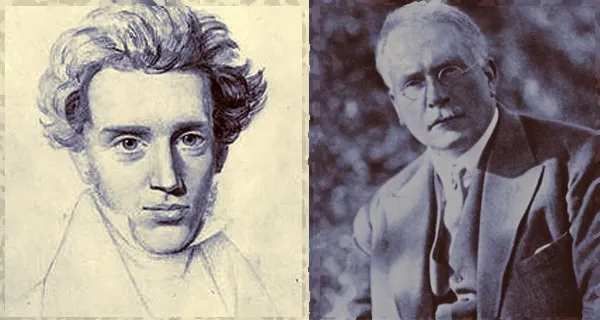
I doubt anyone would disagree that from birth to death we pass through different phases, and our feelings and moods in these phases differ from one another and are sometimes at odds. It is as if we are in search of something lost, which, although we cannot explain it clearly to anyone, we perceive its presence and existence in a completely immediate and direct way, and sometimes we become so estranged from it that we mock those very states. This contraction and expansion can be well traced in certain periods of our lives.
In any case! Those aforementioned, especially those who emphasize the subjective dimensions of the human being, believe that this lost thing of us humans in this endless, cyclical, and non-linear process of becoming is authenticity, something that is constantly pursued in a journey without destination and without end. They believe that each of us, apart from the tribe, has a meaning and an authenticity, the discovery and crystallization of which is the goal of our living—what they call the true self, something that can be formulated in the rich literature surrounding individuality and individuation. In an expression I am very fond of: the realization of our first name!
We initially find our identity from being in the tribe (something like our family name). From who our father and mother are, and as we go further, we carry other incidental burdens on our shoulders, such as academic degrees, job titles, specializations and skills, our knowledge, and dozens of other things! We are all these things we have acquired over all these years, and yet we are none of them. It is as if each and every one of us is composed of an essence. Something beyond all these accidents! Although we are, for example, a manager, a professor, a student, and so on, none of these accidents are synonymous with that original essence. It is as if these masks become tools to hide that essence behind them. Although we do not truly know that essence, we unconsciously know that the consequence of its crystallization brings dangers and threats for us, so it is better to wisely avoid it. A minority of us average people find the opportunity, in an unrepeatable moment, at the peak of exhaustion and weariness from carrying all these masks, to decide to meet our real self!
The merchant of timid nature, his soul of glass / In seeking, finds neither profit nor loss
Nay, he finds loss, for he is deprived and abased / His light is found by one who devours flames
This requires unceasing courage, and after that, everything changes. It is as if the chains of attachment are severed from our soul, and we find the opportunity for liberation and detachment. It is from this point onward that we become clear, pure, and unadulterated.
Since this note is intended to address the stages of becoming authentic comparatively in the literature of Jung (1875–1961) and Kierkegaard (1813–1855), I am setting aside our own excellent Iranian-Islamic sources; otherwise, there is undoubtedly a vast literature surrounding the concept of spiritual wayfaring (suluk).
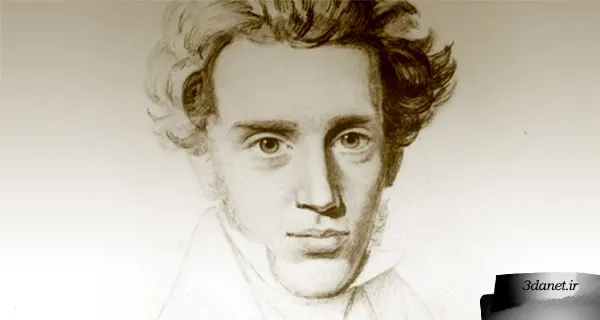
Kierkegaard explains this wayfaring in three stages and mentions heroes for each, which somewhat relieves me of further explanation.
In his book Either/Or, he explains the first two stages, and in the book Stages on Life's Way, he explains the final stage. He believes that although all people are mounted on a steed, they fall into two groups. Some are at the mercy of the steed's will, and others hold the reins of the steed's will. With this explanation, the fate of the majority of average people becomes clear. Only a minority are consciously aware of what they do; in a sense, the majority do not even set foot in any of these stages.
After that self-consciousness, the seeker first experiences the aesthetic stage, which consists of a constant, variety-seeking pursuit of pleasure, and the slightest suffering or hardship overwhelms him. The repetition and boredom of this pleasure-seeking, even if it is varied every day, eventually wears him down like the stone of Sisyphus. He realizes he has everything and has done everything, but he does not feel well. The hero of this stage is Don Juan. Weary of all this unbridledness, he pursues a passionate and eager devotion to a duty. The hero of the second stage, which is the ethical stage, is Socrates, who ultimately gives his life for this very duty. In the next stage, if the seeker can, through a choice and a gamble, to use Rumi's term, experience the leap of faith, he enters the religious stage. His explanations in this stage are truly exciting. In this stage, the seeker passionately and recklessly surrenders to God's command. In his terms, the knight of faith (of this stage) is Abraham. One who, in his words, clashes with ethical principles and, with a loving passion and vitality, submits to what he himself knows to be God's command and receives it without mediation. (This stage, without understanding its details, also has a great propensity for sliding into Daeshism.)
In these three stages, the seeker is faced with:
mortal pleasures,
ethical principles,
or an act of faith.
Although this division contains flashes of genius, in my opinion, Jung, who at least chronologically stands on Kierkegaard's shoulders, is more precise, more illuminating, and more in accordance with our human psyche.
Self-consciousness is also one of Jung's main presuppositions. He explains authenticity through a concept similar to independence in liberation from the mother-womb complex. He explains that we humans, by the nature of our creation, constantly live from the beginning to the end of our lives under the shadow of an authority figure that gives us security. After leaving the mother's womb, until we inevitably enter the second womb around the age of six or seven, we are in the shadow of the parents' ego. They are the ones who define good and bad for us, and we spend all our effort trying to become what they imagine as desirable. After entering school, the audience for this effort of ours expands from parents to teachers and other authorities we find in the world, but the nature of the matter does not change; this is the great shadow of the world's ego. In these two stages, whatever we are, even the best and most admirable being on earth, we are not ourselves and are entangled in the mother-womb complex. He believes that the vast majority of people remain in these very two stages. Around the age of thirty-five, or midlife, almost everyone experiences a depression and a feeling of getting on the slide toward death, feeling they have squandered their entire past on futility. A minority, with self-consciousness, find the courage to migrate from the tribe and can attend to what their true self desires and what their soul needs. This stage is under the control of the true self or the Self ego (the self or soul); the vast majority of self-actualizations and lasting, and possibly authentic, events that have occurred in the human world can be traced to this stage. But this stage, too, around the age of 55, is questioned by the formidable inquiries of the seeker's mature soul as to whether what he has chosen for himself has been authentic or whether another authority must be found for this validation. This stage, which is not so simple to explain, he calls the God-ego. This stage is very similar to the ages around 10-15 that the vast majority of humans experience. A God-seeking without reason or argument, entirely immediate and inexplicable, and if well understood, it well describes ((and indeed, every Zoroastrian becomes devout in old age)).
.
.
The Journey of Life in Jung and Kierkegaard
Author: Naeem Ebrahimian
Ninth of Azar, Ninety-Five
.
.
References for further reading:
For listeners:
On Kierkegaard, I recommend the 12-session course by Soroush Dabbagh, and on Jung, the course on the second half of life by Soheil Rezaei.
For readers:
On Kierkegaard, for detailed study, the two sources mentioned in the note itself, or any history of philosophy book, especially Copleston's volume from Fichte to Nietzsche in the fine translation by Dariush Ashouri; and on Jung, Alchemy and Psychology.
.
.


Discussion0 comments
No comments yet; let yours be the first voice.