Philosophy
The Three Stages of Human Life from Kierkegaard's Perspective
Kierkegaard posits three stages of human life—the aesthetic, the ethical, and the religious—from which one chooses through a momentous decision. In the religious stage, the divine command takes precedence even if it violates ethical norms; the sacrifice of Isaac by Abraham is its exemplar.
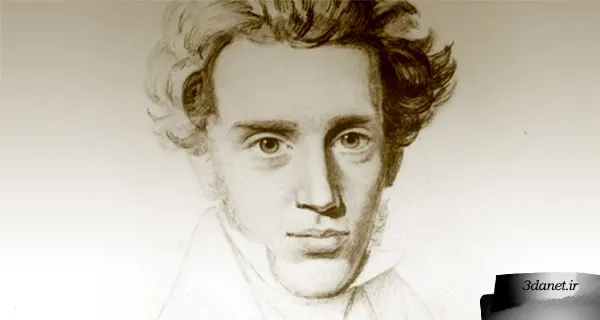
Kierkegaard says that every human being, in any case, lives in one of these three stages of life. 1. The aesthetic stage; the hedonistic or aesthetic. 2. The ethical stage. 3. The religious stage, or living passionately. One can move from the first stage to the second or third, but it is possible for a person to remain in one stage until the end of life. But let us see what the difference between these three stages is?
.
The Three Stages of Human Life from Kierkegaard's Perspective
Kierkegaard says that every human being, in any case, lives in one of these three stages of life. 1. The aesthetic stage; the hedonistic or aesthetic. 2. The ethical stage. 3. The religious stage, or living passionately. One can move from the first stage to the second or third, but it is possible for a person to remain in one stage until the end of life. But let us see what the difference between these three stages is?
1- Kierkegaard says that sometimes the ruling principle of human life is pleasure; that is, one lives in such a way that one's actions and reactions are solely for the sake of gaining as much pleasure as possible. In this state, the person lives in the aesthetic stage. In making choices, they choose the action that provides them with more pleasure, and the criterion for choice is nothing but pleasure. What is meant by pleasure here are the pleasures that the ancients called bodily pleasures — such as the pleasure one derives from eating, drinking, and satisfying the sexual instinct.
2- But sometimes a person does not seek pleasure; rather, they seek to live in such a way that they do not violate ethical rules, and observing these rules is important to them. They follow the Islamic motto: "Speak the truth, even if it is against you." They tell the truth, whether it is pleasurable or not, and the same applies to other ethical rules such as honesty, keeping promises, returning trusts, serving people, humility, and so on. In this stage, they are said to be an ethical person.
3- The third stage is when one is subject neither to pleasure nor to ethical rules, but to divine command and prohibition. What God says is more important to them than anything else. From this, it is understood that Kierkegaard believes divine command and prohibition are not always in accordance with ethical rules. A person who is religious does not concern themselves with ethical rules and follows divine command and prohibition. If divine command and prohibition are in accordance with ethical rules, standards, and laws, so much the better; and if not, there is no problem. But can divine command and prohibition be contrary to ethical standards?! He says: Not only can it be, but it is so, and indeed it must be so. Divine command and prohibition must sometimes violate ethical rules. His famous book, entitled Fear and Trembling, which is his literary-philosophical masterpiece, is in proof of this very claim that God's command and prohibition sometimes violate all ethical rules. In this book, the story of Prophet Abraham's mission to sacrifice his son Ishmael (according to Islamic texts, and Isaac according to Old Testament narratives) is beautifully depicted. According to him, the contradiction in Abraham's act cannot be resolved with calculative reason. Abraham is to be understood with a category other than reason, and that other category is nothing but faith and his passionate or religious stage of living.In this book, Kierkegaard wants to say why Ishmael and Abraham did not object even a little, saying, "O God, killing a person is against ethical rules." Because they were not living in the ethical stage at all, but were living in the passionate stage. The act of Abraham and Ishmael greatly contradicts ethical rules; regarding the act of Prophet Abraham, the first problem is: O God, how is it that on the path to You, if someone wants to attain union, they must kill another person, and unless they become a murderer, they cannot reach You? A greater problem is to say that on the path to reaching God, a person must give up their dearest beloved. What kind of path is this, where a person must confront innate desires (such as love for one's child) that God Himself has placed within them? For what crime should they seize their child by the throat and say, "I want to kill you"? If asked, what should they say? More importantly, Ishmael could have said, "We have committed no sin for our father to want to reach God. My head must go so that his purpose is achieved." If it had been said, "O Abraham! Now that you want to reach Us, submit yourself to be killed," the problem would have been less. But it is said, "Abraham, if you want to reach God, you must consent to the killing of another."
But why did not a shred of these considerations trouble the noble spirit of Abraham, nor the noble spirit of Ishmael? Because they simply did not understand ethical rules. These contradictions are contradictions with ethical rules. They were lovers of God; the language of the lover's state is such that whatever the Beloved commands, that very thing must be done. Especially since the story of Abraham is recounted very briefly in the Quran, but in the Torah it depicts in detail and tragically the states of the father and son, mother and child, and so on, and this matter was deeply penetrating in Kierkegaard's spirit, and therefore the very title he gave the book, Fear and Trembling, expresses that same concept and shows that God's command and prohibition are not subject to ethical rules.
There is another example in the Quran: the story of the Righteous Servant and Moses. The Righteous Servant (and according to narrations, Khidr) beheads a man because if he were to remain alive, twenty years later he would kill his father. From an ethical standpoint, this is retribution before the crime. But in this story, God wants to test His lover and show Moses the stage beyond ethical rules; therefore, ethical rules must be transgressed, and Moses, in this test, cannot tolerate the Righteous Servant's deed and protests against it. The difference between these stages is the degree of tranquility that arises in each of these stages for the possessor of that spirit. In the stage of living amorously, or the religious stage, there is complete assurance for the individual. Kierkegaard, in explaining this assurance or the state of the tranquil soul regarding Abraham, has truly written very beautifully. But unfortunately, this book has been translated very poorly into Persian.
Now, what he means by "choice" is not that for every action a person makes a particular choice, but rather he believes that every human being, depending on their own characteristics, makes one great choice in connection with one of these three stages. For example, if one chooses the aesthetic stage, they organize and choose their other actions and behaviors in accordance with this general pattern, and likewise for someone who chooses the other stages. So, in philosophical terms, we primarily and essentially accept and choose one of these three stages, and secondarily and accidentally, the rest of our actions are realized.
Some human beings are in the aesthetic stage, some in the ethical stage, and some in the amorous stage. The requirement of self-knowledge is that each person see in which stage they are living. Perhaps the meaning of "self-knowledge is the best of knowledges" is precisely this point: that a person realizes their stage of life and does not deceive themselves. Jean-Paul Sartre, precisely in opposition to Kierkegaard, believed that we make a choice about every particular action, and this is the most important difference between Sartre and other existentialist philosophers. Kierkegaard believes that most people live in the first stages of life. Clothing, housing, food, recreation, the pursuit of knowledge; the ultimate end for none of the people is any of these, but rather the end is the pleasure that results from each of them.
.
.
The Three Stages of Human Life from Kierkegaard's Perspective
Mostafa Malekian, History of Western Philosophy, Vol. 4, p. 85, 1990
Selection of this text by Mostafa Malekian's Channel
.
.

.webp)
Discussion0 comments
No comments yet; let yours be the first voice.