Psychology
The Ladder of Inference: Why Do We Jump to Conclusions?
We mistake our beliefs for reality and leap to conclusions based on cherry-picked data. The 'Ladder of Inference' reveals how we make decisions so that, by avoiding hasty judgment, we can make sounder choices.

I recall a story told by one of the country's professional speakers, who runs various courses on personal empowerment and motivation, about one of his seminars. At that seminar, the speaker began his session with his usual enthusiasm and energy. Almost everyone started listening to him with interest and seriousness. At the beginning of the speech, his attention was drawn to an individual who, unlike the rest, seemed to pay him no attention and was restless and fidgety in his seat, constantly shifting around. The speaker, assuming that this person was inattentive to his talk, became preoccupied, and under the influence of that audience member, he could not deliver the speech as he had intended until the end of the session. After the session ended, that participant made his way to the speaker to talk to him, and the speaker, who was upset with him, said sarcastically: "It seems you had no interest in the topic of the speech?" The man replied with distress: "No, my dear sir, I had a severe toothache and despite my unpleasant physical condition, I made it to your session with great difficulty just to listen to your talk, and throughout the session, I was writhing in pain from my toothache!"
You have certainly been in situations where your words or behavior were interpreted in a way you did not intend, or you made a judgment about others that was not correct. The reality is that we live in a world shaped by our perceptions and beliefs, beliefs whose validity we often never test. We accept these beliefs because they are based on conclusions drawn from our past observations and experiences. We think our beliefs are the reality itself, and that this reality is very clear and obvious. We think our beliefs are derived from real data, and that the data we select to reach conclusions is the real data itself!
In today's business world, where managers are under pressure to make decisions quickly, we need our decisions and actions to be based on existing evidence and facts, not our perceptions and beliefs. The Ladder of Inference is a tool that can help managers better understand the mental process of decision-making and reaching conclusions, and to think in a way that avoids jumping to wrong conclusions quickly. You can also use this tool to articulate your own mental decision-making process more explicitly to others, or to question the inferences and decisions of others.
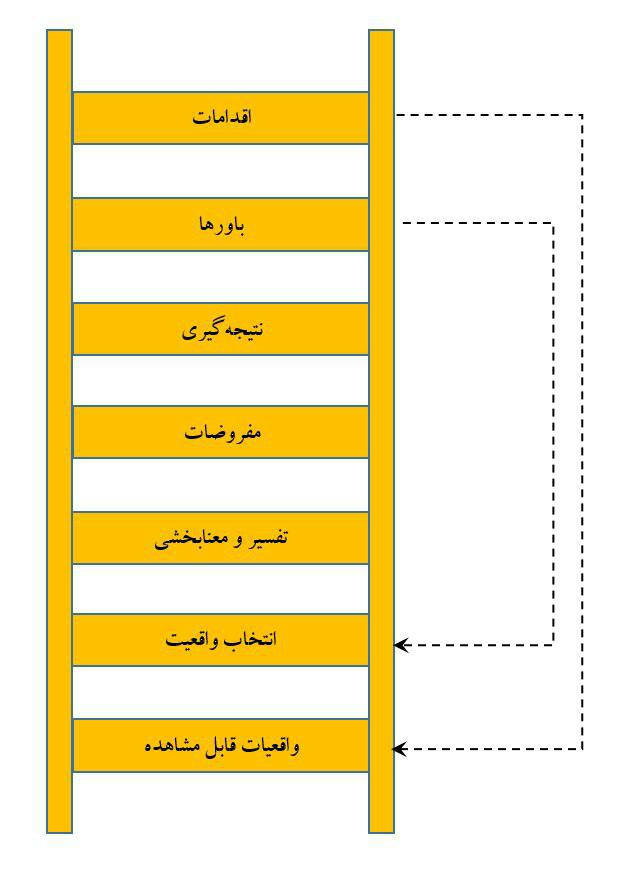
The Ladder of Inference was first introduced by organizational psychologist Chris Argyris and was emphasized in Peter Senge's book The Fifth Discipline. This model suggests that each of us, in our minds, climbs a ladder to make a decision (Figure-1), a process which, of course, occurs subconsciously in many cases.
On the first rung lies observable experiences and data.
Our mind selects a subset of the data and facts for analysis.
The mind interprets the data and events.
It adds its own assumptions to them.
Based on the assumptions and collected data, it draws conclusions.
Based on the conclusions, it updates its beliefs.
It acts based on what it thinks is correct.
In the example I mentioned above, the speaker notices the audience's behavior (observing facts).
Among the audience, his mind focuses more of its attention on the individual who had a toothache (selection).
From the writhing that the said individual did during the session, the speaker diagnoses that he is restless and fidgety (interpreting events).
Based on past experience, the speaker assumes that if his speech is not engaging for the audience, the audience will feel restless and fidgety (assumptions).
Altogether, by combining his interpretation of the events that occurred and his assumptions, he concludes that the listener is not interested in the topic (conclusion).
The speaker then comes to believe that his lecture is not engaging (beliefs).
Ultimately, this belief negatively affects his performance and disrupts his concentration during the lecture (actions).
What consequences can the Ladder of Inference have?
We use this process many times throughout the day and make decisions based on it. While efficient, this process can also lead to problems.
One main problem is that individuals assume others see the world just as they do; therefore, when people argue with one another and reach a disagreement, the debate is often over conclusions. We imagine that others select the same subset of data and events that we have selected, we think they hold the same assumptions as us, and interpret them as we do.
Another point is that, as shown in Figure-1, we select data based on our beliefs. In fact, what we see is the world we believe in, not the world that actually exists. Our mind cannot interpret and analyze a large volume of information, so it resorts to "generalization" and "stereotyping." This method may be efficient in some respects, but in some cases, it blinds us to the facts. The more rigid and limited our beliefs, the more limited the data and realities the mind selects for drawing conclusions and making decisions.
The second loop relates to our actions and behaviors, which can lead to a self-fulfilling prophecy. That is, based on the belief we have reached, we perform actions that help fulfill our assumptions and beliefs. In the aforementioned example, during the seminar, the speaker's thoughts gradually affected his performance, and ultimately he was unable to deliver the speech as he himself had expected. Worse still, if this mental process continues, the person may feel inner satisfaction that his assumptions and beliefs have been confirmed and may take no action to break out of this negative cycle.
How can this model be used in practice?
To aid better decision-making, it is necessary to make this process explicit rather than implicit. The following points can help in this regard:
What data has been selected and why? Have we selected the data accurately and systematically?
What assumptions do you have about the issue under discussion and why? Are these assumptions valid?
When discussing with other people, are there shared understandings of the words and concepts?
Re-analyze your process of drawing conclusions from the assumptions and data.
What beliefs shape your behaviors and actions?
Why are you taking the current actions? Are there even other paths to solve the problem?
Try not to rush through the steps mentioned. Focus on each step with deliberation; you can even ask a colleague or friend to accompany you through each rung of the Ladder of Inference and challenge your way of thinking.
The Ladder of Inference tool can also be very effective in group decision-making. This tool helps you explain the decision-making process and how you reached a conclusion in a clearer and more explicit way to others, and makes the discussion around the issue more structured and efficient. I am certain it will be interesting for you as well to understand how you arrived at that decision!
.
.
References:
King, L. (2013). “The Ladder of Inference: Why We Jump to Conclusions and How to Avoid It?” https://synergycommons.net/resources/the-ladder-of-inference/
Senege, P.M., Kleiner, A., Roberts, C., Ross, R. B., & Smith, B. J. (1994). “The Fifth Discipline Fieldbook: Strategies and Tools for Building a Learning Organization.” Nicholas Brealey Publishing
Sadovey, L. (2015). “Automating Bad Decisions and the Ladder of Inference.” http://blogs.sas.com/content/valuealley/2015/12/15/automating-bad-decisions-and-the-ladder-of-inference/
.
.
The Ladder of Inference: Why Do We Jump to Conclusions?
Author: Farzad Minooei
Published on Analica
.
.




Discussion0 comments
No comments yet; let yours be the first voice.