Philosophy
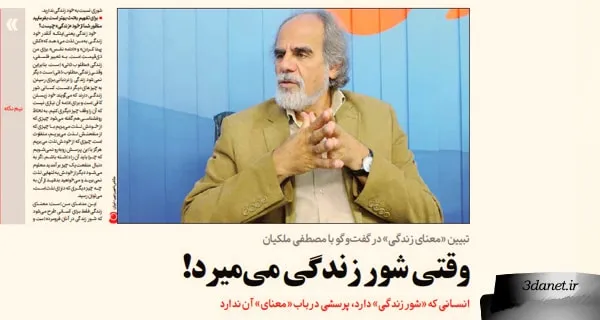
The Meaning of Life: A Lecture Series by Mostafa Malekian
The meaning of life differs from the purpose of creation; Mostafa Malekian examines three conceptions of it: the goal of the one who lives, the function of the human being, and the value of living. If life is an act, its benefits and costs must be weighed: is living worth it or not.

Mostafa Malekian: The lecture series on the meaning of life has been chosen for teaching for two reasons.
First: among the topics related to the philosophy of religion, no subject has been as neglected in university courses as the meaning of life, despite the fact that this discussion is one of the very important topics in the philosophy of religion and, to some extent, moral philosophy.
Second: I have been studying this subject for some time and have not had the opportunity to present the sum of my reflections, and this semester I will present the sum of my studies and reflections.
.
Mapping the Geography of the Meaning of Life Debate:
First, it is necessary to outline the geography of the discussion and then delve into the details.
Distinguishing the topic of the meaning of life from the topic of the purpose of creation:
The first point that must be considered is distinguishing the topic of the meaning of life from the topic of the purpose of creation. Although in some cases and according to certain viewpoints, these two discussions have been linked, in reality, they are logically separable from one another. The discussion of the purpose of creation is a discussion that has a more theological aspect and also carries certain presuppositions.
Theological Presuppositions of the Purpose of Creation Debate:
The theological presuppositions of this topic are that, firstly, this discussion can only be raised when one believes in a personal1, anthropomorphic2 God. Secondly, that this personal, anthropomorphic being has engaged in creation3, and thirdly, one must be able to conceive of a unity for creation, meaning the totality of all that is other than God, in order to say that God had a purpose in bringing this unified whole into being. Otherwise, the purpose of creation will be broken down into the purposes of each individual creature, meaning God had a purpose for every single creature.
The Aspect of Equating the Meaning of Life with the Purpose of Creation:
Of course, it should be noted that if what is meant by the purpose of creation is the creation of human beings and not other beings, then according to a certain viewpoint, this discussion will find a connection with the topic of the meaning of life.
Conceptual Clarification of "The Meaning of Life":
Assessing the relation of life as a category:
To enter this discussion, it is first necessary to conceptually clarify the possessive phrase "the meaning of life." That is, the individual words of the phrase and their combination must first be defined. What is meant by life4? The discussion here connects to metaphysical discussions in philosophy. The ancients, in the general matters of philosophy, classified existents under Aristotelian categories. Although today in metaphysics the Aristotelian classification is not necessarily proposed, other categories are proposed, and according to both views, it must be determined under which category life falls. Is life one of the material substances5 like stone and water; or is life from the category of properties6? Property is, loosely speaking, the same as accidents. According to the view of the ancients, psychological accidents also include number, because number is a connected quantity, but today number does not fit into the category of property. Another category is relation7. Is life from the category of relations, and do we abstract it from the connection it finds with other existents? Another category is mass8. For example, snow falls under the category of mass; without accumulation, the concept of snow does not arise. A drop is another example. Is life from the category of sets9? Is the term life applied to a collection of things? Is life the sum of actions or passions, or both? Another category is number, and it is clear that life does not fall under this category. Events are also a category. Is life an event? The next category is processes11, which some consider the same as the category of event and others consider independent. These are the new categories, and ultimately life must be placed under one of them. Of course, there is also disagreement about the number of these categories.
The Meaning of "The Meaning of Life":
In the meaning of life, what does "meaning" itself mean? It is clear that the meaning intended here is not the meaning inferred from understanding a text, whether spoken or written. There has been extensive discussion on this matter. Some philosophers have considered the meaning of life to be the purpose of life, others have regarded it as its function, and a third group has interpreted it as the value of life.
Examining the purpose of life as the meaning of life:
If the meaning of life is the purpose of life, then this purpose is conceivable only for beings that possess knowledge and will. The question that arises here is whether "life" itself possesses knowledge and will so that a purpose can be attributed to it. It is here that philosophers have distinguished between external and self-founded purposes. Beings have external purposes when they themselves lack knowledge and will, but their maker has a purpose in creating them, like the making of a watch by a watchmaker. However, if a being possesses knowledge and will, it can also be purposeful. Such a being has purpose in its actions and abstentions, and this purpose springs from within it. A being that possesses knowledge and will can have both a self-founded purpose and an external purpose, because it itself has purpose, and its maker also has a purpose in creating it. If the meaning of life is the purpose of life, since life itself lacks knowledge and will, what is meant must be the purpose of the possessor of life from life. Examining function as the meaning of life:
The meaning of life can be function. Function can also be attributed to beings that lack knowledge and will. For example, if we ask what the purpose of trees is, and the answer is increasing oxygen, increasing oxygen is the function of the tree. This function holds true for all natural beings. If it is asked what would happen in the world if there were no water, the answer will reveal the function of water. If we ask what would happen in the world if there were no humans, the answer will specify the function of humans. A number of philosophers have worked on this topic.
Examining value as the meaning of life: The third meaning of "the meaning of life" is the value of life. If we ask whether life is worth living, then we are inquiring about the value of life. If the benefit the liver derives from life is greater than the cost they pay for living, then life has been worthwhile; and if the total benefit is less, then this life has no value, that is, it is meaningless. The same question can be raised about any of the actions of human beings. Such a question can also be asked about life.
The discussion of the value of life arises when life is considered as an action, because worthiness and unworthiness are conceivable only in relation to actions.
Of course, a fourth meaning has also been considered for the meaning of life, which ultimately reduces to one of these three views.
Delimiting the meaning of "the meaning of life":
In the meaning of human life, one must pay attention to whether what is meant by the meaning of human life is the meaning of the life of the human species or race, or the life of a particular human being, or my own life. From the perspective of philosophers, the third-person viewpoint differs from the first-person viewpoint.
Because the method of discovering the answer differs between the first-person and third-person viewpoints. Hence, the life of a particular human being differs from my own life.
Descriptive and Prescriptive Orientations in the Discussion of the Meaning of Life: In discussing the purpose of life, another division can be made, which is to ask: what is the purpose of human life? This is a descriptive17 discussion. The method for discovering the answer to this question is to refer to experience and history. Regarding actually existing human beings, empirical methodology is applied, and regarding past human beings, historical methodology. Sometimes we divide the purpose of life from another angle, which is: what ought the purpose of human life to be? This is a prescriptive18 discussion. Here, numerous questions arise, including: what is the source of the “ought”? And what are the determining presuppositions of these “oughts”? Who is the determining authority for the “oughts”? The answers to these questions fall under the category of duties19 and obligations. This question has been raised since the time of Aristotle. If we ask each and every human being what the purpose of life is, does every human being have one purpose in life or more than one purpose alongside each other? Aristotle believed that every human being pursues a single purpose, and that single purpose is happiness. After Aristotle, others challenged this view and posited multiple purposes alongside each other, all of which together are desirable for their own sake. Some have held that human beings pursue tranquility and joy, and others have added inner contentment. Here, viewpoints differ. Those who have posited a single purpose have also had disagreements in determining that one purpose. But whether Aristotle or his opponents are right depends on the degree of abstraction of the purpose. The more we reduce abstraction and think more concretely, the more multiple purposes will emerge from within that one purpose. For example, all religions consider salvation to be the purpose of life. But if we speak more concretely, we will see that each religion considers salvation to lie in something specific.
Finding Meaning and Creating Meaning in the Discussion of the Meaning of Life:
Another division in this matter is whether the purpose of life is something discovered20 or constructed21. What is meant by discovered is that life has a purpose that exists before and after our knowledge of it, and we ultimately discover it. And what is meant by constructed is that this purpose is our own convention and stipulation. If you hold that it is discovered, you must discuss finding meaning, and if you hold that the purpose is constructed, you must discuss creating meaning.
The Authority for Answering the Question about the Meaning of Life:
The final question here is whether the question “what is the purpose of life?” is answered by religion or by philosophy. Some believe that the problem of the meaning of life cannot be answered in philosophy; rather, it must be left to the domain of religion. Some believe that both can provide an answer. Some also believe that this question cannot be answered at all, and some believe that it can only be answered through philosophy.
.
.
Download audio of the Meaning of Life lecture series (audio of 12 sessions in one zip file)
Session Two Part One | Part Two
.
.
Download the pdf of the lecture text on the Meaning of Life (127 pages – with table of contents)
From Server One | Server Two
.
.
Lecture Series on the Meaning of Life
Mostafa Malekian
Tarbiat Modares University
12 sessions – 1382 (starting 16 Mehr 1382)
.
.




Discussion2 comments
باسلام گويا محتوا ادامه داره لطفا اگه پيدا كرديد اضافه كنيد
سلام وقت به خیر از محتوای معنای زندگی بر میاد که یک جلسه نقص داره. و جلسه 13 هم باید باشه. گفتم اطلاع بدم که اگر در دسترس هست بارگزاری کنید. ممنون