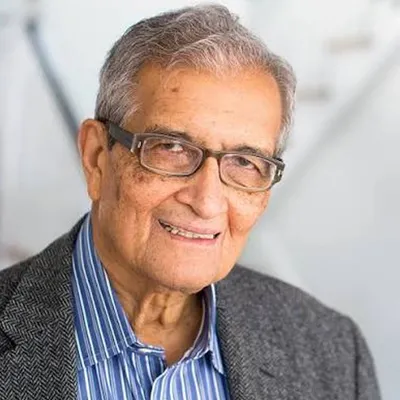
Foreign thinker
Amartya Sen
Amartya SenDevelopment Economics, Moral Philosophy, and Theory of JusticeIndian
Development is a process of expanding the real freedoms that people enjoy.
Life and Thought
Amartya Sen (born 1933) is a distinguished Indian economist and philosopher and the recipient of the 1998 Nobel Prize in Economics. He is internationally renowned for his foundational research in welfare economics, social choice theory, famine, and development based on human capabilities.
Amartya Sen was born in 1933 in Santiniketan, India. He began his higher education at Presidency College, Calcutta, and later received his doctorate from the University of Cambridge. Throughout his brilliant academic career, Sen has taught and conducted research at prestigious universities such as Oxford, the London School of Economics, Harvard, and Cambridge.
His most significant scholarly achievement is the formulation of the "Capability Approach" for evaluating welfare, justice, and development; an approach that measures development not merely by growth in gross national income, but by the expansion of people's real freedoms and capabilities to live lives they have reason to value. Furthermore, his revolutionary research on the causes of famines demonstrated that famine is more often the result of disruptions in distribution mechanisms, inequality in entitlements, and the absence of democracy than a physical shortage of food.
His intellectual masterpieces are crystallized in books such as "Development as Freedom" and "The Idea of Justice." In "The Idea of Justice," by critiquing abstract and utopian theories of justice (including that of John Rawls), he emphasizes the reduction of tangible injustices in the real world and the role of public reasoning. Amartya Sen is considered one of the most influential contemporary thinkers for reconnecting economics with ethics and human-centeredness.




.webp)