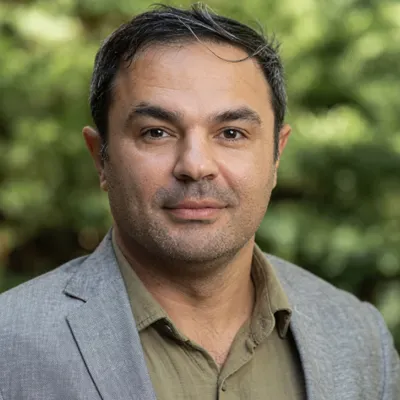
Iranian thinker
Arash Reisinejad
Arash ReisinejadInternational RelationsIranianb. 1984

Life and Thought
Arash Reisinezhad (born 1984) is an Iranian researcher and analyst in the field of international relations and geopolitics. He researches Iran's foreign policy, the New Silk Road, and regional rivalries in West Asia.
Arash Reisinezhad, born in 1984, is an Iranian researcher and analyst in the fields of international relations, geopolitics, Iran's foreign policy, and Middle Eastern studies. He is particularly known for his research on Iran's position in the regional order, Pahlavi foreign policy, Iran's ties with non-state actors, the New Silk Road, and geopolitical rivalries in West Asia.
Reisinezhad initially studied chemical engineering at Sharif University of Technology, graduating in 2007. During his student years at Sharif, he was also involved in student activities. He then entered the University of Tehran, pursuing a master's degree in political science. He went on to Florida International University for further studies, earning both a master's and a PhD in international relations. His doctoral dissertation later became the foundation of his important book on Iran's foreign policy during the Pahlavi era.
After returning to Iran, he taught as an assistant professor of international relations at the University of Tehran from 2019, and for a time also held an executive role in the university's international relations department. In March 2023, news of the objection to the continuation of his collaboration with the University of Tehran was published, sparking reactions in the media and among students.
In the following years, Reisinezhad continued his academic and analytical activities outside Iran. His page at the London School of Economics and Political Science introduces him as a researcher focusing on the impact of China's Belt and Road Initiative on the power configuration in the Middle East, as well as Iran's strategic relations with non-state actors. In more recent profiles, he has also been introduced as a visiting professor at the Fletcher School at Tufts University.
Reisinezhad's public renown, in addition to his academic works, is also related to his media presence. In his analyses, he typically examines Iran's foreign policy in connection with geography, history, state-building, national security, economic corridors, and the rivalry of regional and global powers. His perspective, rather than being merely quotidian or news-driven, emphasizes the historical continuity of Iranian politics and its geopolitical position in West Asia.
His most important work is the book The Shah and the Chessboard of Power in the Middle East, first published in English under the title The Shah of Iran, the Iraqi Kurds, and the Lebanese Shia by Palgrave Macmillan. This book demonstrates that Iran during the era of Mohammad Reza Shah established strategic relations with certain non-state actors, such as the Iraqi Kurds and the Lebanese Shia, to contain regional and ideological threats. The book's English publisher has also introduced it as a study of the formation and fluctuation of Iran's connections with non-state entities in the Middle East.