Foreign thinker
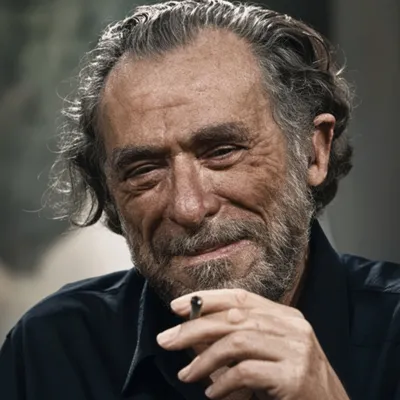
Charles Bukowski
Charles BukowskiPoetry, Fiction, and Contemporary American LiteratureAmerican1920–1994
In their times
Open in the Timeline of ThoughtLife and Thought
Charles Bukowski was an American poet, short story writer, and novelist who wrote with a candid, bitter, and unadorned prose about marginal life, poverty, grinding work, loneliness, human relationships, and urban existence. He is considered one of the most recognized figures of American underground literature in the second half of the twentieth century.
Charles Bukowski was born on August 16, 1920, in Andernach, Germany, and immigrated with his family to the United States as a child. He spent most of his life in Los Angeles, a city that later became one of the most important literary settings of his work. A difficult childhood, a tense relationship with his father, poverty, and marginal social experiences had a profound impact on his literary world.
Bukowski briefly attended Los Angeles City College in his youth but did not continue formal education. He worked various, often low-paying jobs for years, and his long experience at the U.S. Postal Service later became the raw material for one of his most famous novels, Post Office. He began publishing short stories and then poetry in the 1940s, but his widespread fame took shape in the 1960s and 1970s.
Bukowski's poetry and fiction often draw on personal experiences, the daily lives of the lower and marginalized classes, failed romantic relationships, alcohol, gambling, work, loneliness, and social violence. His language is deliberately simple, direct, and anti-ornamentation, often accompanied by dark humor and a pessimistic view of social relations. Yet, amidst this bitterness, a sensitivity to human vulnerability and small moments of meaning and beauty can also be seen.
Among his well-known novels are Post Office, Factotum, Women, Ham on Rye, and Hollywood. The character Henry Chinaski, who appears in many of these works, is a kind of fictionalized self of Bukowski, allowing him to blend his personal experiences with exaggeration, humor, and literary narrative.
Bukowski was also highly prolific in poetry, publishing numerous collections. His poems, like his prose, deal with everyday life, failure, aging, desire, death, work, and loneliness. He held an overt stance against formal language and ornate literature, striving to convey lived experience onto the page with minimal distance and without polish.
Bukowski's place in American literature largely stems from his distinct, anti-establishment voice. Although he is not typically placed within the formal Beat Generation category, his work overlaps with certain characteristics of counterculture and underground literature. His works became popular among a wide readership and continue to be translated and revisited in various languages after his death.
Charles Bukowski died on March 9, 1994, in San Pedro, California. His literary legacy is a vast body of poetry, short stories, novels, and notes that presents a harsh, unvarnished, yet at times tender portrait of modern human existence on the margins of the city and society.