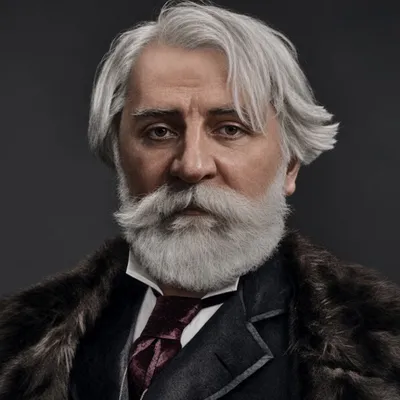
Foreign thinker
Ivan Turgenev
Ivan TurgenevNovel writing, fiction writing, and Russian literatureRussian1818–1883

Life and Thought
Ivan Turgenev was a Russian writer and playwright and one of the prominent figures of nineteenth-century Russian literature. Through works such as Fathers and Sons and A Sportsman's Sketches, he explored generational conflict, social transformation, individual freedom, and the condition of the Russian peasantry, and played an important role in introducing Russian literature to European readers.
Ivan Sergeyevich Turgenev was born on November 9, 1818, in Oryol, Russia, into an aristocratic family. His childhood was spent on the family estate, and from those early years he became intimately acquainted with the lives of peasants and the Russian system of serfdom—an experience that later found significant reflection in his works. He studied at the universities of Moscow and St. Petersburg and then went to Berlin to continue his studies in philosophy and classical languages. His stay in Germany strengthened his familiarity with European thought and liberal tendencies.
Turgenev began his literary career with poetry and plays, but his major fame was established with the collection A Sportsman's Sketches. By depicting the lives of Russian peasants and showing their human dignity, this work offered an indirect yet effective critique of the institution of serfdom. The publication of this collection cemented Turgenev's position as a writer sensitive to social and moral issues.
In his novels, Turgenev addresses the conflict between generations, between tradition and modernity, and between idealism and social reality. Rudin, Home of the Gentry, On the Eve, Smoke, and especially Fathers and Sons are among his most important works. The character of Bazarov in Fathers and Sons is one of the most enduring figures in Russian literature, and the novel, by introducing the concept of "nihilism," prominently displays the rift between the radical younger generation and the older liberal generation.
Turgenev's style is known for its measured, delicate, and fluid prose, precise descriptions of nature, and special attention to the psychology of characters. Unlike Dostoevsky and Tolstoy, who often dealt with immense moral, religious, and historical crises, Turgenev paid more attention to the subtleties of human relationships, gradual social changes, and the emotional and intellectual experiences of his characters.
Turgenev spent a large part of his life outside Russia, especially in France and Germany, and was in contact with many European writers and thinkers. His close relationship with the opera singer Pauline Viardot was one of the most important personal relationships of his life, and he lived for many years near the Viardot family. His long presence in Western Europe turned him into a bridge between Russian literature and European culture.
He died on September 3, 1883, in Bougival, France, and his body was transferred to St. Petersburg for burial. Turgenev's place in literary history rests on his ability to combine social observation, character psychology, and artistic prose—qualities that have made his works an enduring part of the European novel-writing tradition.