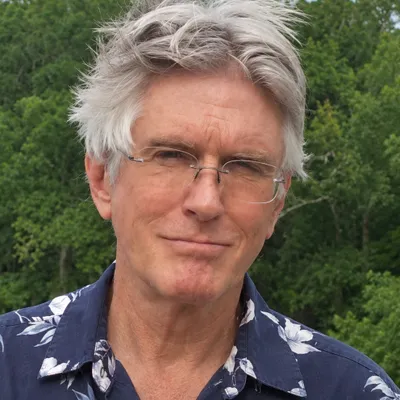
Foreign thinker
Geoffrey George Anderson Clark
Geoffrey George Anderson ClarkPaleoanthropology and Paleolithic archaeologyAmericanb. 1944


Life and Thought
Geoffrey Clark is an American paleoanthropologist and archaeologist, Regents' Professor Emeritus at Arizona State University and a member of the Institute of Human Origins. Having earned his Ph.D. from the University of Chicago in 1971, he is known for his fieldwork in Spain and Jordan and for his rigorous epistemological critiques of the conceptual frameworks underlying modern human origins research.
Geoffrey George Anderson Clark completed his B.A. and M.A. in anthropology at the University of Arizona (1966 and 1967, respectively) and received his Ph.D. from the University of Chicago in 1971 with a dissertation on the Asturian culture of Cantabria. He joined the faculty of Arizona State University in 1971, eventually becoming a Regents' Professor there, and has continued his scholarly work as Professor Emeritus since 2011.
Much of Clark's research career was devoted to excavating and surveying Paleolithic and Mesolithic sites in northern Spain (particularly Asturias and Cantabria) and in Jordan (notably the Wadi al-Hasa). Among his notable findings was the demonstration that dietary intensification driven by population-resource imbalances predated the shift to domestication economies by thousands of years.
He was also an influential voice in epistemological debates within paleoanthropology; in works such as "Conceptual Issues in Modern Human Origins Research" (with Cathy Willermet, 1997) and "Rediscovering Darwin: Evolutionary Theory in Archaeological Explanation" (with C. Michael Barton, 1997), he argued that archaeological data do not exist independently of the conceptual frameworks that define and interpret them. A committed materialist and evolutionist, he was also an outspoken critic of creation science and pseudoscience, addressing the subject in numerous articles and public lectures.
Clark has published more than 250 articles and over a dozen books and edited volumes on human biological and cultural evolution, and during his academic career he chaired more than 25 completed doctoral dissertation committees. He also founded and long edited the Arizona State University Anthropological Research Papers series and played a significant role in bringing the Institute of Human Origins to Arizona State University in 1997.