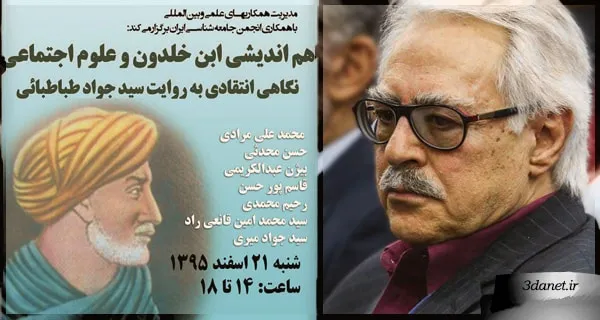
Man is the child of his customs and his character, not the child of his nature and his race.
Life and Thought
Abu Zayd Abd al-Rahman Ibn Khaldun (1332–1406 CE) was a Muslim historian, sociologist, and philosopher of history recognized as a pioneer and founder of sociology and the study of human civilization (ʿumrān). Through his masterpiece, the Muqaddimah, he elucidated the scientific laws governing social transformations, group solidarity (ʿaṣabiyya), and the cyclical rise and fall of civilizations. The impact of his thought on critical historiography and the social sciences has secured him a distinguished place in the history of human thought.
Abd al-Rahman Ibn Khaldun was born in 732 AH (1332 CE) in Tunis to a family of Andalusian origin. In his birthplace, he studied the Qur'anic sciences, jurisprudence, literature, philosophy, and mathematics. Throughout his life, Ibn Khaldun served as a diplomat, minister, and judge in the courts of various North African and Andalusian dynasties, such as the Marinids and the Nasrids. His constant presence at the center of power and his close observation of political conflicts and tribal strife provided him with invaluable experience for conducting a root-cause analysis of social transformations.
His most important and enduring work is the first volume of his comprehensive historical book, Kitāb al-ʿIbar, which gained worldwide fame as the Muqaddimah (Prolegomena) of Ibn Khaldun. In this foundational work, he established a new science called the 'science of ʿumrān' (sociology and the study of human civilization). In the Muqaddimah, Ibn Khaldun severely criticized traditional historiographical methods that relied solely on untested quotations and narratives, calling for an internal critique of historical accounts based on the natural laws of society and the nature of civilization.
One of the most central concepts in Ibn Khaldun's thought is the concept of 'ʿaṣabiyya' (social solidarity and blood/ideological bond). He demonstrated how nomadic and Bedouin groups, due to their strong ʿaṣabiyya, could overcome urban societies and establish dynasties, but after settling in cities and becoming accustomed to luxury and comfort, they lose their ʿaṣabiyya and ultimately collapse in a natural cycle (usually within three or four generations). Ibn Khaldun spent the final years of his life in Egypt as a judge and teacher and died in Cairo in 808 AH (1406 CE).
Sedanet articles about Ibn Khaldun