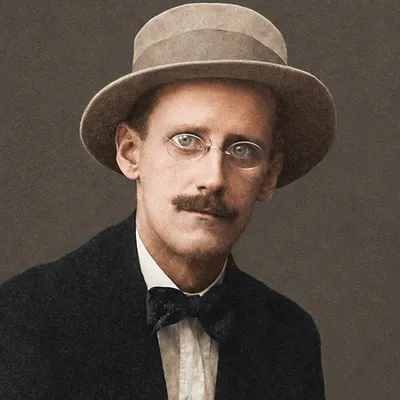
Foreign thinker
James Joyce
James JoyceModern Literature and Novel WritingIrish1882–1941
History is a nightmare from which I am trying to awake.


Life and Thought
James Joyce was an Irish writer and one of the central figures of twentieth-century modernist literature. Through works such as Dubliners, A Portrait of the Artist as a Young Man, Ulysses, and Finnegans Wake, he developed new approaches to narrative, language, and the representation of consciousness, profoundly influencing the modern novel.
James Augustine Aloysius Joyce was born on 2 February 1882 in Dublin. He attended Catholic schools and later studied modern languages at University College Dublin. After completing his studies, he spent time in Paris and, following a brief return to Ireland, lived much of his life abroad, including in Trieste, Paris, and Zurich. Yet Dublin remained the geographical and imaginative center of nearly all his major works.
Joyce’s early major works include the short-story collection Dubliners and the novel A Portrait of the Artist as a Young Man. In these works, he explores everyday life, crises of identity, religion, family, the city, and the formation of artistic consciousness. Stephen Dedalus, the protagonist of A Portrait of the Artist as a Young Man, partly reflects Joyce’s own youthful experience and later reappears in Ulysses.
Joyce’s reputation was firmly established with Ulysses, published in 1922. The novel unfolds in Dublin over a single day, 16 June 1904. Through varied narrative modes, linguistic play, extensive intertextual references, and techniques associated with stream of consciousness, Joyce transformed the traditional structure of the novel. Its structural relation to Homer’s Odyssey and its attention to apparently ordinary details of daily life are among its defining features.
Joyce’s final major work, Finnegans Wake, was published in 1939. With its highly experimental language, extensive wordplay, and multilayered structure, the book brought Joyce’s linguistic experimentation to its furthest point. Both Ulysses and Finnegans Wake played a decisive role in transforming the form, structure, and language of the modern novel.
Joyce died in Zurich on 13 January 1941 following surgery. His place in twentieth-century literature rests chiefly on his innovations in narrative, his expansion of literary language, his attention to the movement of consciousness, and his linking of individual experience to urban life.