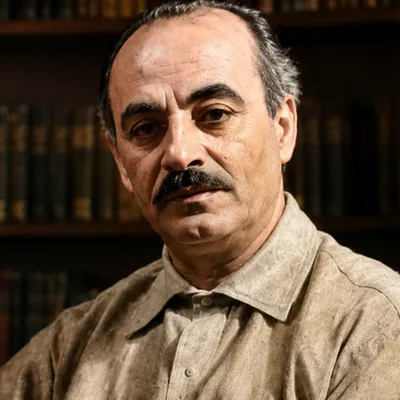
Foreign thinker
Kahlil Gibran
Kahlil GibranLiterature and Mystical PhilosophyLebanese-American1883–1931
Your children are not your children. They are the sons and daughters of Life's longing for itself. They come through you but not from you, and though they are with you yet they belong not to you.


Life and Thought
Gibran Khalil Gibran is a Lebanese-American writer, poet, and painter best known worldwide for his book The Prophet. His works are a blend of Eastern mysticism, Romanticism, and libertarian thought, and have had a profound influence on modern Arabic literature and Western readers. Gibran is considered one of the best-selling poets in history.
Gibran Khalil Gibran was born on January 6, 1883, in the village of Bsharri in the mountains of Lebanon (then part of the Ottoman Empire) into a Maronite Christian family. In 1895, he immigrated with his mother, sisters, and brother to Boston, settling in the Syrian-Lebanese immigrant neighborhood. As a teenager, he returned to Beirut for his studies and, after a few years, went back to America. He later spent time in Paris studying painting and settled in New York from 1912.
Gibran wrote in both Arabic and English. His early works in Arabic, such as Spirits Rebellious and The Broken Wings, were sharp, romantic social critiques of traditional Lebanese society, introducing him in the Arab world as a rebellious and modernist writer. From the 1920s onward, he wrote mostly in English and achieved global fame with the book The Prophet (1923). This work is a collection of poetic prose on love, marriage, work, freedom, death, and religion, which, with its simple and mystical language, has found millions of readers.
Gibran's thought is a synthesis of Christian mysticism, the influences of Nietzsche, William Blake, and Eastern traditions. He emphasized individual freedom, unconditional love, the unity of being, and criticism of rigid religious and political institutions. In addition to writing, he was a skilled painter and often accompanied his literary works with his own illustrations. Gibran died on April 10, 1931, in New York, and his body was returned to Bsharri, Lebanon. Today, he is recognized both in the Arab world and the West as a voice for peace, beauty, and free thought.
Bibliography
Writings and transcribed lectures1 title
The Prophet