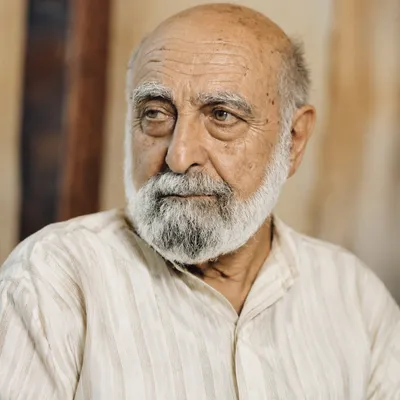
Iranian thinker
Majid Rahnema
Majid RahnemaPost-development Theory and Critique of DevelopmentIranian1924–2015
"The spread of misery and poverty is a manifest and unacceptable social scandal, especially in societies capable of avoiding it."


Life and Thought
Majid Rahnema (1924–2015) was an Iranian diplomat, politician, and scholar, and a leading theorist of the critique of development and post-development thought. Having served as Iran’s Minister of Science and Higher Education and as a member of UNESCO’s Executive Board, he devoted much of his intellectual work to rethinking poverty, development, and participation, with particular emphasis on the distinction between “poverty” and “misery.”
Majid Rahnema was born in Azar 1303 in Tehran, to Zeyn al-Abedin Rahnema and Zakiyeh Haeri. He pursued his education in Beirut and Paris: he studied literature and science at the American University of Beirut, law and political economy at Saint Joseph University of Beirut, and subsequently received his doctorate in law from the University of Paris. In 1324, he joined Iran’s Ministry of Foreign Affairs and held various diplomatic posts, including in Moscow, New York, and San Francisco. He later became Iran’s ambassador to Switzerland and Deputy Minister of Foreign Affairs for International Affairs.
In 1346, when the Ministry of Science and Higher Education was established, Rahnema became its minister and held the office for several years in the cabinet of Amir-Abbas Hoveyda. After leaving government, he worked on the Alishtar educational and development project in Lorestan and later served on UNESCO’s Executive Board. His experience in diplomacy, policymaking, and direct engagement with the problems of societies then described as the Third World provided the basis for his intellectual focus on development and, in particular, poverty.
In later years, Rahnema became a well-known figure in the critique of development and post-development thought. Central to his thinking was a fundamental distinction between “poverty” and “misery.” He did not regard poverty as necessarily synonymous with deprivation or wretchedness, maintaining that simple, low-consumption ways of life in many cultures could embody human relationships, solidarity, and social richness. By contrast, he understood “misery” as a condition in which people are deprived of the necessities of livelihood and of social support networks. From this perspective, he criticized the prevalent assumption that increased production and consumption, or the universalization of the economic model of industrial societies, could in itself eliminate poverty and misery.
These views were developed especially in the book When Misery Hunts Poverty. Participation: A New Look at the Concept of Development, Learning to Live, and Asian and African Countries are among the works associated with his intellectual activity. Rahnema had both an intellectual and a friendly relationship with Ivan Illich, and his critique of development was likewise connected with questioning manufactured needs, consumerism, modern institutions, and the destruction of indigenous and autonomous ways of life.
Majid Rahnema died in Lyon, France, on 14 April 2015, corresponding to 25 Farvardin 1394. His intellectual legacy lies chiefly in critiquing the conventional concept of development, rethinking the meaning of poverty, and exploring the possibility of forms of human life beyond the logic of unlimited economic growth.