Foreign thinker
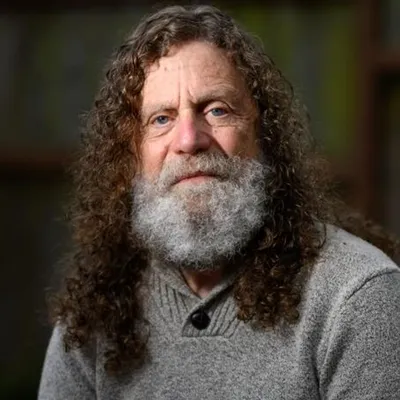
Robert Sapolsky
Robert SapolskyNeuroscience, Neuroendocrinology, and Behavioral BiologyAmericanb. 1957


Life and Thought
Robert Sapolsky is an American neuroscientist, neuroendocrinologist, primatologist, and Stanford University professor whose research focuses on stress, the brain, behavior, and human biology. Through books such as Why Zebras Don’t Get Ulcers, Behave, and Determined, he has also influenced public discussion of the biology of behavior and the problem of free will.
Robert Morris Sapolsky was born in Brooklyn, New York, on 6 April 1957. He studied biological anthropology at Harvard University and then received his PhD in neuroendocrinology from Rockefeller University. Sapolsky later joined Stanford University, where he became a professor of biology, neurology and neurological sciences, and neurosurgery.
An important part of Sapolsky’s scientific reputation rests on his research on stress and its biological consequences. In both laboratory work and field studies of primates, especially baboons in Kenya, he has examined how social status, environment, hormones, and psychological stress affect the brain, the immune system, and health. His research interests also include neuronal death, stress, and gene therapy.
Alongside his academic work, Sapolsky is a prominent writer of popular science. Why Zebras Don’t Get Ulcers explains the mechanisms of stress and stress-related disease, while A Primate’s Memoir recounts his years of field research on baboons. In Behave: The Biology of Humans at Our Best and Worst, he analyses human behaviour at multiple levels, from brain activity in the moments before an action to hormones, individual development, culture, and evolutionary history.
One of the most prominent themes of Sapolsky’s recent work is free will. Drawing on a causal picture of human behaviour, he argues that what people do results from a chain of biological, psychological, environmental, and historical factors, and therefore rejects the conventional conception of free will. He develops this view in detail in Determined: A Science of Life Without Free Will and considers its implications for moral responsibility, punishment, and justice.
Sapolsky’s work lies at the intersection of neuroscience, evolutionary biology, primatology, and the study of human behavior. A distinctive feature of his writing is its attempt to explain behaviour without reducing it to a single cause: understanding an action requires attention to neural and hormonal activity, childhood experience, social structure, and evolutionary history. This multi-level approach has made his research and writing prominent in contemporary debates about stress, violence, altruism, responsibility, and human freedom.