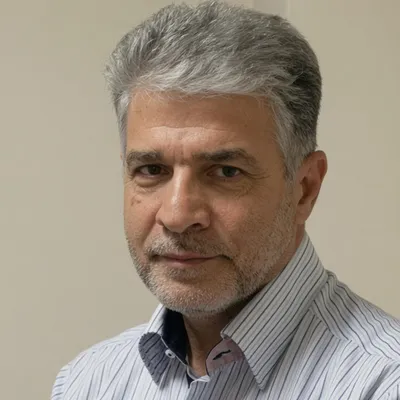
Iranian thinker
Sadegh Haghighat
Sadegh HaghighatIslamic Political ThoughtIranian
Life and Thought
Seyyed Sadegh Haghighat (born 1962) is a university professor and researcher in Islamic political thought. He is the theorist of 'convergence' (Hamravi), which proposes a third way between maximalist and minimalist approaches to religion, and has authored significant works on the methodology of political science and Islamic political philosophy.
Seyyed Sadegh Haghighat was born in 1962. After obtaining a high school diploma in experimental sciences, he entered the Isfahan Seminary in 1981 and later moved to Qom for advanced seminary studies. Concurrently with his seminary education, he studied political science at the University of Tehran and received an MA in International Relations and a PhD in Political Thought from Tarbiat Modares University.
He taught for many years at Mofid University, attaining the rank of full professor. He has also taught at the University of Tehran, Baqir al-Olum University, and for a period at Florida International University. Since 2023, he has been a faculty member at the Imam Khomeini and Islamic Revolution Research Institute. Haghighat has been repeatedly recognized as an exemplary researcher of Qom Province and a distinguished researcher by the Ministry of Science and the National Elite Foundation.
His areas of expertise are Islamic political thought, the methodology of political science, the Islamic Revolution, and political Islam. His most important theory is the 'Theory of Convergence' (Hamravi), which proposes a third way between text-oriented and extra-textual tendencies toward religion, as well as between maximalist and minimalist approaches to Islam. In this theory, both textual and extra-textual evidence hold relative validity, and the degree to which each is utilized depends on the subject matter. Among his important works are 'Methodology of Political Science,' 'The Convergence of Political Philosophy and Political Jurisprudence,' 'Foundations of Political Thought in Islam,' and translations such as Michael Walzer's 'Thick and Thin.'