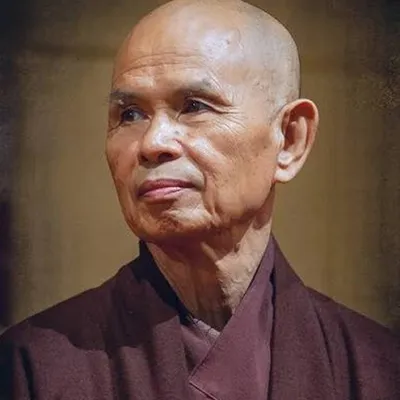
Foreign thinker
Thich Nhat Hanh
Thich Nhat HanhEngaged Buddhism and mindfulness teachingVietnamese1926–2022
Smile, breathe, and go slowly.


Life and Thought
Thich Nhat Hanh (1926–2022) was a Vietnamese Buddhist monk, poet, and peace activist, and one of the most prominent popularizers of Buddhism in the West, who introduced the concept of "Engaged Buddhism" to link spiritual contemplation with social action. Through teaching mindfulness to Western audiences, he became one of the most influential figures in contemporary global spirituality.
Thich Nhat Hanh, born Nguyễn Xuân Bảo, was born on October 11, 1926, in central Vietnam, and entered a Buddhist monastery at the age of sixteen. In the 1960s, amid the Vietnam War, he founded the concept of "Engaged Buddhism," an approach linking Buddhist contemplation and meditation with social responsibility and peace activism. His anti-war activities — including a trip to the United States to call for an end to the war — led to a four-decade exile from Vietnam; Martin Luther King Jr. nominated him for the Nobel Peace Prize in 1967.
During his exile, he founded a retreat in France called "Plum Village," which became a global center for teaching meditation and mindfulness. Thich Nhat Hanh authored more than a hundred books; his best-known works include The Miracle of Mindfulness and Peace Is Every Step. He translated traditional Buddhist teachings, particularly concepts such as "being present in the now" and "dependent co-arising," into simple, practical language for non-Buddhist Western audiences, playing a key role in popularizing the secular mindfulness movement in the West.
He returned to Vietnam in 2018 and died on January 22, 2022, at his home temple in Huế.