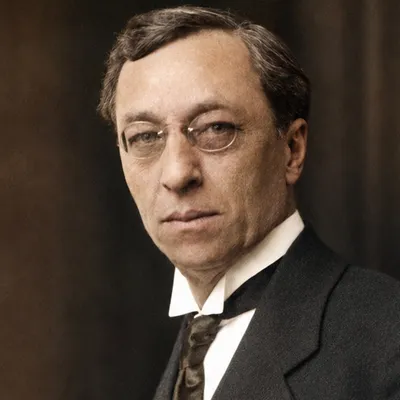
Foreign thinker
Wassily Kandinsky
Wassily KandinskyAbstract painting and art theoryRussian-French1866–1944
“Colour is a power which directly influences the soul.”
In their times
Open in the Timeline of ThoughtLife and Thought
Wassily Kandinsky was a Russian-French painter and theorist, and one of the pioneers of abstract art. By linking colour, form, music, and inner experience, he freed painting from its dependence on representing the external world and exerted a profound influence on modern art.
Wassily Kandinsky was born in Moscow on 16 December 1866. He initially studied law and economics at Moscow University, but changed his professional path in 1896 and moved to Munich to study art. His encounter with Impressionist painting, especially the experience of colour in Claude Monet’s work, was formative for his artistic development.
In 1911, Kandinsky co-founded the Blue Rider group with Franz Marc. During the same period, he wrote his important book Concerning the Spiritual in Art and placed the idea of “inner necessity” at the centre of his theory: a work of art must arise from the artist’s inner need and resonate in the viewer’s soul. Inspired by music, he called many of his works “improvisations” and “compositions.”
After a period in Russia, Kandinsky taught at the Bauhaus from 1922 to 1933, further developing his research on the relations among colour, line, and form. Works such as Composition VII, Yellow-Red-Blue, and Several Circles are among his major achievements. After the Bauhaus was closed, he moved to Paris, became a French citizen, and continued painting until his death. Kandinsky died in Neuilly-sur-Seine on 13 December 1944.