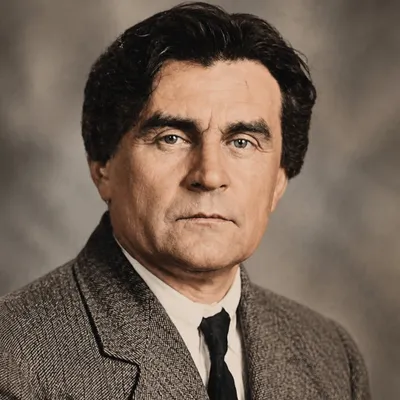
Foreign thinker
Kazimir Malevich
Kazimir MalevichAbstract painting and SuprematismRussian-Ukrainian1879–1935
“The artist can be a creator only when the forms in his painting have nothing in common with nature.”
In their times
Open in the Timeline of ThoughtLife and Thought
Kazimir Malevich was an avant-garde painter and theorist, born in Kyiv, and the founder of Suprematism. By reducing painting to pure shapes and colours, he played a foundational role in the development of twentieth-century abstract art.
Kazimir Malevich was born on 23 February 1879 in Kyiv, into a family of Polish descent. In the early years of his career, he experimented with diverse modernist styles, from Impressionism and Primitivism to Cubism and Futurism, and developed within the dynamic world of the Russian avant-garde.
In 1915, Malevich formulated Suprematism, an approach centred on the supremacy of pure feeling and the fundamental visual elements of colour and form. Black Square is his most famous and consequential work; by abandoning representation of the external world, it became a defining moment in the history of abstract art. White on White and the Suprematist Composition series are also among his key works.
In addition to painting, he worked in stage design, architecture, and art education. As Stalinist cultural policies took hold, avant-garde art was marginalised, and Malevich was arrested and interrogated in 1930. In his final years, he returned to figurative painting, while retaining the Suprematist sign in his signature and works. He died in Leningrad on 15 May 1935.