Religion
Twelve Teachings Common to Mystics, Mostafa Malekian
Mostafa Malekian identifies twelve shared teachings of practical mysticism as a path to serenity and a better life—even without belief in God or religion—an approach that begins with the threefold silence and a life rooted in the here and now.
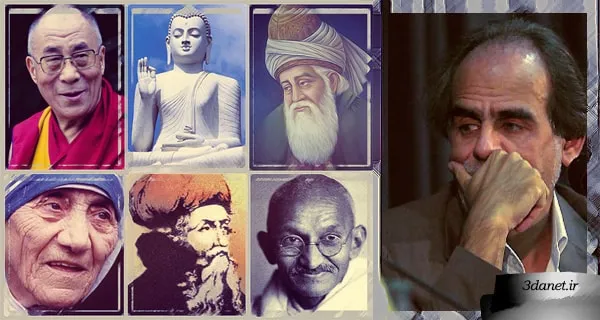
These 12 teachings can be viewed from 3 perspectives
The twelve teachings I intend to set forth can be viewed from three perspectives. One perspective is the mystical perspective. Mysticism has three parts. One part is referred to as practical mysticism or the mystical wayfaring and spiritual journey, and today it is called the mystical method. Another part of mysticism is theoretical mysticism, or in today's terms, mystical doctrine or teaching. The third part is "mystical experience," which was formerly called unveiling and witnessing or revelations, and the term "mystical experience" has become prevalent in the last century.
Our discussion relates to practical mysticism. In practical mysticism, the question can be raised as to whether the systems of practical mysticism, despite their many differences, have had common features. In this regard, it can be said that all systems of practical mysticism in the world share twelve components.
But these twelve steps and practical teachings can also be viewed from a second perspective.
The religious and denominational outlook yields a series of psychological desiderata, and all adherents of a religion and denomination benefit from these desiderata to the extent of their theoretical and practical commitment. Desiderata such as tranquility, joy, hopefulness, self-satisfaction, and finding meaning in life (meaning encompassing the value, purpose, and function of life).
Until recently, there was a consensus among scholars of psychology, philosophy of religion, and theology that losing the religious and denominational outlook results in deprivation from these desiderata.
But in my opinion, these psychological desiderata can also be obtained through other means. Although this other path is far more difficult than the first path (commitment to a specific religion and denomination).
The twelve steps I want to discuss are twelve steps for recovering the psychological desiderata lost as a result of abandoning religion and denomination.
These twelve components can also be viewed from a third perspective, which is that even if you are a pure materialist and consider the universe to be limited to matter and energy and their various and mutual transformations, you still want to be happier in this life before you. In my opinion, anyone who traverses these twelve steps, even if they have nothing to do with God, life after death, transcendence, religion, denomination, etc., will have a happier life. Even if you have no concern for mysticism, religion, or denomination, adherence to these twelve steps will make life happier.
In explaining these twelve steps, I will try to observe a kind of sequence. Although, especially from the fifth step onward, observing this sequence becomes difficult.
First Teaching:
Silence
Silence in its political and social sense, meaning non-protest and passivity, is not intended. Rather, I mean three types of silence, which are, in order: silence of the large tongue, silence of the small tongue, and mental silence.
In the past, whoever spoke less in a gathering was seen as possessing greater perfections; but now the situation has changed, and whoever is more talkative is considered more perfect. This is a very new kind of perception and was not known to our predecessors, and it is, of course, one of the greatest problems we have today.
That the principle in life is silence, and that we do not speak except when necessary and to the extent necessary, is the first step of primal mysticism. But regarding the three types of silence;
The first type of silence is verbal silence. Its meaning is that when someone is speaking, I do not speak with my tongue.
This silence is a prelude to the second silence, which is the silence of the small tongue.
Despite having verbal silence and apparently listening, we constantly think in our minds. Thinking is, in fact, speaking to oneself. Speech (nutq) means both speaking with the large tongue and speaking with the small tongue, which is thought.
The meaning of the second silence is that when I am speaking, you are entirely in my world, and whatever reflections you have about this speech, you postpone until after you have fully received my words.
Of course, if the first silence is not attained, it is impossible to attain the second silence.
But there is also a third silence, which Islamic mystics call the removal of thoughts and mental intrusions (raf‘-i khāṭirāt va khuṭūrāt), and in Buddhism it is called stillness of mind. The two aforementioned types of silence find meaning in relation to another person who is speaking. But the third type of silence is silence in solitude.
Even when you are alone, you are usually either riding the stream of consciousness, or associations of ideas constantly arise in you, or you ruminate on past memories, or future thoughts come and go in your mind.
Association of ideas is when I cling to the resemblance between things and slide from one thing to another. From the brown color of my notebook to the brown color of the room curtain, from the room curtain to the thought...
These three types of silence greatly contribute to our mental hygiene.
In no religion has the value of silence been emphasized as much as in Buddhism. In Buddhism, four types of great verbal silence are obligatory. Silence during eating, two hours in a day and night, one full day and night per week, and two consecutive weeks per year.
Second Teaching:
Living Here and Now
Our body always lives in the present, but our mind and psyche are not like this.
Psychologists say that most of us rarely live in the present moment for even a quarter of an hour in a day and night. Our mind and psyche mostly wander in the past and future. Wandering in the past and future has two very great harms.
If you have a life here and now, you will not commit any immoral act or unethical vice. Every immoral act or vice arises from a flight into the past or future. For example, your article comes to me for review; if I go back to the past and see that you have done a kindness to me or one of my relatives, I deviate from fairness and approve your article despite its lack of merit. Or, with a view to the future, in expectation of a benefit that might come to me from you, I deviate from fairness.
Vengefulness is always directed at the past. Anger, malice, and hatred toward someone are also related to the recollection of the past. Theft also arises from the fear of poverty in the future. It is unlikely that someone on the verge of death from hunger right now would commit theft. Otherwise, necessities of life make prohibitions permissible, and their theft would not be a wrongful act at all. They steal because they think of the future and wander in the future living conditions of their family. If our memory were cut off from the future, only those dying of hunger would steal.
The valuable innovation of Rawls (the American philosopher) in the realm of politics was the defense of the "veil of ignorance." He said the only way to understand whether a law is just is for the lawmakers to forget who they are. To make laws as if they are unaware whether they are students or professors, men or women, employers or workers, urban or rural dwellers... to forget whether they are Muslim or non-Muslim. Then they would pass a law that is fair.
It is like wanting to divide a cake between your two daughters. You tell one daughter to divide the cake, with the knowledge that the choice of either half will be at her sister's discretion. Then your daughter divides the cake with the utmost precision and complete fairness, because she knows the choice of either half is not up to her.
If I cut myself off from my past and future, I will adopt a just approach in every action.
This is from the perspective of the goodness and morality of life.
But living here and now has a tremendous impact on the happiness of life. The more we live in the present moment, the more our life's pleasures increase, and the pains, sorrows, and sufferings of life decrease.
If I have a toothache right now and do not recall the past or the future, I only endure the pain of that very moment. But if I remember that in the past, whenever I had a toothache, it lasted for three days, the toothache is doubled in the present moment as well. Or if I pay attention to the fact that from tonight, when my toothache started, until tomorrow morning when I go to the dentist, I must endure this pain for hours, my pain and suffering increase.
The same applies to the pleasures of life. If you are my guest and sit at my colorful table, but your mind is preoccupied with the past and future sufferings of your sick mother, you will not derive sufficient pleasure.
Therefore, this living in the here-and-now is beneficial for both the goodness of life and the pleasure of life.
The actualization of the potential of pleasurable things depends on your inner state and condition, and the same is true for painful and agonizing things. The pleasure-giving quality of a date depends on who is eating it.
In the Analects of Confucius, it is recounted that when he incurred the wrath of the Emperor of China and was sentenced to death, on the night before his execution, while in prison, he said to his cellmate, "Look, when this butterfly opens its wings, what color does it become, and when it closes its wings, what color!" His cellmate said, "I thought you were a wise man, but I see you are nothing more than a fool. How, knowing that you will be executed tomorrow, can you take delight in this?" Confucius said, "I do not let my dying tomorrow prevent me from enjoying my now. Besides, if I knew that this lack of enjoyment would lead to a reduction of my punishment and death, I would forgo it, but since I know it has no effect, why should I deprive myself of this amount of pleasure?"
Confucius was able to push the future out of his mind.
Third Teaching:
Action without Desire
"Action without desire," whose principle lies in Hinduism, is among the commonalities of all practical mysticisms. In Hinduism, they said either you have desire but no action, or you have both action and desire; but both are wrong. You must have "action without desire."
Do whatever you can, but then have absolutely no concern for what will happen. For our success—for example, in an entrance exam—billions of factors must work hand in hand, of which only one is our own effort and activity. My studying is a necessary condition for success, but it is never a sufficient condition. In the wheel and feathers of the universe, one must not wait for the other factors. There is nothing in the world that a person can be certain of attaining.
In Islam, "action without desire" is interpreted as "tawakkul" (trust in God). That is, you do your work and cast the result upon God's shoulders, and immediately after completing one task, turn to another.
We lose many of our mental and psychological capacities because we are waiting for a result, whereas the result is not within our control.
Fourth Teaching:
The Wisdom of "What Is That to Me?!"
First, the wisdom of "what is that to me" does not pertain to the realm of action but rather to the realm of theory. It is not that if we witness an injustice, we should say, "What is that to me?"; rather, we are morally obligated to react. It is in the position of "learning" that the principle of "what is that to me" is applicable.
Second, the "wisdom of what concern is it of mine" does not pertain to our specialized field, which is necessary for our financial independence. The explanation being that if we want our lives to be ethical, we must have independence. To be ethical, we need freedom, and for this freedom, we need material and financial independence, and for this independence, we need an income, and for an income, we must have a job and profession, and to have a job and profession, we must have expertise in a science, technique, or art. Thus, having expertise in a science, technique, or art is a necessary condition for living ethically, and the wisdom of what concern is it of mine is not related to this domain.
But what should be done regarding the rest of knowledge? Mystics say: pursue learning something that has an impact on your life. Only seek answers to questions that possess these three characteristics:
Questions where your practical life differs before the question itself occurs to your mind and after it occurs to your mind. Questions that make a difference in practical life before finding the answer and after finding the answer, and questions where it makes a difference if the answer is x compared to when the answer is y.
But pursuing other questions makes your life unhappy.
They say that a Turk in Saqsin has two bows,
If one or two are lost, what loss is it to us?
Let us pay attention to whether the information we pursue has an effect on our practical life or not. This is what is referred to as the "wisdom of what concern is it of mine."
The Prophet of Islam, in his supplication, sought refuge in God from "knowledge that does not benefit": "O God, I seek refuge in You from knowledge that does not benefit."
Krishnamurti said one must attain "freedom from the known" (1). That is, the value of knowing must reach zero in your view. As long as you are devouring books, you will get nowhere, unless the book you are reading falls into one of those three categories mentioned.
The filter of "what concern is it of mine" truly turns life upside down. Abandoning the knowledge of geography, history, a part of philosophy, etc., is a requisite of acting upon this step, unless it is our specialized field.
What difference there is between optimism and credulity, and how we create a balance between the two, is something that affects our life, about which we know nothing.
Shams said: "They told Juha: 'Look this way, for they are carrying trays [of food].' Juha said: 'What is that to me?' They said: 'They are carrying them to your house.' He said: 'What is that to you?' Now, what is it to you?"
None of our mystics emphasized this element as much as Shams Tabrizi. In one place, he tells an interesting story about a man who was confounded by the dispute between the People of Anthropomorphism and the People of Transcendence regarding the attributes and essence of God, and did not know which to adhere to. The man's wife, seeing her husband's distressed state, says:
"O man, do not be confounded at all, and do not dwell on bewilderment. Whether He is on the Throne or without a Throne, whether He is in a place or without a place, wherever He is, may His life be long! May His dominion endure! You attend to your own poverty and think of your own poverty." (2)
Fifth Teaching:
Our goal must be solely self-reform
If I reform myself, those around me and my society, to the extent that they are under my influence, will find a better state. The result of success in reforming myself is that the pain and suffering of those whose lives are influenced by me decreases. This is the sole way to reduce human pain and suffering. My goal must be to reform myself, even though the result of success in this task is the betterment of society's condition to that same extent.
The best way to improve the state of society is for my goal not to be the improvement of society. My goal must be to have a happier, better, and more valuable life. The translation of this view in the world of society and politics is this: the best way of socio-political struggle is for everyone to do well the task they have undertaken.
Self-reform is the goal, and the reform of society is the result.
To the extent that I am a good teacher if I am a teacher, a good carpenter if I am a carpenter, and a good auto mechanic if I am an auto mechanic, I have a share in reforming society.
Corruption in society stems either from the fact that people have undertaken a task without the necessary knowledge and information, or they do not act according to their knowledge and learning. They either take on a job they do not know how to do, or they do not perform the job they have undertaken as they know they should.
All corruption comes from within ourselves, and each of us has a Pharaoh inside; some have found the opportunity [to manifest it], and some have not.
The Sixth Teaching:
Love, Yes; Attachment, No!
While self-reform is our goal, we must love all human beings, and indeed all creatures. But love, not attachment.
The distinction between love and attachment historically goes back to the Buddha, but it is accepted in all mystical traditions. Of course, the Buddha used the term "compassion" and not love. The Buddha said we must have compassion for all beings. He said the cause of human pain and suffering is attachment, and the savior of humanity from all pain and suffering is love. That is, he placed these two in such opposition to each other. The third of the Four Noble Truths of Buddhism is precisely this attachment, which must be replaced by love. The Buddha said love for a being has three components:
First, absorb into your own existence every possible pleasure you can from your beloved; be sure to absorb it into your own existence. That is, actualize all the pleasures you can potentially receive from that being. Otherwise, you will feel regret later.
Second, perform every good deed I can do for my beloved. That is, a one-hundred-percent commitment to the moral duties I have towards my beloved.
The third characteristic is the reason the Buddha is sometimes called a hard-hearted prophet. It is that if, for any reason, the beloved disappears—either because they have truly been annihilated or because they have gone out of my sight and view—I must behave as if that beloved had never existed at all.
When we look back at our past loves, we feel "regret" when we realize we did not absorb the necessary pleasure from the beloved's presence. When we remember that we did not properly fulfill our moral duties towards the beloved, "remorse" befalls us. "Regret" arises from the perception of missed opportunities. Remorse arises from knowing I did not fulfill a moral duty. And when we cannot cope with the absence of the beloved, we fall into "sorrow."
The Buddha said your sorrow is because you do not know that you live in a world where the only constant principle is the principle of "impermanence." In my opinion, this is the very essence of universal wisdom and a wise life. To know that you live in a world where the only constant thing is "impermanence." We think that once someone becomes our beloved, they will remain our beloved forever, so when we lose them, we become sorrowful. We are oblivious to the fact that the emotional connection between two human beings, like all other affairs of existence, is impermanent. All those who grieve over losing something dear do so because they imagined they were living in a world that possessed stability.
Ali ibn Abi Talib said:
«الزُّهْدُ کلُّهُ بَینَ کلِمَتَینِ مِنَ الْقُرْآنِ قَالَ اللَّهُ سُبْحَانَهُ (لِکیلا تَأْسَوْا عَلى ما فاتَکمْ وَ لا تَفْرَحُوا بِما آتاکمْ) وَ مَنْ لَمْ یأْسَ عَلَى الْمَاضِی وَ لَمْ یفْرَحْ بِالْآتِی فَقَدْ أَخَذَ الزُّهْدَ بِطَرَفَیهِ؛
Two phrases from the Quran interpret "Zuhd" (asceticism): "So that you may not grieve over what has escaped you, nor exult over what He has given you." And one who does not grieve over the past and does not exult over what has come to him has grasped asceticism in its entirety." (Nahj al-Balagha, Saying 431)
When you gain something, do not rejoice, and when you lose something, do not grieve. Why? Because there is no permanence.
The last two pages of the Arafah Supplication, which are mistakenly attributed to Imam Hussein and in fact belong to "Abu Abdullah al-Niffari"—a mystic from the western part of the Islamic world and the author of the two books Al-Mawaqif and Al-Mukhatabat, which I consider a masterpiece of world mysticism—and these two pages of the famous Arafah Supplication are a part of his book Al-Mawaqif. It states there:
"O my God, the variation in Your management and the swift folding up of Your decrees prevent Your servants who know You from resting in any gift and from despairing of You in any trial."
It says: O God, the constant coming and going and substitution of Your plans and the rapid transformation of Your decisions (these two phenomena) prevent the mystics from finding repose in Your gift and from becoming despondent in Your trial.
Neither in joy am I secure, nor in sorrow am I despondent. All of this, in philosophical language, means the world is a world of impermanence, and when you lose your beloved, you should say, "Ah! So, the principle of impermanence applied to you too. I expected it." This is how you have loved in a Buddha-like manner.
But for you and me, with the departure of the beloved, the central pillar of our life collapses, because we had assumed there was a guarantee. Whereas this guarantee does not exist in any of the phenomena of the universe.
If we achieve not just an intellectual understanding, but an "existential digestion" of this principle, we will have a much happier, much better, and much more valuable life.
We suffer from attachment, not love. We do not take the possible pleasures from the presence of the beloved, we do not perform the necessary kindnesses for them, and then we become sorrowful upon losing them.
The Seventh Teaching:
Gratitude Toward Existence
The expression "a greeting and a farewell" appears in Eastern religions. Buddha said never part from any being, event, or process unless you have paid all your debts to it, because you may never encounter this person, event, or process again. This principle is called the principle of "gratitude toward existence." Buddha said if you accept the principle of impermanence and believe that this might be my last meeting with this person, you will strive to have no debts toward them. You must, whenever I part from you, part from you in such a way that I have a clearance of accounts with you. Every encounter with any being, event, or process is a greeting and a farewell.
The best character I have seen in novels is Zorba, who is depicted in the novel Zorba the Greek. Zorba's love is precisely a Buddhist love. After his beloved is killed in the most horrific way, he tells his friend, "Let's go to the seashore and dance." (3)
Not grieving is not heartlessness; because for the beloved who has disappeared, it makes no difference whether you grieve or not. But if you grieve, you have wronged yourself. Because you yourself are also deserving of compassion and love. When you continue to grieve over the absence and loss of the beloved, you deprive others who could be the object of your love and compassion.
The Eighth Teaching:
Disregard for the Value Judgments of Others
Some were so extreme in this principle that they became part of the Malamatiyya. This, of course, is also an excess. It has been said that a dervish was praying and was preoccupied with his beard. A voice from the unseen called out, "O dervish, you are preoccupied with your beard." When the dervish heard this, he began to pluck out his beard. The voice called out, "You are still preoccupied with your beard." (4)
This means that the one who is Malamati is still in bondage to the value judgments of others.
For someone to act in a way that makes others view them negatively is still to give weight to the value judgments of others. Not giving weight to the value judgments of others means living naturally. Natural living, or simplicity, means that the presence or absence of others has no effect on my behavior. A child possesses simplicity; the presence or absence of others makes no difference to them. In interpreting this saying of Christ, which appears in three of the Gospels: "Unless you turn and become like little children, you will never enter the kingdom of heaven," most theologians and mystics have said that what is meant is the "simplicity" of children.
Today, existentialist philosophers interpret "simplicity" and natural living as "authentic life." That is, a life lived according to one's own understanding and discernment. If I am not authentic, my life is not spontaneous and self-originating, but borrowed. I do not do what springs from within me. Authentic life means acting on the basis of your own reason and moral conscience. Saadi relates in Golestan:
"An ascetic was the guest of a king. When they sat down to eat, he ate less than he wished, and when they rose for prayer, he prayed more than was his habit, so that they might think highly of his piety.
He said, 'In their sight, I ate nothing that would be of use.' The reply came, 'Then make up your prayer as well, for you did nothing that would be of use.'"
Authentic life means that private and public make no difference to us. Authentic life is a life that is "self-tested," "self-measured," and "self-criterioned," and the individual possesses the scale of right and wrong within themselves. In theoretical matters, they make their own reason the judge, and in practical matters, their own conscience.
Authentic human beings are completely indifferent to public opinion, the intellectual fashions of the age, or what Hegelians call the "spirit of the times." Someone who cares about the value judgments of others harbors an inferiority complex deep within their being. Why, when my own judgment is that I am doing the right thing, should I desist because of your judgment? Why should I prioritize your judgment over my own? Because I consider myself less than you. At the root and foundation of this act lies a kind of inferiority complex, and mystics believed that there are three reasons why we should not feel an inferiority complex towards others.
I will not, in this context, address these three reasons nor the psychological and ethical effects arising from an authentic life.
The Eighth Teaching:
The Improvement of the World is Subject to the Principle of Gradualness
The existing state of the world is subject to the principle of "instability," and its improvement is subject to the principle of "gradualness." To reform oneself, which leads to the reform of the world, one must pay attention to the principle of gradualness.
Suppose you are addicted to cigarettes and smoke 50 a day. Then, a sudden transformation occurs within you, and you decide that from this moment on, you will not touch another cigarette. If you act in this way, I guarantee you will remain a smoker for the rest of your life. But if you say, "I have decided to quit smoking, but from now until two months from now, instead of 50 cigarettes, I will smoke 49," I guarantee that one day you will quit smoking. Because your organism, physically and biologically as well as neurologically and psychologically, has become accustomed to 50 cigarettes. If tomorrow you try to smoke none at all, you might endure until noon, but the psychosomatic unit that is accustomed to 50 cigarettes will absolutely rebel against total cigarette deprivation. The moment you smoke even one cigarette, your decision to quit is destroyed and broken, and you are left frustrated.
A body accustomed to 50 cigarettes can, over two months, become accustomed to 49, and thus gradually reduce the number of cigarettes.
The mystics were concerned that your decision might disregard this principle. If you say, "From tomorrow morning, I will maintain complete silence for the rest of my life," you will remain a chatterbox.
Refer to the novel Zeno's Conscience by Italo Svevo, translated by Morteza Kalantarian and published by Agah Publications. This book was translated into Persian before the revolution and has a good translation. If you don't have the patience to read the whole book, just read the first chapter. Zeno decides to quit smoking and then wants to quit smoking without regard for the principle of gradualness; he fails, and at the end of that very chapter, he concludes that he must start with another vice and cannot quit smoking. This novel is a very serious and important psychological novel.
If you want to change yourself, observe gradualness. Do not have ambitious plans. Mystics not only opposed socio-political revolutions but also said you should not stage a revolution in relation to yourself either; rather, you must change your psychological and moral regime bit by bit.
Ninth Teaching:
Living According to the Three Principles of Integrity, Benevolence, and Humility
The sources of ethics, according to mystics, come back to these three: integrity, benevolence, and humility. From the perspective of mysticism, morally right actions are of no more than three kinds, and morally wrong actions are the opposites or contraries of these three. Mystics construct a tree-like system for ethics. That is, we have three right actions, and the rest of moral actions are either instances of these three or arise from the marriage and combination of these three. Some are instances, and some are the offspring of these three. These three are integrity, benevolence, and humility.
"Integrity" is the integration and harmony of all five domains of our existence. That is, the domains of beliefs; emotions, feelings, passions; desires and will; actions; and speech. The first three domains are within us, and the latter two are outside us.
It should be noted that "truthfulness," or telling the truth, is only one of the instances of "integrity" and means the correspondence of speech with belief.
Likewise, "hypocrisy" is the non-correspondence of the domain of speech or action with the second domain of our existence. It also often happens that our beliefs do not correspond with our emotions, feelings, and passions. For example, I know someone who is among the notable figures of our time and is a complete neo-Marxist, but he says that on the day of Ashura, watching the mourning on television, he was moved and shed tears.
"Humility" is considering oneself as another in the blessings of life. In the positive aspects of life, I should assume myself to be another. That is, if I win the Nobel Prize, I should feel as if someone else has won this prize. The same amount of puffing up with pride, rejoicing, and expecting different treatment that would arise in me if someone else had won that prize should come to me now that I myself have won.
That is, whatever is considered positive in your own value system, assume it has fallen into the hands of another.
"Benevolence" means that in the calamities of life, in the bad and unpleasant things of life, I should regard another as myself. If my child falls ill, how much anxiety I have to get them to the hospital as soon as possible; now, if your child falls ill, I should get them to the hospital with that same anxiety. That is, every evil and unpleasantness in the lives of others is as if it is the evil and unpleasantness of my life. Abul-Hasan Kharaqani said: "If from Turkestan to the gate of Damascus, a thorn should prick someone's finger, that is mine, and likewise, if from Turkestan to Damascus, someone's foot should strike a stone, the harm is mine, and if there is sorrow in any heart, that heart is mine."
The Quran says about the Prophet of Islam: "Grievous to him is whatever you suffer" (At-Tawbah:128). "Anaat" is a small suffering, and "Izzah" is a great suffering. That is, every small suffering of yours is a great suffering for the Prophet.
"Benevolence" is both goodwill and good deeds. It has both an aspect of desire and of action. A poet said:
May God be the friend of whoever was not our friend
May whoever scorned us be blessed with a long life
Whoever cast a thorn in our path out of enmity
May every flower in the garden of their life bloom without thorns
In two worlds, we have no dust or quarrel with anyone
Whoever troubles us, may their comfort be abundant
He says: I love that the one who scatters thorns at my feet, may even their flowers be without thorns.
These poems and sayings are at least a kind of (Guide Line). A kind of guide for action. When we tell our child, "Do not stop until you have read all the books in the world," we know they will not be able to read all the books in the world, but we say this so they will not be content with any point. In psychology and psychotherapy, these recommendations and instructions are called (Guide Line). Rumi paid much attention to this point. He says:
In whatever form you come, you stand
Saying, "This is me, by God," but that is not you [Masnavi: Book Four]
That is, as soon as you say, "I have reached this point," I say no, there are still untraveled paths. You are higher than this. You can take other steps as well.
And if you have not reached that degree of benevolence, at least reach the point where you can have forgiveness (pardon). Even if you do not reach the point of saying, "May every flower that loses its life be without thorns," at the very least, you can forgive.
In the view of the mystics, all ethics are based on these three: first, that we have sincerity and no dissimulation or hypocrisy finds its way into us; second, that whatever joy comes to us, we assume it has come to another; and third, that whatever displeasure comes to another, we assume it has come to ourselves.
(11)
Eleventh Teaching:
Slowness
If I tell you that a wise person lived in ancient China, a calm and composed human being is evoked in your mind, someone who speaks slowly, does not interrupt you, does not leave their own words unfinished, and does not do two things at once. Our intuition is that the more complete a human being becomes, the more slowly and with greater composure they live.
One of the characteristics of modern humans, unfortunately, is hastiness, and many social psychologists and sociologists have pointed to this issue. I recommend reading Milan Kundera's short novel "Slowness." In this short novel, Kundera wants to show how we destroy our psyche with our hastiness, and following the loss of mental health, we also lose our moral health.
Peter Berger, the American sociologist and social psychologist who has an important book about today's society, has dedicated one of the chapters of his book to this very "slowness."
Let me give an example. You wake up in the morning and want to go to work. You are running late and do everything hastily. Then, when you go to get your car, you see that you do not have the car keys. Despite all this haste and half-done tasks, to find your car keys, you are forced to stop for a moment. To calm down and even close your eyes. Because it is only in this state of concentration, slowness, and composure that you can find what you have lost.
When we are hasty, we are deprived of the treasury of our memory. It is as if we put all our wealth in a room and lose the key. In a sense, we are wealthy, but because we do not have access to our wealth, we are, in fact, poor. In hastiness, a person loses access to their reasoning power, their stored knowledge, and their memories. In order not to lose this access, we must have a kind of slowness or composure in our behavior and speech. To the extent that we are slow and deliberate, our mastery over ourselves is greater.
Modern life, as it takes composure from our speech and actions, also takes composure from our thought and reduces our access to the totality of our inner wealth and endowments. The mystics said that in all your movements, there must be a kind of stillness.
To reach the true self, our concentration must increase day by day. At every moment, we must focus on a single task. When we do several things at once, it means we lack concentration.
Madame Simone Weil, the French mystic, theologian, and philosopher, has a classic and very famous essay titled “Reflections on the Right Use of School Studies with a View to the Love of God,” which has been translated by Mr. Ehsan Momtahen and published in the third issue of the Naqed quarterly. The essay discusses how mathematics can bring us closer to God. Simone Weil’s brother, André Weil, was one of the greatest mathematicians of the twentieth century, and Simone Weil herself studied mathematics for a long time and wanted to compete with her brother. Weil says that because mathematics, among the sciences, demands the greatest concentration, it is an excellent exercise for drawing ever closer to the true self, and since everyone’s true self is God, mathematics can therefore bring a person closer to God. For her, mathematics is the symbol of concentration among the sciences.
Slowness, in fact, means concentrating on only one task at each moment. The essence of slowness is concentration, and the more concentration increases, the more I realize my true self and the more I am freed from false selves, and since, in the view of mystics, the true self is God, by drawing closer to the true self, you draw closer to God.
This teaching brings us close to the twelfth step.
Twelfth Teaching:
Distinguishing Between the Self and One’s Possessions
Suppose one of the lamps lit in your room believed that, structurally, it has the most beautiful structure and, functionally, the best function among all the lamps in the world, and it engaged in a kind of self-praise and boasting, claiming superiority and pre-eminence over all other lamps. In that case, assuming the other lamps could answer it, they would say: you are made of glass; therefore, if there were no stones in nature from which glass could be made, or if there were no metals that could be turned into metal filaments and placed inside you, or if all these raw materials existed but there were no engineers who could extract such things from these metals and stones, or if there were engineers but no factories, you would not now exist.
If you follow this chain, you will see that there is no part of existence that has not, in some way, been involved in bringing that lamp into being. The mountains from which these mineral materials were extracted, the sun that shone upon these mountains, and so on... in short, the entire natural world has had an effect and involvement in your acquiring such a structure and light. Therefore, you have nothing that belongs to you alone, upon which you might rely to boast and take pride over other lamps. Can one point to a substance, a property, an event, a process, or a relation among parts within this lamp that belongs solely to this lamp itself? If the other lamps had the capacity for reasoning and dialogue, they would say: you must be appreciative and grateful to the whole of existence, which gave this structure to you instead of to someone else, and this should not cause you conceit, arrogance, haughtiness, or pride; rather, this awareness should make you more humble and modest toward all of existence. For all the parts of existence have joined hands so that you have come into being with this structure and function.
Suppose I believed—regardless of how true it might be—that I have a far better structure and function than you. My body is healthier, more beautiful, and stronger. In the realm of the mind, my learning ability, speed of transmission, power of thought, depth of understanding, and memory are better than yours. In the domain of my psyche, I possess more generosity, courage, and moral virtues, or in my interactions, in terms of eloquence, personal magnetism, persuasive power, wit, quick-wittedness, and other skillful abilities, I surpass all of you. With all these circumstances, and assuming the truth of all these claims, can I say that “this is I, become the peacock of the highest paradise”?
No; because you can tell me that many of these traits of yours were the product of genetics, your educational environment, especially in the first three years of life, and many other factors. Even the climate you lived in has had an effect on you. Your family, the characteristics of your father and mother, and the fact that you were born into a deeply rooted and noble family have all played a part. You have nothing that belongs solely to you. Even if I were to say that I had perseverance, while my identical twin, in exactly the same circumstances, lacked perseverance and therefore got nowhere, one could ask: who gave you this passion, this strong will, and this perseverance? It would have sufficed for just one of the events that occurred in your life not to have occurred, and you would not be what you are.
From this example, one must either conclude that there is no "I" at all, as the Buddha and, among modern philosophers, David Hume said, or one must conclude that there is an "I," but there is no boundary between "I" and "not-I." If there is an "I," it is afloat in the totality of existence. What is exclusively at our disposal, which existence has no power to influence? If it rains for several consecutive days and you cannot leave the house and become dispirited, you will understand that the rain is also a part of you and is not outside of you. Everything in the world affects our state and condition.
We humans usually accept this in the realm of our bodies—that, for instance, our beauty or the strength of our teeth was not in our own hands and we inherited them; but in the realm of the mind, and even more so in the realm of the psyche and soul, we are not receptive to this notion. That is, we want to attribute our mental and psychological abilities to ourselves. It says in the Quran that when Korah, one of the wealthy men of Moses's time, was asked to give a portion of his wealth to the poor, he replied: "I have only been given it because of the knowledge I possess." I obtained these through my own knowledge and learning. One must ask him: who gave you this high intelligence and strong memory? The entire universe has handed things to you, step by step, and has bestowed all this upon you freely. No blessing has been granted to you because of your merit, nor have afflictions been due to your lack of merit. Therefore, from what has been freely bestowed upon you, you too should give freely.
You had gone to buy a textbook, and by chance, a mystical book came into your hands, and your life was transformed. One thing leads to another in the world. The coming and going of events shape us, and even if you say your abilities are the product of your planning, we ask: who gave you the intelligence and the art of planning?
Let me give another example. Imagine a thread of infinite length, and someone is constantly tying knots in this thread. At one point, fifty knots might be tied, and at another point, only one knot, and naturally, where it has become a large knot, it will have a different structure and function. Can the larger knot boast over the other knots? We, too, in the infinite thread of existence, have had our knots tied large and small, and there is nothing to boast or take pride in.
Therefore, either there is no "I," or the "I" is fluid and afloat throughout the entire universe, and the slightest change in the universe creates a change in me. In this world, we are constantly bumping into one another, and as a result of this bumping, both the one who bumps and the one who is bumped undergo change, and there is no escape or avoidance from this bumping. This perspective prevents me from considering myself distinct and distinguished from others.
What we have discussed so far can also be viewed from another perspective, and that is the perspective expressed by the mystics.
From time immemorial in philosophy, and currently in the philosophy of mind and cognitive sciences, there has been a discussion about how many domains a human being has. Some, since ancient times, have said that a human being has no more than one domain, and that is the domain of the body (the physical form, the flesh). In another view, a human being is the body plus the mind. In a third view, a human being is the body plus the mind and the soul. In one view, a human being has only the two domains of body and soul. In another view, besides the three domains of body, mind, and soul, a human being also has the domain of the spirit. Through the combination and blending of these four domains, compound and molecular views emerge, but in any case, the simple elements of these views are these four domains. That is, the domains of body, mind, soul, and spirit.
It can almost be said that all mystics recognize all four domains for the human being. The question then is: which of these four domains can be predicated of the human being with the verb “to be,” and which with the verb “to have”? Is the human being a body who has a spirit, a mind, and a soul? Or a mind who has a body, a soul, and a spirit? Or, as Plato said, a soul who has a body and a mind? In the terminology of the philosophers, which should be predicated by “is-ness” (huwa huwa) and which by “has-ness” (dhū huwa)? There is no doubt that among these four domains, only one can be predicated of the human being with the verb “to be,” and the rest with the verb “to have.” For the human being is no more than one existent and possesses a single identity, whereas one’s possessions can be multiple; therefore, only one of the domains can be predicated of the human being with the verb “to be.”
Contrary to common understanding, the statements of philosophers, and even contrary to the statements of most theologians throughout history, mystics believed that the domains of the body, mind, and soul are among our possessions, and it is only the domain of the spirit that can be predicated of the human being with the verb “to be.” They would say: you are a spirit, but you have a body, a mind, and a soul.
No philosopher has accepted this view, nor have theologians generally accepted it, but most mystics hold this view.
The domain of the body, or the physical form, is clear as to what domain it is. The domain of the soul, which is our third domain, contains within itself three domains. First, the domain of our beliefs, which we deal with when we use verbs such as “I believe,” “I am certain,” “I doubt,” “I suspect,” “I consider probable,” “I critique,” and so on. All these verbs belong to our doxastic or cognitive domain, and this domain is a subset of the domain of our soul.
The second subset of the domain of our soul is our emotional and affective domain. Expressions such as “I love,” “I hate,” “I am angry,” “I take pleasure,” “I suffer pain,” “I hope,” and so on belong to our emotional and affective domain. This domain is the domain of pleasures and pains. The emotions, feelings, and affects, which number 85 in total, are situated in this domain. The emotional and affective domain is the second subset of the domain of our soul.
The third subset of the domain of our soul is the domain of our wants, which is called the volitional domain or the conative domain. All of our decisions, volitions, inclinations, and desires belong to this domain.
These three domains—that is, the cognitive or doxastic domain, the emotional or affective domain, and the volitional or conative domain—are subsets of our third domain, namely, the domain of the soul.
But the domain of our mind is the domain that is the intermediary between our body and our soul. The domain of the mind is the domain that is aware of everything that transpires in our soul and of some of what transpires in our body. The mind is a bridge between the body and the soul, and its function is “awareness.”
If you ask a computer to tell you the product of 19 times 19, it will say 361. This is a task that we also perform in our cognitive domain. But the difference is that we calculate while being aware that we are calculating, whereas a computer has no awareness of this action of its own.
Many philosophers have said, and in my opinion it is a correct statement, that our difference from animals and computers lies precisely in this “awareness.” We die and are aware that we die, but animals die and are not aware that they will die.
There is a theory, and I subscribe to it, which says that the entirety of human culture and civilization has been constructed for death. Because human beings are aware that they die, they have created this culture and civilization, whereas bears and cats, being devoid of this awareness, have built no civilization. Poets have composed poetry to confront death, and architects have practiced architecture to confront death.
Thus far, we have referred to the domain of the body, the mind, and the soul, as well as to the three subsets of the domain of the soul; but our fourth domain is the domain of the spirit.
The difference between the first three domains and the domain of the spirit is that the first three domains accept a “governing noun” (muḍāf ilayh), but the domain of the spirit does not accept a governing noun. We can say my body, your body, his body, my soul, your soul, my mind, your mind, and so on; but one cannot speak in this way regarding the spirit. We differ from one another in body, mind, and soul. Our bodies, minds, emotions and feelings, beliefs, and wants differ from one another.
With this explanation, it can be said that the first three realms constitute the realm of our "individuality," while the realm of the spirit is the realm of our "collectivity." In the first three realms, I am other than you, and you are other than me. We are separated from one another in these three realms, but in the fourth realm, we are all one. There is only one spirit, but bodies, minds, and souls are as numerous as human beings.
Up to this point, the discussion can be summarized in two points. First, that of our four realms, three are among our possessions and are not our true selves. I have a soul, I have a mind, I have a body, but I am spirit. The mystics said we must accept that we are not the body, nor are we the mind or the soul; we are spirit, possessing a body, mind, and soul.
Second, you are also spirit, and he is spirit, and everyone is, in truth, spirit, and there is no more than one spirit; therefore, we are ultimately one. I am you, and you are me. This realm is the realm of our collectivity. We possess unity. Unity, not unification, meaning we are one, not that we must become one. The mystics did not say, "Unite with one another"; they said, "Fundamentally, you possess unity with one another." You are one. This oneness even extends to animals, plants, and inanimate objects, for the entire universe is filled with one thing called "spirit." I am spirit, and you are spirit.
But the question arises: why do we not understand that we are one? The mystic says it is because you have identified yourselves with your body, mind, and soul, whereas they are your property and possessions, not you. From a mystic's perspective, throughout our entire lives, we have felt a sense of oneness with our non-selves (5). As long as I feel a sense of oneness and identity with my soul, which is not part of me but rather my possession, I cannot understand that I am spirit and none of these things.
When you see your white hairs or the wrinkles on your face, you become sorrowful because you think you are your body. But this is not the case with your socks; if someone says your socks have become worn out, you are not distressed. The reason we become upset when we hear someone say we have gained weight or lack our former agility is that we have identified ourselves with our body.
But this identification of ours is not limited to the realm of our body. We have also identified ourselves with the realms of our soul and mind. If someone tells us our IQ is low or our understanding is not deep, we feel we have been attacked, because we consider ourselves to be our soul and mind. The mystic says that if you know you are not your soul, mind, or body, "no dust will settle upon the skirt of your pride."
This perspective continually clips our wings and makes our circle narrower and narrower. We, who not only feel a sense of identity with the three realms of body, soul, and mind, but even say "my Saadi," "my Ferdowsi," "my country." That is, merely because a man named Ferdowsi lived 1800 kilometers away from me, a thousand years ago, I say "my Ferdowsi" and take pride in it.
The mystics also cut away the past and the future, saying you not only have no identity with the past and future, but you are not even your body. Apparently, this view continually makes the human circle smaller and smaller until it reaches the infinity of the spirit.
A couplet is attributed to Ali ibn Abi Talib:
أتَزْعَمُ انَّكَ جِرْمٌ صَغْيِرٌ
وَفيْكَ انْطَوىَ الْعالَمُ الْاكْبَر
Do you suppose you are a small body? While the greatest world is folded within you?
The mystics called this fourth realm the spirit. Some, like Mansur al-Hallaj, who said "Ana al-Haqq" (I am the Truth), called it "the Truth." Some philosophers call it the "essence of existence" or "pure existence." The mystics say that the God of religions and creeds is another name for this very spirit. From the mystics' perspective, by traversing the previous eleven steps, you can gradually reach this stage.
In his Ishārāt and the Ilāhiyyāt of the Shifāʾ, Avicenna devises an experiment to prove that we are not our bodies and that the soul is other than the body, which he calls the “Floating Man.” Avicenna says that if we imagine a person suspended in a free and still air, unable to sense or touch his body, this floating man would still be capable of recognizing himself and would never fall into doubt about his own existence. With this argument, he seeks to show that our spirit or soul is other than our body.
But Avicenna does this only with respect to the first domain, namely the domain of our body. The mystics say that by applying the previous eleven steps, you can do this with respect to all three domains of your existence and realize that you are not your body, your mind, or your psyche. You are spirit, and body, mind, and psyche are your possessions and belongings.
If we look at this conception purely from a negative aspect, it also has many advantages. If we accept and realize that we are not our body, psyche, and mind, then we become invulnerable. We will be free of all anger, malice, and hatred, and no one can make us sorrowful. For example, when someone attacks one of our beliefs and calls it into question, we do not become agitated, because we know we are not identical with our beliefs but rather possess them. So we listen to what they say, and if their reasons are convincing, we abandon our belief, and if not, we remain committed to it. That is, a kind of equanimity and non-attachment toward our beliefs and emotions arises in us.
Attachment is the source of all pain and suffering. When you lose your memory, you do not grieve; it is to you like having lost all your clothes. You have lost your possessions, not yourself.
You are spirit, and you watch and observe as your emotions and beliefs come and go, increase and decrease, and shift places, yet you remain constant, and the comings and goings of your possessions and the three domains do not disturb or agitate you. You look down upon your three domains from above, seeing them as your belongings.
The twelfth common teaching of the mystics is that we should distinguish between ourselves and our possessions, not consider ourselves identical and one with our body, mind, and psyche, and not mistake the “not-self” for the “self.”
.
.
Annotations (from the transcriber):
1- Freedom from the Known is the title of one of Krishnamurti’s books, which has also been translated into Persian:
Freedom from the Known, translated by Mersedeh Lesani, Behnām Publications.
2- Maqālāt-i Shams-i Tabrīzī, edited by Mohammad-Ali Movahed, Khārazmī Publications
3.
- Zorba, you forgot that poor Bouboulina pretty quickly, eh!
Zorba was offended and raised his voice. He said loudly:
- New ways and new plans! I’ve given up remembering what happened yesterday or talking about what will happen tomorrow. I only seize the moment and am concerned only with what is happening today, right at this instant. I say to myself: “What are you doing at this moment, Zorba? – I’m working – then work well! – What are you occupied with at this moment, Zorba? I’m making love to a woman – then make love well, Zorba! And at the moment you are engaged in that, forget everything else. In the world, no one exists but you and her. By God, be occupied with her!
[Zorba the Greek, Nikos Kazantzakis, translated by Mohammad Ghāzi, Khārazmī Publications]
4- There was a devotee in the time of Kalīm / Who dwelt in worship day and night,
He found not a speck of savor or expansion / From the sun, his breast gained no radiance,
That good man had a very fine beard / From time to time he would comb his beard,
The devotee saw Moses from afar / He went before him, saying: O commander of Tūr,
For God’s sake, ask of God / Why I have neither savor nor spiritual state,
When the tale was shortened on Mount Tur, / He asked again of that speech; Truth said, "Be far."
The essence is that one who remains a dervish from union with Us / Remains perpetually occupied with his own beard.
Moses came and said, "What is the story?" / The man was plucking his own beard and weeping.
Gabriel came running to Moses, / Saying, "He is occupied with a beard at this moment.
If he adorns the beard, he is in anxiety, / And if he plucks it, he is still a dervish.
To spend a single breath without Him is an error, / Whether you are left behind by Him crookedly or rightly.
Not having come out of his own beard, / Not having drowned in this sea of blood,
When you first free yourself from your beard, / Your resolve in this sea will be sound.
And if you enter the sea with this beard, / You will also become heedless of your own beard.
(The Conference of the Birds, Attar of Nishapur)
5- For example, in the following verses, Rumi says that our earthly body is a stranger and not the self:
Do not make a home in the land of men,
Do your own work, do not do the work of a stranger.
Who is the stranger? Your earthly body,
For which you are sorrowful.
(Masnavi: Book Two)
.
.
Twelve Teachings Common to Mystics
(Twelve Steps of Practical Mysticism)
Bahman 1393 – Mostafa Malekian
Text Transcription and Annotations: Seddiq Qotbi
.
.



Discussion6 comments
نوشته ها بسیار پیچیده و طولانی هستند. پیشنهاد میدهم که اول یا آخر هر نوشته خلاصه مطلب را به صورت فهرست وار و خلاصه بنویسید تا خواننده مطلب از سوال و جستجوی خود پشیمان نشود
بسيار عالي بود. دريچه ديگري به رويم باز كرد.
سلام به همه ی دوستان صدا نتی عزیز و ممنون بابت زحماتی که می کشید نکاتی به ذهنم رسید که دوست دارم با شما در میان بگذارم و در صورتی که نکته ای در باب آن ها داشتید خواهش می کنم با من در میان بگذارید : یک نکته درباره ی اندیشیدن به حال ، راستش من خودم چنین تجربه و شهودی رو به صورت مشخص در زندگی نداشتم . در باب مثال کنفسیوس هم همان طور که دکتر فرمودند ، کنفسیوس نخست به کیفیت تاثیر زمان حال در رخداد آینده می اندیشد و بعد از بی اثر یافتن آن ، به لذت بردن در زمان حال مبادرت می ورزد . البته به نظر می رسد او می توانست در عین انجام کاری هم که در سرنوشت فردایش موثر است ، لذت ببرد اما نکته ی من تاثیر غیر قابل کتمان زمان گذشته و خصوصا آینده بر کیفیت عمل ما و لذت و المی که از آن می بریم است . اما در باب کنش بی خواهش به نظرم می رسد این درست است که ما در هنگام توکل به این اذعان داریم که نتیجه دست ما نیست ، اما از سوی دیگر به نظرم می رسد این را نیز مدنظر قرار می دهیم که در عین تلاش، نتیجه را به خداوند عادل و قادر و رحیم واگذار می کنیم، این یعنی این طور نیست که مطلقا عنان نتیجه اندیشی را در تفکرات و ذهنیات خود ، کنار بگذاریم بلکه از آن رو که آن را به ستون محکمی وا گذار می کنیم ، خیالمان آسوده است ... ولی جدای از این ها کل متن واقعا جالب توجه بود و در این بین نکته ی دوازدهم بسیار تحلیل جالب و لذت بخشی در خود داشت .
با سلام نوسینده تلاش خوبی داشته و کمال سپاسگذاری را از ایشان دارم.
سلام. بسیار ممنونم از انتشار این سخنان آموزنده. خسته نباشید. دست تان درد نکناد!
سپاسگذارم از به اشتراک گذاشتن این متن آموزنده .